Everything you need for your visit to the Abbey Library of Saint Gall in St. Gallen: tickets, opening hours, parking tips, photo rules and the treasures to see inside.

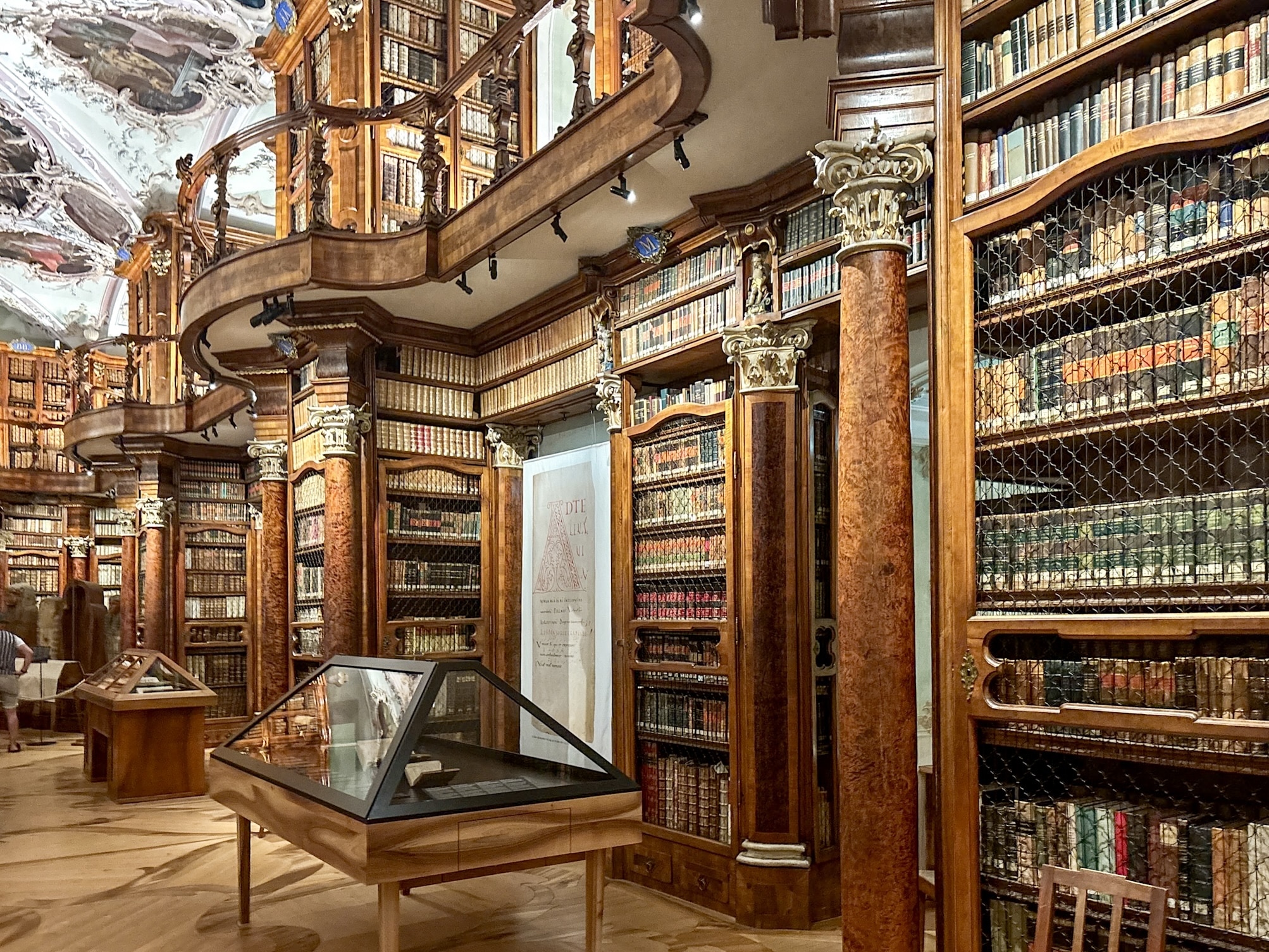
The Abbey Library of Saint Gall is a baroque library hall in St. Gallen, a small city in northeastern Switzerland, and it's one of the oldest libraries in the world still in use today. You walk in wearing felt overshoes, with carved wooden galleries all around you and a painted ceiling above, and the visit itself is fairly short, so it fits easily into a day trip.
In this guide I'll cover everything you need to plan your visit: how to get there by train or by car, where to park, ticket prices and opening hours, the photo rules (which have changed, and a lot of older articles still get them wrong), what to see inside, and whether the other two exhibitions included in your ticket are worth your time.
I visited in August on a rainy day during a hiking trip in Appenzell, and I'd recommend adding it to your itinerary if you're anywhere in the area.
Abbey Library of Saint Gall: Quick Facts for Your Visit
If you only have a minute, these are the things I'd want to know before going.
- Where it is: in the Abbey District in the center of St. Gallen, right behind the cathedral. The address is Klosterhof 6d, 9000 St. Gallen, Switzerland, and the entrance is across from the little Klosterbistro café.
- Tickets: CHF 18 for adults and CHF 12 for students. Kids under 16 get in free with their parents. The ticket covers three things: the library hall, the Vaulted Cellar and the Exhibition Space. Free entry with the Swiss Travel Pass or the Swiss Museum Pass.
- Opening hours: every day from 10 am to 5 pm, and until 6 pm from July to September. Last entry is 15 minutes before closing, and there are a few closure days during the year, so check the official website before you go.
- Audio guide: CHF 5, in English, German, French and Italian.
- Photos: allowed for private use, without flash, tripods or selfie sticks.
- Best time to go: right at 10 am on a weekday, before the tour groups arrive.
- If you're still planning your trip around the country, here are the most beautiful places to visit in Switzerland I'd put on your itinerary.
What Is the Abbey Library of Saint Gall?
First, a quick note on the name, because it confuses a lot of people. Saint Gall is the saint, an Irish monk also known as Gallus, while St. Gallen is the name of the city that grew up around his monastery. So "Abbey Library of Saint Gall" and "St. Gallen Abbey Library" are the same place, and locals call it the Stiftsbibliothek, which is simply German for abbey library.
The story starts in 612, when Gallus built a small hermitage in the forest. According to local legend, a bear helped him gather wood for it, which is why you'll see bears all over St. Gallen. After he died, his grave turned into a pilgrimage site, and a proper Benedictine monastery was founded there in the 700s, together with its library.
For centuries this was one of the most important centers of learning in Europe. The monks copied and illustrated books by hand. In 1805 the newly created canton of St. Gallen shut the monastery down, but decided to keep the library, and in 1983 the whole Abbey District became a UNESCO World Heritage Site.
The library owns around 170,000 books, about 2,100 handwritten manuscripts, and over 1,600 incunabula, the name for the very first printed books, made before the year 1500. Only a small selection is on display at any time, and the library still works as a lending library and reading room for researchers.
The famous room you visit today is younger, a rococo hall built between 1758 and 1767, designed by the architect Peter Thumb.
How to Get to the Abbey Library in St. Gallen, Switzerland
St. Gallen sits in the northeast corner of Switzerland, close to Lake Constance and the borders with Germany and Austria. It's easy to reach both by train and by car, and the library is right in the middle of the old town.
By Train from Zurich
Most people visit on a day trip from Zurich, and the train is the simplest way to do it. Direct trains leave from Zurich's main station (Zürich HB) several times an hour and take about 1 hour to get to St. Gallen station.
From St. Gallen station it's a flat 10-minute walk to the Abbey District. You can also take bus number 11 toward Abacus-Platz and get off at the Stiftsbezirk stop, right next to the library, which is handy if it's pouring.
If you have a Swiss Travel Pass, it covers both the train and your library ticket, so the whole day costs you nothing extra.
By Car and Where to Park
I came by car from Wasserauen, a tiny village at the end of the road in Appenzell where I was staying for a few days of hiking, including the Schäfler Ridge hike from Wasserauen to Seealpsee. The drive took me about 25 minutes. From Zurich, plan on roughly an hour.
Parking in the old town is limited, and a lot of garages have tight spaces. I parked at Einstein Parking (run by Wildegg Immo), one of the few private covered garages in the center, with wide, comfortable spots. It cost me CHF 2.50 per hour, and from there it was a 10-minute walk to the library.
Finding the Library Entrance
The Abbey District is a big complex, and the library entrance is not where you'd naturally look. It's behind the cathedral, in the courtyard across from the Klosterbistro, a small café run by the abbey. Honestly, the easiest thing is to search for "Abbey Library of St. Gallen" on Google Maps and follow the pin, because it takes you straight to the right door.
Abbey Library Ticket Prices, Hours and Audio Guide
Ticket Prices and What's Included
There's one ticket for everything, called "Entire Abbey", and it gets you into three places: the library hall, the Vaulted Cellar (a stone cellar under the library with a permanent exhibition on the abbey's history) and the Exhibition Space, where you can see the famous Plan of St. Gall. I'll talk about both of those further down. Prices at the moment are:
Adults: CHF 18; Students and apprentices: CHF 12; Groups of 10 or more: CHF 16 for adults, CHF 10 for students; Kids under 16 with their parents: free
You can buy tickets online on the official Stiftsbezirk website or at the ticket desk. I bought mine at the desk on a Sunday morning in August and didn't have to wait more than a couple of minutes, so I don't think booking ahead is strictly necessary. Just keep in mind that online tickets are for a specific date and can't be refunded or moved.
I paid the extra CHF 5 for the audio guide, and I'd say it's worth it. The library hall is small, but it's packed with details, and without someone telling you what you're looking at, it's easy to just walk around, say "wow" at the ceiling and leave after ten minutes. It's available in English, German, French and Italian.
Who Gets In for Free
Quite a few people don't need to pay at all:
- Kids under 16 visiting with their parents
- Swiss Travel Pass holders
- Swiss Museum Pass holders
- St. Gallen Museum Card and Bodensee Card PLUS holders
Even if you get in free, you still need to pick up a free ticket at the ticket desk, and you can't do it online.
Opening Hours and Closures
The library, the Vaulted Cellar and the Exhibition Space all follow the same schedule:
October to June: every day from 10 am to 5 pm
July to September: every day from 10 am to 6 pm
Last entry: 15 minutes before closing
The library also closes on a few days each year for holidays and maintenance. In 2026, for example, everything was closed from November 9 to 23 and on December 24 and 25. The dates change from year to year, so it's worth a quick look at the official website before you go.
What to See, in Order, Inside the Abbey Library
The library is small. What you see in the photos is all there is, one single long hall with a wooden gallery running around the upper level, and nothing else is open to visitors. However, there's still quite a lot to see inside:
The Felt Overshoes
Right before the library entrance you'll see a pile of big gray felt overshoes on the floor. You slip them on over your own shoes, and their whole job is to keep the 250-year-old wooden floor from getting scratched. Mine were way too big for my feet, so I ended up shuffling around slowly and a bit awkwardly.
The Door with the Greek Inscription
Before you go in, look up. Above the carved wooden double doors there's a gold frame with two little cherubs on the sides and a Greek inscription, ΨΥΧΗΣ ΙΑΤΡΕΙΟΝ (psyches iatreion). It translates as "pharmacy of the soul", or "healing place for the soul", and the idea goes back to ancient Egypt, where a similar phrase is said to have hung over the library of the pharaoh Ramesses II.
Once you enter, keep in mind that photos are allowed inside, as long as you don't use flash, a tripod or a selfie stick, and you only use them privately. A lot of older blog posts still say photography is banned, but the rule changed.
The Giant Globe by the Entrance
The first thing you'll bump into is a huge painted globe standing in the middle of the floor behind a rope. It shows the world as Europeans knew it around 1570, with sea monsters and little ships sailing.
The globe you see is a replica, and the story behind it is my favorite thing about the whole library. The original arrived at the abbey in 1595, but in 1712, during a war between Swiss cantons, troops from Zurich took it home. The two cities argued about it for almost 300 years. The dispute was only settled in 2006: Zurich kept the original, which is now in the Swiss National Museum, and paid for this exact copy, which was delivered to St. Gallen in 2009.
The Hall: Painted Ceiling and Inlaid Floor
First, look up. The big paintings were done by Josef Wannenmacher and show the first four great councils of the early Christian church. They're framed by curvy pink and white stucco, and in between you'll spot Latin mottos like "Docebit vos omnem veritatem", which means "he will teach you all truth".
Then look down. The floor is made of different kinds of wood laid in curving patterns and big star shapes, and once you notice it, the overshoes make a lot more sense.
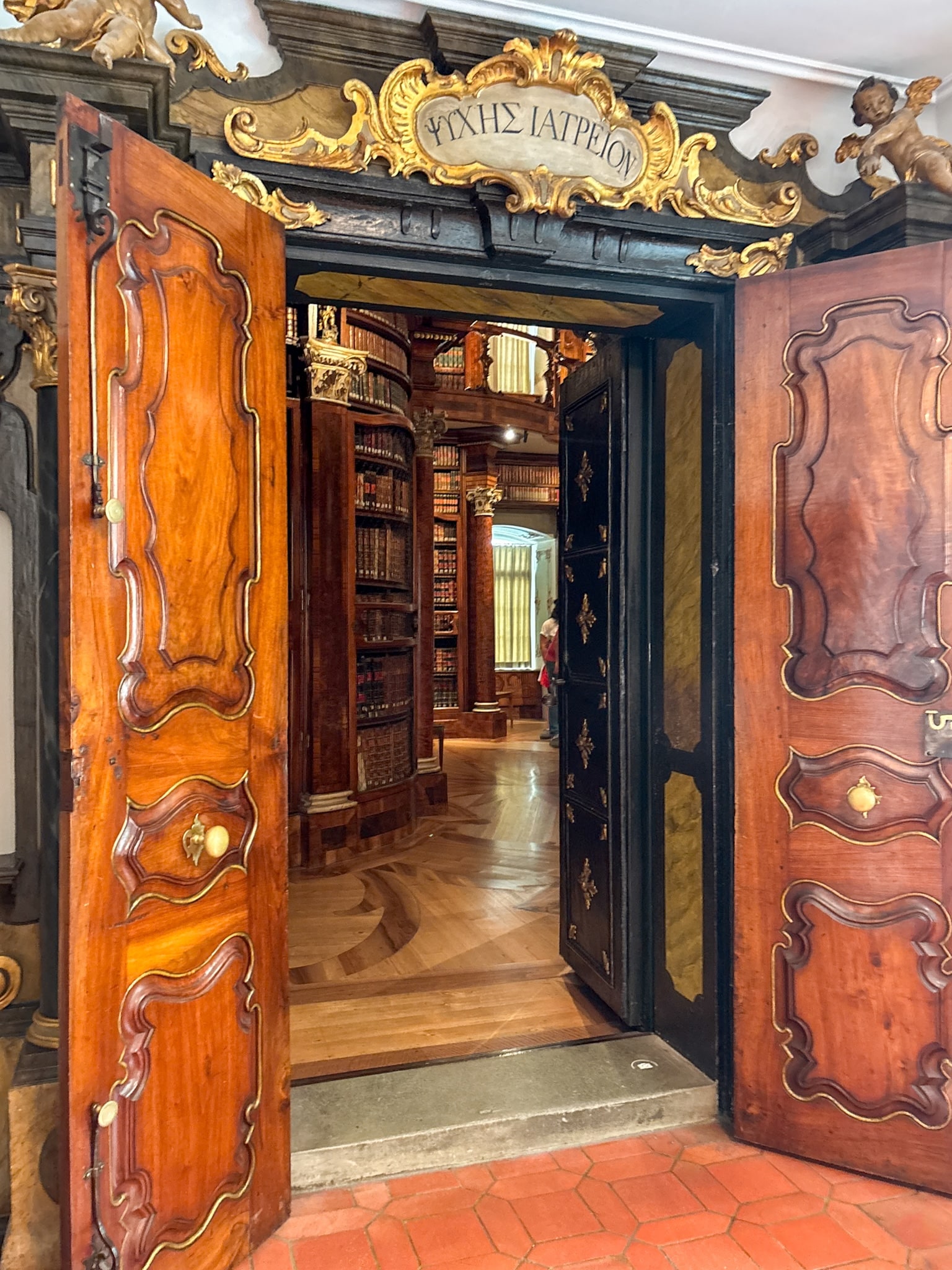
Entrance door to Abbey Library of Saint Gall
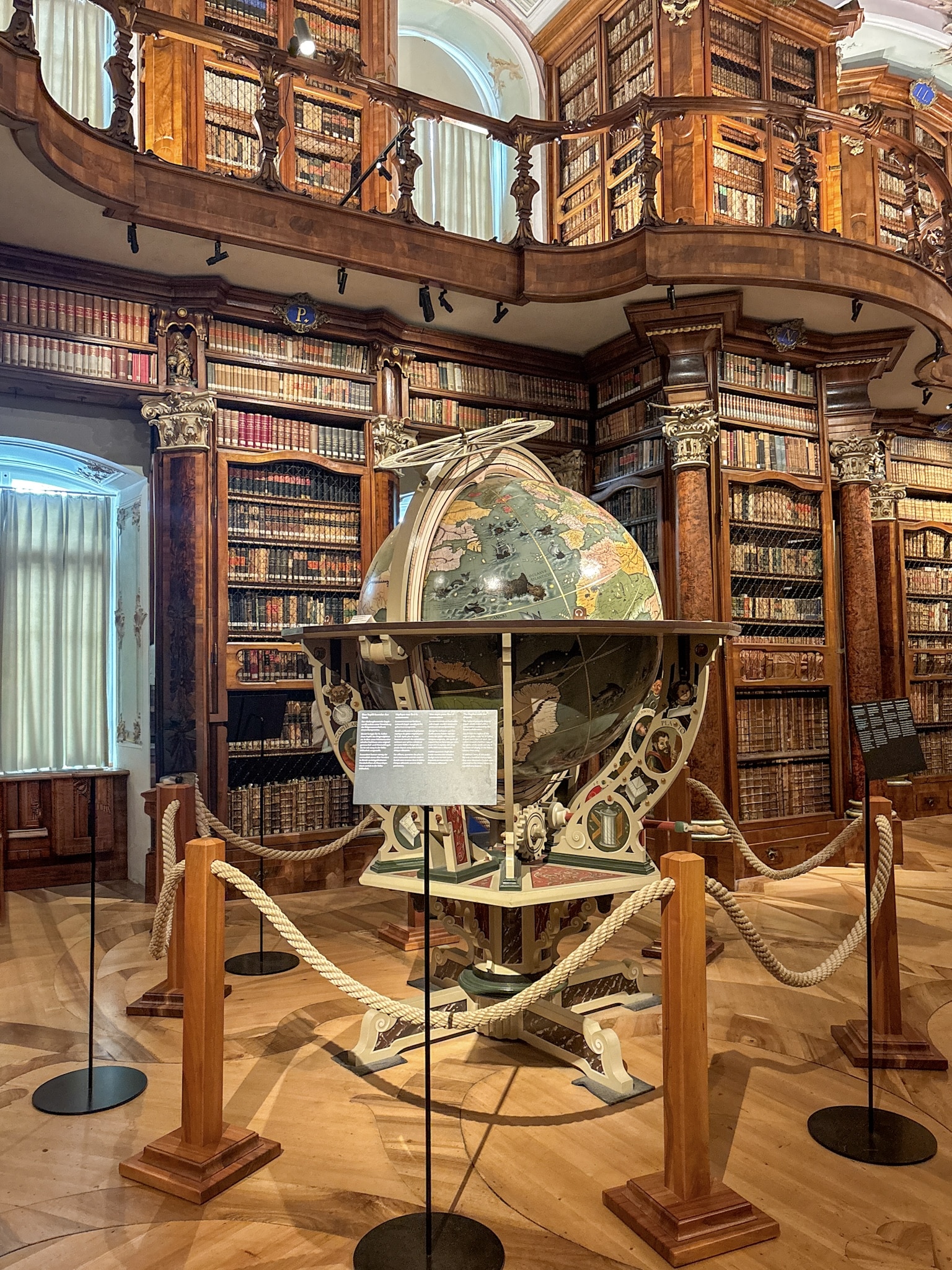
Painted Globe Replica from 1570
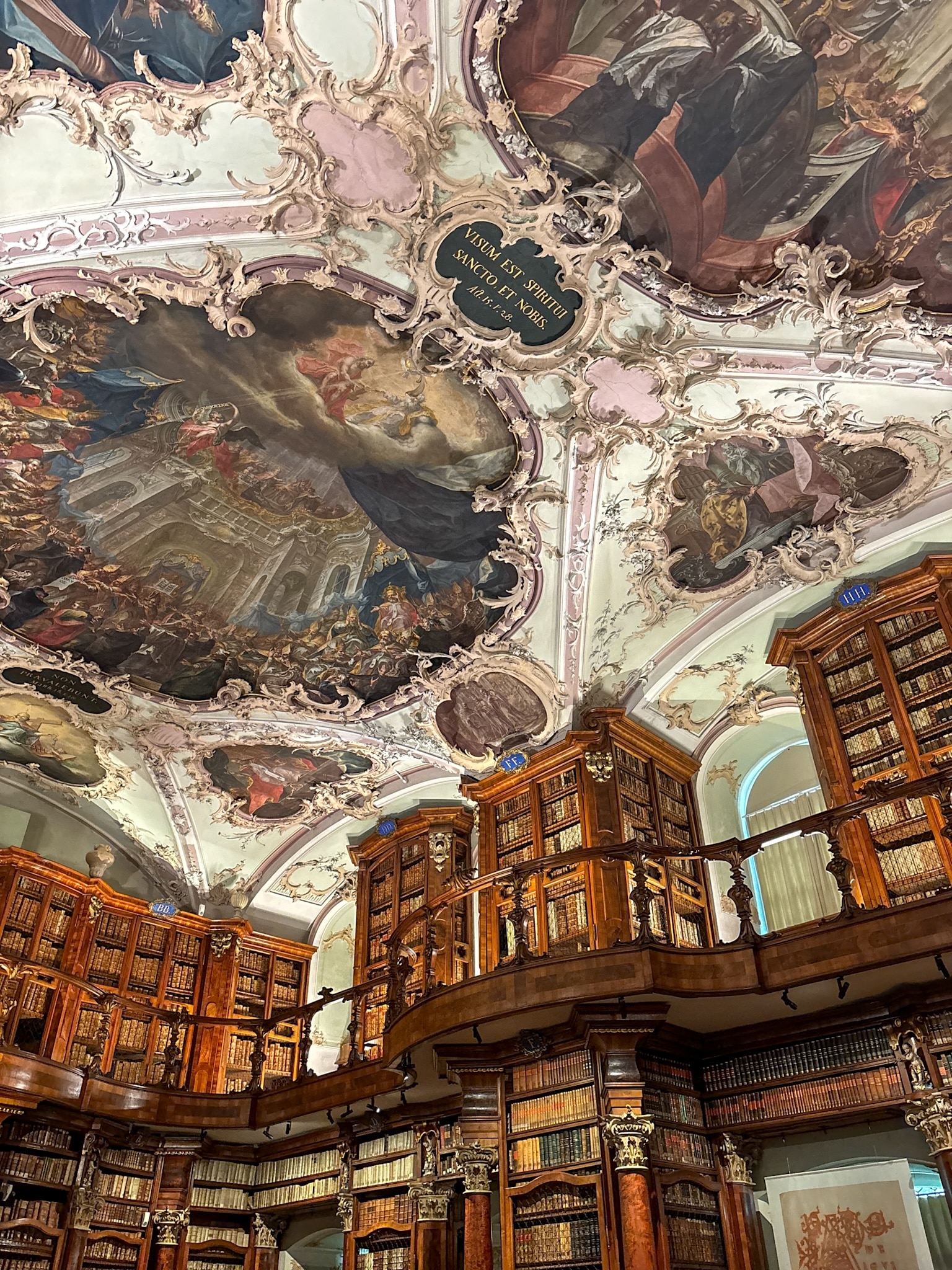
Painted ceiling of Abbey Library
The Bookcases
Look at the top of each bookcase and you'll see a blue shield with a gold letter on it: A, B, R, and up on the gallery double letters like RR or PP. That was the monks' filing system, a bit like the call numbers in a modern library, so they could find any book in the room.
Most of the bookcases are closed with decorative metal grilles, so you can look but not touch. And the really precious medieval manuscripts are kept elsewhere, in climate-controlled storage.
Medieval Manuscripts and Rotating Exhibitions
Spread around the hall you'll find wooden display cases with original manuscripts inside, and large printed banners showing some of their pages up close. What's on display changes twice a year: there's a summer exhibition, and a winter one, each one built around a different theme. You can check the current one on the official website.
When I visited, there were several big choir books on display. Music is a big part of St. Gallen's history, because the abbey owns some of the oldest surviving music manuscripts in Europe, written with early signs called neumes that told singers how the melody went before modern music notation existed.
The Egyptian Mummy at the Far End
At the far end of the hall, behind a rope, there's something you really don't expect in a monastery library: an Egyptian mummy, lying in a glass case next to her two painted wooden coffins. Her name was Shepenese, she was the daughter of a priest from Thebes, and she lived around 2,600 years ago.
She was never part of the monks' collection. The mummy arrived in St. Gallen in 1820, after the abbey had already been closed, and the library bought it in 1836.
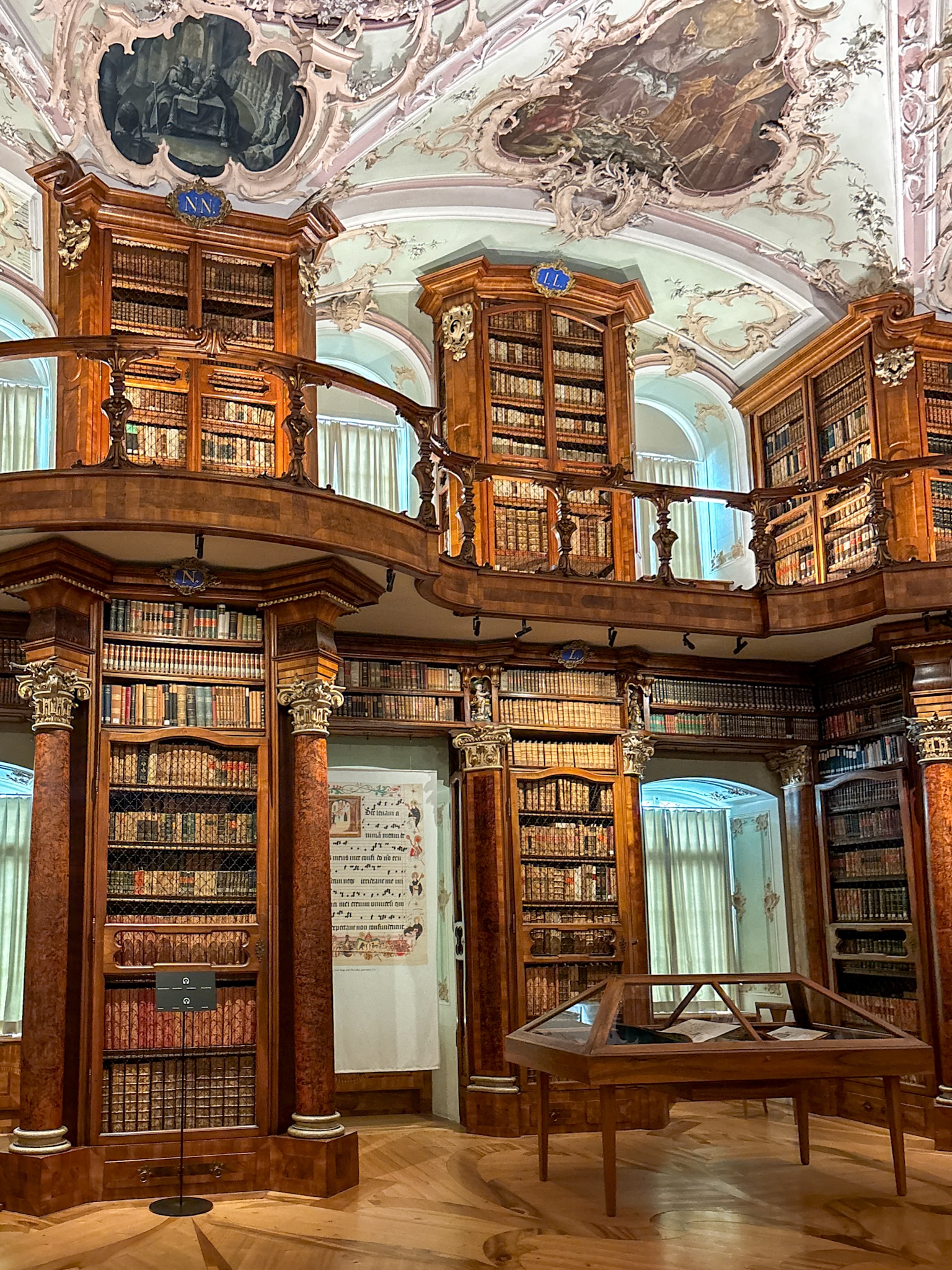
Bookcases of the Library
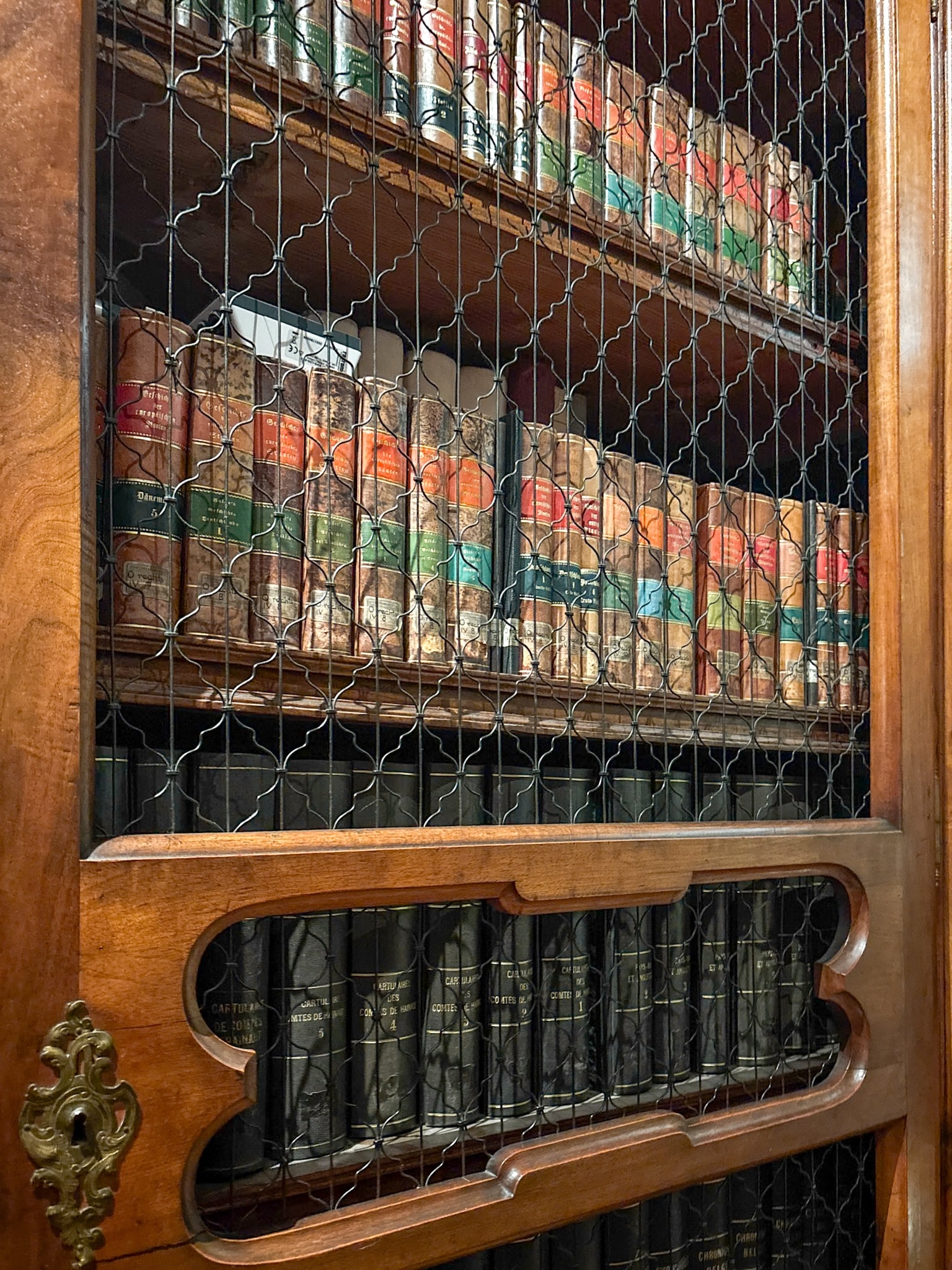
Bookcase closeup
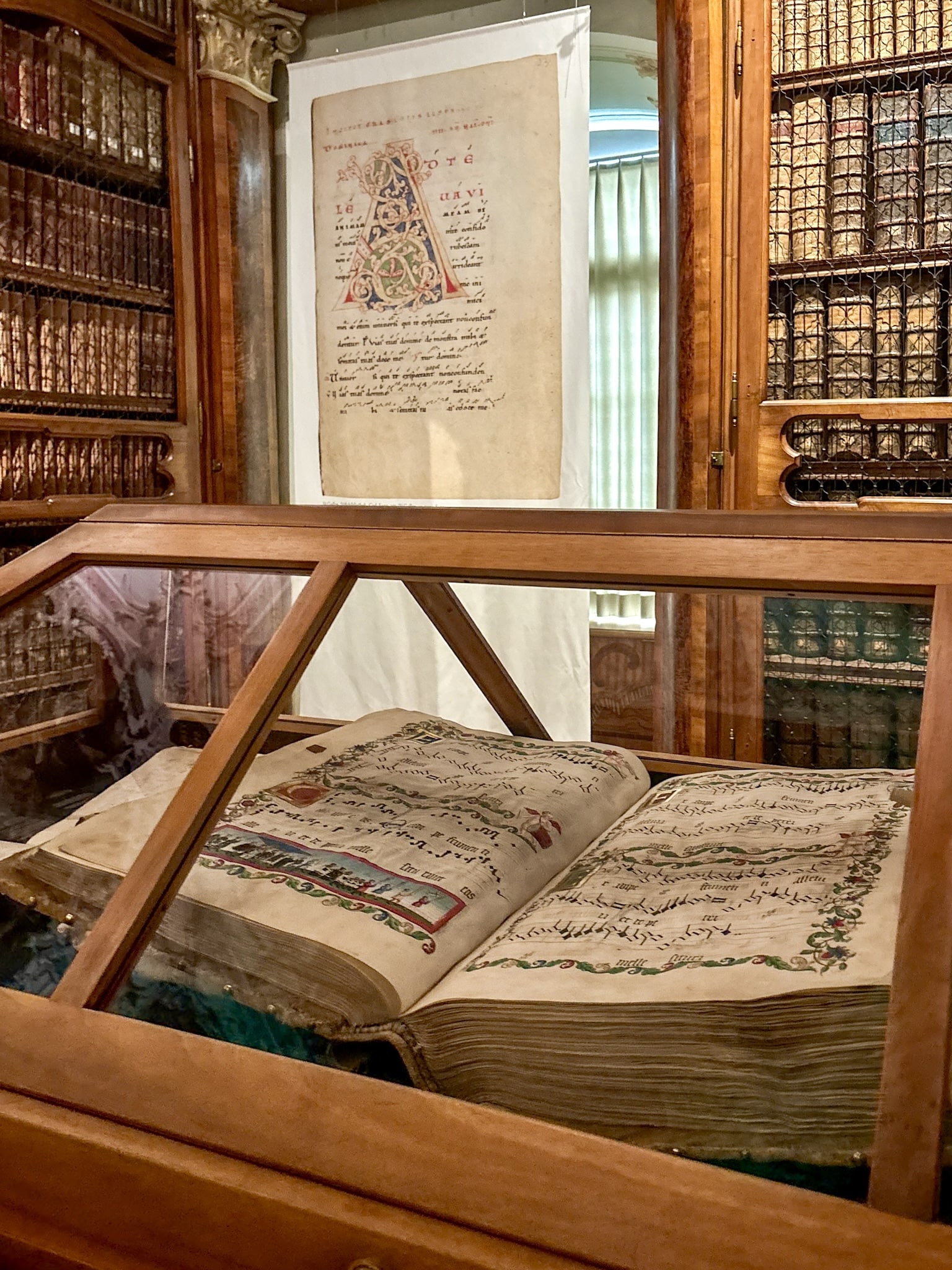
Medieval Manuscript (Choir book)
The Vaulted Cellar and the Exhibition Space
Your ticket also includes two smaller exhibitions, and since they're already paid for, I'd see both. They fill in a lot of the history that the library hall only hints at.
The Vaulted Cellar
The Vaulted Cellar is right under the library, in a stone basement with low arched ceilings. It holds a permanent exhibition about Gallus and the abbey, covering 1,400 years of history from his first hermit's cell to the UNESCO site you're standing in.
There are original manuscripts and objects on display, and the highlight is the Evangelium Longum, a book of the Gospels with a cover made around 895 by Tuotilo, a monk who was also a carver and artist.
The Exhibition Space and the Plan of St. Gall
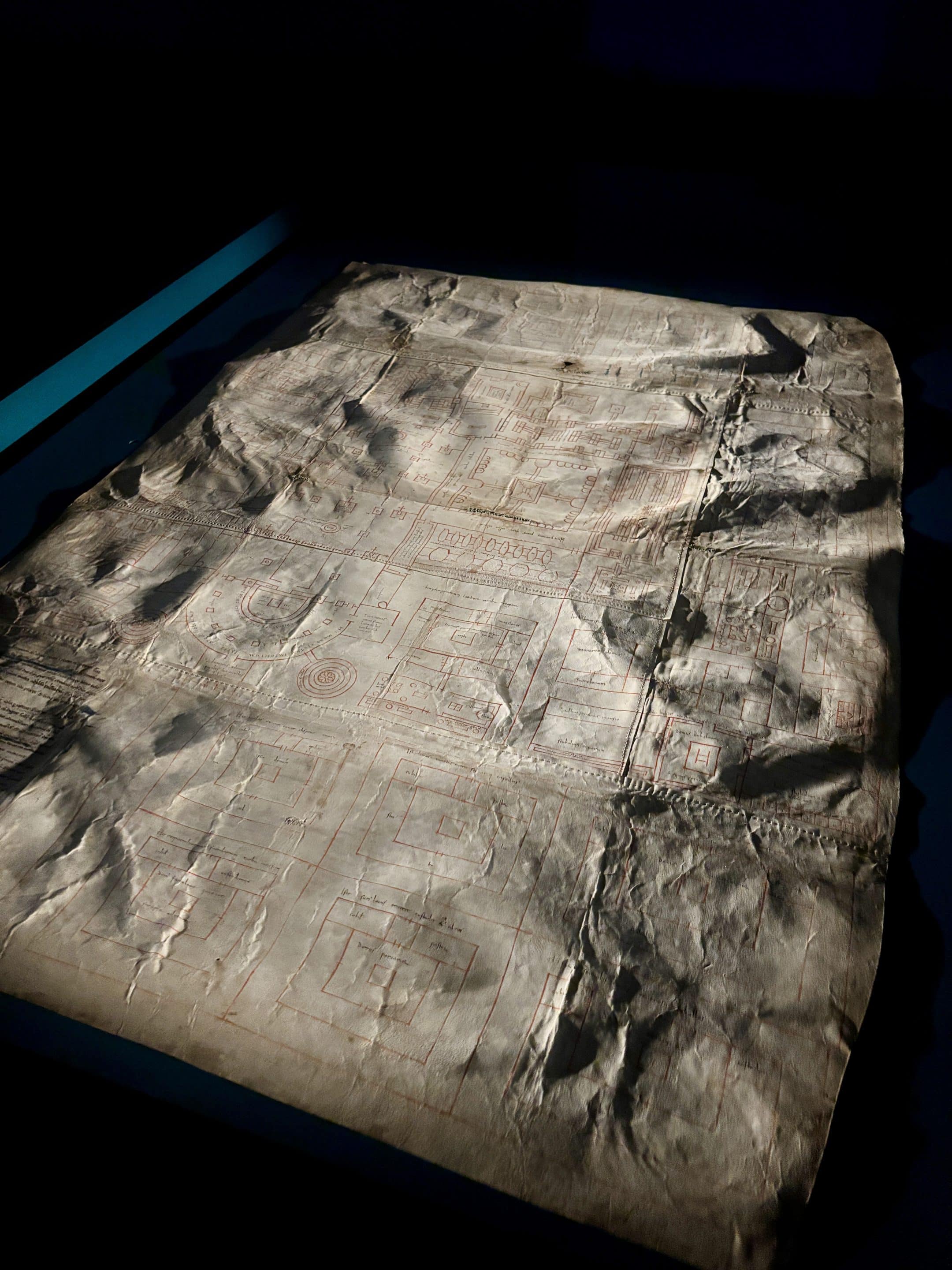
The Exhibition Space is in a separate building of the Abbey District, a short walk across the courtyard, and this is where you'll find the Plan of St. Gall. It's a drawing on parchment made around 825, showing the layout of an ideal Benedictine monastery: the church, the cloister, the school, the guest house, the gardens, even the bakery and the brewery, all drawn in red ink with labels in Latin. It's considered the most important architectural drawing of the Middle Ages, and it's the oldest surviving architectural plan drawn on parchment.
Because light damages it, the plan is kept in a dark room of its own. First you watch a short introductory video, and then the plan lights up for just a few seconds before going dark again. I waited for the next round to start just to see it, and I'm glad I did.
The rest of the Exhibition Space is dedicated to old documents from the Abbey Archives, plus a temporary exhibition that changes every year.
Best Things to Do In & Around St. Gallen, Besides the Library
St. Gallen Cathedral
The cathedral is right next to the library, it's free, and you don't need a ticket, so it makes sense to go in once you're done. It was built in the same years as the library hall, in the mid-1700s, on the exact spot where Gallus is said to have built his hermitage.
Inside it's bright and very white, with pale green stucco, gold details and huge dark paintings in the domes. Just keep in mind that it's an active church, so you can't walk around during services, and Sunday mornings are reserved for mass.
A Short Walk Around the Old Town
St. Gallen's old town is small and easy to see on foot in an hour or less, and I spent a bit of time wandering around before heading back to the car. What stands out are the painted house fronts and the oriel windows, wooden bay windows that stick out from the upper floors of the houses, often carved and painted. Rich merchants built them to show off, back when St. Gallen was famous all over Europe for its linen and embroidery.
Go Hiking in Nearby Appenzell
If you have a car and some time, the mountains of Appenzell are right on St. Gallen's doorstep. Wasserauen, the little village where most of the classic hikes start, is about 25 minutes away by car, and it's where I was staying during my trip.
The area has some of the most rewarding hiking I did in Switzerland. My favorite day was the Schäfler Ridge hike from Wasserauen to Seealpsee, a ridge walk with big views that ends at a lake surrounded by cliffs. I also hiked up to the Saxer Lücke, a mountain pass on the other side of the range.
That's also why the library fits so well into a trip like this: it's a perfect rest day for tired legs, a good plan B when the weather in the mountains doesn't cooperate, and a nice change if you want some history next to all the lakes and peaks. For more trails around the country, I've put together a guide to the best hikes in Switzerland.
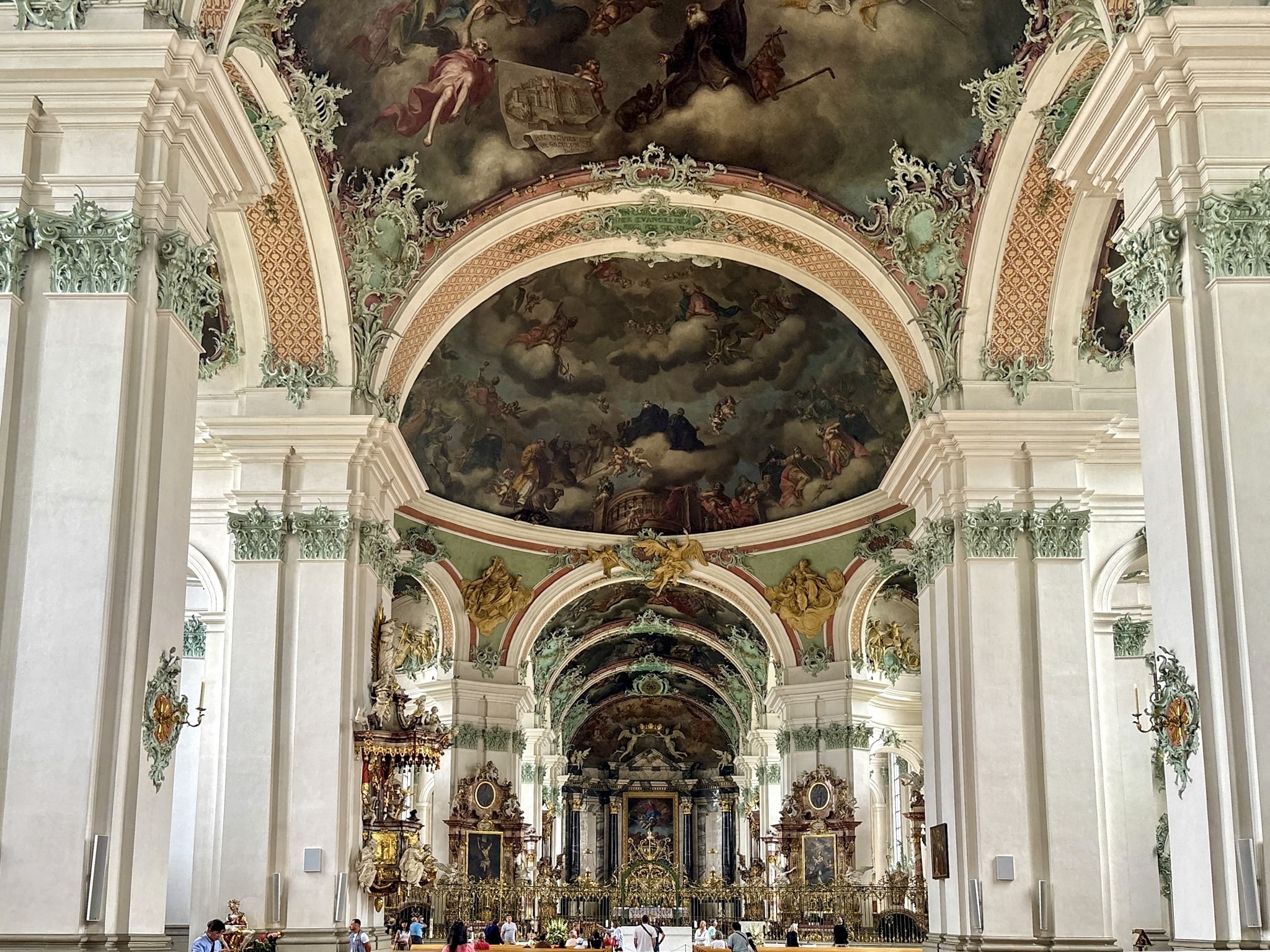
St. Gallen Cathedral
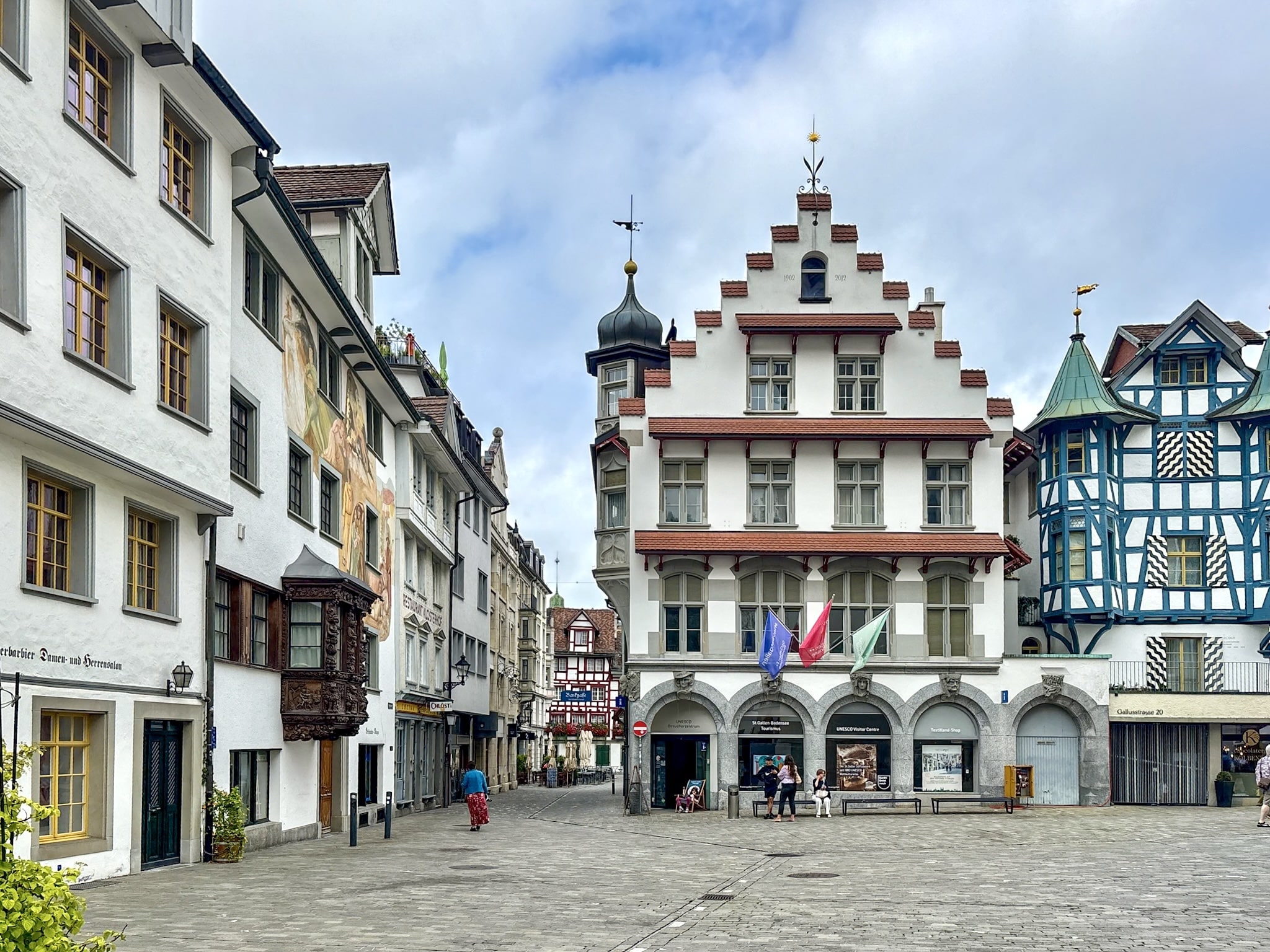
St. Gallen Town

Shafler Ridge Hike Swizerland 3
Abbey Library of Saint Gall FAQ
Can you take photos inside the Abbey Library of Saint Gall?
Yes. Photos are allowed for private use, as long as you don't use flash, a tripod or a selfie stick. Many older articles still say photography is banned, but that rule has changed recently, and I took pictures throughout my visit.
Is the Abbey Library of Saint Gall worth visiting?
I think so, as long as you know it's one single hall and the visit is short. It's one of the most beautiful and historic rooms I've seen in Switzerland, and with the cathedral and the other two exhibitions it makes a great half day, especially if you want a break from hiking.
Do you need to book tickets in advance?
Usually no. I bought my ticket at the desk on a busy August Sunday without any trouble. Online tickets are tied to a specific date and can't be refunded, so I'd only book ahead if you're coming with a group.
Is the Abbey Library free with the Swiss Travel Pass?
Yes. Swiss Travel Pass holders get in free, and so do Swiss Museum Pass holders and kids under 16 with their parents. You still need to pick up a free ticket at the ticket desk.
Can you go up to the upper gallery?
No. The wooden gallery that runs around the top of the hall is closed to visitors, and the visit takes place entirely on the ground floor of the hall.
Is the Abbey Library wheelchair accessible?
Yes. All three exhibitions are wheelchair accessible, and the library has a wheelchair you can borrow on site. Strollers, on the other hand, have to be left in the entrance area.
Can you visit the Abbey Library as a day trip from Zurich?
Yes, and it's an easy one. The direct train takes about an hour, the library is a 10-minute walk from the station, and half a day is enough to see the library, the other exhibitions, the cathedral and a bit of the old town.
Can you borrow books from the Abbey Library?
Yes, the Abbey Library still works as a lending library, with a reading room open on weekdays. The historic hall you visit with your ticket is a museum space, though, so borrowing and research happen separately, following the library's own rules.