My visitor guide to the St. Beatus Caves near Interlaken: how to get there by bus, boat or car, where to park, tickets and what you see inside.
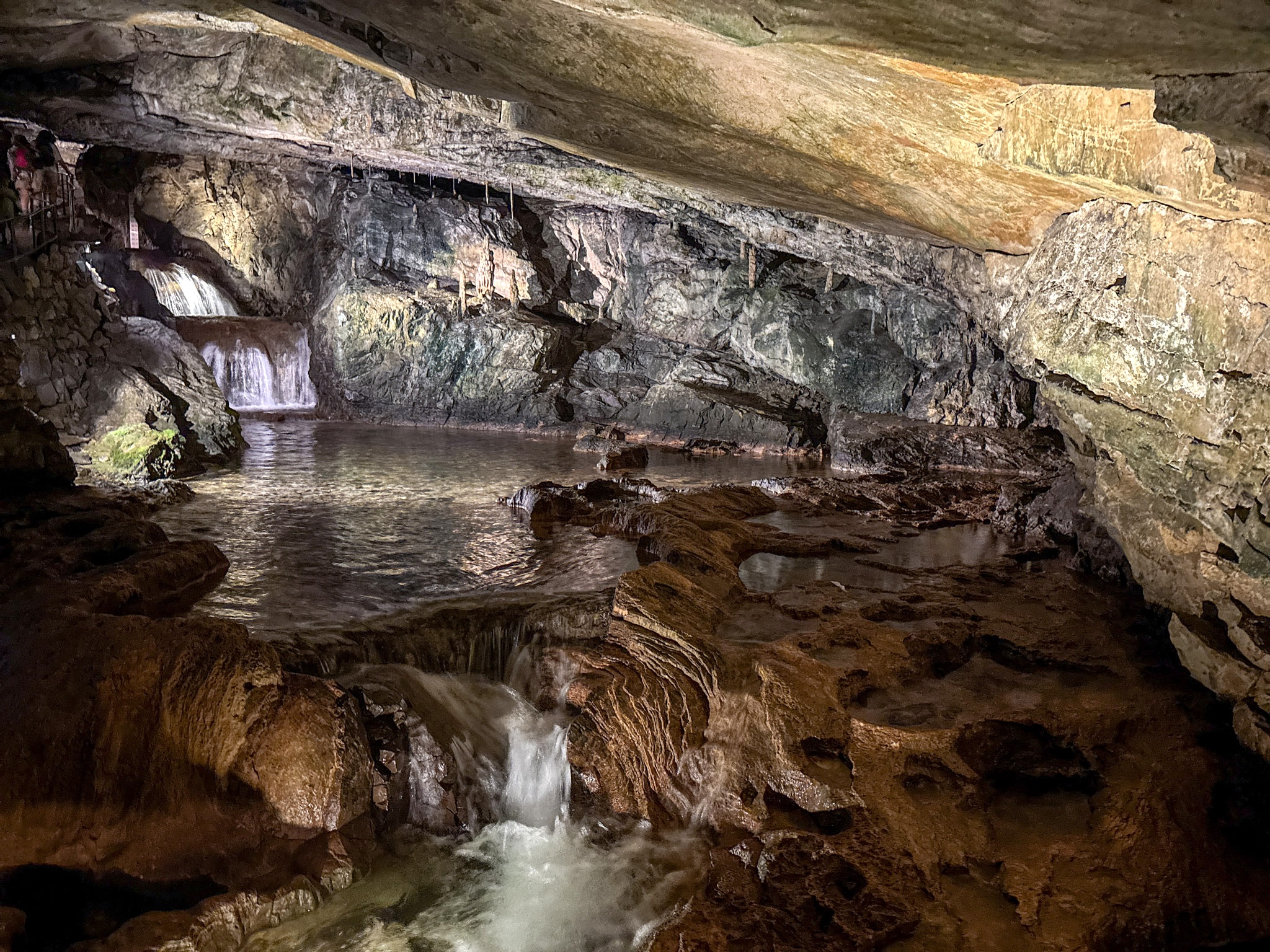
The St. Beatus Caves are a cave system inside the mountain above Lake Thun, in a tiny place called Sundlauenen, about 7 kilometers (4 miles) from Interlaken. A lit path takes you almost a kilometer into the rock, past underground waterfalls and pools of water so still they reflect the ceiling.
It's a peculiar place. I visited in mid-August, on a rainy but very hot day, and I was still glad I had a sweatshirt with me once I got inside.
This guide covers how to get to the St. Beatus Caves from Interlaken or Thun by bus, boat or car, where to park your car, how to get the tickets, and what you actually see once you’re exploring inside.
St. Beatus Caves at a Glance
For those of you in a hurry, here are the basics:
- Where: Sundlauenen, on the north shore of Lake Thun, about 7 km (4 miles) from Interlaken
- Getting there: bus 21 from Interlaken or Thun stops right below the entrance, about 15 to 20 minutes from Interlaken West
- Time needed for a visit: about 2 hours, with roughly 1 hour inside the cave
- Tickets: CHF 20 adults, CHF 12 kids 6 to 16, free under 6, CHF 52 family ticket, CHF 10 dogs, cave museum included
- Summer hours (March 28 to November 8, 2026): 9 a.m. to 6 p.m., until 9 p.m. on Fridays and Saturdays
- Winter hours (November 21, 2026 to March 20, 2027): 10 a.m. to 5 p.m., until 6:30 p.m. on Saturdays
- Inside temperature: 8 to 10°C (46 to 50°F) all year, very humid
- The route: about 1 km into the mountain on a lit path, 297 steps and 87 m (285 feet) of climbing, then back the same way
- Parking: two small paid lots at CHF 7 for the day, often full by mid-morning in summer
- Kids and dogs: fine for kids from about 5, no strollers inside; dogs welcome on a leash
- Accessibility: the cave is not wheelchair accessible; the museum and restaurant are step-free from the lower parking lot
- If you're still planning your trip around the country, here are the most beautiful places to visit in Switzerland I'd put on your itinerary.
What Are the St. Beatus Caves?
The St. Beatus Caves (St. Beatus-Höhlen in German) are a network of tunnels and halls that water has carved into the limestone of the Niederhorn, the mountain that rises straight up from the northern shore of Lake Thun. Cave explorers have mapped about 14 kilometers so far. Visitors get to see roughly one of them, which is still a long way to walk inside a mountain.
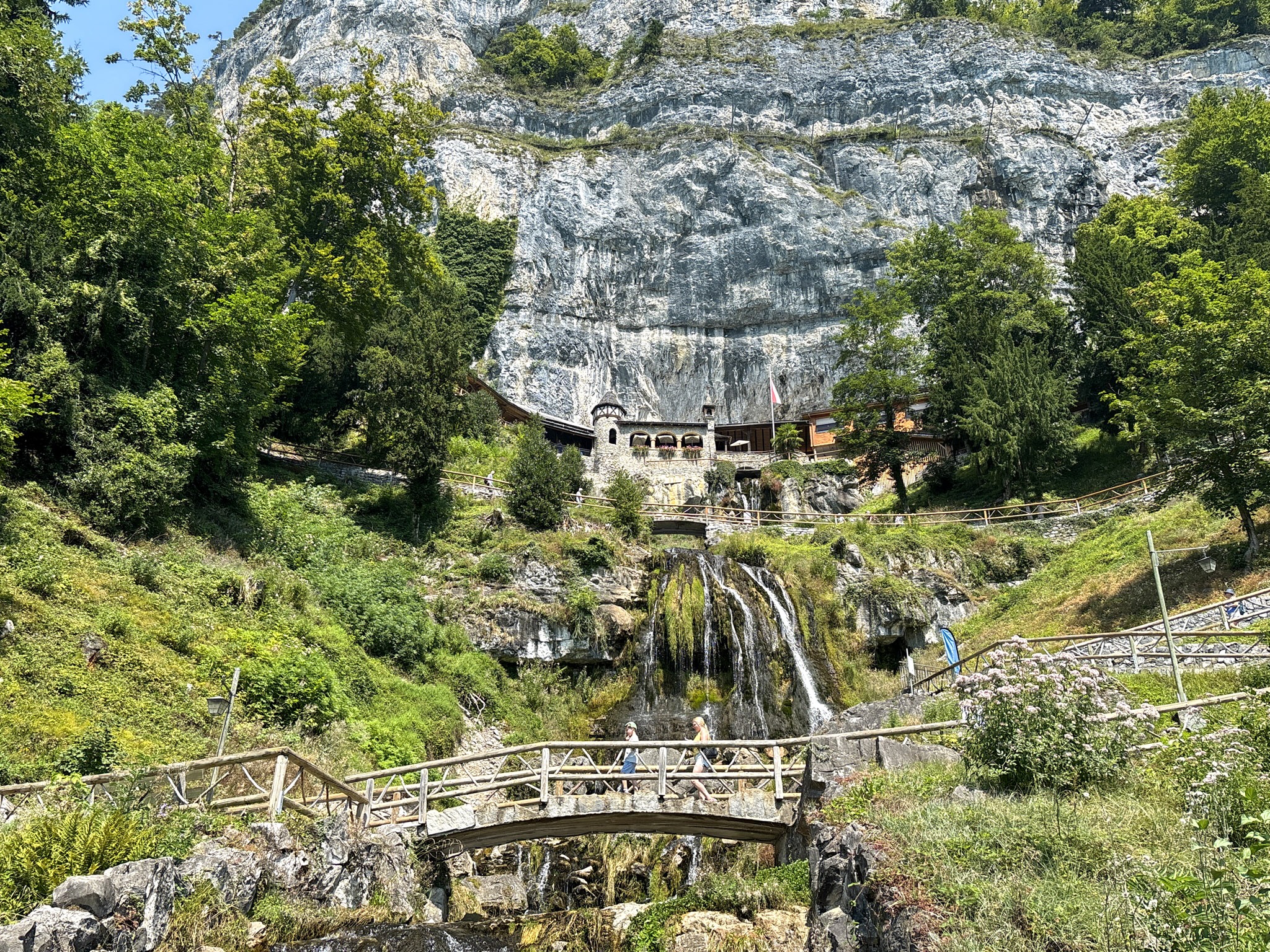
What sets this cave apart from many others is the water. A stream runs through the whole system, drops in small waterfalls along the path, and finally comes out of the rock right below the entrance, where it turns into the waterfall you see from the road.
People have known about this place for a very long time. Archaeologists found signs that people sheltered here around 700 BC. The first real push into the dark came in 1814, when a local painter got about 200 meters in. Then in 1903 the director of the regional tourism office crawled on his belly through the narrow passages, realized how big the caves were, and a year later the first part opened to visitors. Over the years, Goethe, Lord Byron, and Richard Wagner all came here too.
The Legend of St. Beatus and the Dragon
The name of the place comes from Beatus, a monk from Ireland (some versions say Scotland) who, according to the legend, came to Switzerland in the 2nd century to spread Christianity. The people living by the lake told him about a dragon in the cave that kept terrorizing them. Beatus took a boat across, climbed up to the cave, and drove the dragon out, and it fell into Lake Thun.
After that, Beatus moved into a small grotto next to the main cave and lived there as a hermit. His cell, with a lifelike figure of the monk inside, is just before the entrance turnstile, and his grave is right next to it.
How much of this really happened is another question. Historians think the story mixes up several monks, and many give the title of first apostle of Switzerland to Saint Gall instead, the Irish monk behind the town of St. Gallen and its Abbey Library of Saint Gall.
How to Get to St. Beatus Caves
The caves sit between Interlaken and Thun, so you can reach them by bus, by boat, by car or even on foot. For most people, the bus is the easiest option. I had a car, so I drove.
Whichever way you arrive, the last part is a 15-minute walk uphill to the entrance, so keep that in mind if you’re traveling with small kids or with someone who struggles on slopes.
How to Get to St. Beatus Caves from Interlaken by Bus
Most people come from Interlaken, since it’s the base for this whole area (if you’re planning a few days there, here are my favorite things to do in Interlaken). Bus 21 runs between Interlaken and Thun along the lake and stops right at the bottom of the path to the caves. The stop is called Beatushöhlen, the German name of the caves.
- Bus 21 direction: Thun
- From Interlaken Ost station: about 20 minutes, because the bus starts there and then passes Interlaken West
- From Interlaken West station: about 15 minutes
- Tickets: in the SBB app or at the machine at the stop; the ride is covered by the Swiss Travel Pass and the Berner Oberland Pass
The bus runs all day, so you can go without planning much. When you leave Interlaken, grab a seat on the left side, because that’s where the lake is.
How to Get to St. Beatus Caves from Thun by Bus
It’s the same bus going the other way. Bus 21 leaves from the bus area in front of Thun train station, heading toward Interlaken, and it takes about 35 to 40 minutes. The road hugs the lake the whole way and passes through Hilterfingen and Oberhofen, a village with a small castle sitting right on the water, so it’s a nice ride on its own.
Getting There By Boat on Lake Thun
This is the slowest way to get there and also the nicest. The passenger boats on Lake Thun are run by a company called BLS, and they stop at a small pier called Beatushöhlen-Sundlauenen at the bottom of the hill.
- From the Interlaken West pier: about 30 minutes
- From Thun: close to two hours, with stops in the villages along the shore
Boats run often from spring to fall and only a few times a day in the colder months, so check the BLS timetable before you go. The boats are covered by the Swiss Travel Pass and the Jungfrau Travel Pass. If you pay for your boat ticket, ask at the BLS counter or on board for the combined boat and cave ticket, which gives you 50% off the cave entrance.
A plan I like a lot: boat on the way there, bus on the way back, so you see the lake from both sides.
Getting There By Car and Where to Park
From Interlaken it’s about 10 minutes by car along the lake road toward Thun, and from Thun about 25 minutes along the north shore. Signs for Beatushöhlen point you to the parking.
There are two paid parking lots, and both cost CHF 7 for the whole day:
- P1, the lower lot: near the main road, about 15 minutes on foot to the cave entrance
- P2, the upper lot: right next to the cave museum, also about 15 minutes from the entrance
Here’s the problem. Both lots are small, and in summer they’re often full by mid-morning. Once they’re full there’s nowhere else to park nearby, and the police do check and give fines to cars left on the side of the road. When I went in August, I found a spot by pure luck.
If you’re driving in July or August or on a weekend, try to arrive before 10 a.m. or later in the afternoon. And if both lots are full, the easiest fix is to drive back to Interlaken, which takes ten minutes, leave the car in a garage near Interlaken West and take bus 21 from there.
Walking from Interlaken
If you like walking, there’s a signposted route from Interlaken West station that follows the shore of Lake Thun. It passes the ruins of Weissenau Castle, a medieval castle that now sits in a small nature reserve full of birds, then goes through Sundlauenen and up to the caves.
It’s about 8.5 km (5.3 miles) and takes around two hours and twenty minutes. In summer there are a few spots along the way where you can stop for a swim, and you can take the bus or the boat back.
The Walk Up to the Cave Entrance
From the bus stop or the parking lot, a paved path climbs through the trees and crosses the Beatus waterfall on a series of small bridges. It takes 15 minutes, and there are benches along the way if you need a break. Near the waterfall the ground can be wet, so wear shoes with some grip.
Anyone who’s used to walking a bit will be fine.
Turn around once in a while on the way up, because the view over Lake Thun keeps getting better. The path, the waterfall and the area around the entrance are all free, and you only need a ticket for the cave and the museum.
What to See Inside the St. Beatus Caves
The visit is self-guided. You follow a lit path with railings and information boards in English and German, walk about a kilometer into the mountain, then come back the same way. In some spots the ceiling is low enough that you have to duck, and in the narrow sections you may wait a minute for people coming the other way. I spent about 1 hour inside.
The Underground Waterfalls
The stream that falls outside the entrance runs through the whole cave and drops in waterfalls all along the route, some right next to the path, others pouring into wide pools in the bigger halls. This was my favorite part. The largest is in the Milton Grotto, and it’s also the turnaround point when the water is high after heavy rain.
The Grottos and Mirror Pools
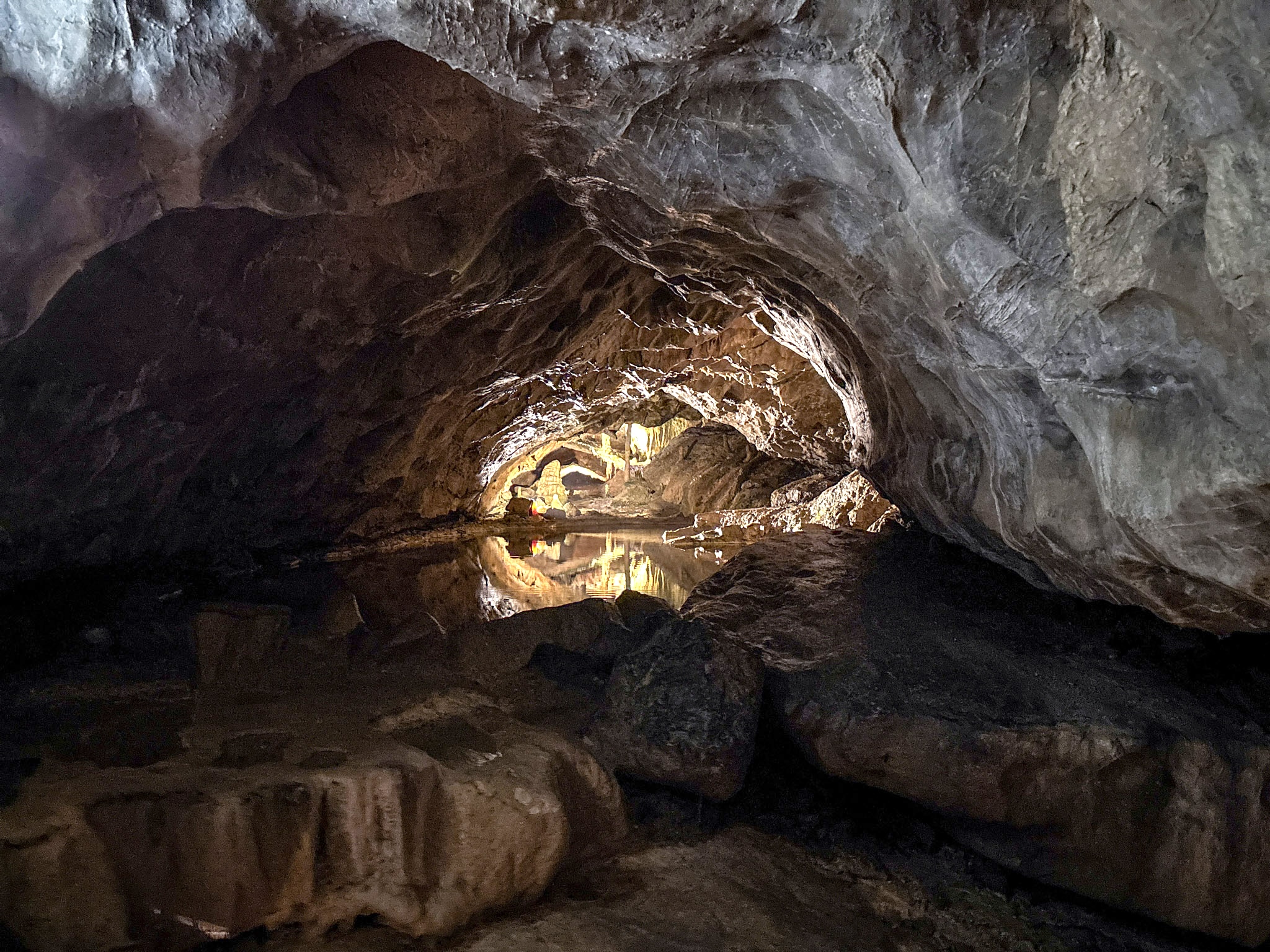
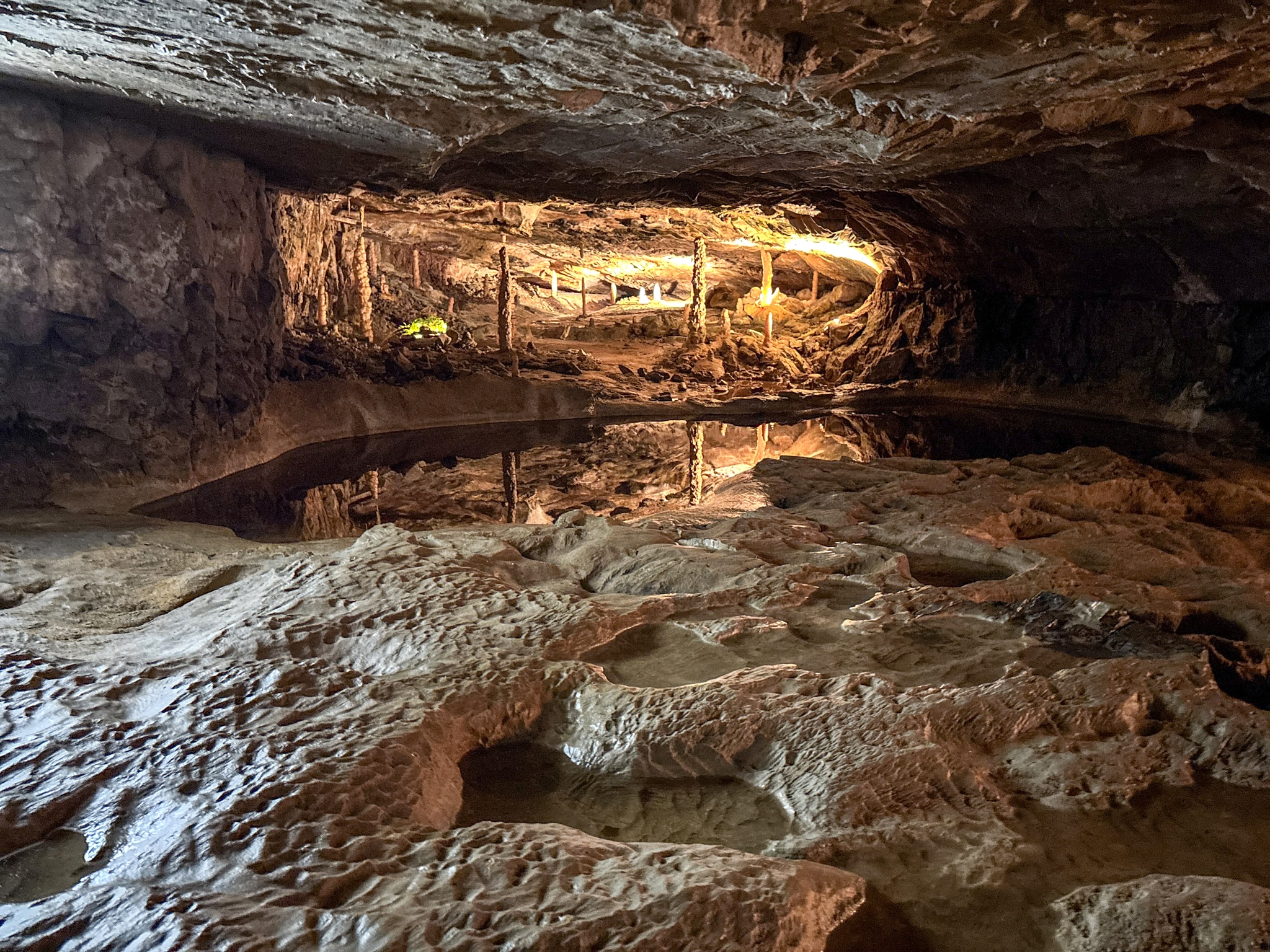
The larger rooms along the path are called grottos, and a few have names. The Captain’s Grotto is named after the lake steamer captain who explored this far in 1848. The Dome Grotto has the highest ceiling on the route. In the Mirror Grotto the water is so still that the lit formations on the ceiling show up upside down on the surface.
Stalactites and Stalagmites
Stalactites hang from the ceiling, stalagmites grow up from the floor, and both form drop by drop from water carrying dissolved limestone, so slowly that one centimeter can take a century. Here you’ll see thin needles over the path, columns where the two have joined, and formations standing right in the stream.
The Museum, Restaurant and Playground at St. Beatus Caves
The Cave Museum
The museum is included in your ticket and sits along the path between the upper parking lot and the cave entrance. It’s small and it’s split into three parts: how the cave formed and how cavers mapped its 14 kilometers, the legend of St. Beatus, and stations with fossils and prehistoric finds from the caves.
I’d go before the cave. Once you know how the formations grow and how far the explorers crawled, you look at everything inside differently. In summer the museum opens at 10:30 a.m., a bit later than the cave.
Stein & Sein Restaurant
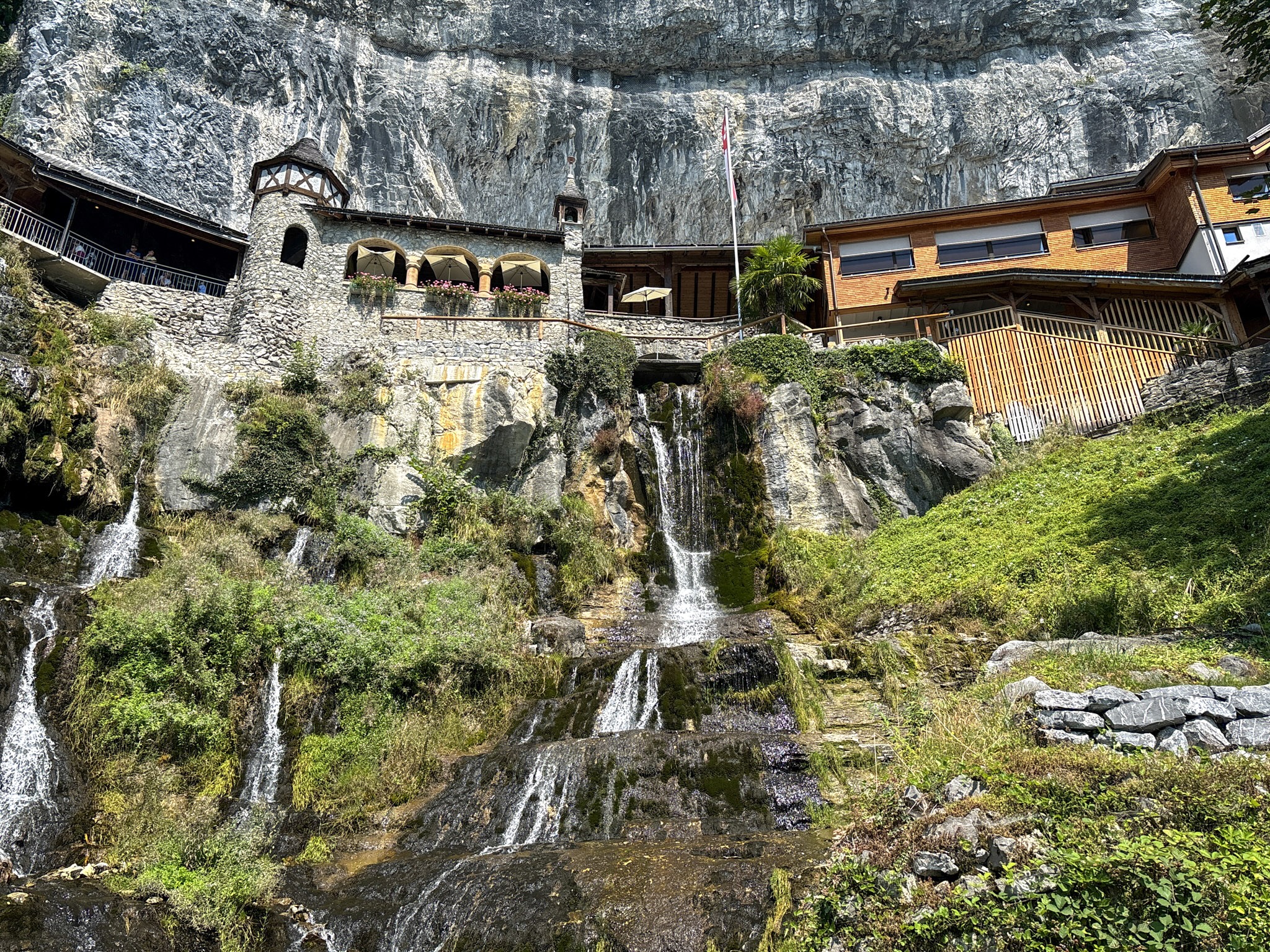
Stein & Sein, which means “stone and being” in German, is the restaurant right next to the cave entrance. The menu is regional Swiss food, with a kids’ menu. There’s also a snack bar at the entrance for coffee, drinks and ice cream.
On Sundays they do a brunch from 9:30 a.m. to noon, and in winter they run raclette evenings inside the cave.
Visiting with Kids
The cave works well for kids from around 5 or 6, as long as they can handle the stairs. Strollers aren’t allowed inside, so bring a baby carrier for little ones.
Outside, there’s a playground with a dragon slide and a wooden castle to climb, open to everyone without a ticket. The Flimbo Trail, named after the cave’s cartoon dragon, is a one-hour walk through the woods with four activity stations about caves, water and rocks, and it’s included in the cave ticket.
Tips for Visiting St. Beatus Caves
- Wear shoes with good grip. The steps and paths inside are always wet, and so is the stretch of path next to the waterfall outside.
- Bring a warm layer, even in summer. A sweatshirt or light jacket is enough from June to September. In winter you’ll want a proper coat.
- Keep your hands free. A small backpack works better than a tote bag, because you’ll want to hold the railings on the wet stairs.
- Don’t rush it. Between the walk up, the museum and the cave, plan about two hours. The visit is longer than it looks from outside.
- Go early or late. Late morning and early afternoon are the busiest hours. In summer the cave stays open until 9 p.m. on Fridays and Saturdays, and those evenings are usually much quieter.
- Eat before or after. Food and drinks aren’t allowed inside, so have lunch first or plan to stop at the restaurant on the way out.
What to Do Near St. Beatus Caves
The caves fill half a day, so it’s easy to pair them with something else along Lake Thun.
- Niederhorn: take bus 21 one stop to Beatenbucht, ride the funicular up to the village of Beatenberg and continue by gondola to the Niederhorn, a summit at about 1,950 meters (6,400 feet) with a wide view over Lake Thun and the Eiger, Mönch and Jungfrau. In summer you can ride back down on a kick scooter, and in winter on a sled.
- Oberhofen Castle: about 15 minutes on bus 21 toward Thun. The castle sits right on the water, with a tower that seems to rise out of the lake and a park along the shore.
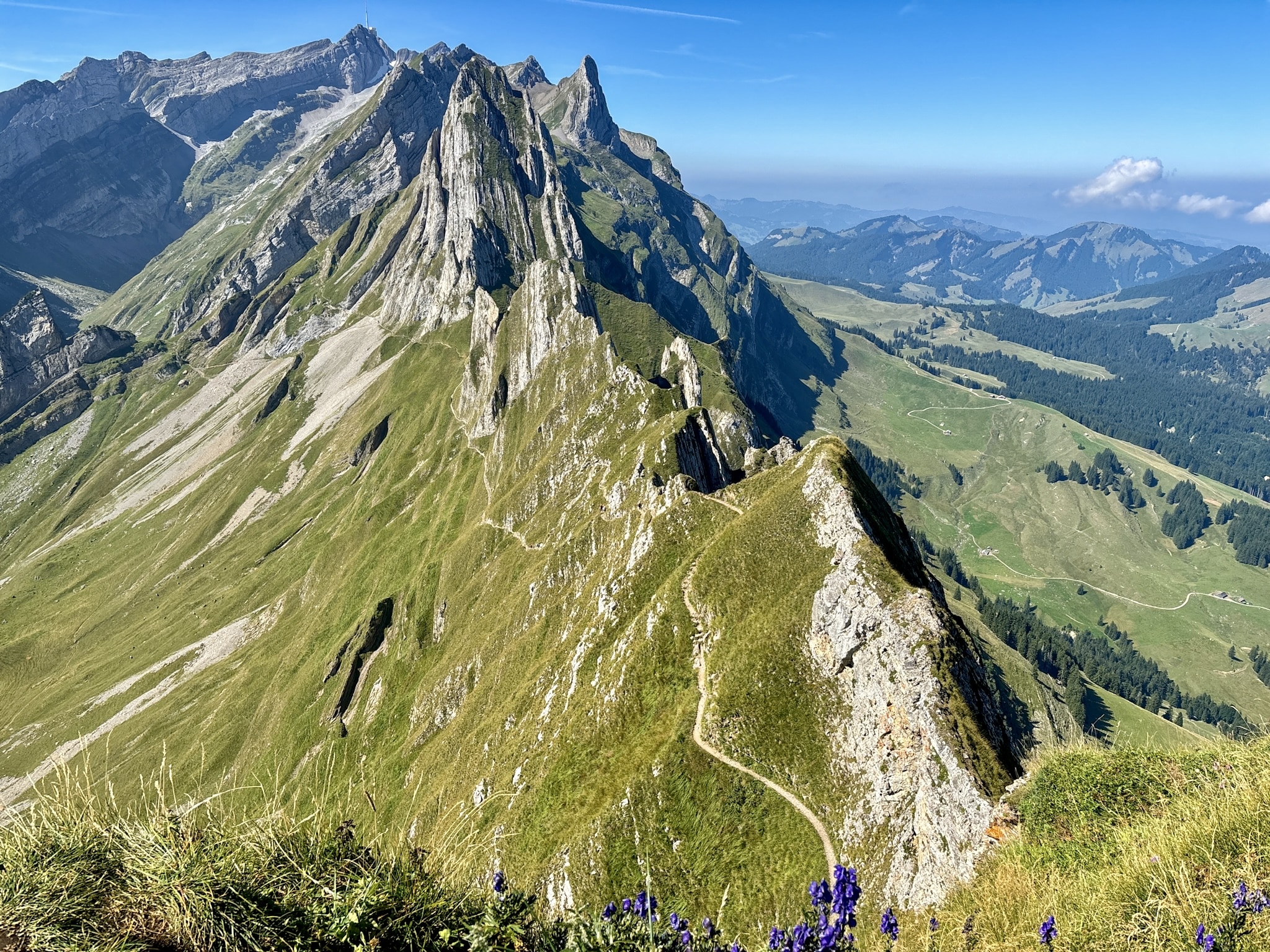
- Augstmatthorn: if the clouds lift and you still have energy, the Augstmatthorn hike from Lombachalp starts about 25 minutes from Interlaken and follows a grassy ridge high above Lake Brienz.

Augstmatthorn Ridge View

Augstmatthorn hike via Lombachalp
FAQ
Do you need to book St. Beatus Caves tickets in advance?
Usually not. I bought mine at the ticket office in mid-August and waited about five minutes. Online tickets are valid for a year and let you scan straight through the turnstile, which helps on busy days, but they can’t be refunded.
Are there discounts on St. Beatus Caves tickets?
The Swiss Travel Pass covers the bus and the boat but not the cave entrance. The Berner Oberland Pass gives 30% off, the SBB RailAway combo 20%, and the BLS boat and cave ticket 50%. There are no senior discounts.
Can you visit St. Beatus Caves without a car?
Yes, and it’s often easier. Bus 21 between Interlaken and Thun stops at the bottom of the path, and the boats on Lake Thun stop at the pier below.
Are the St. Beatus Caves open in winter?
Yes, with shorter hours. The inside stays at 8 to 10°C (46 to 50°F) all year, so it’s a good winter outing, but the path up isn’t cleared of snow.
Are the St. Beatus Caves good for kids?
Yes, for kids from about 5 who can manage the stairs. Strollers aren’t allowed inside, and there’s a playground and a short adventure trail outside.
Can you bring a dog?
Yes, on a leash, for CHF 10. Keep in mind the wet stairs and the cold.
Can you see anything for free?
Yes. The path up, the waterfall, the hermit’s cell and the playground are all free. You only pay for the cave and the museum.
Are the St. Beatus Caves worth visiting?
Yes, especially on a rainy day or if you’ve never been inside a big cave. The underground waterfalls were my favorite part.