Seeing the northern lights in Lofoten takes less luck than you might expect. Learn when to go, the best places to watch them and how to read the forecast apps, all based on my aurora hunting days in Reine.
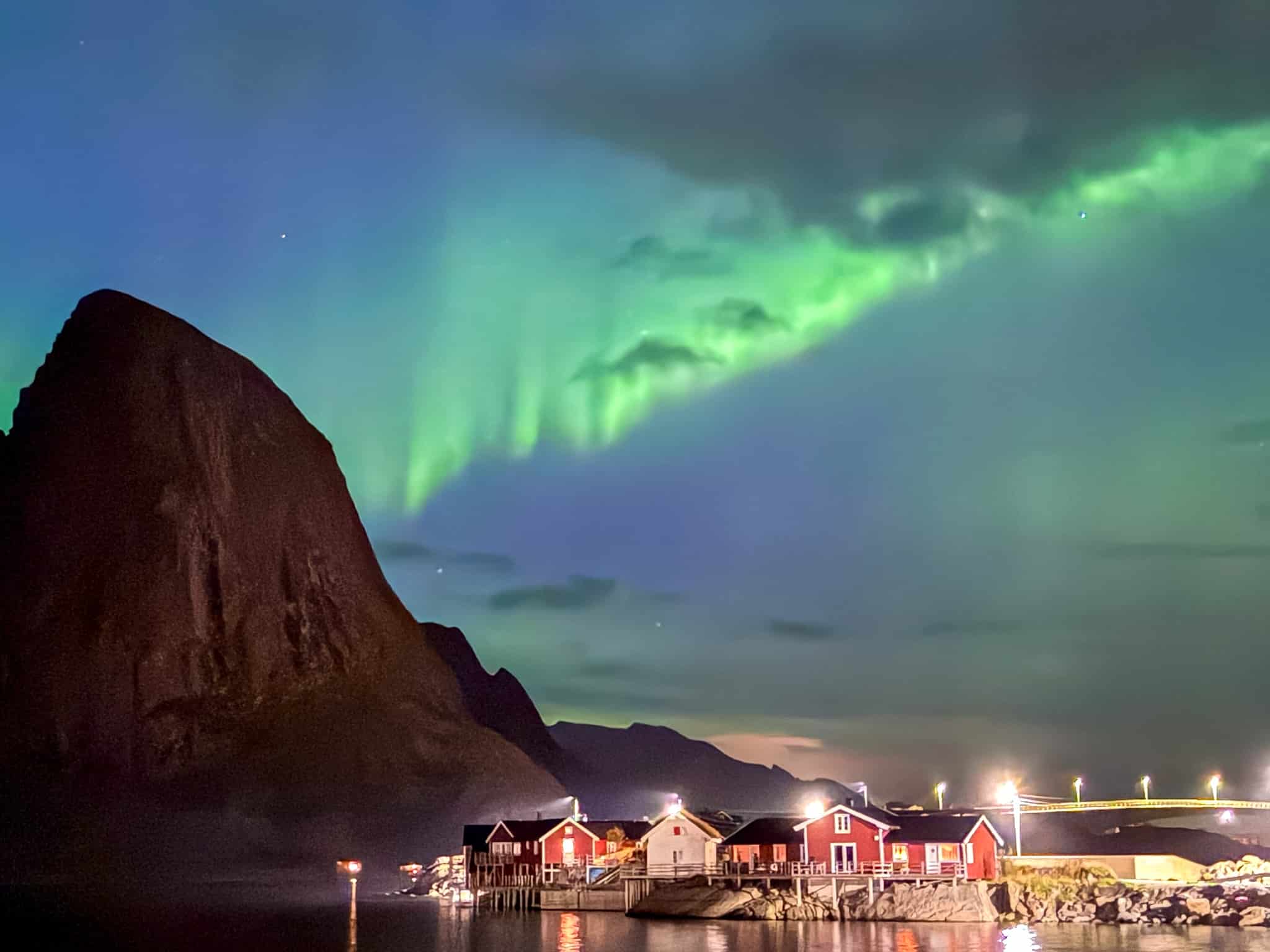
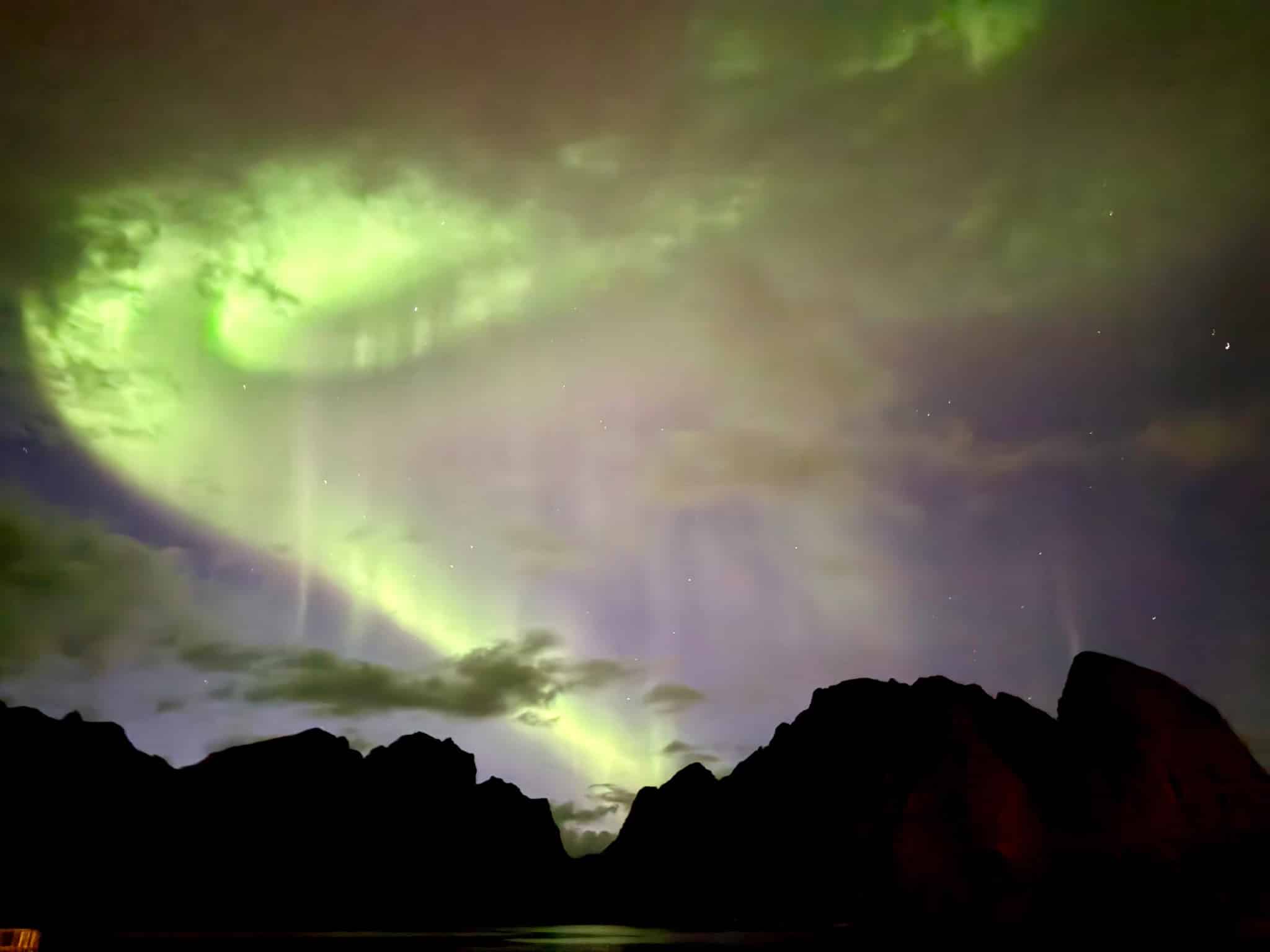
I saw the Northern Lights in Lofoten on my fourth night on the islands. My aurora app sent a notification at 10:30 p.m., so I put on my jacket and went outside, and the sky over the mountains was already green. It stayed like that until midnight, at first in long bands that pulsed, then moving at the edges over the yellow cabins of Sakrisøy.
Lofoten is so far north that you can see the aurora even when solar activity is low. You mostly need darkness and a sky clear of clouds (and the clouds here move fast). Earlier in the week, near Svolvær, I also had a weak aurora that I could only see on my phone screen.
In this guide, I share what helped me the most: which months to visit Lofoten for the Northern Lights; how many nights; where to sleep for the best place to see them; which forecast apps worked best for going aurora hunting alone; and when a tour is a good idea. These guidelines work for the whole season, from late August to mid-April.
And yes, all the photos you see here are from my iPhone, no tripod.
Aurora-Friendly Stays in Lofoten: My Shortlist
If you haven’t booked yet, look for a place away from town lights, with a view over the water or toward the north. The options below worked perfectly for me, with barely any light around and open sky right outside the door.
- Anitas Waterfront Cabins: where I stayed on a quiet stretch between Hamnøy and Reine. I saw a very strong northern lights show here, just a few steps from my door.
- Eliassen Rorbuer: red fishing cabins right on the water in Hamnøy, one of the places where I stood that same night.
- Lofoten Apartments: sea-view apartments in Hopen, between Svolvær and Henningsvær, with a private lot. My first base, where I also caught some glimpses of the aurora.
- Thon Hotel Svolvær ⭐⭐⭐⭐⭐: a practical base if you plan to join a northern lights tour, since most of them leave from Svolvær. Breakfast is included
I compare more cabins and hotels in my guide to where to stay in Lofoten.
Lofoten Northern Lights Basics Before You Plan
- What the aurora or 'Northern Lights' is: charged particles from the sun hit the gases high in our atmosphere and make them glow. Most of the time the color is green.
- Why Lofoten is a great place for the Northern Lights: the islands sit under the auroral oval, a ring around the North Pole where the lights appear most often. So you don’t need a rare event to see them.
- The KP index: a scale from 0 to 9 that measures how disturbed Earth’s magnetic field is, which is what pushes the aurora to show up. In Lofoten a KP of 1 or 2 can already be enough to see vivid colors on a clear night.
- Best Northern Lights Season: from late August to mid-April. In summer the midnight sun keeps the sky too bright.
- Time of night: usually between about 9 p.m. and 1 a.m., though a strong night can go on longer. My app kept sending alerts until 4 a.m.
- Clouds: they matter more than any number. Even a strong aurora is invisible behind a thick layer of cloud, and in Lofoten the sky can clear or close in less than an hour.
- Nights to book: five or more if the aurora is a priority, so a few cloudy nights don’t ruin your chances.
- Tours vs going independently: tours are completely optional. With a car and/or a dark place to sleep you can do it alone. A guide helps if you stay in town or don’t want to drive around at night looking for a gap in the clouds.
- How to Take Photos: a camera on a tripod gives the best results if you care about professional shots. If you’d rather travel light, my photos show that an iPhone in night mode, held in your hands, can handle a strong display.
My Experience With the Northern Lights
My first try didn’t go that well. I was staying in Hopen, near Svolvær, and the app showed some activity one evening. I went out, looked up, and saw almost nothing due to fog. My phone camera picked up a faint green glow, my eyes didn’t.
The good night came on September 8, when I was staying in my second base near Reine, at Anita's Waterfront cabins complex. I got a notification from my Aurora app around 10:30 p.m. From the kitchen window, I could already see a pale light behind the mountains. Outside it was much stronger.
For the next hour and a half I kept going in and out, warming up inside and running back out every time it got brighter. That’s the big advantage of staying in a dark spot, no driving and no waiting in a parking lot.
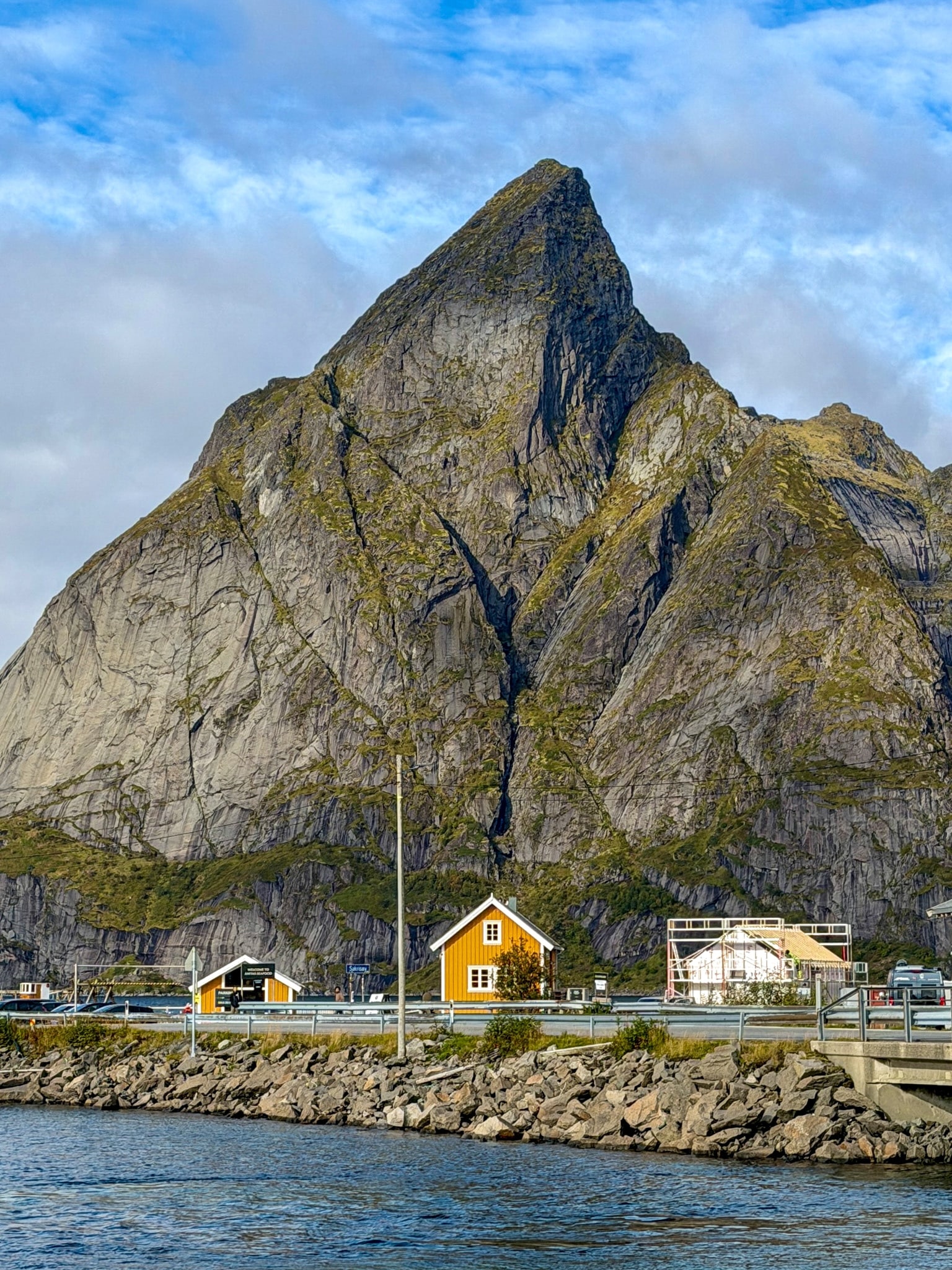
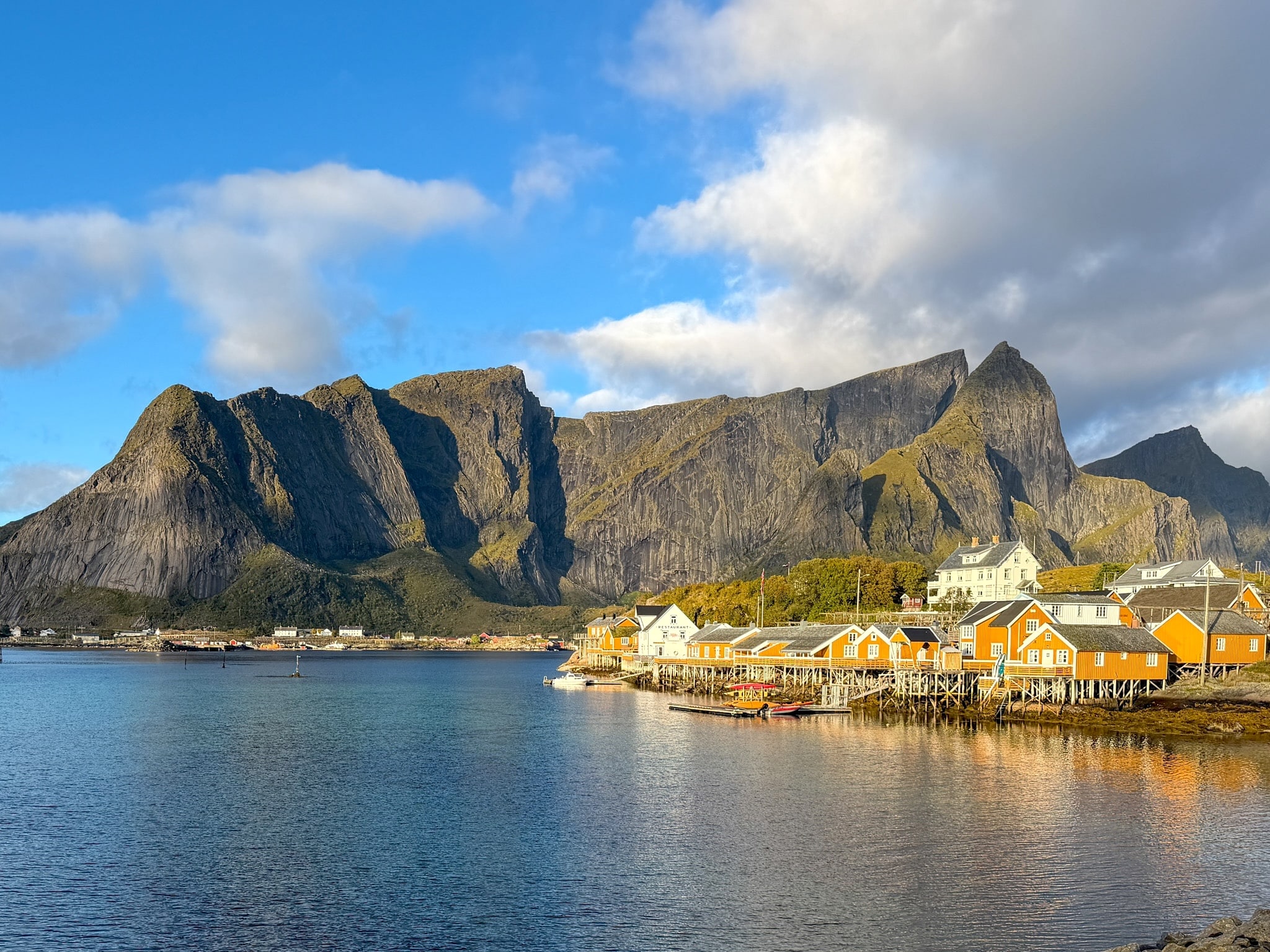
Olstind above the yellow cabins of Sakrisøy, a two-minute walk from my cabin
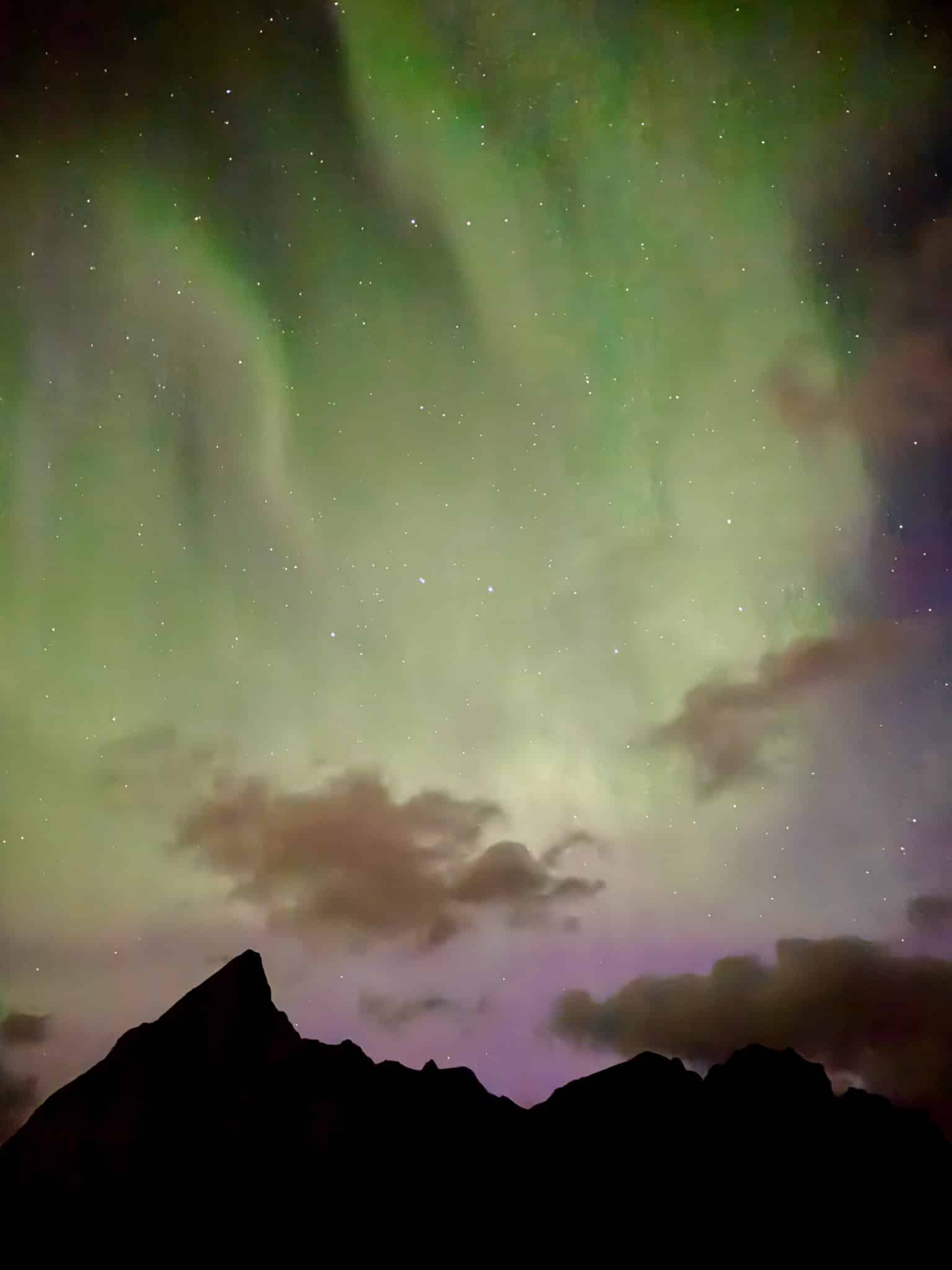
The same peak that night, under the northern lights
At some point I wanted a different angle, so I drove a few minutes past Hamnøy and stopped there too. The aurora looked different every time I checked. At first it was wide bands that pulsed slowly. Later the edges started moving fast, almost like curtains in the wind. To my eyes it was all green, the pink and purple only showed up on my phone.
I went to bed around midnight. In the morning I found more notifications on my phone, the last one around 4 a.m. So the show probably went on for a while without me.
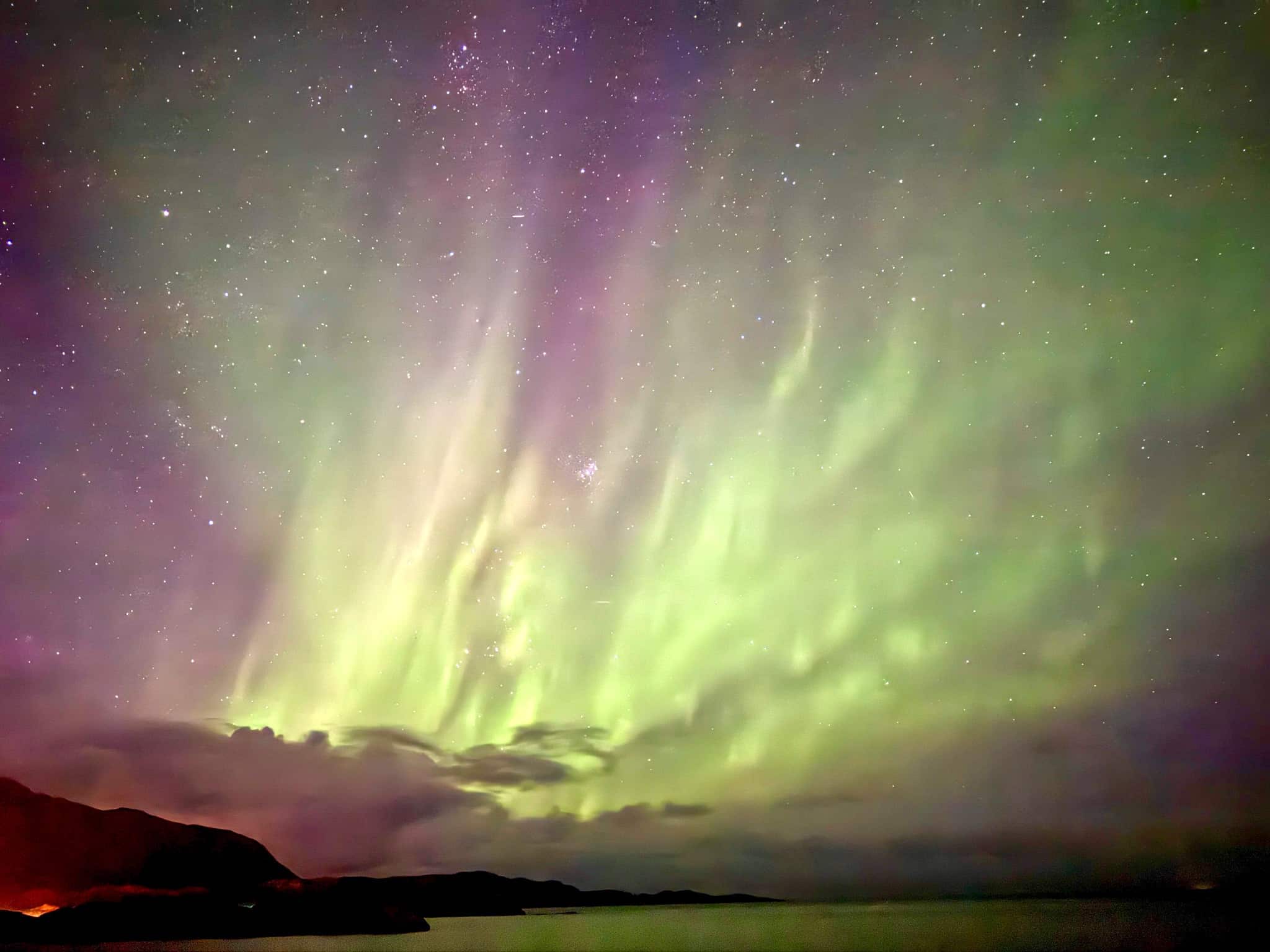
Pink and purple streaks my phone caught, which I couldn’t see with my own eyes
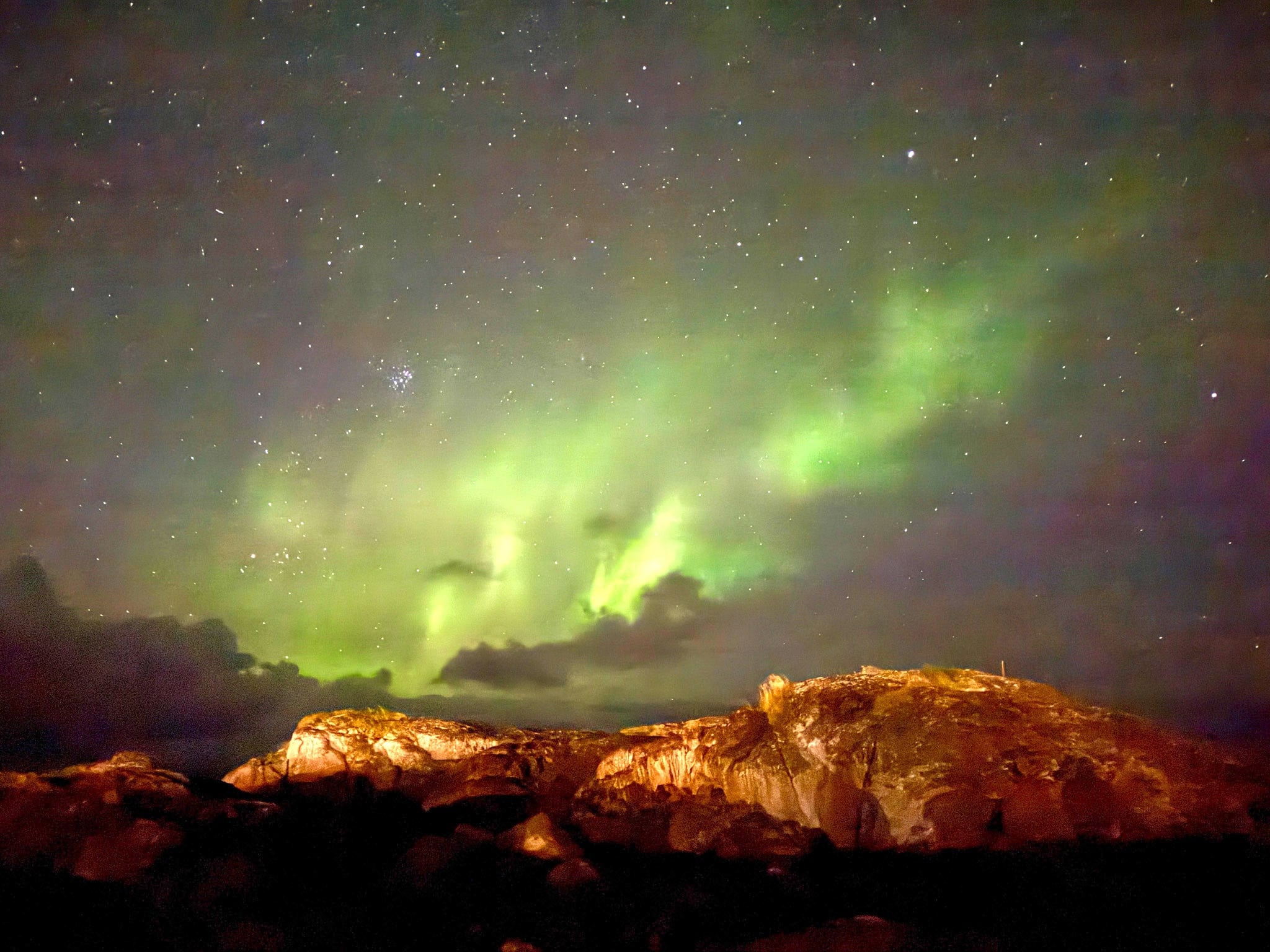
Dancing Northern Lights in the Lofoten islands
When to See the Northern Lights in Lofoten
The Aurora Season in Lofoten, Month by Month
The northern lights are up there all year. You only see them when the sky is dark enough, which in Lofoten means from late August to mid-April. Each part of the season has a different trade-off.
- Late August and September: darkness comes back after some months of midnight sun. Nights are short at first, but there's enough darkness after 10 p.m. to spot the aurora. Days are long and mild, and the hiking season is still fully on. I went in early September, and I’d pick it again for a first trip. It’s a good middle ground.
- October: longer nights and fall colors. Some sources put it among the best months, partly because it tends to be a bit less cloudy than midwinter.
- November and December: the longest nights of the year, but also the wettest and stormiest weather. Remember that more dark hours don’t automatically mean more aurora.
- January and February: snow on the peaks, still plenty of darkness and the classic winter look of the photos you’ve probably seen.
- March: often named as one of the strongest months. The weeks around the spring equinox, like the ones around the fall equinox in late September, tend to bring more geomagnetic activity.
If you only care about the aurora, October, February and March come up again and again in what I read. Honestly, though, the weather on the nights you’re there matters more than the month.
The Best Time of Night
Most displays happen between about 9 p.m. and 1 a.m., and many forecast sites point to 10 p.m. to 2 a.m. as the peak. Mine started at 10:30 p.m. Strong nights can begin as soon as it gets dark and keep going until early morning, so I’d check the sky every half hour or so instead of going out once and giving up.
Planning Months Ahead: Solar Cycle, Moon and Nights
Most people book flights months in advance, long before any aurora forecast exists. These are the things you can actually plan for:
- The solar cycle: the sun goes through a roughly 11-year cycle. The last peak was in October 2024, and 2026 and 2027 are in the declining phase. That means fewer big solar storms overall, but strong ones still happen, and Lofoten doesn’t need them anyway.
- The moon: a full moon brightens the sky and makes faint auroras harder to see. Moon phases are known years ahead, so if you can, plan your nights around the new moon. However, a strong aurora is still visible with a full moon.
- The number of nights: this is the one that really changes your chances. With five or more nights, a few cloudy evenings still leave room for a clear one.
- Where you sleep: a dark base lets you check the sky in five minutes, as many times as you like.
If your dates are flexible, there’s also NOAA’s 27-day outlook, a long-range forecast of geomagnetic activity based on the sun’s rotation. You can read it on spaceweatherlive.com. It’s only a rough guide and it covers four weeks, so it helps last-minute travelers more than anyone else.
How & Where to Read the Lofoten Northern Lights Forecast
An aurora forecast is really two forecasts in one: how active the sky is, and whether clouds will hide it. You need both on your side.
What the KP Number Tells You
The KP number in your app is a global estimate for blocks of three hours, so it says nothing about the sky above your cabin. In Lofoten I’d read it like this:
- KP 0 to 2: low activity. Often enough here, especially toward the north.
- KP 3 to 4: active. The lights can climb high and cover a big part of the sky.
- KP 5 and up: a geomagnetic storm. Rare and great, but not something you need to wait for.
When activity gets strong, the aurora also spreads east and west instead of staying low in the north. That’s worth knowing when you pick where to stand, and I come back to it in the next section.
Cloud Coverage
Clouds matter more than KP. A KP of 1 under a clear sky beats a KP of 6 under thick clouds. This was the part I checked most.
Lofoten weather moves fast. During my week, the sky could go from sunny to rainy and back in about an hour, and it was often clear in one village and cloudy 20 minutes down the road. So a bad forecast at 6 p.m. didn’t mean much at 10 p.m.
The Best Apps I Used: My Aurora Forecast and Yr
I used two free apps and kept the notifications on the default settings:
- My Aurora Forecast was the one that sent me notifications. The home screen shows the current KP and a percentage chance of seeing the lights where you are. Below that you’ll find the probability for the next 30 minutes, the cloud cover hour by hour for the night and the KP forecast for the next few days.
- Yr is the weather app from the Norwegian Meteorological Institute. For Lofoten it was more accurate than the weather app on my iPhone, and I used it for everything, from planning hikes to choosing the rainy day for my fjord cruise. Fewer people know it also has an aurora section. Scroll down to see the expected activity, the time of the best chance, cloud cover and even how much light pollution there is.
My routine was simple. Around dinner time, I checked Yr for clouds. If the night looked at least partly clear, I left My Aurora Forecast notifications on and waited for the ping.
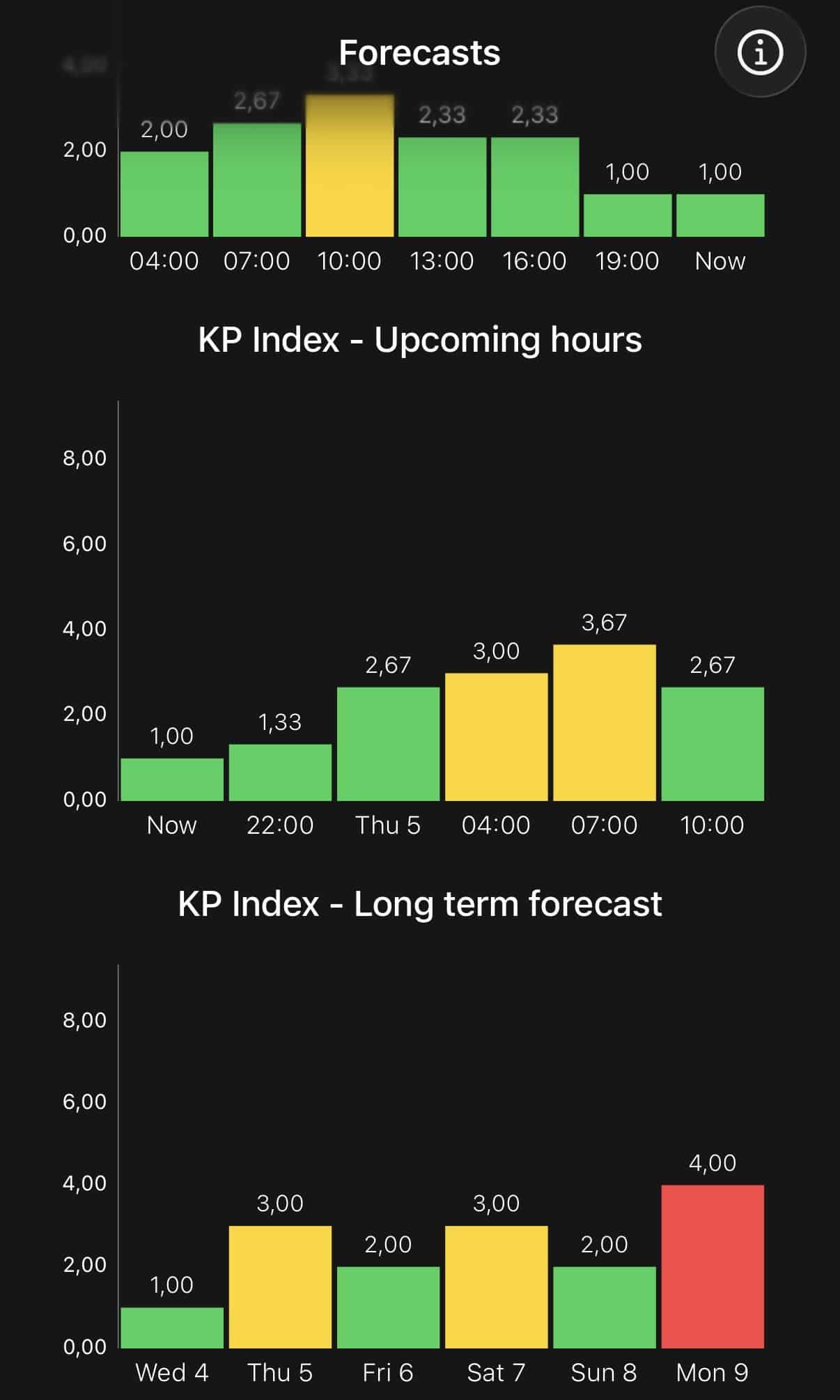
The KP forecast of My Aurora app for the next hours and days
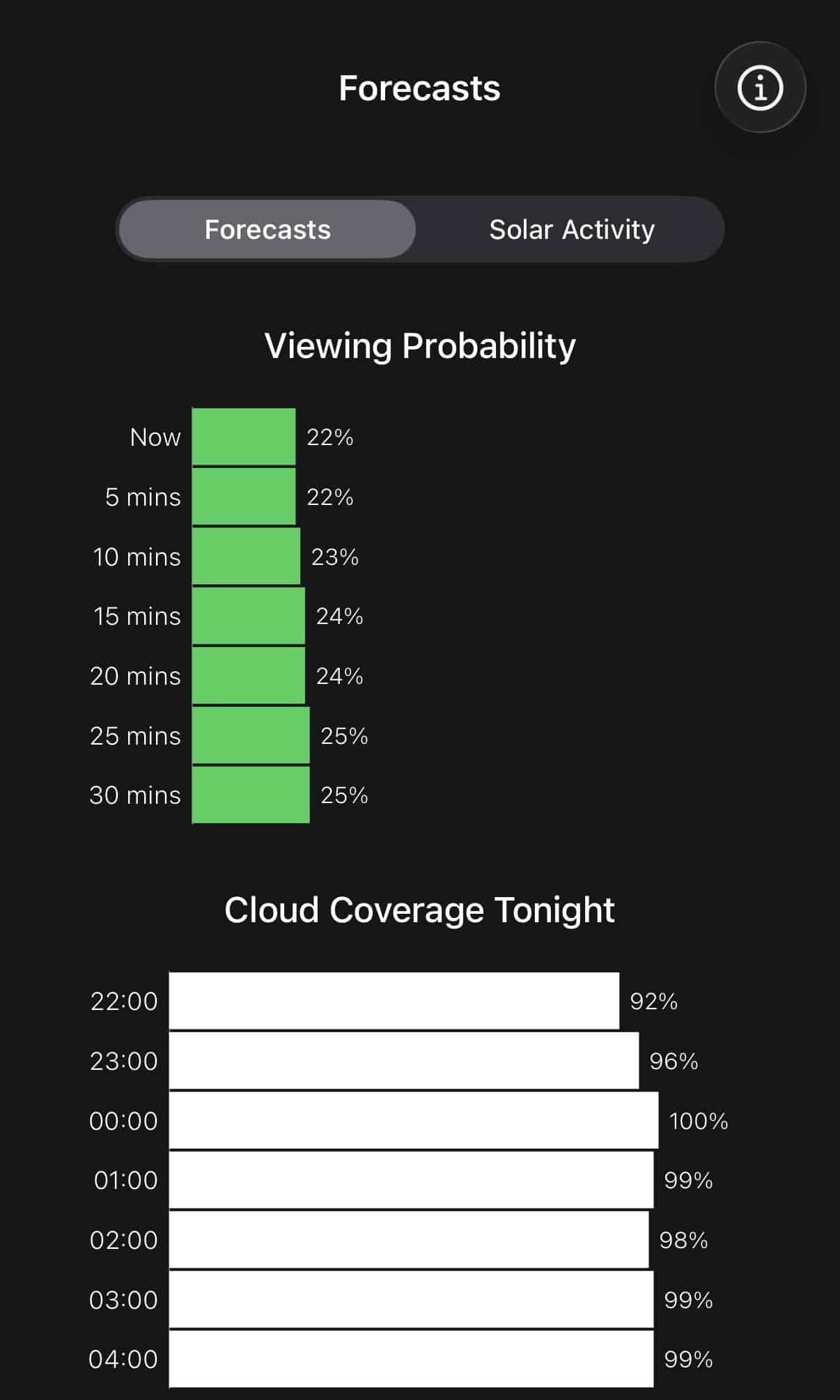
On My Aurora app: Decent activity, but 92% to 100% cloud cover all night: a classic stay-inside evening
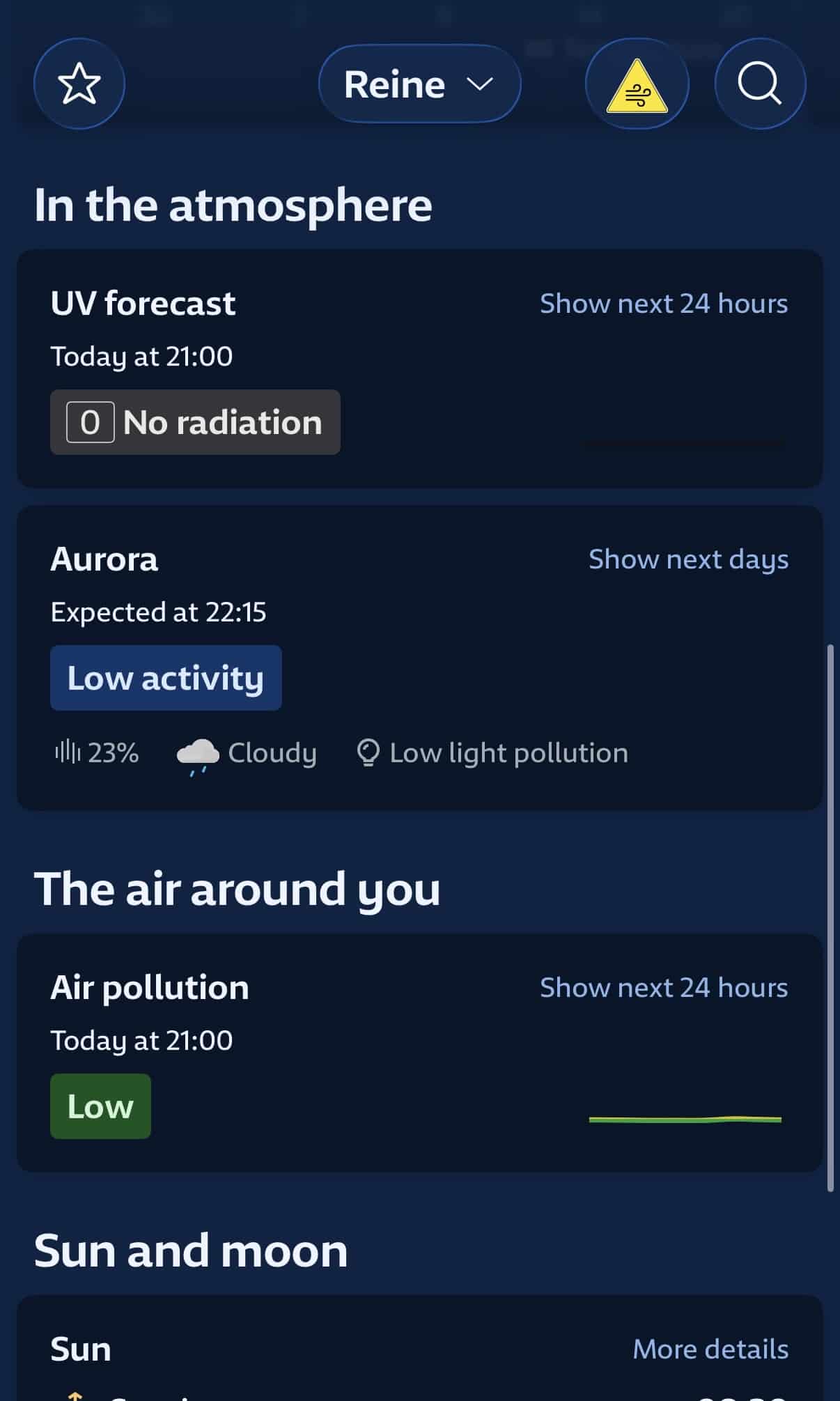
The aurora section in the Yr app for Reine, with expected time, activity and cloud cover
Where to See the Northern Lights in Lofoten: Best Places
Start With Where You Sleep
This is the tip I’d give before any spot. Outside Svolvær and Leknes there’s very little artificial light, so many cabins and rorbuer (the traditional fishermen’s cabins on the water) already sit in the dark. If yours does, you can check the sky from the window and step out in seconds.
When booking, I’d look at three things: no streetlights right outside, an open view over the water or toward the north, and free parking in case you want to drive somewhere else. In my guide to where to stay in Lofoten you can get some ideas.
Where I Watched Them: Olenilsøy, Sakrisøy and Hamnøy
All three are on the same short stretch of road in the west of Lofoten, a few minutes from Reine.
- Olenilsøy: the tiny island where my cabin stood, facing the water and the mountains. This is where I spent most of the night, and where most of my photos come from.
- Sakrisøy: the village of yellow cabins across the water, with the pointed peak of Olstind behind it. Seen from Olenilsøy, the aurora rose right over it.
- Hamnøy: the red cabins by the bridge, one of the most photographed views in Lofoten. The bridge lamps and the lights of the cabins add some glow, but with a strong aurora that wasn’t a problem.
Classic Spots: Uttakleiv, Haukland and Gimsøy
These are the names that come up in almost every aurora guide. I visited most of them in daylight, so I can tell you where they are and what they look like, but not how they were at night.
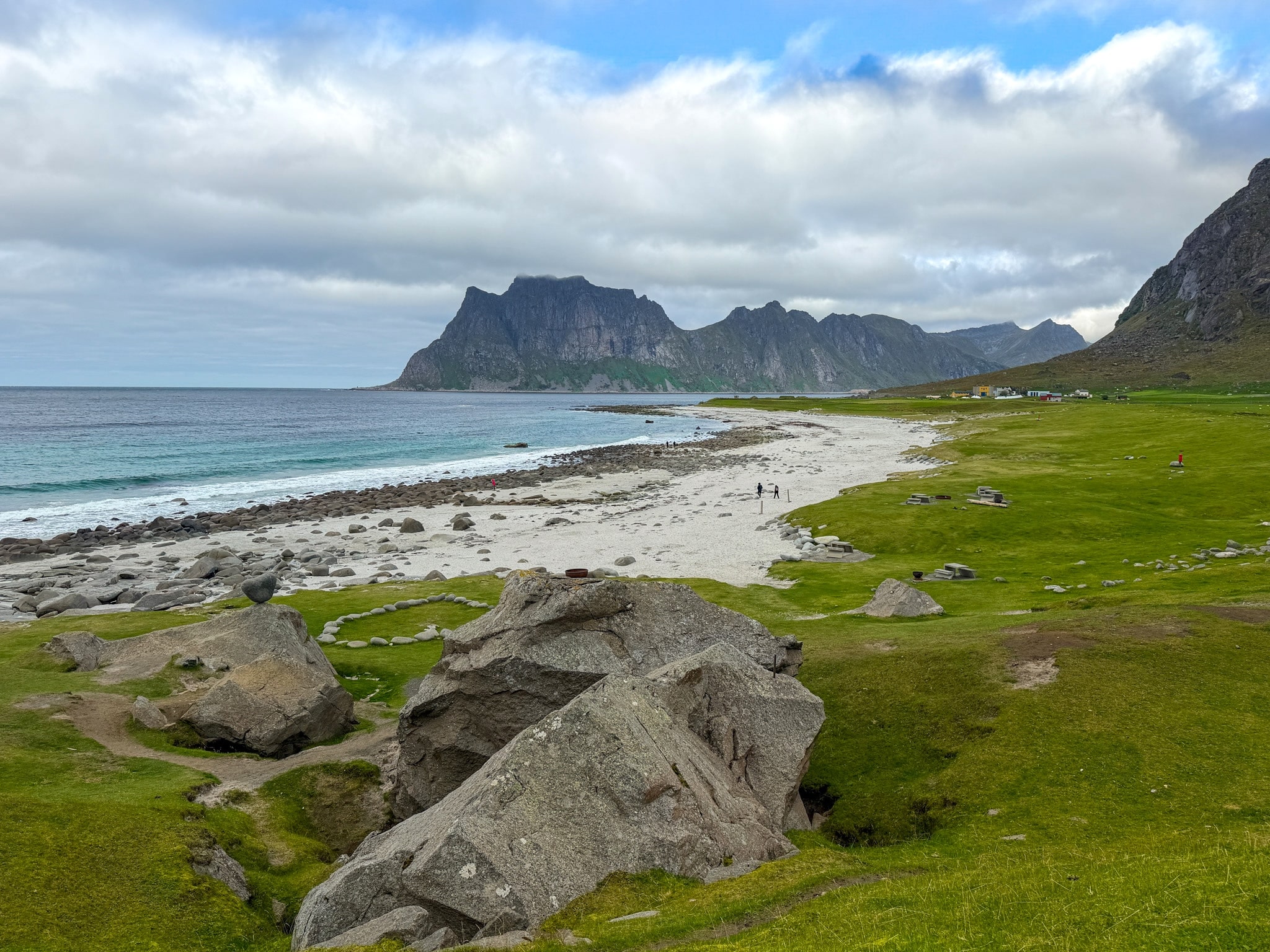
- Uttakleiv: a north-facing beach with big round boulders, on Vestvågøy, about 15 minutes from Leknes. I walked there on the hiking loop from Haukland. With low activity the aurora stays low in the north, so you want an open northern horizon, like at Uttakleiv.
- Haukland: the white-sand beach right next to Uttakleiv, with mountains on both sides. It looks more to the west.
- Skagsanden: a wide sandy beach near Flakstad, facing north. I stopped here on the drive to Reine.
- Gimsøy: a flat island between Svolvær and Leknes, with open views in almost every direction. I didn’t stop there, but it’s often recommended for nights when the lights are low on the horizon.
Where You Can Safely Stop at Night
The hardest part of chasing the aurora by car is finding a place to stop. The roads are narrow, and in the dark everything looks like a parking spot.
- Don’t stop on the roadside or in passing places. The small pull-outs marked with an “M” sign are for letting cars pass on narrow roads. Parking there can get you a fine, and it’s dangerous in the dark.
- Use real parking lots, at beaches, viewpoints and trailheads. Many charge a fee, often through the EasyPark app, so check the sign even at night.
- Turn off your headlights once you’ve parked. Other people may be taking photos, and your eyes need the dark too.
I wrote more about parking rules and fines in my guide to renting a car in Lofoten.
Lofoten Northern Lights Tours: Do You Need One?
When a Tour Makes Sense
I didn’t book a tour, and I didn’t miss one. My cabin was dark enough and I had a car. That’s the setup where you can easily do it alone.
A tour is a good idea in other cases:
- If you’re staying in the center of Svolvær or Reine, the lights of town get in the way.
- If you don’t have a car, you have no way to move.
- And even with a car, driving narrow roads at night while looking for a safe place to stop isn’t much fun.
Guides know which spots have parking, which direction tends to clear first and how to move around a band of clouds. On a night with patchy weather, that can be the difference.
If the forecast looks good and you want to make the most of it, a tour also takes care of the photos, which helps if you don’t want to fiddle with settings in the cold. Just keep in mind that no tour can promise the aurora.
Tours From Svolvær
Svolvær is where most northern lights tours in Lofoten start. These two have small groups and good reviews on GetYourGuide:
- Svolvær: Ultimate Aurora Hunt: a 4-hour tour with Lofoten Insight, led by a photographer. It’s one of the most reviewed aurora tours in the area.
- Svolvær: Northern Lights Tour with Hot Drinks & Photos: 4.5 hours with RAW Lofoten, maximum seven people, in a van with a glass roof. If the weather cancels the tour, you can reschedule or get a refund.
Tours From Reine
In the west there are fewer options, and I didn’t find any on the big booking sites. Reine Rorbuer, a hotel in Reine, runs its own small-group tour for up to eight people. It leaves from their reception and includes warm drinks. When I checked their calendar, the next dates started in February 2027, at 2,200 NOK per person (about $210). Since the dates change from season to season, I’d email them at post@reinerorbuer.no before planning around it.
Tips for Aurora Nights in Lofoten
Photographing the Northern Lights With Your Phone
All the photos in this guide come from my iPhone in night mode, held in my hands. The aurora was bright that night, and that’s what made it possible. On a faint night a phone struggles much more. What helped:
- Let night mode do its thing. On an iPhone the moon icon appears by itself in the dark. Tap it and you can make the exposure longer, up to 30 seconds if the phone sits on something steady.
- Keep the phone as still as possible. I leaned my arms on a railing or held my breath for the few seconds of the shot. Any wall, car roof or rock works too.
- Turn off the flash. It lights up the foreground a little and does nothing for the sky.
- Expect more color on the screen than in the sky. The camera collects light for several seconds, so it shows pink and purple that your eyes may not see. To me the aurora was green.
If you care about professional photos, a camera on a tripod is still the best option. Photographers usually start from a wide aperture (f/1.4 to f/2.8), ISO 1600 to 3200 and 5 to 15 seconds of exposure, with the focus set to infinity, and adjust from there. In winter, keep a spare battery in an inside pocket, since the cold drains it fast.
What to Wear
In early September it was around 5°C (41°F) at night, and I wore my heavy down jacket. That may seem a lot for autumn, but standing still for an hour by the water cools you down quickly.
For any month, I’d bring warm layers, a hat, gloves you can still use your phone with and shoes that don’t mind wet grass. From late autumn to spring, add winter boots, something for the wind and microspikes for icy paths. A headlamp is useful all season for walking back to the car.
Give Your Eyes Time
Your eyes need about 20 minutes in the dark to see faint auroras well. Every time you look at a bright screen, you start over. So I’d turn the phone brightness down and look at the sky first, the screen second. And don’t leave the moment it fades, as the aurora often comes in bursts: it goes quiet for a while, then comes back stronger.
Lofoten Northern Lights FAQ
Can you see the Northern Lights in Lofoten in August?
Only in the last days of August, when the nights start getting dark again. The dark window is very short and the sky stays a bit bright, so you need a fairly strong aurora and a clear night.
Can you see the Northern Lights with a full moon?
Yes, if the aurora is strong. The moonlight washes out faint displays, but it also lights up the mountains, which some photographers like.
Can you see the Northern Lights from both Svolvær and Reine?
Yes, on a strong night you can sort of see them from town too. For weaker displays, a few minutes’ drive away from streetlights makes a huge difference.
Can you see the aurora on a cloudy night?
Not really. Thin high clouds sometimes let it through, and the sky can open up in a different part of the islands. But with thick low clouds everywhere, you’re better off resting for the next night.
Will 2027 still be a good year for the Northern Lights?
The sun is moving away from the peak of its cycle, so big storms become less frequent. Strong ones still happen in this phase, and in Lofoten even average activity can be enough on a clear night.
How do I get to Lofoten in aurora season?
Outside summer there are no direct flights from Oslo, so most people fly via Bodø to Leknes or Svolvær, or to Harstad/Narvik and drive. I explain every option in my guide on how to get to the Lofoten Islands.
Do I need a car to see the northern lights in Lofoten?
Not if your accommodation is dark or you join a tour. A car gives you the freedom to chase clear skies, and I share costs, agencies and night driving tips in my guide to renting a car in Lofoten.
Keep reading: