Where to rent a car in Lofoten and which agencies to trust, what it typically costs to tourists, how parking and fine charges work and what driving the islands is like, all based on my recent self-drive trip.
I picked up my rental car in Lofoten at Leknes Airport a few steps from the baggage belt and drove across most of the islands, from the trailheads near Svolvær to the parking lots of Reine. The car was a small hybrid Toyota Yaris, and it handled every road and trailhead I needed. I can confirm, having also seen the minimal public transport network there, that renting a car in Lofoten is the easiest way to see the islands.
Choosing the company took me, however, longer than any drive. The rental agencies exist at every airport and in a few villages, but some barely show up in a basic search. Plenty of the ones that do have bad reviews that made me nervous.
This guide is the summary of that research, first online and then on the ground. I list:
- every rental company I could confirm in person, grouped by the airports and ferry ports where you’re likely to arrive. I'm also including local agencies that deliver cars to you
- typical costs and my direct experience, in case you're also arriving in and renting from Leknes Airport
- driving and parking rules. They matter more than they seem, because speeding tickets and parking fines usually go to the rental company first and land on your card weeks after you fly home. A lot of one-star reviews start there.
Lofoten Quick Planner: Arrival and Stays With Parking
- Where you’ll pick up the car: the main rental desks are at Leknes, Svolvær, Harstad/Narvik (Evenes) and Bodø airports. My guide on how to get to the Lofoten Islands compares all four routes.
- Where to sleep: parking in the villages is limited and rarely free, so I only booked places with their own spaces. Some suggestions based on the places I tried and liked:
- Anitas Waterfront Cabins: modern cabins between Hamnøy and Reine with parking outside the door. I stayed here three nights.
- Lofoten Apartments: sea-view apartments in Hopen, between Svolvær and Henningsvær, with a private lot. My first base.
- More areas and hotels: I compare every part of the islands in my guide to where to stay in Lofoten.
Do You Need a Car in Lofoten?
Let's get over this common question before you book your rental. A quick answer: if you want to hike, chase beaches and move between villages on your own schedule, yes. A car is the easiest way to see Lofoten, and I wouldn’t plan a first trip without one.
Public transport does exist. Bus 300 runs from Narvik and Evenes through Svolvær and Leknes to Å, bus 741 links Svolvær and Leknes, and bus 742 covers Leknes to Å. They’re fine for moving between towns, but they’re less useful for trailheads and beaches, which are often a few miles from the nearest stop, and departures thin out outside summer.
Also, the islands are long, and the places worth visiting are spread out. However, most people will explore three or four places in a day, including short hikes. On a bus timetable, that would be impossible.
You can skip the rental car if: you’re staying in one base like Reine or Svolvær, joining guided tours, or arriving on the Hurtigruten coastal ferry for a day or two. Otherwise, renting a car in Lofoten will give you a much better experience, and the rest of this guide is about doing it without surprises.
Where to Rent a Car in Lofoten
There are 5 places where you’re likely to pick up a car: the two small Leknes and Svolvær airports inside Lofoten, the bigger Harstad/Narvik airport at Evenes on the mainland side, and Moskenes or Bodø ports if you take the ferry across. The lists below come from the airport operator Avinor, which I cross-checked with each company’s own site.
Leknes Airport Car Rentals
- Best for: the west side, from Leknes and Vestvågøy down to Hamnøy, Reine and Å.
- Companies: Avis, Hertz, Europcar and Sixt are listed by the airport. Local agencies like Lofoten Car Hire and Bilutleie i Lofoten also hand over cars here.
- Getting there: Widerøe flies in from Bodø and Oslo. Reine is about 56 km (35 mi) away, roughly an hour.
- My take: this is where I rented my car. The desk sits next to baggage claim and the cars wait in a lot right outside, so I was on the road a few minutes after landing. When I went through, the only branded desk I saw was the shared Hertz and Avis Budget counter.
Svolvær Airport Car Rentals
- Best for: Svolvær, Kabelvåg, Henningsvær and the eastern hikes.
- Companies: Avis, Hertz, Europcar and Sixt. Local agencies in Svolvær, such as Lofoten Rental Car and Rent a Car Lofoten, can meet you here.
- Getting there: Widerøe flies in from Bodø. The airport is a short drive from the center of Svolvær.
- My take: a good pick if your first nights are in the east. Driving from Svolvær to Reine takes about two hours, 120 km (75 mi), so you’ll cover the whole archipelago in one go at some point.
Harstad/Narvik Airport (Evenes) Car Rentals
- Best for: direct flights from Oslo, Copenhagen or Frankfurt, and travelers who want to drive in through Vesterålen.
- Companies: the widest choice outside Bodø, with Avis, Budget, Hertz, Europcar, Enterprise and Sixt.
- Getting there: Svolvær is about 166 km (103 mi) away, a three-hour drive, and the islands start feeling like Lofoten only toward the end.
- My take: the bigger fleet can mean better prices, but add a full travel day each way. Avis lists a one-way option between its Lofoten stations and Evenes if you want to fly in to one airport and out of another.
Bodø and the Ferry to Moskenes Car Rentals
- Best for: people already in Bodø, or anyone who wants a bigger fleet and a ferry ride.
- Companies: Avis, Budget, Hertz, Sixt, Alamo, Enterprise and National at the airport.
- Getting there: the car ferry to Moskenes takes about 3 hours 15 minutes. A car under 6 m (19.7 ft) costs around 605 NOK plus a 250 NOK reservation fee, and only about half the space can be booked ahead, so the rest goes first come, first served.
- My take: I skipped this route. In summer, the ferry queue is the weak link, and the crossing is often rough. Check that your rental company allows its cars on the ferry before you book.
Moskenes, Reine and Local Pickups
- Best for: travelers arriving by ferry at Moskenes or staying around Reine without a car.
- Companies: Avis runs a summer station in Moskenes and a pickup point in Reine. Bilutleie i Lofoten is based in Moskenes, and Lofoten Car Hire delivers to Moskenes, Svolvær and Evenes by appointment.
- Getting there: Moskenes is about 5 km (3 mi) from Reine.
- My take: handy if you start in the west, but there are few cars and hours are seasonal. Book early and get the delivery details in writing.
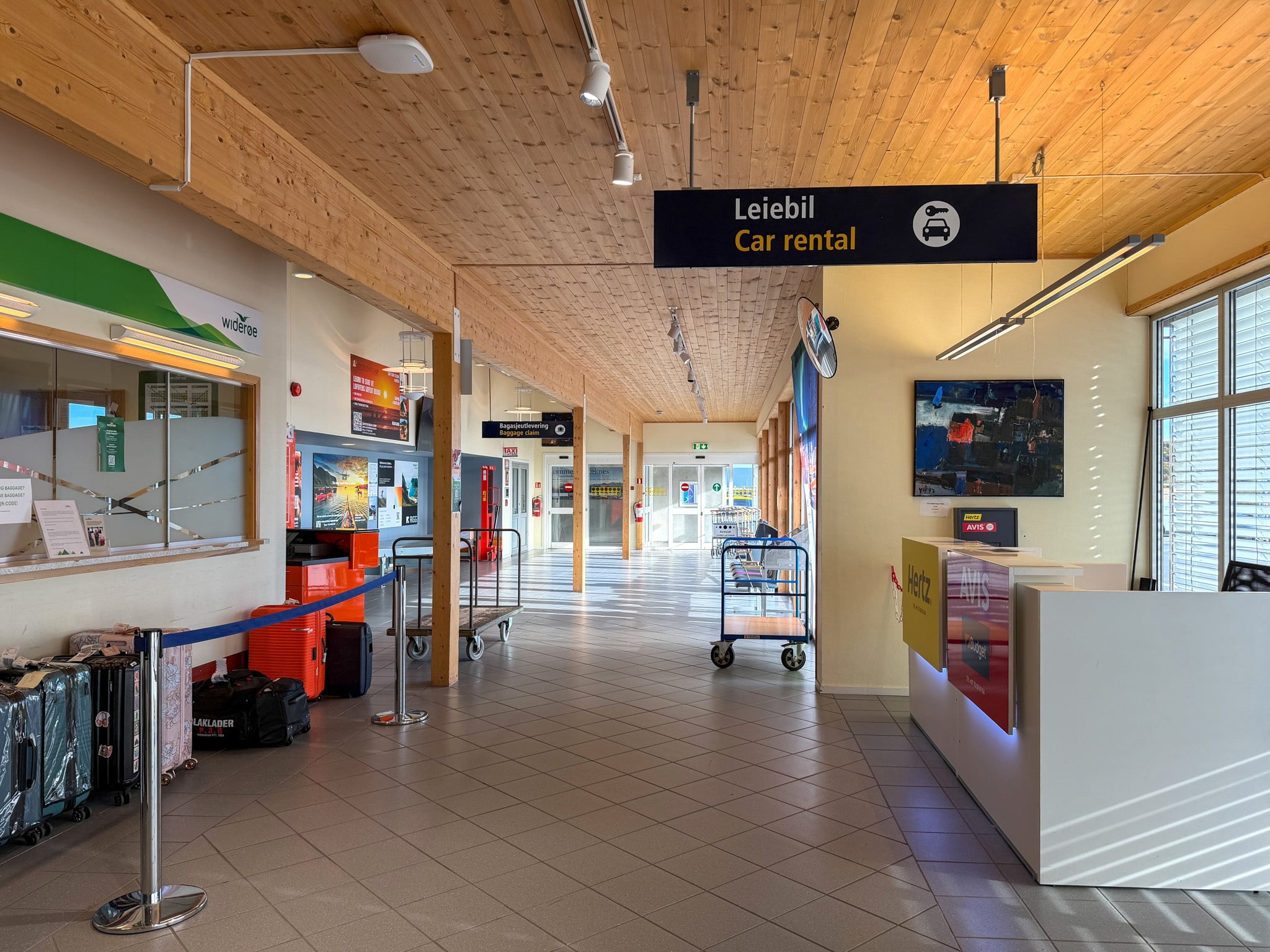
The car rental desk and baggage claim at Leknes airport, all in one room
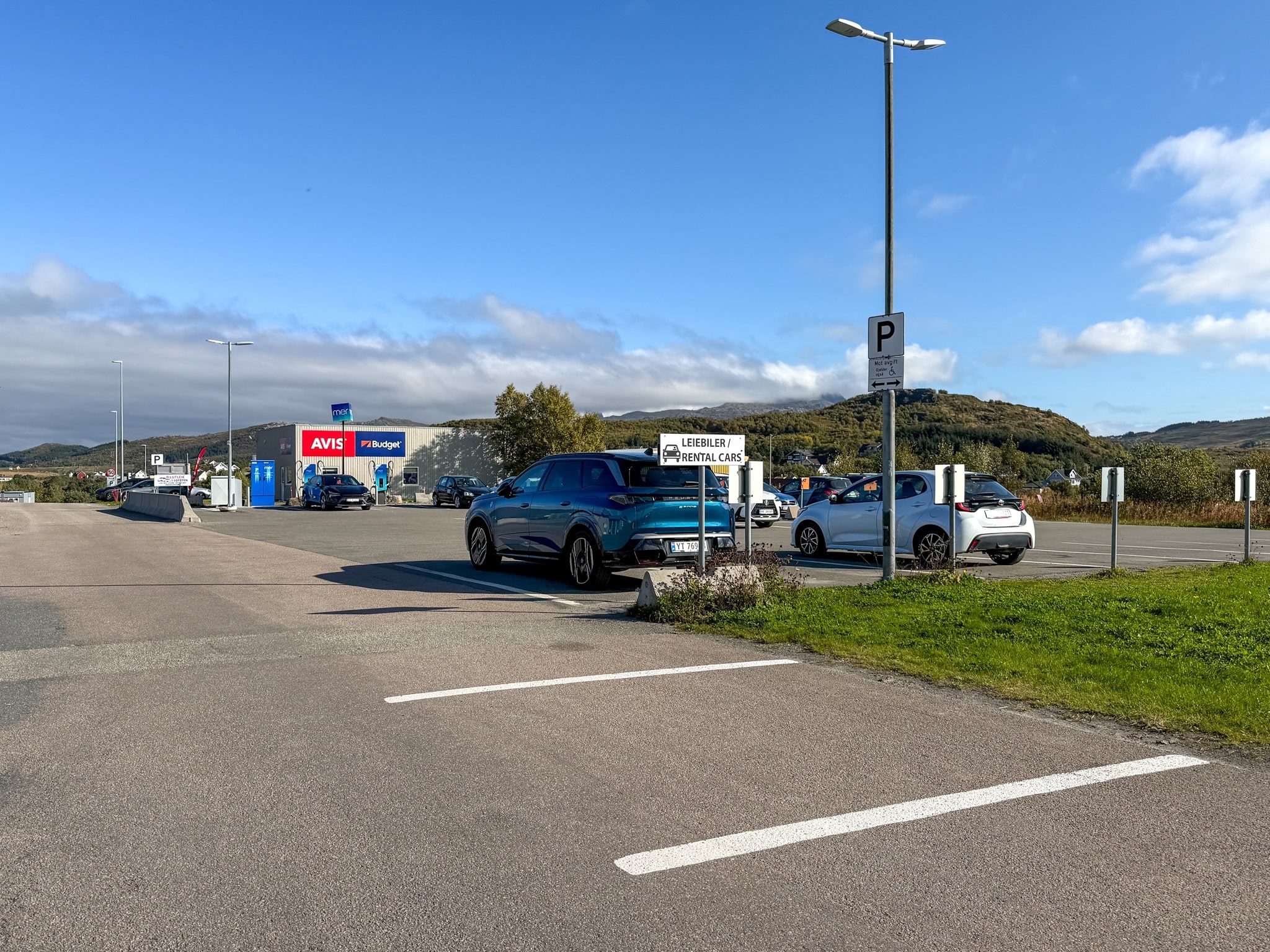
The rental car lot at Leknes Airport, where I picked up my Yaris
Lofoten Car Rental Companies: What Reviews Say
I read a lot of reviews before booking, on Google, Tripadvisor, Reddit and travel forums. A few patterns came up again and again. Here’s the summary, company by company, just to spare you some time:
Avis, Hertz, Sixt and Europcar
- Avis has surprisingly few detailed reviews for its Lofoten stations, despite its presence. The ones I found were mostly for the Leknes airport (AVIS Leiebil) and positive, which convinced me. So I booked with Avis directly on its website, and I cover how the pickup and return went in the next section.
- Hertz collected the most complaints in my research. The common ones were emails that went unanswered, slow service at Evenes, and sudden damage charges that showed up weeks after the return.
- Sixt reviews were split in half. A lot were positive, but many report instances of insanely expensive extra charges due to scratches which were found/claimed weeks after rental return. I really found this to be a common theme in Lofoten.
- Europcar is listed at all four airports, but I couldn’t find a single review specific to Lofoten.
Local Agencies in Lofoten
The local companies are smaller, often family-run, and they don’t always show up when you search for car rental. Several will bring the car to you:
- Lofoten Rental Car (Svolvær and Kabelvåg): the most praised name I found. They meet you at the airport or your accommodation, the cars are older, and reviewers say they’re relaxed about small scratches. You pay at pickup, and there’s a 300 NOK airport fee.
- Rent a Car Lofoten (Svolvær): around since 2003 and run by Lofoten Bil, a local car dealer with its own workshop. It delivers cars too. Reviews are mixed.
- Lofoten Car Hire (Leknes Airport): newer cars and delivery to Moskenes, Svolvær and Evenes by appointment. Visit Lofoten lists prices from around 1250 NOK a day. A few Reddit threads ask whether it’s legit, which tells you more about how little information exists than about the company.
- Leknes Bilutleie (Rent A Wreck Lofoten): a small agency in Leknes with good reviews.
- Bilutleie i Lofoten (Moskenes): founded in 2024, so there’s little feedback yet, but it's mostly positive.
Never Book a Rental Car Through Facebook
One local company, Rent a Car Moskenes, closed down and sold its cars to Lofoten Car Hire. Its old Facebook page is still active, now run by scammers who take deposits for cars that don’t exist. Book only on a company’s official website or by phone, and never pay through Facebook or Messenger, however friendly the reply.
My Experience Renting a Car in Lofoten With Avis
I booked in January for a September trip, directly on the Avis website. I always book rentals directly when I can, because if something goes wrong there’s one company to deal with, not two.
My car was a Toyota Yaris hybrid, booked with full insurance and one driver, for 6510 NOK for the week. It was small enough for narrow roads and village parking, and our luggage still fit.
At Leknes it seemed like everyone from my flight walked to the same desk. The line moved fast anyway. Paperwork took a few minutes, and the car was parked right outside, clean and in great condition.
Two things are worth knowing from the pickup:
- First, the full coverage I’d selected online and that was included in the email confirmation was missing from the contract there. I only noticed because the total looked different from my booking, and the agent added it back at the same price after I mentioned it. Read the contract before you sign, even if you’re tired from the flight.
- Second, nobody walked around the car with me to check for existing scratches, which I found unusual. They just gave me directly the keys. I had opted for full coverage, so for me it was fine, but in any case, take multiple slow videos of every side of the car, the wheels, and the windshield before driving off, so you have your own proof.
The pre-authorization on my credit card was more than double the rental price. It was released after the return, which was quick: someone checked the car, I’d refilled the tank as the full-to-full policy required, and that was it. No extra charges came later.
How Much Renting a Car in Lofoten Costs
The total comes from three things: the base rental, the insurance you add on top, and what you spend while driving. I compared prices from Kayak, DiscoverCars and several recent trip reports, and checked them against what I paid.
Rental Prices by Season
All prices are per day for a small car. “Without insurance” means the base price, which includes basic collision cover with an excess, the amount you’d pay if the car gets damaged, while “with full insurance” means zero excess.
- Summer (June to August)
- Without insurance: around 1000 to 1500 NOK ($95 to $140)
- With full insurance: around 1200 to 1800 NOK ($115 to $170)
- Peak season, with the fewest cars left. Book as soon as you have flights.
- Shoulder season (April, May, September, October)
- Without insurance: around 500 to 1000 NOK ($45 to $95)
- With full insurance: around 700 to 1300 NOK ($65 to $125)
- Usually cheaper than summer, especially April and September
- Winter (November to March)
- Without insurance: around 700 to 1200 NOK ($65 to $115)
- With full insurance: around 900 to 1500 NOK ($85 to $145)
- November is the cheapest month. February comes close to summer prices.
SUVs cost more in every season, and in summer the difference can be 50% or more.
What I Paid
- Car: Toyota Yaris hybrid, booked directly with Avis in January
- Dates: six days in September
- Base rental: 4590 NOK, about 765 NOK a day
- Full insurance: 1920 NOK, about 320 NOK a day
- Total: 6510 NOK
The insurance came close to a third of the bill. With narrow roads, gravel parking lots and the amount of reviews I've seen about scratch-related extra charges, I’d pay it again.
Fuel, Charging, Parking and Tolls
- Petrol: around 22 to 23 NOK per liter as of September 2026
- EV fast charging: around 5 to 7 NOK per kWh. Circle K, Mer and Recharge have chargers across the islands, and Svolvær has a Tesla Supercharger. The Elton app shows prices and lets you pay at most of them.
- Parking: usually 20 to 45 NOK an hour in villages and at many trailheads, with a few popular lots like Reinebringen charging much more
- Tolls: I didn’t pass any inside Lofoten. On the mainland, AutoPASS charges them automatically to your rental company, which bills you later with an admin fee.
Extra Fees to Check Before Booking
- One-way rentals: often expensive between different stations, for example Leknes to Evenes.
- Airport handovers: some local agencies charge for them, like the 300 NOK fee at Lofoten Rental Car.
I’d compare prices on Kayak as soon as your flights are booked, then book with the company directly if the rate is the same.
Insurance, Deposits and Charges After You Fly Home
Most bad reviews of Lofoten rental companies are about money that gets charged weeks after the trip has ended. Knowing how insurance, deposits and fines work before you pick up the keys avoids most of it.
Your Insurance Options
- Basic cover (included in the price). Covers damage, but you pay the excess first, usually around 10000 to 20000 NOK.
- Full cover from the rental company. Brings the excess to zero, or close to it. Avis calls it Super Cover. If something happens, you return the car and walk away. This is what I booked.
- Full cover from a comparison site or a third-party insurer. Usually cheaper, but it works by reimbursement. The desk still blocks the full deposit, and if there’s damage, you pay the rental company first and claim the money back later.
- Credit card coverage. Some US cards, like the Chase Sapphire cards, include primary rental car cover abroad. It usually applies only if you decline the rental company’s own damage waiver. Check your card’s terms for Norway before you travel.
The Deposit
- The desk places a hold on your credit card when you pick up the car, called a pre-authorization.
- It has to be a credit card in the main driver’s name. Debit cards are often refused.
- Mine was more than double the rental price, even with full insurance.
- It was released after I returned the car, though some banks take a few days to show it.
Charges That Arrive Weeks Later
- Damage found after the return. The absolute most common complaint in reviews, especially when nobody checked the car with the customer, which seems to be the norm in Lofoten. Take plenty of videos in good lighting of every single side of the car, with close-ups to any tiny scratch you see.
- Speeding and parking fines. Cameras and parking companies send the fine to the rental company, which pays it, finds out who had the car and charges your card. On top of the fine, companies add an admin fee. Enterprise in Norway, for example, charges 375 NOK per fine. Lofoten islands have pretty strict rules for speeding and for parking out of designated areas.
How I’d Protect Myself
- Read the contract before signing and check that the insurance you booked is on it.
- Film the car from every side at pickup, including wheels and windshield.
- Do the same at the return, and ask someone to check the car with you if possible.
- Return the tank full and keep the fuel receipt.
- Keep your booking confirmation and contract until a couple of months after the trip.
When I returned my car, someone checked it while I was there, and no extra charges came later. Driving and parking carefully is the other half of it, which is what the next two sections are about.
Driving in Lofoten: What You Need to Know
Driving in Lofoten is easy in the practical sense. Every road I needed was paved, signs are clear, and my small Yaris reached every trailhead without trouble. What takes some getting used to is the pace: narrow roads, low speed limits and plenty of reasons to slow down.
Narrow Roads, Passing Places and One-Lane Bridges
The E10 is the main road through the islands, and outside the towns it’s often narrow, with no shoulder. Smaller side roads to villages and beaches get narrower still, sometimes with room for one car.
- Passing places: look for the blue sign with a white “M”, short for møteplass, the Norwegian word for meeting place. Whoever is closer pulls in and lets the other car pass.
- One-lane bridges: several bridges are single lane. Check the signs before you go onto one, because they tell you who has priority.
- Traffic lights: around Reine I hit a few temporary lights controlling single-lane stretches. Waiting a couple of minutes is normal.
The one rule I’d stress: never stop on the road or in a passing place to take a photo. It’s tempting every few minutes, and it’s how most near-misses happen. Wait for a proper pull-out or parking area.
The Nappstraumen Tunnel is Under Renovation Until 2027
The Nappstraumen tunnel connects Vestvågøy and Flakstadøy, and it’s the only road link to the west side, Reine and Å included. It’s 1780 m (1.1 mi) long and has been under upgrade since August 2025, with work planned to end in December 2027.
- Daytime: traffic goes through in convoys led by a pilot car.
- Twice an hour from 06:00 to 09:00 and from 15:00 to 17:00, otherwise once an hour.
- Convoys leave on the hour from the Flesa side, toward Leknes, and on the half hour from the Napp side.
- Night: the tunnel is closed from 23:00 to 06:00, with a single passage at 02:00 (00:30 in winter).
- Extra closures: the 2027 schedule hasn’t been published yet.
- Bikes and pedestrians: not allowed through.
When I drove through, I planned around the convoy times and never waited long. If you’re staying near Reine and flying out of Leknes or Svolvær, check the schedule the night before so you don’t miss your flight.
Speed Limits, Cameras and Fines
Speed limits are lower than in most of Europe and the US. The usual limit is 80 km/h (50 mph) outside towns and 50 km/h (31 mph) in built-up areas, often lower near villages and schools. Speed cameras are common, and they’re marked by signs.
Fines in Norway are fixed and steep. From 2026:
- In a 50 km/h zone
- 1 to 5 km/h over: 1250 NOK; 6 to 10 km/h over: 3350 NOK; 11 to 15 km/h over: 5950 NOK; 16 to 20 km/h over: 8650 NOK
- In an 80 km/h zone
- 1 to 5 km/h over: 1250 NOK; 6 to 10 km/h over: 3350 NOK; 11 to 15 km/h over: 5350 NOK; 16 to 20 km/h over: 7450 NOK; 21 to 25 km/h over: 10100 NOK
A few other rules worth knowing:
- Headlights must be on at all times, day or night.
- The alcohol limit is 0.02%, which in practice means not drinking at all if you’re driving.
- Fines caught by camera go to the rental company and come back to you with an admin fee.
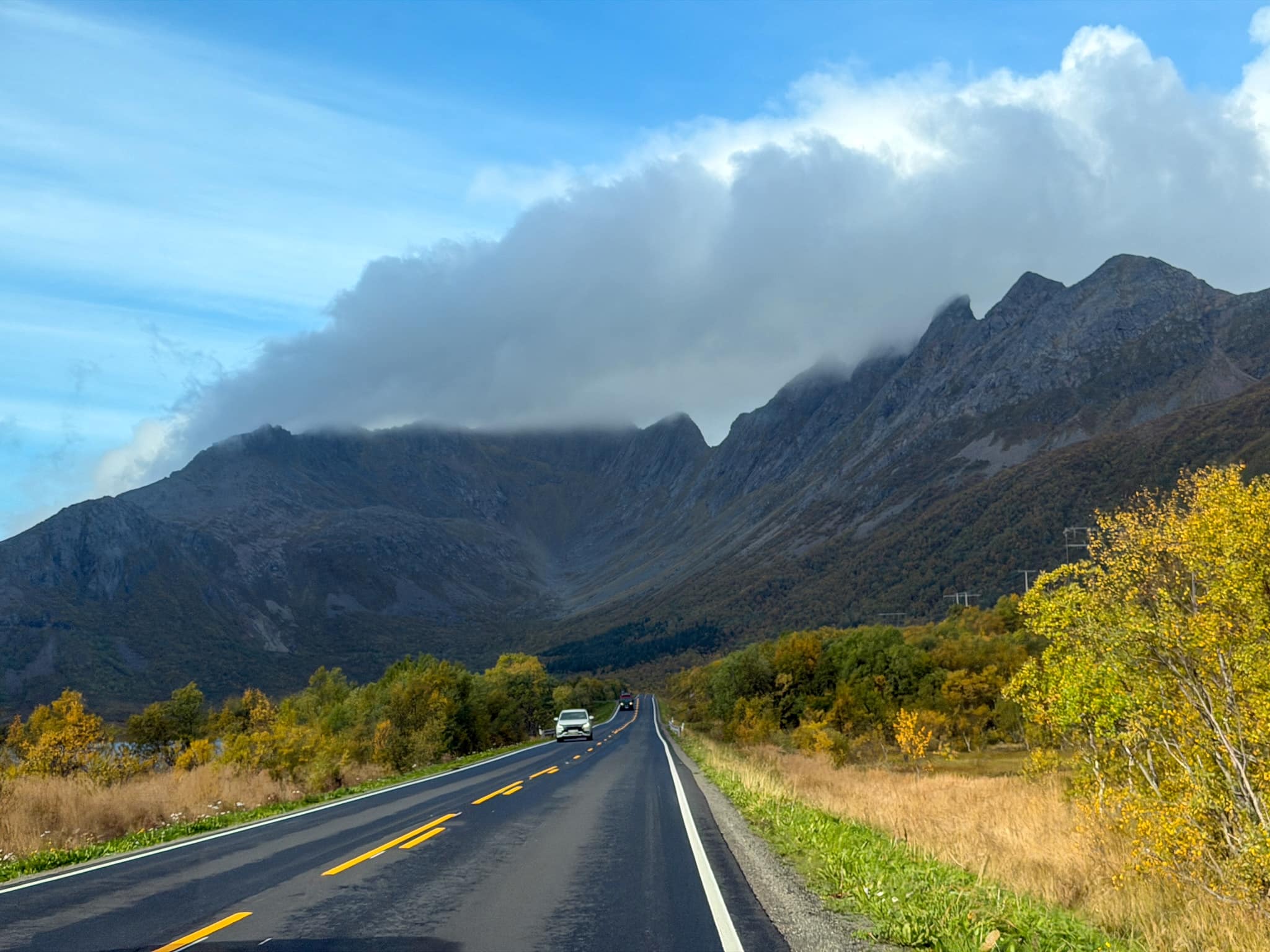
E10 Main Road in Lofoten
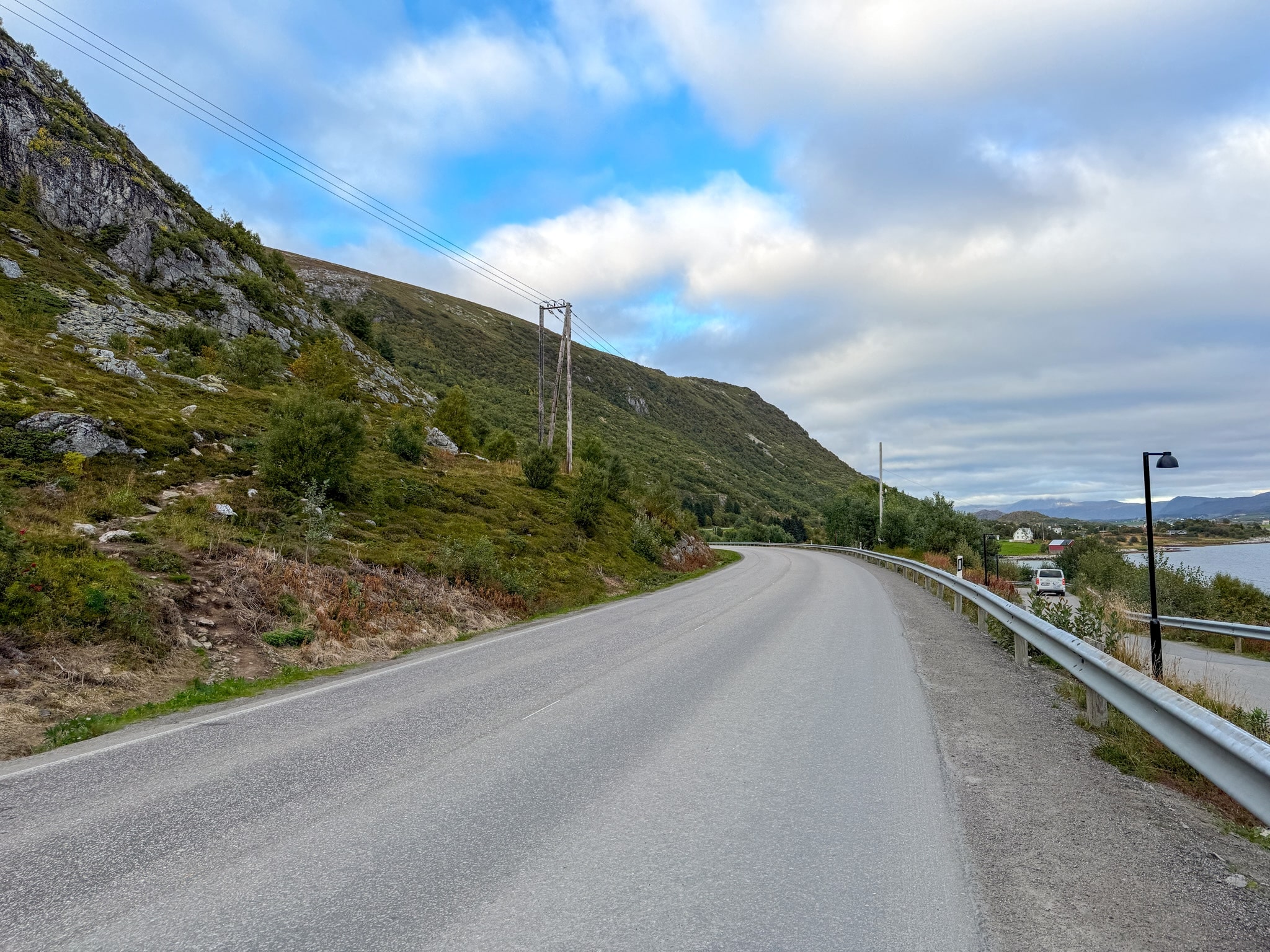
Typical road in Lofoten, in good conditions
Parking in Lofoten: What To Expect
Parking areas in most villages and many trailheads charge by the hour, the free lots usually have a time limit, and parking is checked often, by attendants and by cameras. Here’s how it worked for me.
Paying With EasyPark and QR Codes
EasyPark is the main Lofoten parking app, and I used it almost everywhere. Each lot has a sign with a zone number. You enter it in the app, start parking when you arrive and stop it when you leave, so you pay for the exact time. Remember to stop it as soon as you’re back at the car, or it keeps running.
Not every lot uses EasyPark. Some private lots have their own system, usually a QR code on a sign. At the Festvågtind trailhead near Henningsvær, for example, you pay through Festvåg Camp’s website by scanning the code on the info board.
Free Parking With Time Limits
Some lots are free but limited to a few hours. This is the case, for example, of the main parking lot located in Å. The sign shows a P with a line underneath, like “over 4 timer”, meaning no parking for more than four hours. You need to show your arrival time with a parking disc on the dashboard, a small cardboard or plastic clock you set to when you arrived.
Rental cars don’t always come with a disc.
What I Paid for Parking in a Week
I spent 650 NOK on parking in total. Some examples:
- Reinebringen, Reine: 258 NOK for just under three hours, the most expensive parking of my trip. The lot is next to the orange former school that now houses the visitor center, about 1.4 km (0.9 mi) from the trailhead. It’s the closest official parking.
- Svolvær center: 126 NOK for about four hours, on a day with cruise ships in port.
- Haukland Beach: around 20 NOK an hour.
Parking Rules That Get Tourists Fined
Parking fines are where many rental horror stories start. These are the 2026 amounts, use them only as a general reference:
- No disc or ticket in a free time-limited lot: 330 NOK
- Not paying, or parking outside the lines: 660 NOK
- Parking in a disabled spot without a permit: 990 NOK
- Stopping where it’s not allowed: 900 NOK
A few rules people miss:
- Keep all four wheels inside the white lines. I watched an attendant fine a car with one wheel over the line.
- Never park on the roadside on roads with limits above 50 km/h, even for a minute.
As with speeding, the fine goes to the rental car company, which charges your card later and adds an admin fee.
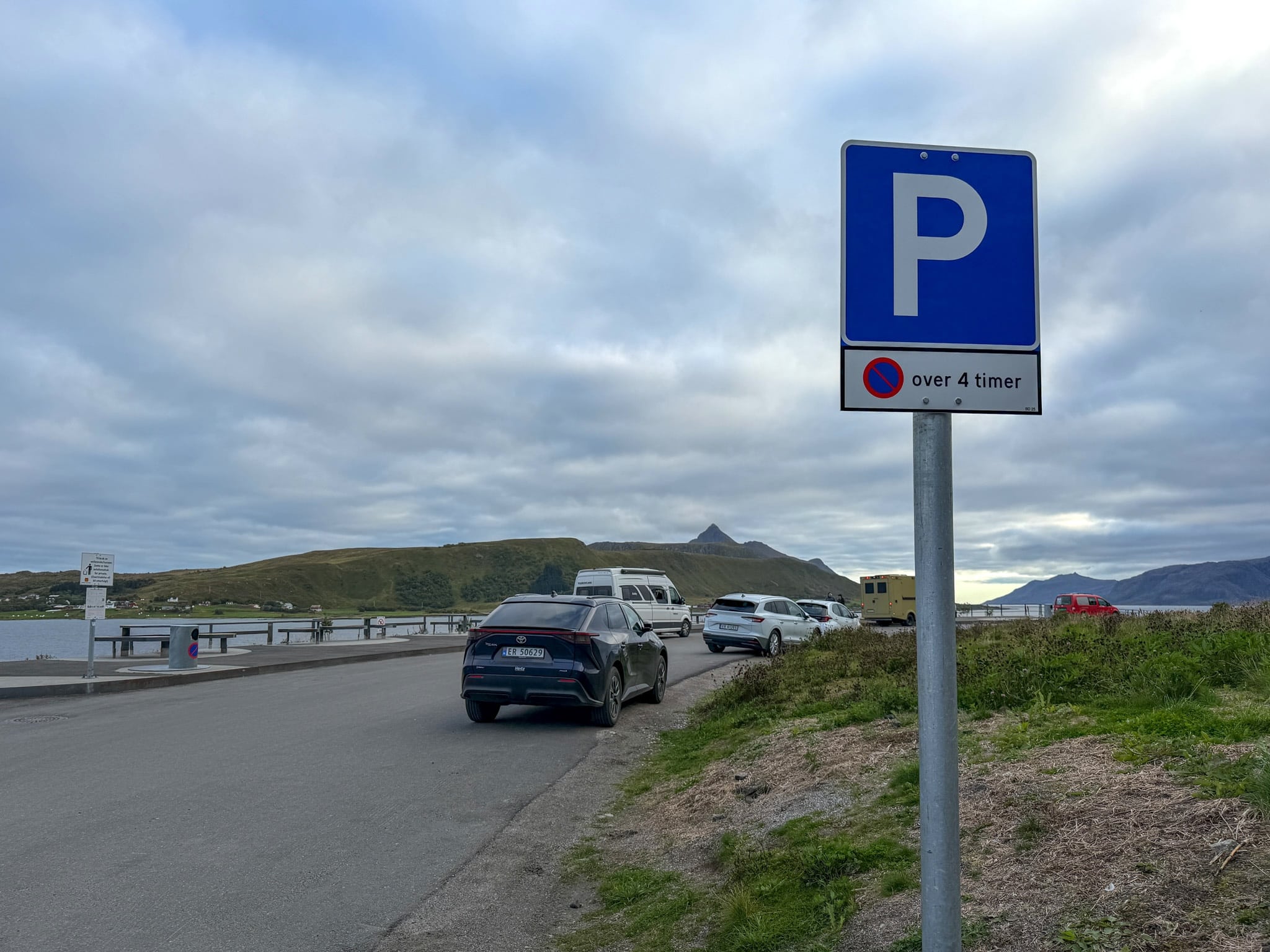
The Offersøykammen lot is free, but only for four hours with a parking disc

The EasyPark sign in Henningsvær shows the zone number you enter in the app
What US Drivers Need to Rent a Car in Norway
Renting a car in Norway with a US license is straightforward, similarly to those with an EU license. A few things work differently from home, mostly around payment.
- Driver’s license. A valid US license is accepted for up to three months from your arrival. An International Driving Permit isn’t required. Enterprise in Bodø, for example, confirms it for US licenses. Some travelers bring one anyway, and it’s cheap at AAA.
- Age. Drivers under 25 usually pay a young driver fee, and some car categories have higher minimum ages. Check the terms before you book.
- Credit card. You need a credit card in the main driver’s name for the deposit. Debit cards are often refused.
- Insurance through your card. Some cards, like the Chase Sapphire cards, include primary rental car cover abroad. It usually applies only if you decline the rental company’s own damage waiver, and the desk will then block a bigger deposit.
- Paying for fuel. Many gas stations in Lofoten are unmanned at night or in small villages, and their pumps need a chip and PIN card. Some US cards don’t have a PIN and get rejected. Fill up at staffed stations during opening hours, or set a PIN with your bank before the trip.