
A practical, experience-based guide to the best places to visit in Egypt, from Cairo and the Nile to the Red Sea and the desert. Ideal for first-time travelers.

Egypt is better approached in layers. The more you read about the country, the more places start competing for your time, all of them excellent, all of them impossible to fit into one trip without losing your mind. So you study it, you visit a part of it, and then you start understanding what you’d come back for. And that’s exactly what this list is meant to do.
These are the best places to visit in Egypt that stood out most while travelling through the country, each for different reasons. Some are monumental, all of them memorable. Together, they give you a clear picture of what Egypt does beautifully, how these places are usually visited, and which ones make the most sense to start with on a first trip.
Cairo

Cairo is where every first trip to Egypt should begin, mainly because it puts several of the country’s most important sites within easy reach. The pyramids are not in the city itself but on the Giza Plateau, about 30–45 minutes from central Cairo, depending on traffic, and they usually take up most of a day when visited properly.
Right next to Giza is the Grand Egyptian Museum, the largest archaeological museum in the world and since 2025, the clearest introduction to ancient Egypt. The galleries finally give space and order to the material, including the full Tutankhamun collection, which for the first time is displayed together. Visiting the museum on the same day as the pyramids makes the experience more intelligible, especially if this is your first exposure to Egyptian history.
A second day should be spent south of Cairo at Saqqara, where the Step Pyramid of Djoser sits inside a vast necropolis dotted with mastaba tombs that still show detailed scenes of daily life. Saqqara explains how pyramid-building started and feels calmer and more spacious than Giza. From there, a short stop at Memphis works well. There isn’t much left of the ancient city, but the open-air museum with the colossal statue of Ramses II takes very little time.
Back in Cairo itself, it’s ideal to choose one additional focus rather than trying to see everything. The old Egyptian Museum is excellent for comparing the old way of displaying artefacts with the new museum. Islamic Cairo is the better choice to get a sense of the city beyond antiquities, with mosques, markets, and street life packed into a relatively walkable area.
For most travelers, two full days cover Cairo well: one for Giza and the Grand Egyptian Museum, and one for Saqqara, Memphis, and a single city highlight.


Luxor

Luxor is the most concentrated dose of ancient Egypt you’ll get anywhere in the country. Temples, tombs, pylons, colossi, everything here is on a scale that makes even frequent travellers slow down. It’s also one of the main boarding points for Nile cruises, so for many travellers, Luxor is either the beginning or the grand finale of a few slow days on the river, depending on which direction they’re sailing.
On land, the city divides neatly between east and west. The East Bank hosts Karnak Temple and Luxor Temple, both easy to reach and surprisingly straightforward to visit. Karnak is vast enough to reward patience, especially if you enjoy figuring out how one pharaoh tried to outdo the previous one. Luxor Temple, smaller and more compact, works particularly well later in the day, when the light softens.
Across the Nile, the West Bank shifts the tone. The Valley of the Kings is the headline stop, with a rotating selection of tombs open to visitors, including some of the most famous names in Egyptian history. Nearby sites like Hatshepsut’s mortuary temple and the Valley of the Queens add context without requiring heroic amounts of walking, which is exactly why cruise itineraries tend to group them efficiently into a single day.
Whether you’re here independently or as part of a cruise, Luxor usually takes two full days to visit properly. It’s one of those places to visit in Egypt where the concentration of monuments genuinely shapes how the rest of the trip feels.


Aswan

Aswan feels noticeably calmer than Luxor, and I was grateful for that by the time I got there. It’s the southern gateway of many Nile cruises, either as the final stop after days of temples or as the starting point before heading north.
The city itself sits directly on the Nile, and the river is very much the main event. Short felucca rides around the islands are one of the simplest pleasures of the trip. The most important site to visit nearby is Philae Temple, relocated onto an island and reached by boat, which somehow makes the whole visit feel more deliberate, even if it’s firmly on the cruise circuit.
Aswan is also where you’ll find the Aswan High Dam, often included in cruise itineraries as a brief stop. It’s not visually thrilling, but it does help explain how modern Egypt manages the Nile, and why the river you’ve been admiring so calmly is actually under constant control.
You need one full day here, and staying longer makes sense if you’re interested in Nubian culture, local villages, or simply want a slower rhythm before moving on.


Abu Simbel

Abu Simbel is almost always visited from Aswan, and there are two realistic ways to do it. The easiest is a short domestic flight that takes about forty minutes each way. The other option is going by road, which means roughly three and a half hours per direction, usually as a very early morning excursion. Both are common, both work, and which one makes sense mostly depends on time, budget and tolerance for long days. Once you’re there, the logistics fade quickly.
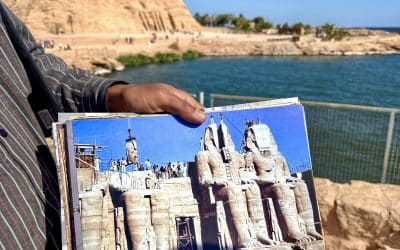
The two rock temples, commissioned by Ramses II, are carved directly into a cliff overlooking Lake Nasser and designed to impress from the first second, which they do. The scale is immediate and slightly absurd, in a way that makes you stop taking photos just to stare for a moment. Inside, the reliefs are crisp, orderly, and remarkably intact, especially considering the temples were entirely relocated in the 1960s to save them from flooding after the construction of the Aswan High Dam.
Most visitors see Abu Simbel on a tightly timed excursion, and I found that to be fine. You need no more than 2 hours on site, but it’s still completely worth it. It’s visually distinct from everything else in Egypt, more theatrical than Luxor and more isolated than anything around Cairo.


Sharm el-Sheikh

Sharm el-Sheikh is where a lot of first trips to Egypt slow down, often right when people realize they’ve been waking up early for temples for several days in a row. Logistically, it’s one of the easiest stops in the country, with frequent flights from Cairo and plenty of direct international connections.
The main reason to come is the water. The coral reefs are right there, often reached from a jetty attached to your hotel, which makes this one of the best places to visit in Egypt if what you’re after is sea life without complicated logistics. If you dive, the area around Ras Mohammed National Park is the obvious highlight, with visibility and marine life that still justify the reputation.
Sharm is clearly built for tourism, and it doesn’t pretend otherwise. You’re not here to explore neighborhoods or stumble into surprises. You’re here to swim, rest, and briefly forget what day it is.


Marsa Alam

Marsa Alam does the Red Sea without the infrastructure-heavy feel. It’s quieter, more spread out, and noticeably less interested in entertaining you beyond what’s happening underwater. Most people reach it by flying in from Cairo or directly from Europe, then staying put, because moving around here isn’t really the point.
The reefs are the reason you come. Snorkeling and diving are excellent, straight off the beach or after very short boat rides. Spots like Dolphin House are well known, but even low-key house reefs can be enough to fill several days without repetition. That simplicity is the appeal, and for many travellers the most memorable thing to do here involves nothing more elaborate than getting back into the water twice a day.
There’s no real town to explore, no nightlife to speak of, and very little pressure to do anything. For a first trip to Egypt, it’s a good alternative to Sharm if you want the Red Sea without the feeling of being scheduled, and it pairs especially well after a stretch of temples, early mornings, and long drives.


Mount Sinai

Mount Sinai sits in the southern part of the Sinai Peninsula and is best reached via Sharm el-Sheikh. Logistically, it’s straightforward enough to include if you’re already on the Red Sea.
The experience is built around a night hike that ends at sunrise. You start in the dark, walk steadily for a few hours, and reach the summit just as the light comes up over the mountains. It’s not technically difficult, but it does require patience and warm layers, even outside winter, because the temperature drop is real. People go for religious reasons, historical curiosity, or simply because it’s one of the more visually stunning sites to see in Egypt.
At the base of the mountain sits St. Catherine’s Monastery, one of the oldest continuously functioning monasteries in the world. Visiting it after the hike adds context and grounds the experience.
Mount Sinai is a one-night, one-morning experience that fits neatly into a broader Red Sea stay. In the context of a first trip, it works as a reminder that some of the most memorable places to visit in Egypt are about landscape and timing rather than scale, and that occasionally setting an alarm for an unreasonable hour pays off.


Siwa Oasis

Siwa Oasis is one of the most remote tourist areas in Egypt. It sits deep in the Western Desert, close to the Libyan border, and is almost always reached from Cairo. There are no reliable commercial flights, so most travelers either go by road with a private driver, which takes around eight to nine hours, or, if time matters more than money, by private charter flight into Siwa’s small airport.
Once there, the pace drops immediately. Siwa is compact, walkable, and far more about landscape and atmosphere than ticking off sites. The old mud-brick Shali Fortress gives a sense of how the oasis once functioned as a self-contained town, while places like Cleopatra’s Spring are casual stops rather than formal attractions. The real highlights tend to be outside the town itself: salt lakes with unreal colors, palm groves, and desert stretches reached by 4×4.
You’ll need two or three nights, which is enough to explore the oasis, do a short desert excursion, and reset before heading back to Cairo or on to the Red Sea.
Siwa works best as a deliberate detour for travellers with more time on their hand who want to see a quieter, more self-contained side of Egypt, and who don’t mind that getting there is part of the commitment.


White Desert

The White Desert is one of the most unusual sites to see in Egypt, and also one of the least intuitive to plan if you’re visiting the country for the first time. Located in the Western Desert near Farafra, it’s usually reached from Cairo as part of a guided desert excursion, often combined with the Black Desert and nearby oases.
What makes it special are the chalk formations scattered across the landscape, shaped by wind into forms that look deliberately sculpted rather than accidental. Most visits include an overnight stay, usually camping in the desert, which turns this into one of the more memorable things to do in Egypt for most visitors.
Tours handle transport, permits, and equipment, which is why even experienced travellers rarely attempt it independently. If your first trip to Egypt includes Cairo and you’re curious about the desert beyond postcards, this is the most accessible way to experience it without overplanning.
In terms of variety, the White Desert adds contrast to an itinerary dominated by historical sites. It’s quiet, visually striking, and uncomplicated in the best possible way, which is exactly why it earns its place among the best places to visit in Egypt.


Alexandria

Alexandria is often overlooked on a first trip, which is ironic considering how easy it is to reach from Cairo and how different it feels from the rest of the country. Sitting on the Mediterranean, I found it to have a cooler climate, a slower pace, and a layered history that leans more Greco-Roman than pharaonic.
Here it’s best to focus on a small cluster of sites rather than a long checklist. The modern Bibliotheca Alexandrina is usually the anchor, partly for what it represents and partly because it’s one of the few contemporary cultural projects in Egypt that feels genuinely lived in. Nearby, the Catacombs of Kom el Shoqafa add a surprising underground detour, blending Egyptian and Roman elements in a way that doesn’t exist elsewhere in the country.
Alexandria works best as a short addition rather than a major stop. One full day, or even a long day trip from Cairo, is usually enough to get a sense of the city, walk along the Corniche, and understand why it occupies such a specific place in Egypt’s cultural imagination.

How to approach Egypt on a first trip
Planning a first trip around these places to visit in Egypt usually starts with an unrealistic amount of enthusiasm and a browser full of tabs. Then reality kicks in, and suddenly the question isn’t what to see, but what actually fits together in the time you have.
If you have a long weekend or 4–5 days, Cairo is the obvious focus. That usually means the pyramids at Giza, the Grand Egyptian Museum, and one additional day split between Saqqara, Memphis, or a slice of the city itself. You could potentially squeeze in a 2-day tour of the White Desert. It’s intense but manageable, and it gives you a solid first understanding of Egypt.
With 7–8 days, you can combine Cairo with either Luxor or Aswan or ideally both, linked by a Nile cruise segment. This is where some of the most important sites to see in Egypt start to feel contextual rather than overwhelming, and where the country begins to open up beyond the capital.
At 10–12 days, the classic structure comes together. Cairo, the Nile between Luxor and Aswan, and a few days on the Red Sea form a balanced first trip, mixing history with downtime.
If you’re looking at two weeks or more, that’s when detours start to make sense. Places like Siwa Oasis, the White Desert, or Alexandria usually appear at this stage on top of the main itinerary, added deliberately.
Keep reading:

A 10-Day Egypt Itinerary: Cairo, Luxor, Nile Cruise & Red Sea
A complete 10-day Egypt itinerary covering Cairo, the pyramids, a Nile cruise and the Red Sea, with realistic travel planning, costs and booking advice.[dssb_sharing_buttons icon_placement="icon" icon_width="fixed" alignment="left" icon_color="#000000"...

Visiting Egypt On Your Own: The Limits of Independent Travel
A practical look at Egypt independent travel, from checkpoints and permits to trains, pricing gaps, safety, and which experiences still require agencies. [dssb_sharing_buttons icon_placement="icon" icon_width="fixed" alignment="left" icon_color="#000000"...
The Ancient Egyptian Temples That Had to Be Moved
Several ancient Egyptian temples were physically moved to survive modern dams. Here’s what was saved, what was lost, and how to read these famous sites today. [dssb_sharing_buttons icon_placement="icon" icon_width="fixed" alignment="left" icon_color="#000000"...