Georgia’s Katskhi Pillar: a 131-foot rock column with a church on top, where monks lived for centuries. Find out how to visit, the climbing rules, the church and museum at the base, and the monks’ real story from the archives.
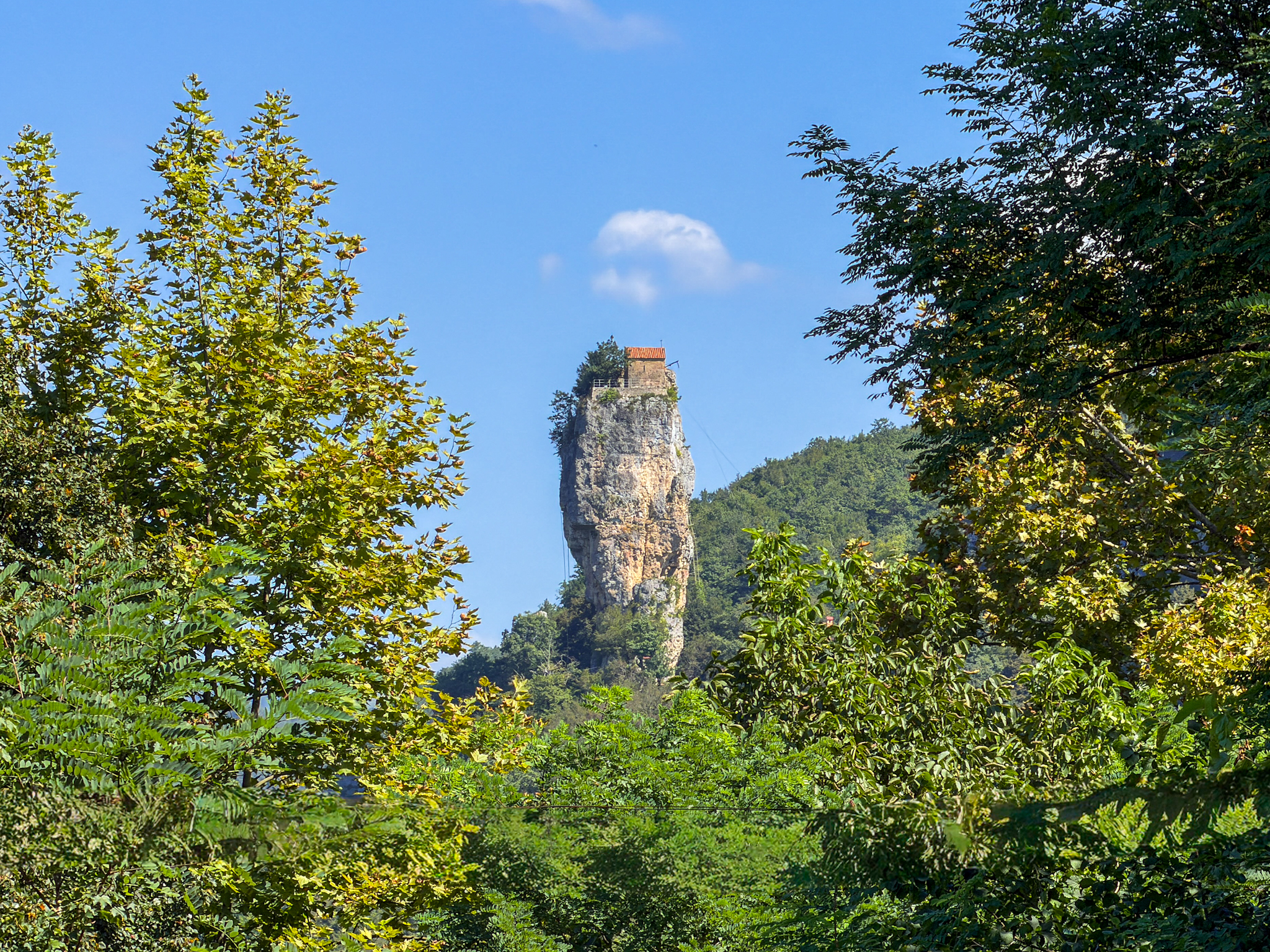
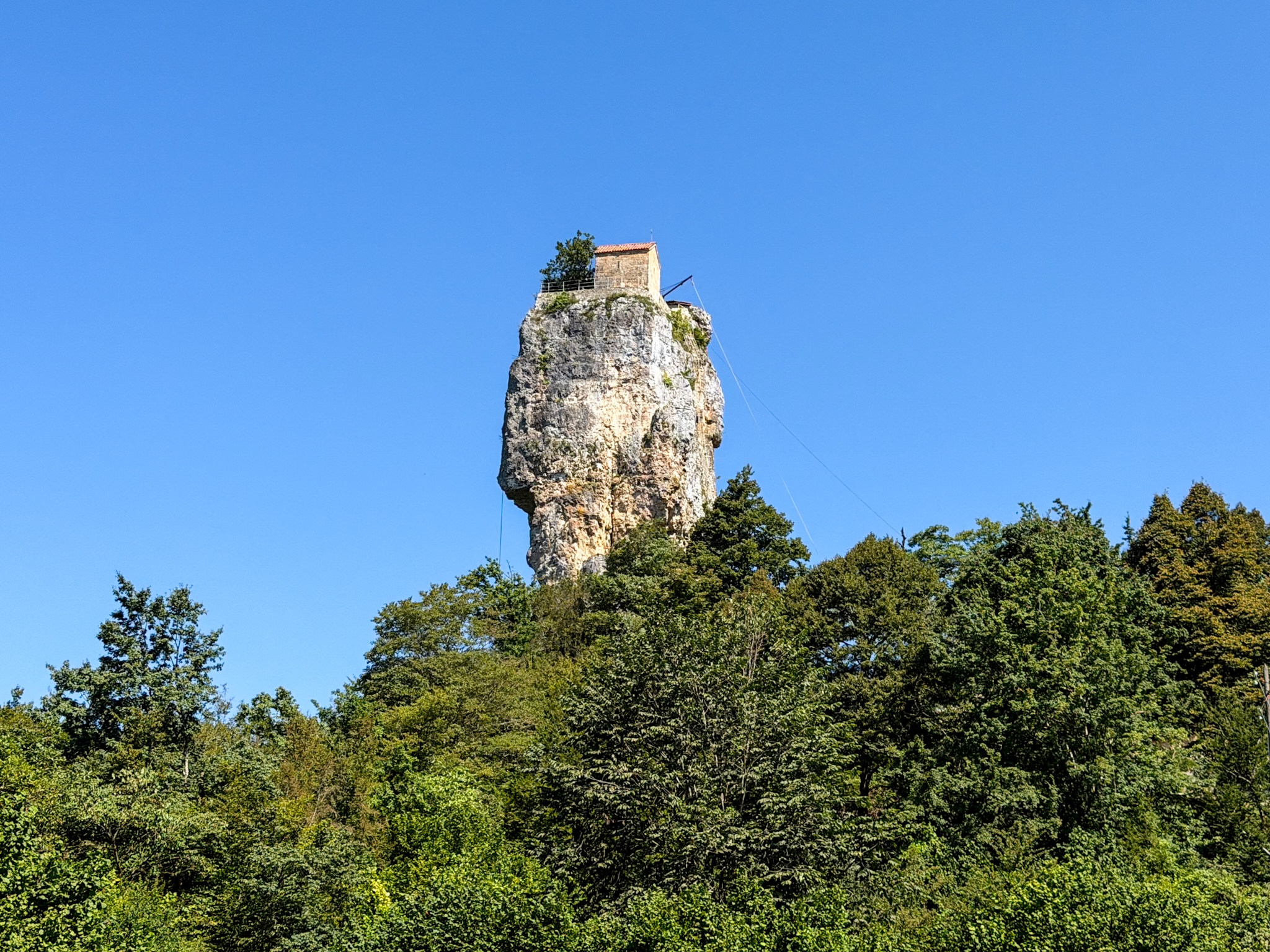
I stopped at the Katskhi Pillar on a long drive across Georgia, approaching Kutaisi. I’d seen one photo of it before the trip and honestly wasn’t sure it was real. A narrow column of limestone, about 131 feet (40 m) tall, rising out of a forest with a small stone church sitting right on the edge of the top.
I had the same questions most people have. Does anyone still live up there? How do you even get up there? Is it worth going out of your way for? To spoil the surprise: nobody lives on top full time anymore, though some monks still go up. No one else is allowed to climb. As for the detour, if you’re anywhere near Kutaisi or driving between Tbilisi and Kutaisi, I’d say yes, 100%.
Below you’ll find a guide on how to get there, what you can actually see at the base, and the intriguing history behind this place. I spent more time on that last part than I planned, because between the museum panels and some digging in Georgian archives, a few things you’ll read online turned out to be wrong.
Katskhi Pillar: Visiting Tips Before You Go
-
- Where it is: Katskhi Pillar stands just outside the village of Katskhi, in Imereti, a region of western Georgia. The closest town is Chiatura, an old mining town a short drive away. It’s about 40 miles (65 km) from Kutaisi, roughly 1 hour and 15 minutes by car. From Tbilisi it’s about 125 miles (200 km), around 3 hours.
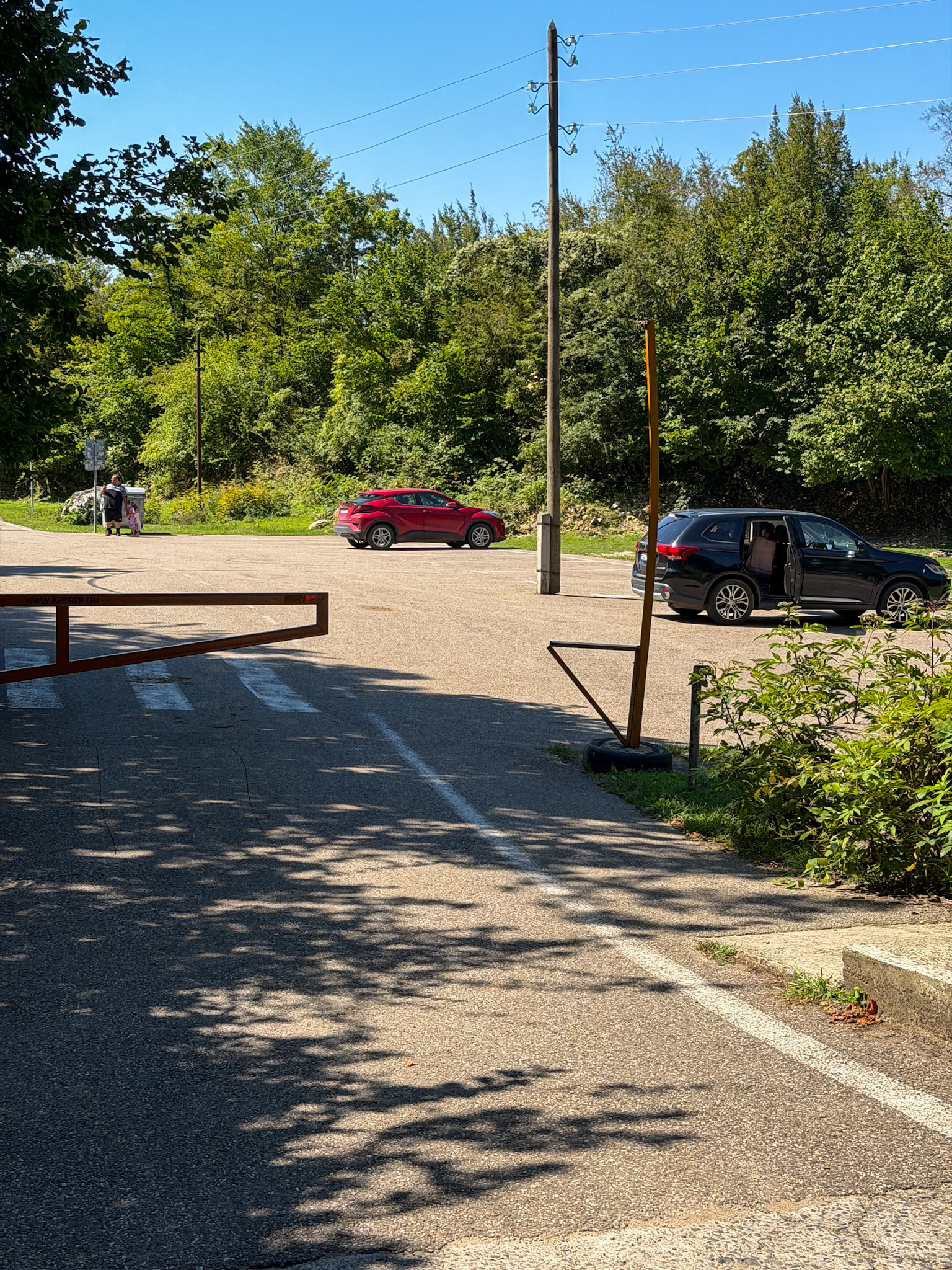
- Getting there: A car is by far the easiest option. There’s a free parking lot with about a dozen spaces at the end of a mostly paved road, and from there it’s a 5-minute walk uphill to the pillar.
- Day tours from Kutaisi: If you’d rather not drive, these tours stop at the pillar:
-
- Chiatura, Katskhi Pillar & Mgvimevi Monastery: the pillar, Mgvimevi (a monastery built into a cliff near Chiatura) and the Chiatura cable cars.
- Katskhi Pillar, Gelati & Motsameta: the pillar, Chiatura and Mgvimevi, then two medieval monasteries just outside Kutaisi.
- Katskhi Pillar, Tskaltubo & Kutaisi Cathedrals: the pillar, Chiatura, plus the abandoned Soviet sanatoriums of Tskaltubo and three churches in Kutaisi.
-
- Entrance fee: There’s none. The church and the small museum at the base are both free.
- Opening hours: The sign on the gate says 9:00 to 20:00.
- Time needed for the visit: About an hour is enough to see the base, the church and the museum.
- Climbing the pillar: Visitors can’t go up. Only the monks use the ladder.
- What to wear: This is an active monastery, so cover your shoulders and knees. Women also need a headscarf and a skirt to enter the church. You can borrow both from a basket inside the museum, right next door.
- Food and restrooms: There’s a small kiosk along the road to the parking lot, a bit hidden. On Google Maps it’s listed as “Cafe - Ice Cream”. I didn’t see any public toilets on site.
- What else to do in the area: if you’re staying in Kutaisi, I put together the 10 best things to do in Kutaisi and its surroundings, with the other easy day trips from the city.
-
-
Where to stay:
-
Kutaisi is the best base, with plenty of hotels and restaurants and lots of other day trips nearby. I stayed at the Newport Hotel Kutaisi ⭐⭐⭐⭐ and then at the Hotel Memoire Kutaisi ⭐⭐⭐, both right in the center.
-
If you want to sleep closer to the pillar, Hotel Chiatureli ⭐⭐⭐⭐ in Chiatura has a pool and makes its own wine.
-
-
What Is the Katskhi Pillar?
The Katskhi Pillar is a natural tower of limestone, about 131 feet (40 m) high, standing alone in a wooded valley. In Georgian it’s called Katskhis Sveti, which simply means “the pillar of Katskhi”, after the village next to it. Locals also call it the Pillar of Life.
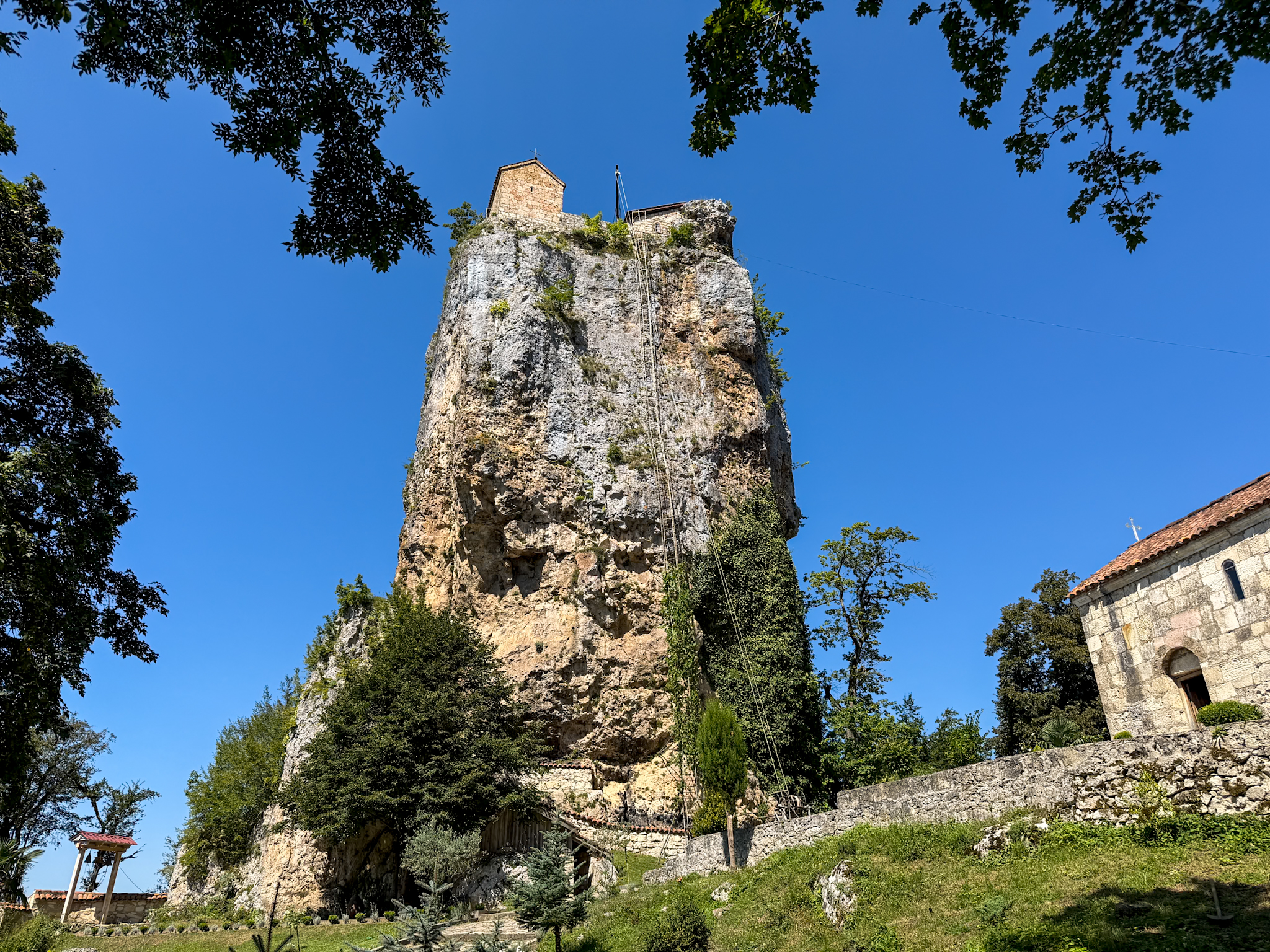
Nobody built it. According to the Georgian Encyclopedia, it’s what’s left of a much bigger mass of rock, worn down over time by earth movements and erosion until only this column survived. The top is a flat rectangle of about 56 by 33 feet (17 by 10 m). The base is narrower than the top, so the walls actually lean outward a little. That’s why, for centuries, nobody could get up there without climbing gear.
On top there’s a small stone church dedicated to Saint Maximus the Confessor, a Byzantine monk who died in Georgia in the 7th century, along with the remains of a few cells where monks lived. At the bottom there’s a working men’s monastery, with a second church, a bell tower and a free museum.
One thing that confuses a lot of people: the Katskhi Pillar and Katskhi Monastery are two different places. The monastery is a domed church in the village, about a mile (1.5 km) away.
How to Get to the Katskhi Pillar
The easiest way to reach Katskhi Pillar is by car, and most people come from Kutaisi, the closest big city. Below are the options from Kutaisi or Tbilisi, always in the same order: car, marshrutka, and day tour.
From Kutaisi
🚗 By car
Best for: anyone who wants to stop where they like and combine the pillar with other sights on the same day.
- Time: about 1 hour and 15 minutes for 40 miles (65 km).
- Cost: just fuel. Parking at the pillar is free.
- How to get there: search “Katskhi Pillar” on Google Maps, which takes you all the way to the parking lot. The last stretch is a narrow but mostly paved side road off the Zestafoni to Chiatura highway.
🚐 By marshrutka
Best for: budget travelers who don’t mind a slower day. A marshrutka is a shared minivan, the main form of public transport between Georgian towns.
- Time: around 1 hour and 30 minutes to the pillar, with a short stop in Zestafoni.
- Cost: about 10 to 15 GEL one way
- How to book: vans to Chiatura leave Kutaisi’s Central Bus Station roughly every hour, from early morning to mid-afternoon. Tell the driver you want to get off at Katskhis Sveti, the pillar’s Georgian name. To get back, wave down a Kutaisi-bound van on the same road. The last ones pass in the afternoon, so don’t leave it too late. You’ll also have a walk from the main road up to the pillar, so bring water.
🧭 On a day tour
Best for: first-timers who’d like a guide and a few more stops in the same day.
- Time: 8 to 10 hours, with about an hour at the pillar.
- Cost: a per-person price that depends on the tour and group size. All three have free cancellation up to 24 hours before.
- How to book:
- Chiatura, Katskhi Pillar & Mgvimevi Monastery: the classic group tour, with the most reviews, hotel pickup and the Chiatura cable cars.
- Katskhi Pillar, Gelati & Motsameta: a small group of up to four, with two medieval monasteries near Kutaisi in the afternoon.
- Katskhi Pillar, Tskaltubo & Kutaisi Cathedrals: a private tour that also covers the abandoned Soviet sanatoriums of Tskaltubo. It’s the closest to the day I did on my own.
From Tbilisi
🚗 By car
Best for: anyone driving across Georgia toward Kutaisi.
- Time: about 3 hours for 125 miles (200 km). It’s a long detour as a day trip, but it fits naturally as a stop on the road west.
- Cost: just fuel.
- How to get there: follow the main highway west toward Kutaisi, then turn off at Zestafoni toward Chiatura.
🚐 By marshrutka
Best for: budget travelers with time to spare.
- Time: 2 hours and 30 minutes to 3 hours and 30 minutes to Chiatura, plus the taxi to the pillar.
- Cost: about 15 GEL (around $6) to Chiatura, based on 2024 prices, plus the taxi.
- How to book: vans to Chiatura leave Tbilisi’s Didube bus station about every hour during the day. From Chiatura, take a taxi to the pillar.
🧭 On a day tour
Best for: travelers based in Tbilisi who want someone else to handle the long drive.
- Time: about 10 hours.
- Cost: a per-person price, with lunch and a cable car ride included.
- How to book: Chiatura: Journey Through Time, a private tour by Friendly.ge with hotel pickup in Tbilisi, the pillar, the Mgvimevi monastery and the Chiatura cable cars.
Parking and the Walk Up
The side road to the pillar ends at a small parking lot in the woods. Just before you get there, a little hidden on the side of the road, there’s a kiosk selling drinks and ice cream, and across from it a rock wall set up for climbing.
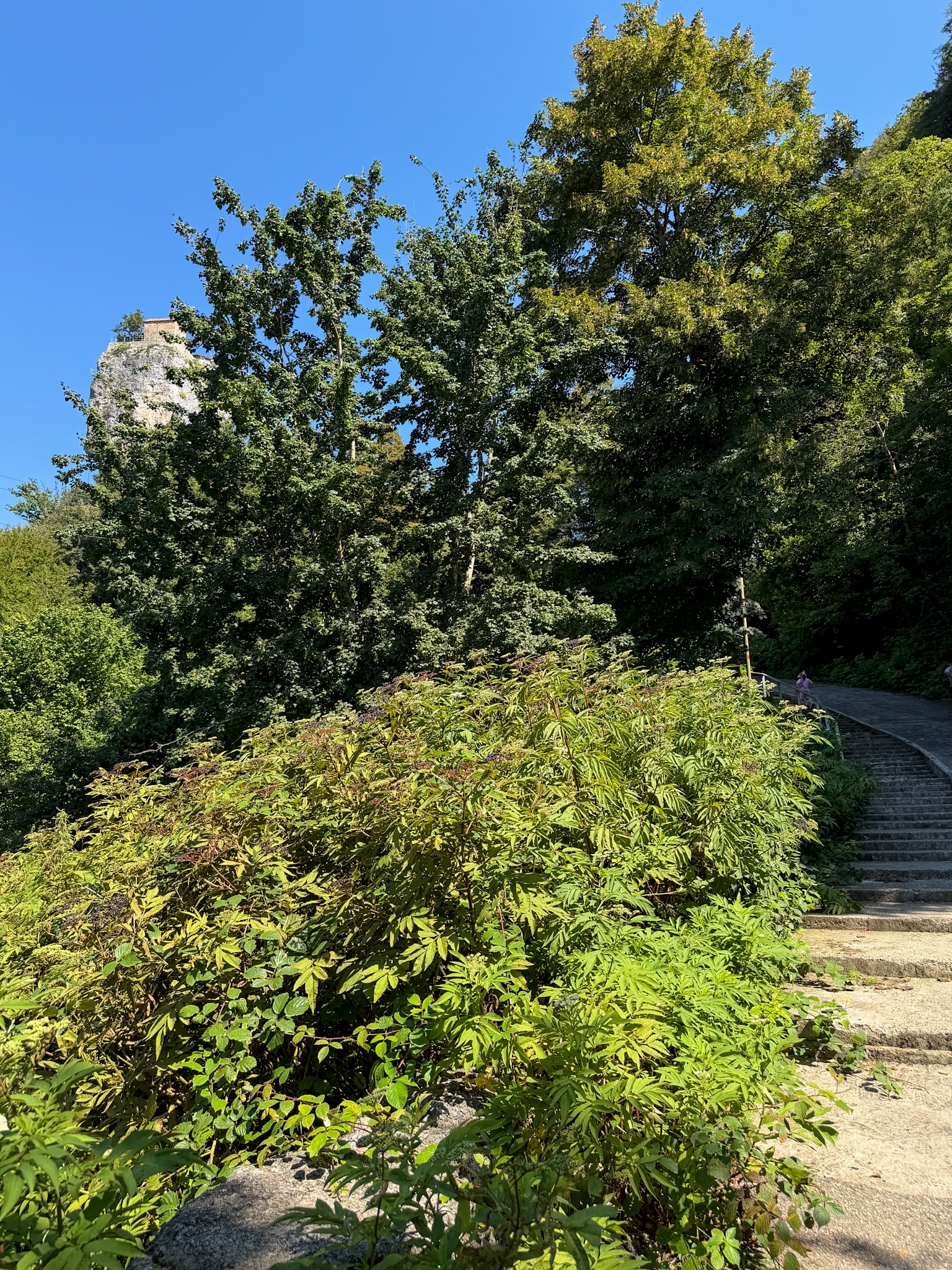
From the parking lot, a concrete lane and a staircase with a handrail run side by side up the hill. It’s steep for about 5 minutes. At the top of the slope you reach the wooden gate of the monastery. A sign in Georgian, Russian and English names it as the men’s monastery of Saint Simeon the Stylite, and from there a stone path leads into the garden.
Katskhi Pillar parking area
The walk up to Katskhi Pillar from the parking area
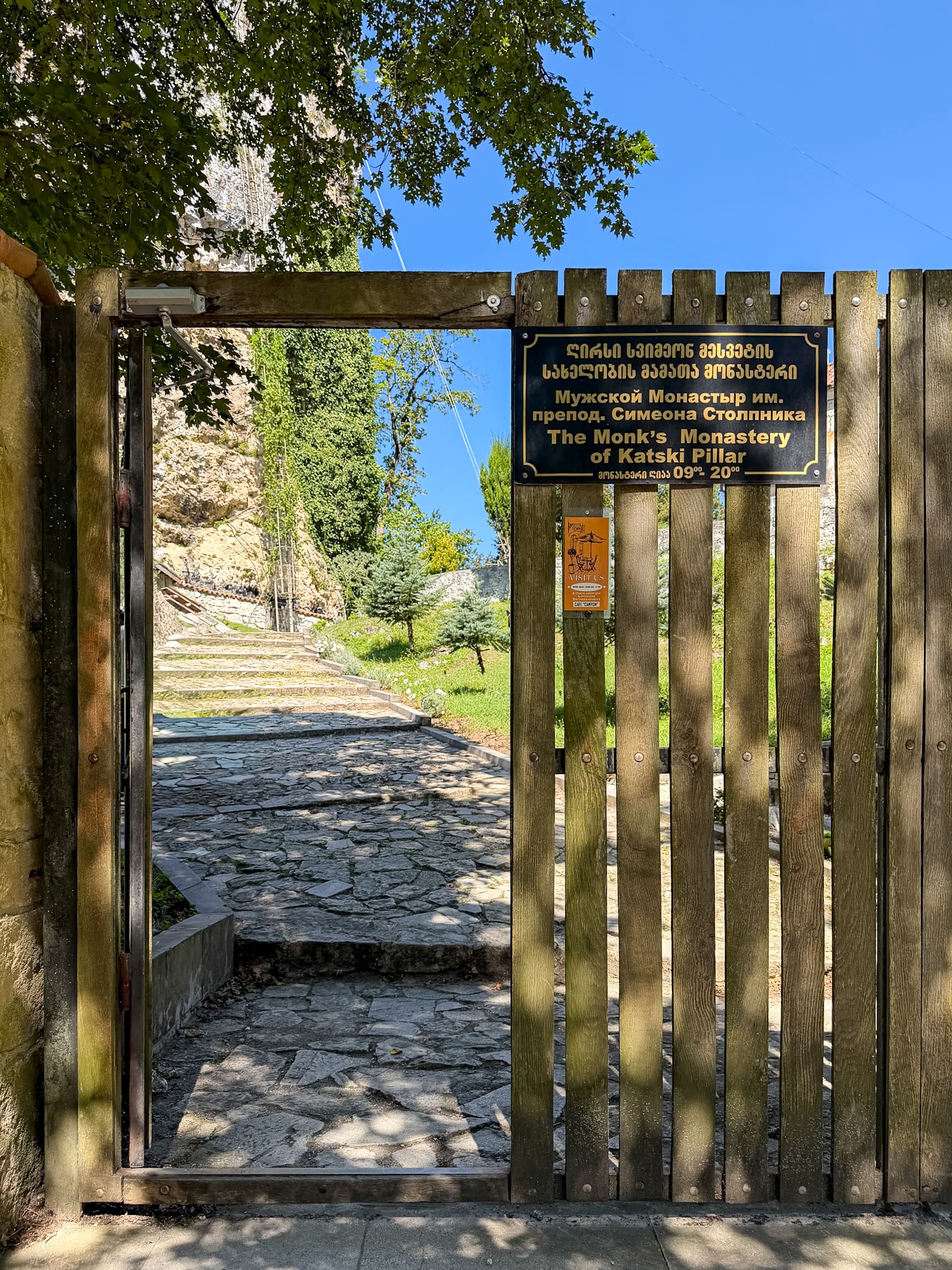
The gate to the monastery grounds
What You Can See at the Base of Katskhi Pillar
The Ladder to the Top
This was the part I couldn’t stop looking at. The ladder starts right at the foot of the rock, behind a low stone wall with red tiles on top, and climbs straight up the side of the pillar. The lowest stretch is wrapped in a cage of wire mesh, and higher up it’s just thin iron rungs against bare rock.
Stand back on the lawn and you can follow the whole thing up to the church. To the right of the ladder there’s a cable running from the summit down to the ground, used to haul supplies.
The Candle Niche and the 6th-Century Cross
At the foot of the pillar there’s a small recess in the rock where people come to light candles. The stone around it is black from years of smoke. Inside there’s a golden candle stand covered in wax and an iron cross planted in a block of stone. It’s the spot where visitors pray at the base, since they can’t go to the church on top.
The oldest Christian sign on the whole site is carved on this lower part of the rock, on its east side at ground level. It’s an equal-armed cross inside a circle, standing on a stepped base, and the archaeologist who excavated the summit dates it to the 6th century.
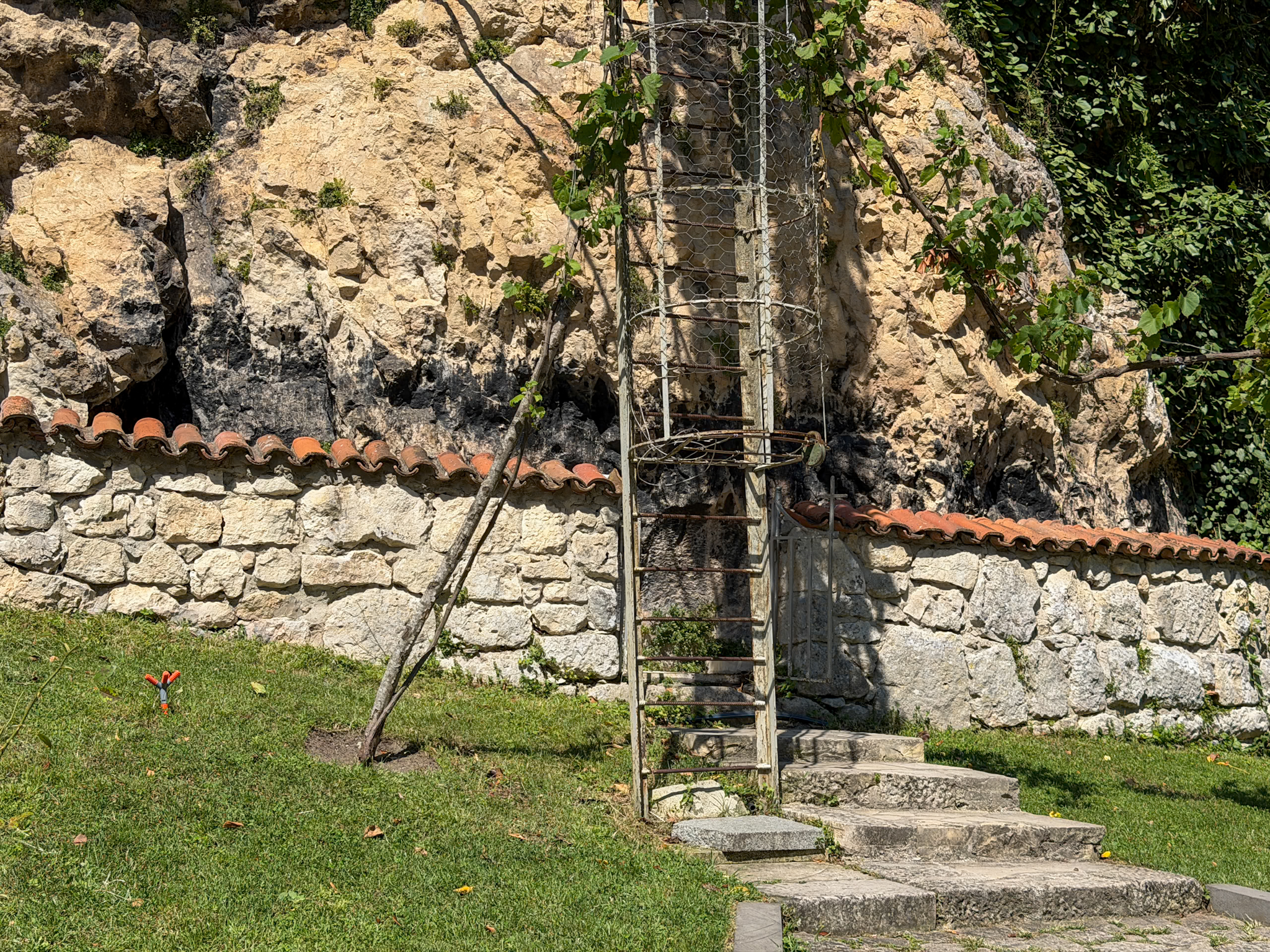
The bottom of the monks’ ladder, with its wire-mesh cage
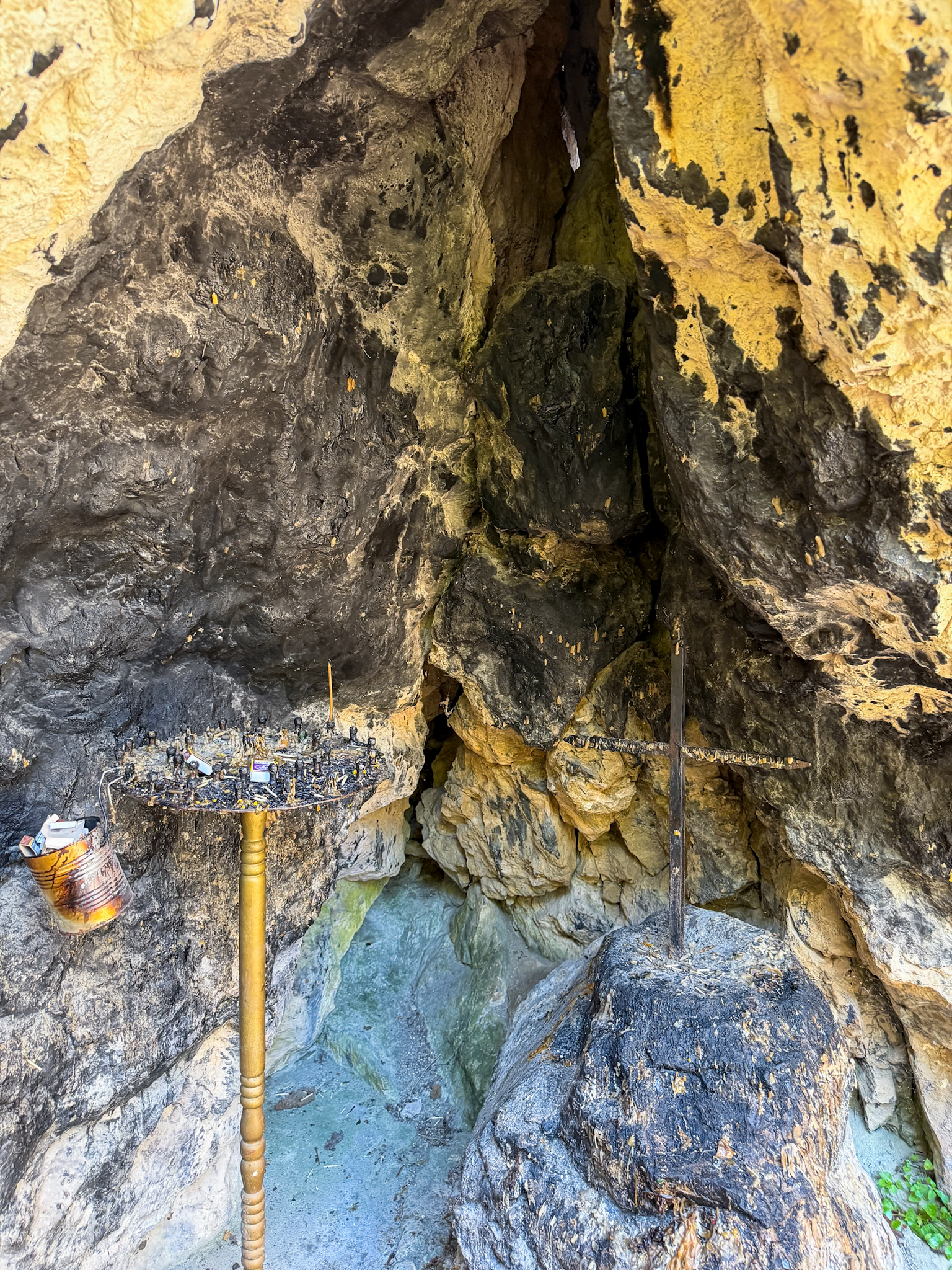
The candle niche at the foot of the pillar
Church of Saint Simeon the Stylite
The little stone church at the base is dedicated to Saint Simeon the Stylite. He was a monk in 5th-century Syria who spent decades living on top of a stone column near Aleppo, and he started a whole tradition of “pillar saints”. The church sits next to the monks’ wooden and stone house, with a lawn, a palm tree and a stone cross on a boulder in front. Father Maxime, the monk who brought religious life back to the pillar in the 1990s, had it restored in 1999.
Inside it’s tiny and covered in bright frescoes. Above the altar, Christ sits on a throne between the Virgin Mary and John the Baptist. On the wall to the left there’s a bearded monk painted standing inside a column, which is about as on-topic as a fresco can get here.
The usual Georgian church rules apply: shoulders and knees covered, and women also need a headscarf and a skirt. You can take photos inside.
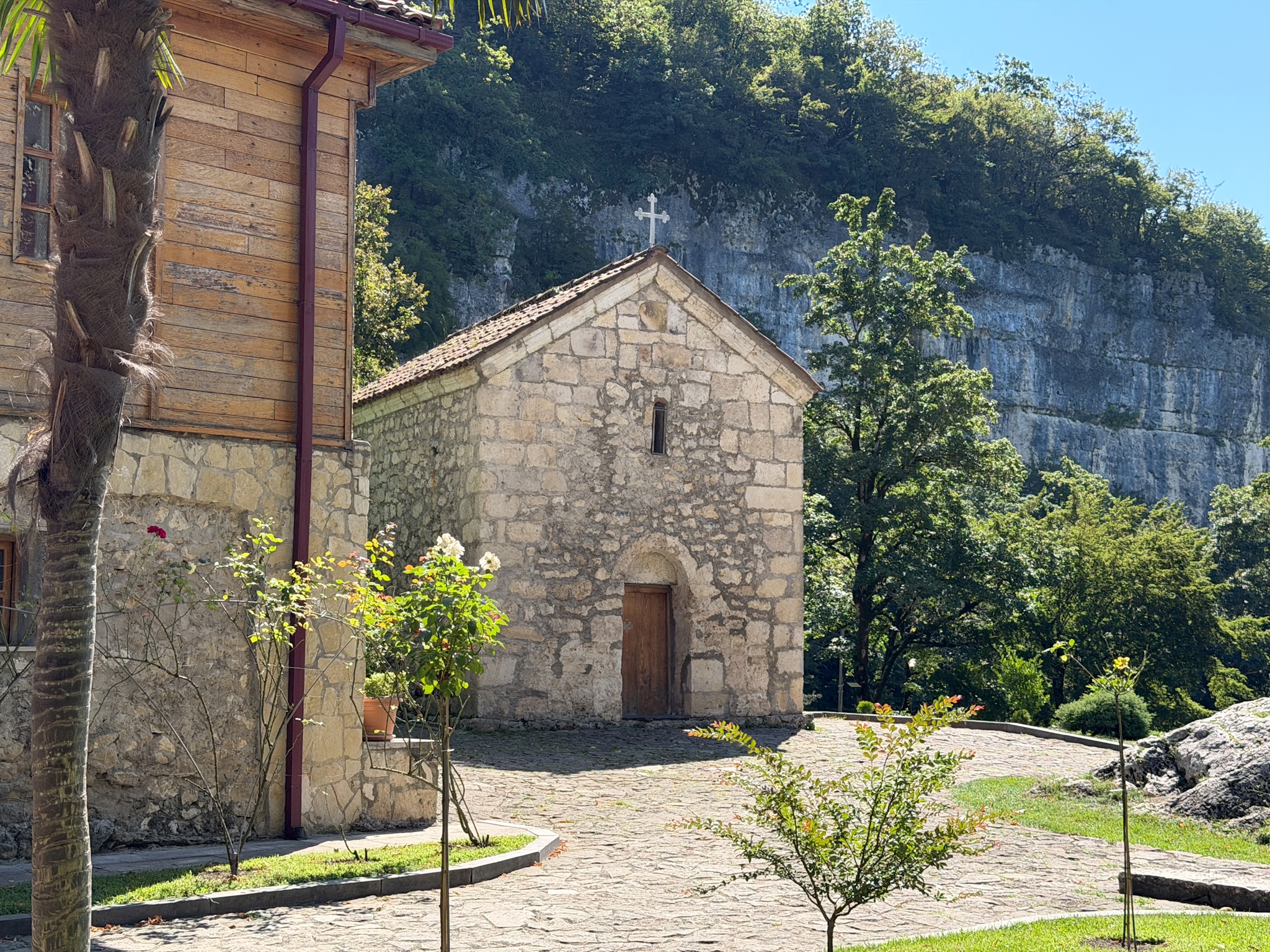
Church of Saint Simeon the Stylite at Katskhi Pillar
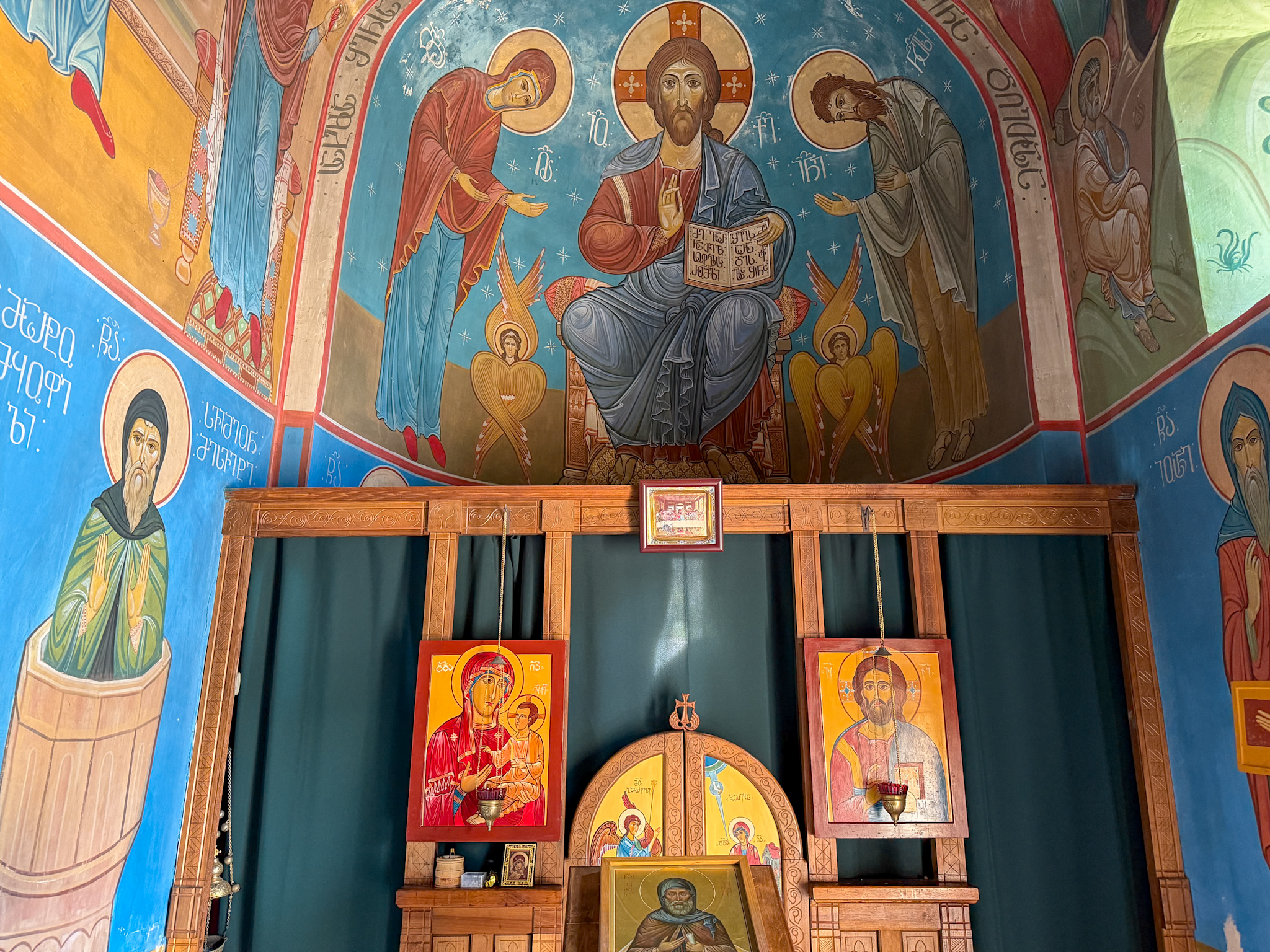
Inside The Church of Saint Simeon the Stylite
The Museum
Across from the pillar, in a stone house with arched windows, there’s a one-room museum with a small corner selling souvenirs. Entry is free, and it’s where you’ll find the basket of scarves and skirts to borrow for the church.
Most of what’s on display was found on top of the pillar. There are pieces of clay qvevri (the big jars Georgians bury in the ground to make and store wine), a stone mortar for grinding, tools used for climbing and working, an old wooden chest and stones carved with Georgian writing. The walls are covered in photos from the last few decades, from the ruins on the summit before restoration to the camp of the 1944 expedition. There’s also a long English panel on the history of the pillar, which is worth reading before you go back outside.
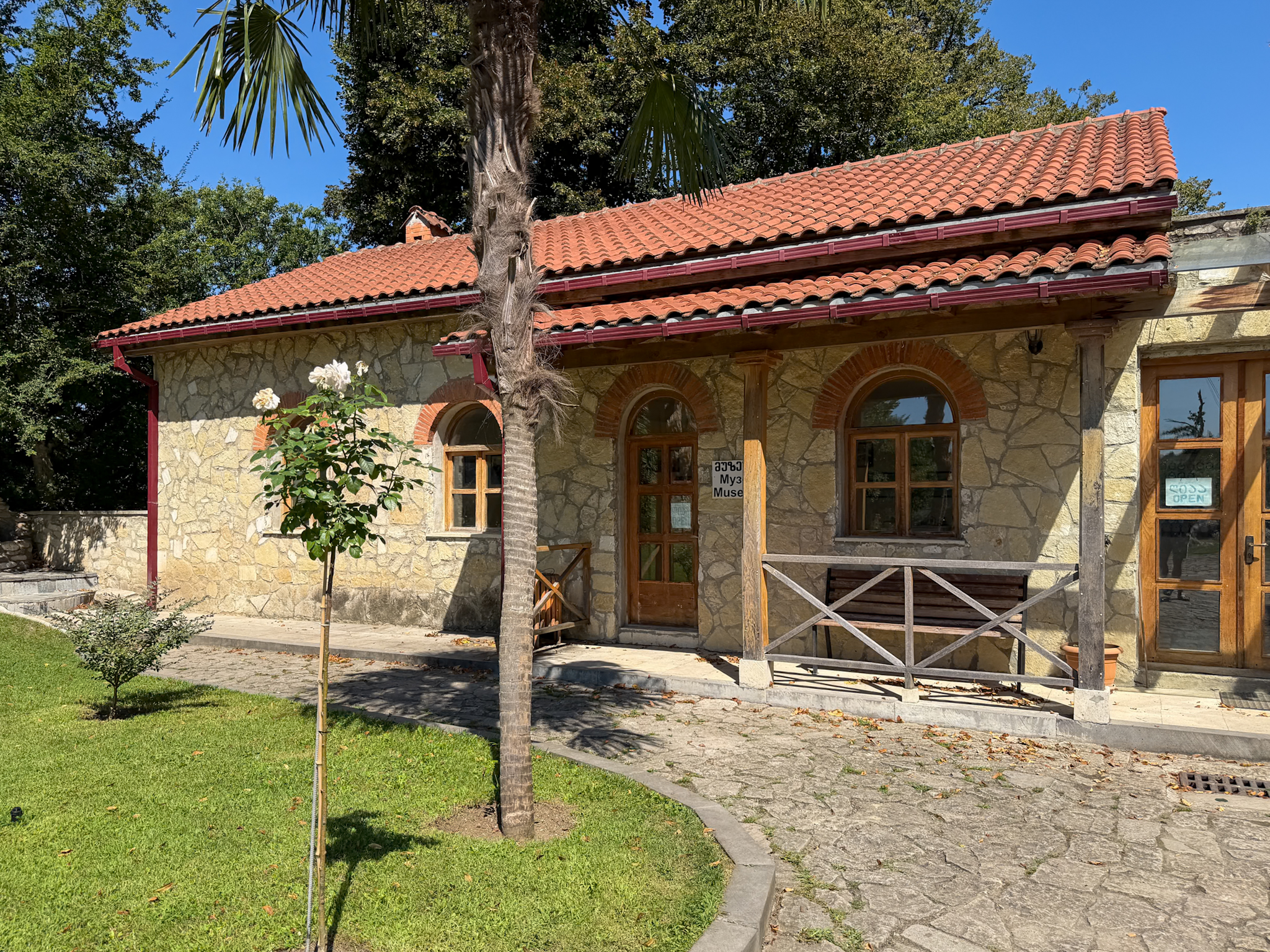
The small free museum facing the pillar.
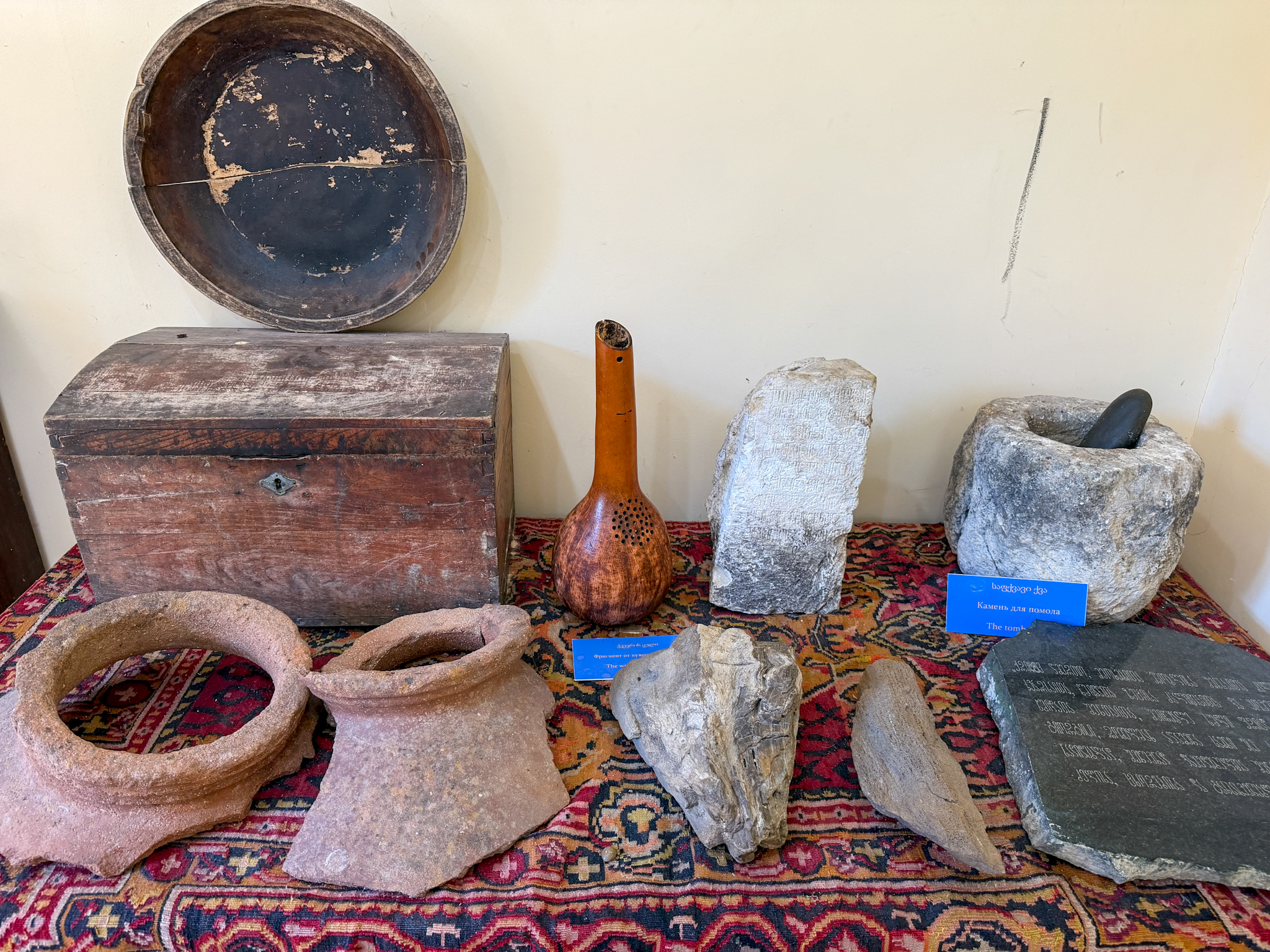
Finds from the top of the pillar, including pieces of qvevri wine jars and a grinding stone.
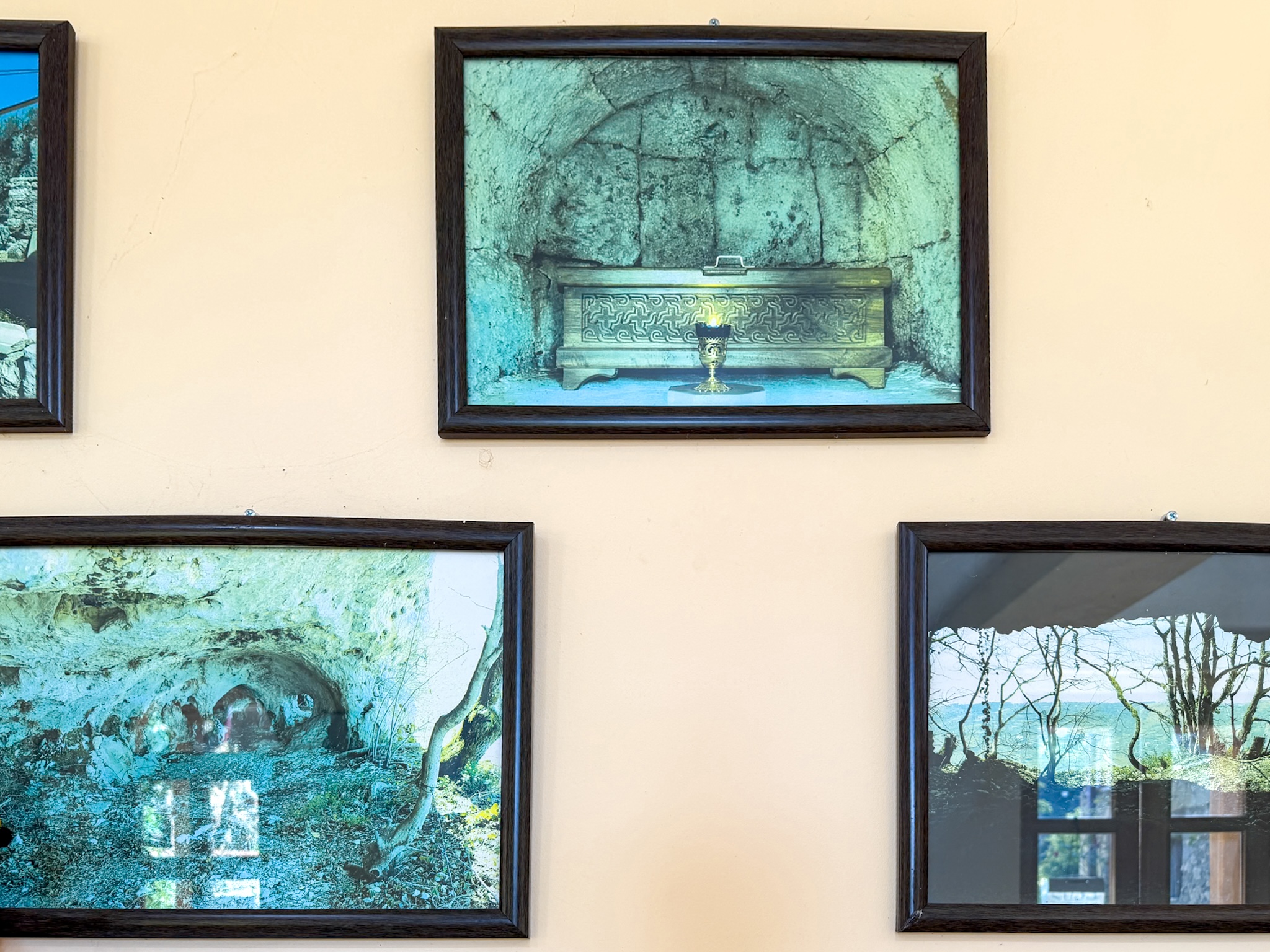
Old photographs of Katskhi Pillar
Other Katskhi Pillar Viewpoints From Above
You get your first good look at the pillar from the road, as you drive in, when it suddenly appears above the trees on the side of the valley. To see it from above, there’s a hiking loop on the hill behind the monastery.
I didn’t do this hike. I was happy with the view from the bottom. Here’s what I found out afterward:
- Route: a loop of about 3 miles (4.8 km) through the woods around the pillar, which you can walk in either direction.
- Elevation gain: about 680 feet (210 m), up to roughly 2,260 feet (690 m) above sea level, which puts you well above the church on the summit.
- Time: around 1 hour and 30 minutes with stops.
- Difficulty: moderate. The trail is wild and unmarked, so wear proper shoes and skip it after heavy rain.
- Finding the trail: check this “Katskhi Pillar Panorama” on Wikiloc. A hiker uploaded the GPS track in July 2025, starting near the parking lot. With no visible signs on the ground, a downloaded track is the easiest way not to get lost.
Can You Climb the Katskhi Pillar?
No. Visitors aren’t allowed on the ladder anymore, men included.
The ban comes from the top of the Georgian Orthodox Church. In 2018, Patriarch Ilia II, the head of the Church, ruled that only the monks may go up to the church on the summit, as the abbot of the monastery explained to CNN the following year.
Before that, a few men were occasionally allowed up with the monks’ blessing. Women have never been allowed to climb, at any point in the pillar’s history. It’s an old monastic rule that goes back to the stylite tradition, and similar bans exist at some pagan shrines in Georgia’s northern mountains. Women can still visit everything at the base.
The monks still use it. They climb an iron ladder bolted to the side of the rock, which locals call the stairway to heaven, and it takes them about 20 minutes to reach the top. Food, water and building materials go up separately, hauled on a cable.
From the ground you can still get very close to the bottom of the ladder, which is one of the most impressive parts of the visit. I’ve described it in the next section.
Katskhi Pillar History: What the Records Actually Say
Between the museum panels, what the monastery museum’s guide told us and some digging in Georgian archives and academic papers, I did a proper deep dive.
From Pagan Rock to Christian Cross
Before Christianity the rock was already sacred. According to the museum, pagan rituals were held here, with sacrifices on a stone near the pillar. In the 6th century, after Georgia became Christian, someone carved the cross on its east side. The pillar became the “tree of life”, an old name for Christ’s cross, which is why locals still call it the Pillar of Life. It still has two feasts: Svetoba, on the Friday a week after Easter, and Kokhinjvroba on May 7, an old ritual against hail.
The Medieval Monastery on the Summit
Many sources say the church on top is from the 5th or 6th century, built by stylites, hermits who lived alone on columns. That comes from a 1946 study. However, archaeologist Giorgi Gagoshidze, who excavated the summit in 2006, re-dated it to the 9th or 10th century.
He found a small monastery for two or three monks. They had two cells, one with a fireplace carved into the rock and a chimney facing east, where the wind rarely blows. There was a rainwater tank, and a wine cellar with eight qvevri. As Emma Loosley of the University of Exeter notes, it was closer to the monasteries of Meteora in Greece than to the Syrian hermits on their columns. A tiny cell with two windows is also cut into the west face, about 33 feet (10 m) below the top.
There's a stone with a 13th-century inscription, the oldest text from the summit. In it a “great sinner Giorgi” thanks God for building three little houses on the “tree of life”.
The 1944 Expedition That Rediscovered the Summit
Monks climbed the pillar for hundreds of years. How did they get up there in the first place? Nobody knows for sure. Gagoshidze thinks the medieval monks used a winch, a rope-and-pulley system, at an opening on the east side, which was probably also the way in.
Anyhow, once the monastery was abandoned, the way up was forgotten. On July 29, 1944, mountaineer Alexander Japaridze reached the top with architect Vakhtang Tsintsadze, writer Levan Gotua and two local young men, Shutu Popkhadze and Petre Kupatadze. A second writer, Akaki Beliashvili, stayed on the ground. They slept on the summit and found the church ruins, broken qvevri and the bones of a man who had lived and died up there centuries before.
Father Maxime and the Modern Revival
Father Maxime Qavtaradze, born in nearby Chiatura, drank, sold drugs and served time in prison as a young man, by his own account. He took his vows in 1993 and moved to Katskhi soon after. For his first two years on top he slept in an old fridge. With donations and help from locals, he rebuilt the church on the summit, restored the one at the base and had the iron ladder installed in the mid-2000.
He lived on top for about twenty years, coming down a couple of times a week, until 2015 according to CNN. Today nobody lives up there full time, but the monks still climb up to pray.
Whose Grave Is at the Foot of the Pillar?
Several blogs say the black stone grave in the monastery garden is Father Maxime’s. It isn’t. The Georgian inscription reads Beri Gabrieli, Elise Bitsadze, that is, Monk Gabriel, born Elise Bitsadze, 1933 to 2014. Maxime was 55 in 2010, so he was born in the mid-1950s, and CNN places him on the pillar in 2015. I couldn’t find anything else about Monk Gabriel, in English or in Georgian.
Local Legends
The legends collected by dzeglebi.ge are a good part of the fun.
- The origin: God planned a new Eden here, found a serpent nesting under a stone and drowned it in boiling mud, which froze into the pillar.
- The chain: a chain once linked the summit to the church in Katskhi village, and when the monks shook it to pray, the villagers knelt with them.
- The warning: anyone who plans to climb goes blind. One man ate 50 eggs for strength and died the moment he touched the rock.
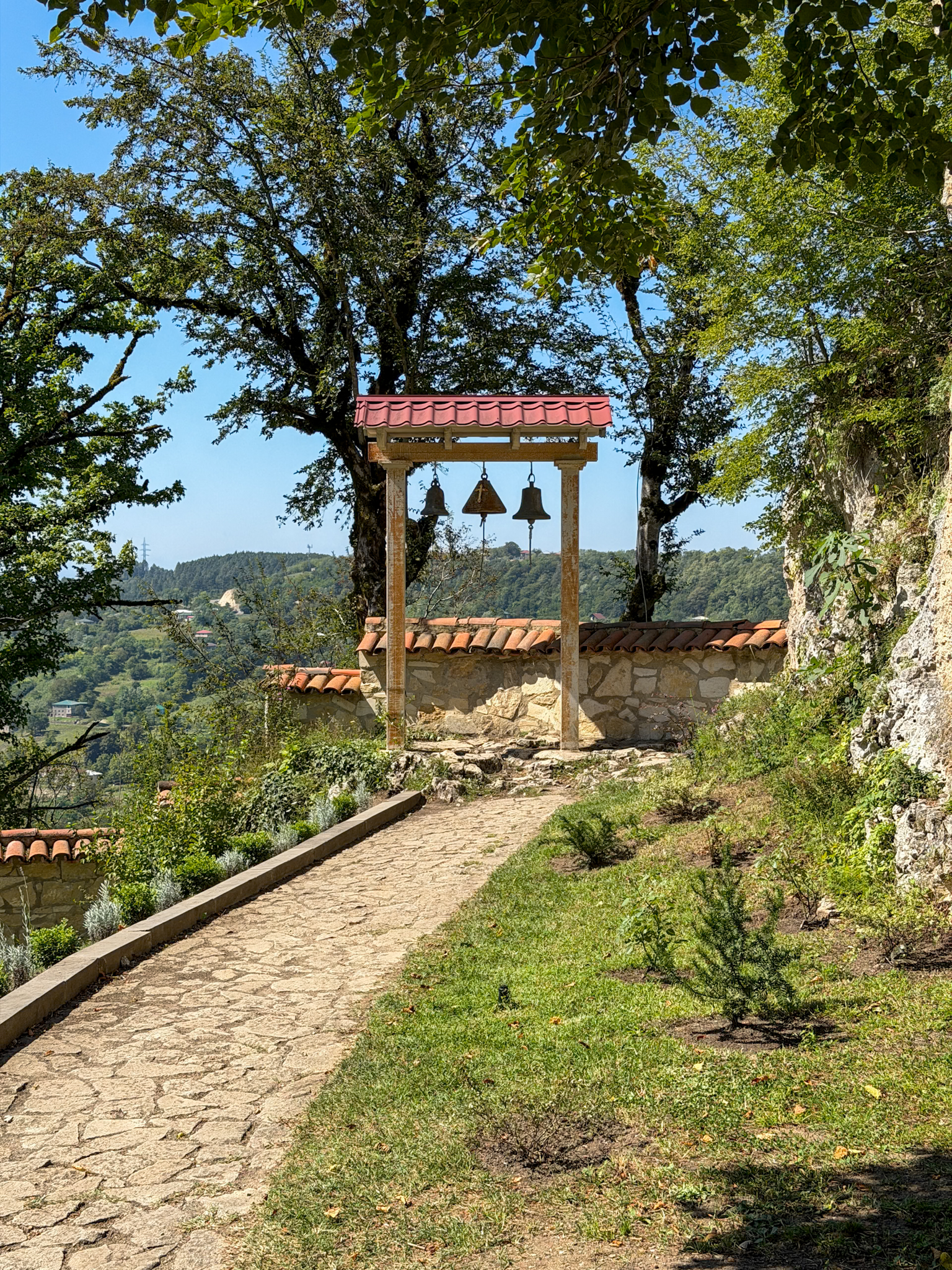
The bell tower at the edge of the monastery garden, looking over the valley.
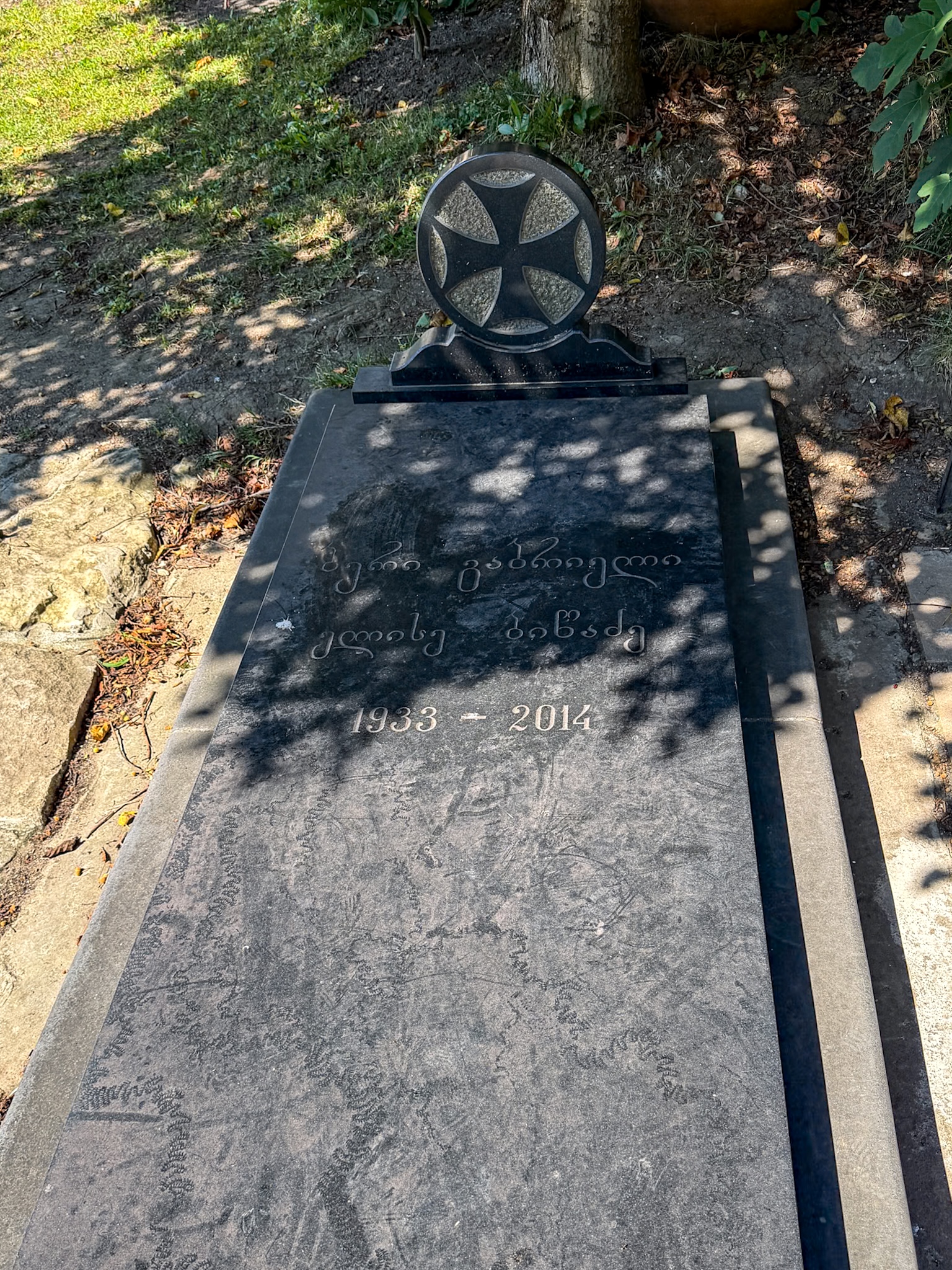
The grave of Monk Gabriel (Elise Bitsadze), 1933 to 2014, in the monastery garden.
Is Katskhi Pillar Worth Visiting?
Yes, if you’re passing anywhere near it. I’d put it on the list of anyone driving between Tbilisi and Kutaisi, and it’s an easy half-day trip if you’re staying in Kutaisi. It also suits anyone looking for the stranger side of Georgia.
Just keep your expectations realistic. You can’t go up, and the visit itself takes about an hour. As a return trip from Tbilisi, that’s a lot of driving for one stop.
If you have more time:
- Near the pillar: Chiatura, the cable car town just up the road, the domed Katskhi Monastery in the village and Mgvimevi, a convent built into a cliff, are all a short drive away.
- Tskaltubo: a Soviet spa town about 20 minutes from Kutaisi, where I stopped on the same day. I wrote a full guide on Tskaltubo's abandoned sanatoriums
- Martvili and Okatse canyons: two canyons on the other side of Kutaisi, perfect for a separate day trip. I wrote about the boat ride and scams at Martvili Canyon and my day trip guide to Okatse Canyon.
FAQ
Is the road to the pillar OK for a normal car?
Yes. The side road off the highway is narrow but mostly paved, and you don’t need a 4x4. The parking lot only has about a dozen spaces. On a summer day with tour vans around it can fill up, so arriving early helps.
When is the best time to visit?
Late spring to early autumn, on a clear day. The valley can fill with fog, and some travelers have arrived to find the pillar completely hidden in the clouds. I went in August and had blue skies, but it was hot on the walk up, so bring water and a hat.
Is Katskhi Pillar accessible with kids or limited mobility?
It’s fine with kids, but not wheelchair accessible. The walk from the parking lot is short but steep, with stairs and an uneven stone path, and there’s no other way up to the base.
Can you take photos?
Yes, everywhere at the base, including inside the church and the museum. It’s an active monastery, though, so ask before photographing the monks and keep your voice down if there’s a service going on.
Do I need cash?
Not for the visit, since the church and the museum are free. Bring a few lari anyway for the candles sold for prayers and for the small kiosk on the road to the parking lot. The nearest ATMs are in Chiatura, about 15 minutes away.
Keep reading: