A guide to the best things to do in Kutaisi, Georgia: visiting the Bagrati Cathedral and the old center, plus the canyons, caves, monasteries and an ex-Soviet spa town nearby, with a map, a two-day plan and where to eat.
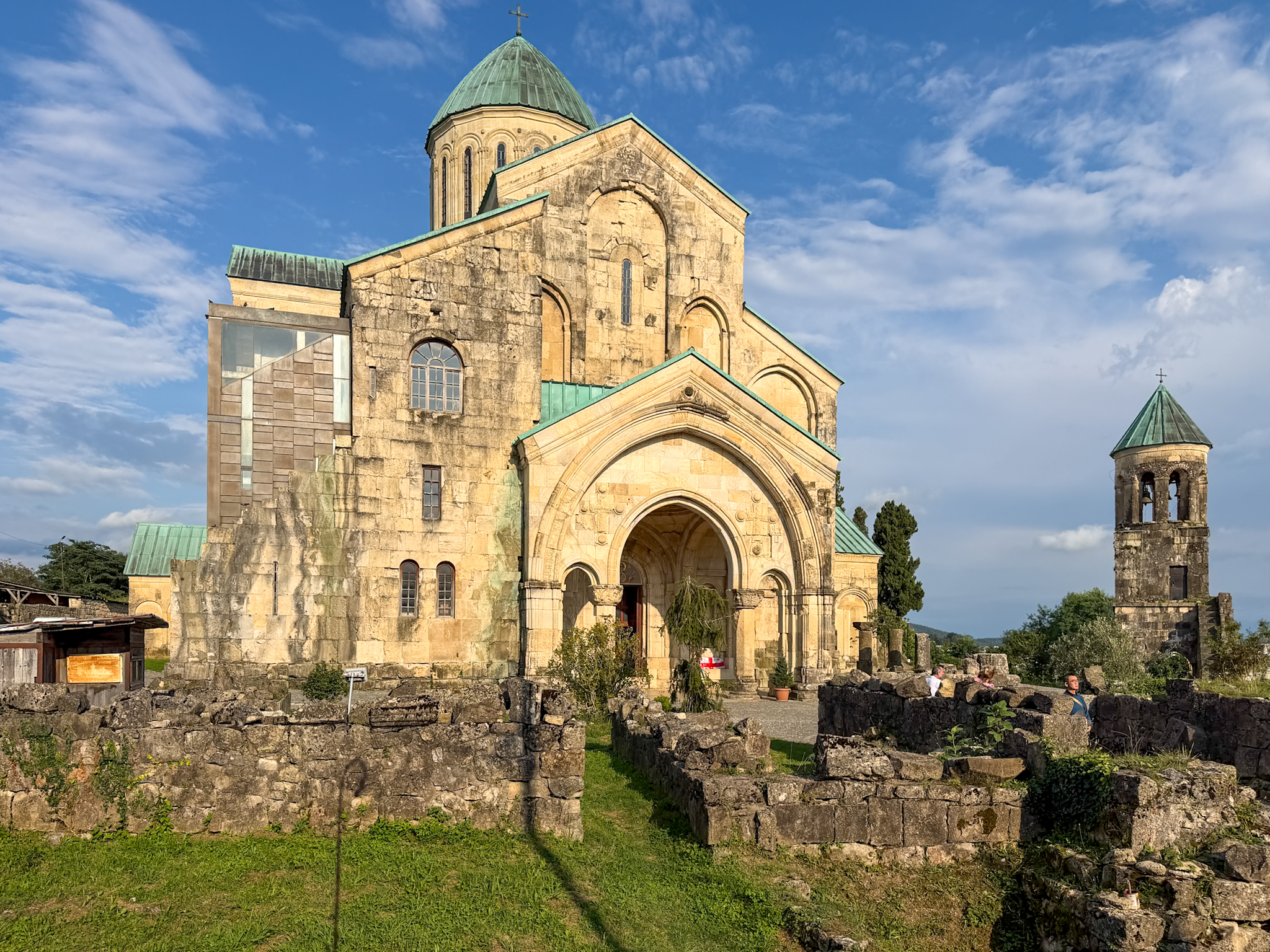
Kutaisi is one of the most underrated places in Georgia. The center is worth a stop, with Bagrati Cathedral up on its hill, the Colchis Fountain and the old cable car over the river. The bigger reason to come, though, is everything you can reach from here in an hour or less.
Around Kutaisi there’s a former Soviet spa town full of abandoned sanatoriums, a canyon you can ride through on a raft and another with a walkway hanging over its edge. There’s one of the biggest caves you can visit in Georgia, two old monasteries in the hills, and a small church built on top of a rock pillar.
That’s why I’d give Kutaisi at least two days. Below are the 10 best things to do in Kutaisi for a first trip, with a map and a simple plan to fit them all in.
Kutaisi Travel Essentials Before You Go
- Where it is: Kutaisi is the main city of western Georgia. It sits about 230 km (143 mi) west of Tbilisi, the capital.
- Main airport: Kutaisi International Airport is about 25 km (16 mi) from the center. Most of its flights are budget routes from Europe. An official shuttle bus runs from the airport to the city center around the clock.
- Coming from Tbilisi: The drive takes about 3.5 hours. Trains go to Rioni station, about 20 minutes by taxi from the center.
- Getting around: The center is easy to walk. For the day trips you need a car, a driver or a tour. We rented a car, and parking in the center wasn’t always easy to find. Bolt, the taxi app most people use in Georgia, works here too, though there are fewer drivers than in Tbilisi.
- Tours from Kutaisi: This canyons and cave day tour covers Prometheus Cave, Martvili Canyon and Okatse Canyon. These monastery tours cover Gelati, Motsameta and Bagrati.
-
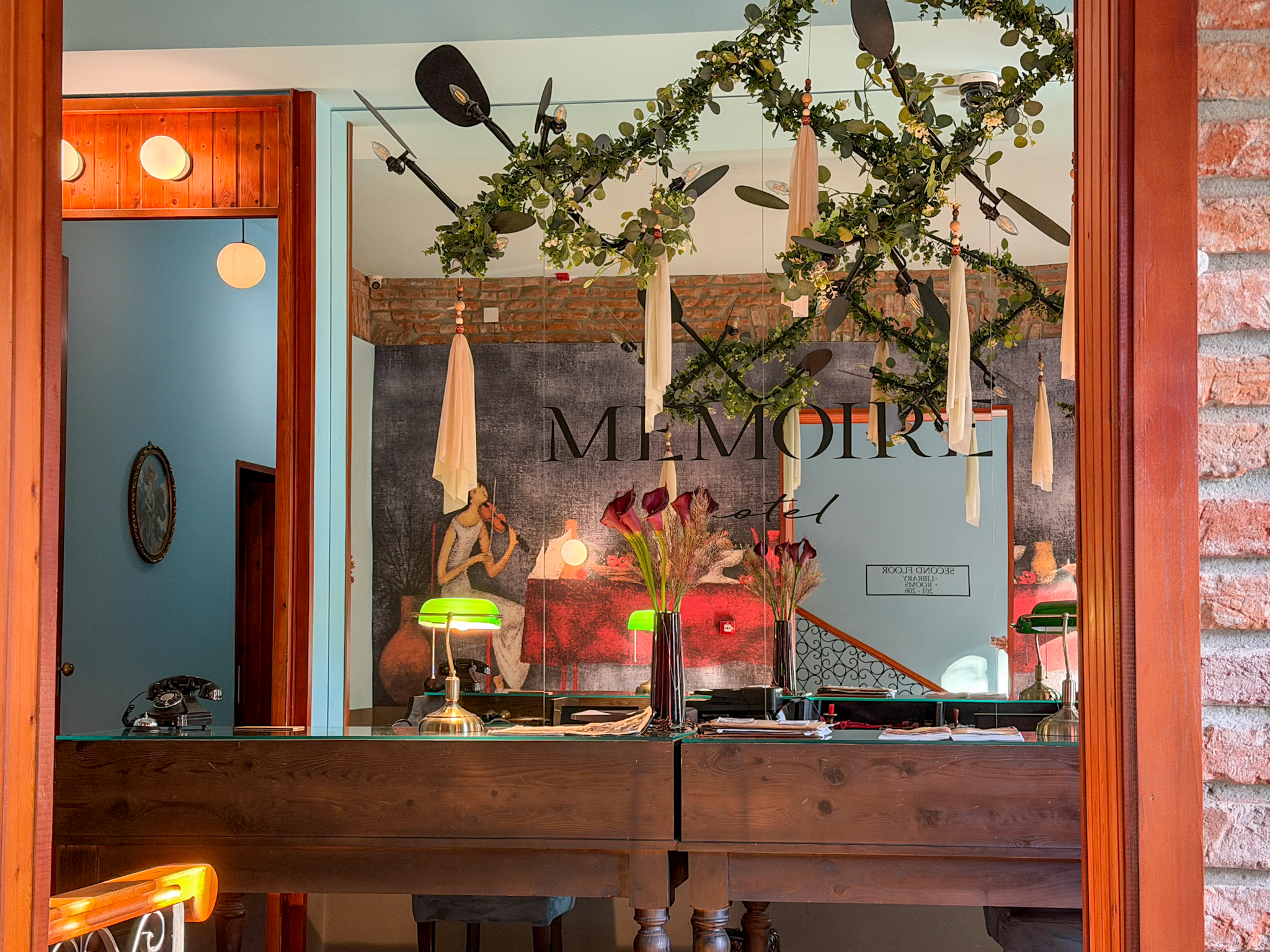
- Where to Stay: we stayed at Newport Hotel Kutaisi ⭐⭐⭐⭐, which has more of an international vibe, and at Hotel Memoire Kutaisi ⭐⭐⭐, which has a more local Georgian feel. They are both very near the Colchis Fountain and genuinely good choices.
10 Best Things to Do in Kutaisi
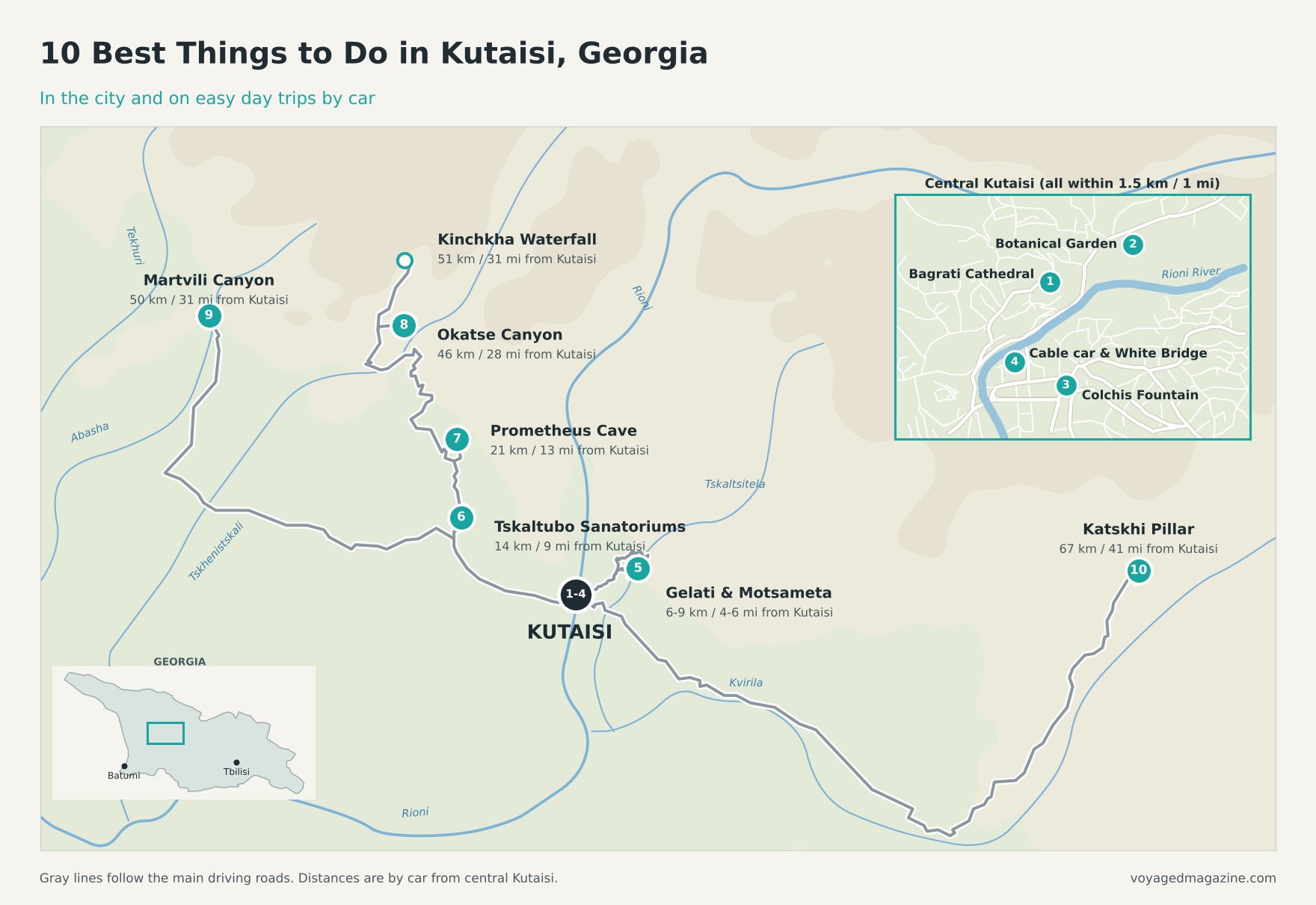
The first four things on this list are in the city center, within about 1.5 km (1 mi) of each other, so you can see them in an afternoon. The other six are day trips, from 10 minutes to just over an hour away by car.
The map just below shows where everything is, with the city sights in the box and the real driving routes to each day trip.
1. Bagrati Cathedral
Best for: the best view over Kutaisi, and the city’s most important church.
- Cost: free, donations welcome
- Time needed: about 45 minutes
- Getting there: a 25-minute uphill walk from the Colchis Fountain, or a short Bolt ride. We drove, and both roads to the top are extremely narrow and steep. I wouldn’t do it again. Walk up, or have a driver deal with it.
Bagrati Cathedral is the big stone church you see on the hill from almost anywhere in Kutaisi. King Bagrat III, the first king of a united Georgia, had it built in the early 11th century. Ottoman troops wrecked it in 1692 and the roof and dome caved in, so for about 300 years it stood as a ruin.
The restoration finished in 2012, and it’s the reason Bagrati is so talked about. The architects added a modern steel and glass section to one side and metal-covered pillars inside. In 2017, UNESCO took the cathedral off its World Heritage list because of those changes, while nearby Gelati Monastery kept its place. I found the cathedral beautiful. The new parts I liked less, the different materials really stand out next to the old stone, and you’ll see them both outside and inside.
Inside, the walls are mostly bare stone with icons hanging along the sides. Dress as you would for any Orthodox church in Georgia: shoulders and knees covered, and women usually cover their hair.
Right before the door, there’s a cross made from a twisted grapevine branch set into a stone base. The shape, with the arms bending down, is the grapevine cross of St. Nino, the woman who brought Christianity to Georgia in the 4th century, and you’ll see it all over the country.
Walk around the outside before you leave. The cathedral sits on a wide grassy terrace with the low walls of an older fortress and a ruined bell tower, and from the edge you get a view over the whole city.
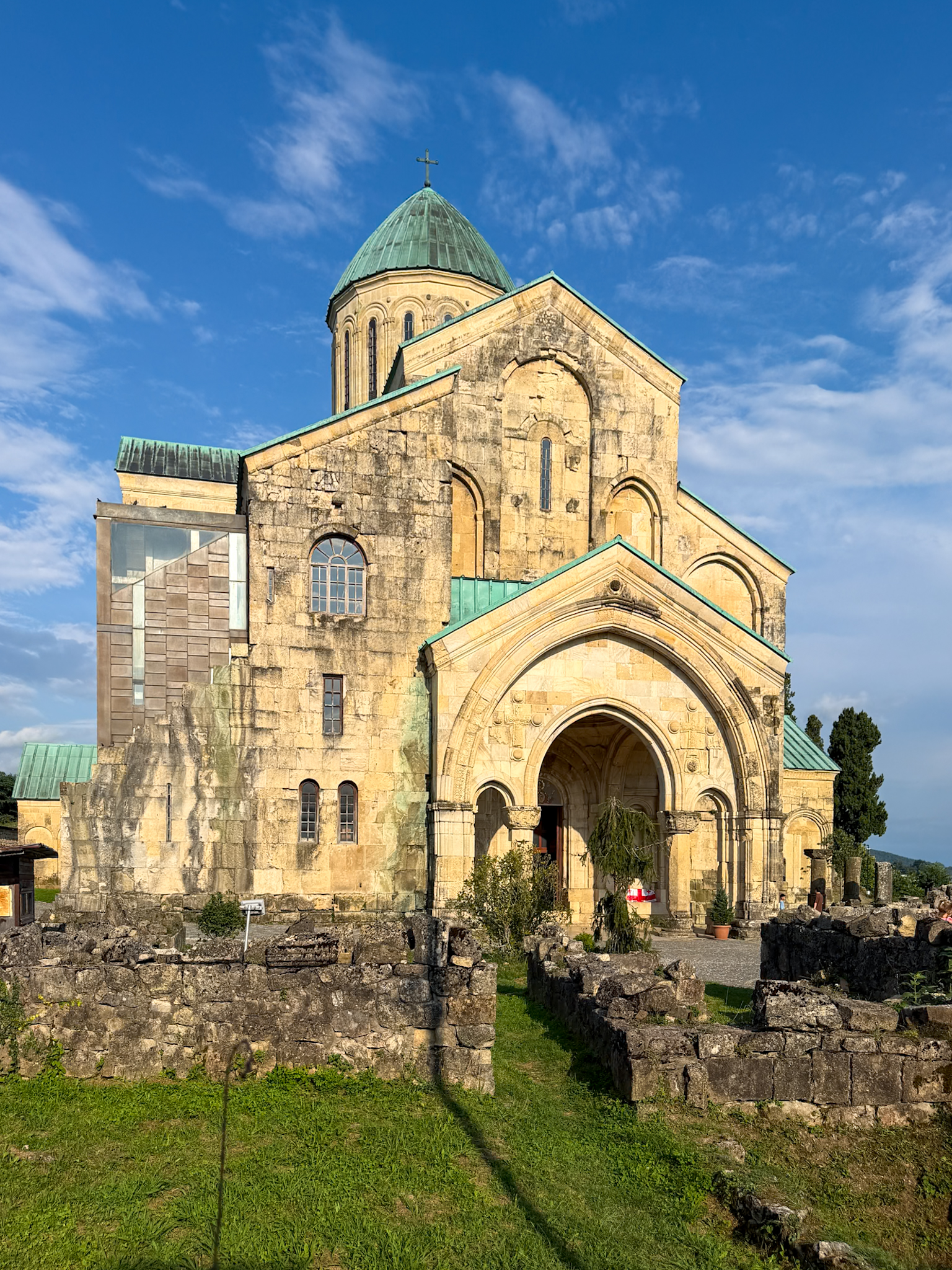
The front of Bagrati Cathedral, with its carved stone porch.
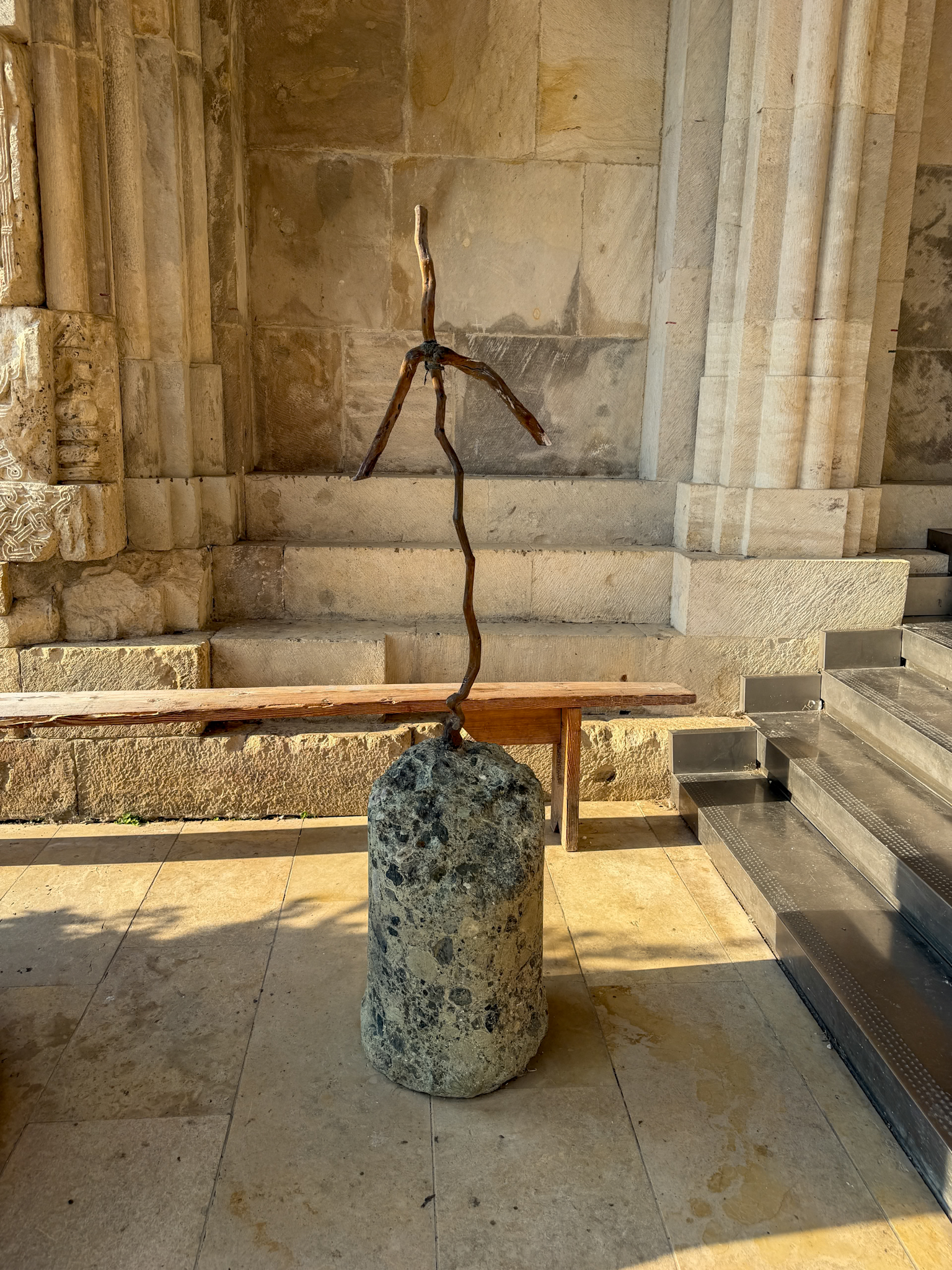
Grapevine cross of St. Nino on a stone base at the entrance of Bagrati Cathedral
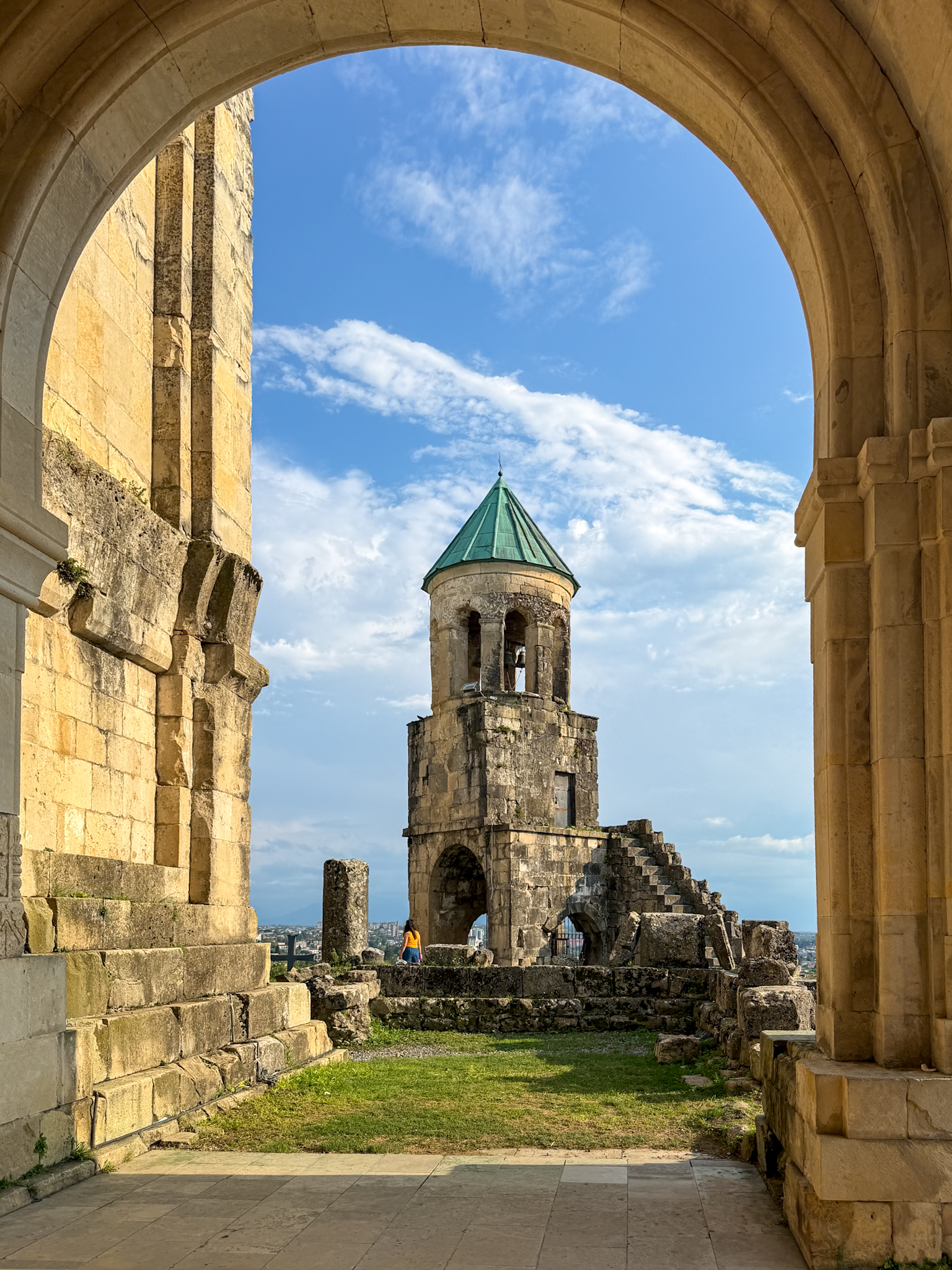
Ruined bell tower of Bagrati Cathedral seen through a stone arch, with Kutaisi in the background
2. Kutaisi Botanical Garden
Best for: a quiet hour in the shade after Bagrati, and a chapel built inside a tree.
- Cost: 5 GEL (about $2), cards accepted
- Time needed: about 1 hour
- Getting there: a few minutes by car from Bagrati, on the same side of the river
The Botanical Garden is close to Bagrati, so the two fit well together in one afternoon. It’s small and looks more like a city park than a botanical garden, with shady paths, benches, some fountains and a little open-air amphitheater. I wouldn’t put it at the top of the list if you're in a hurry. It’s a nice break, though.
The reason most people come is the chapel inside an old oak tree. The oak is about 400 years old, and its trunk is hollow at the bottom. In 2014, with the blessing of the Georgian Orthodox Church, the garden turned the hollow into a tiny chapel with a wooden door. Inside, the walls of the trunk are covered with icons. There’s room for one person at a time.
One practical note: I found a lot of mosquitoes in the garden, so put repellent on before you go in.
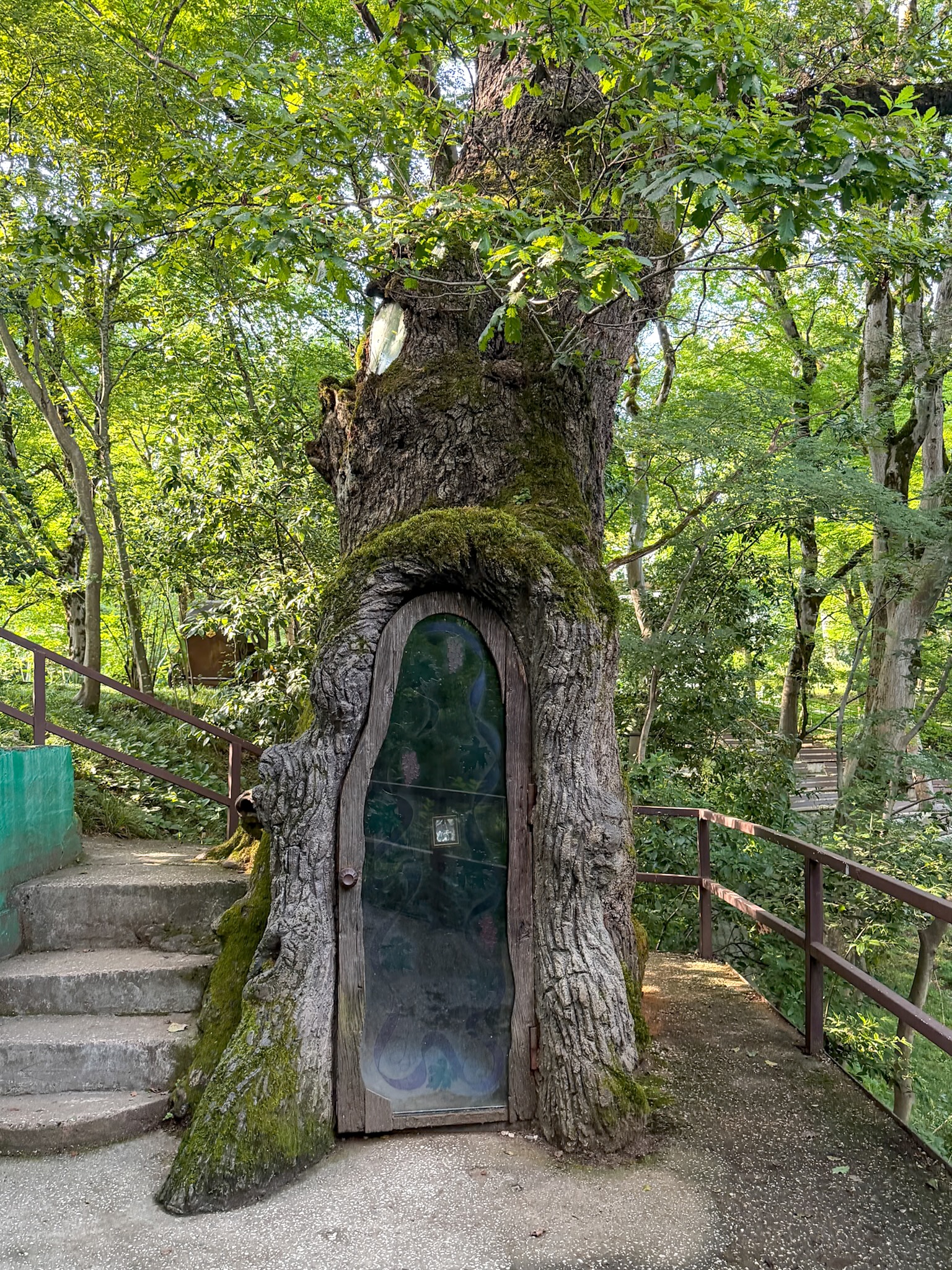
The oak tree chapel and the small amphitheater in the Botanical Garden.
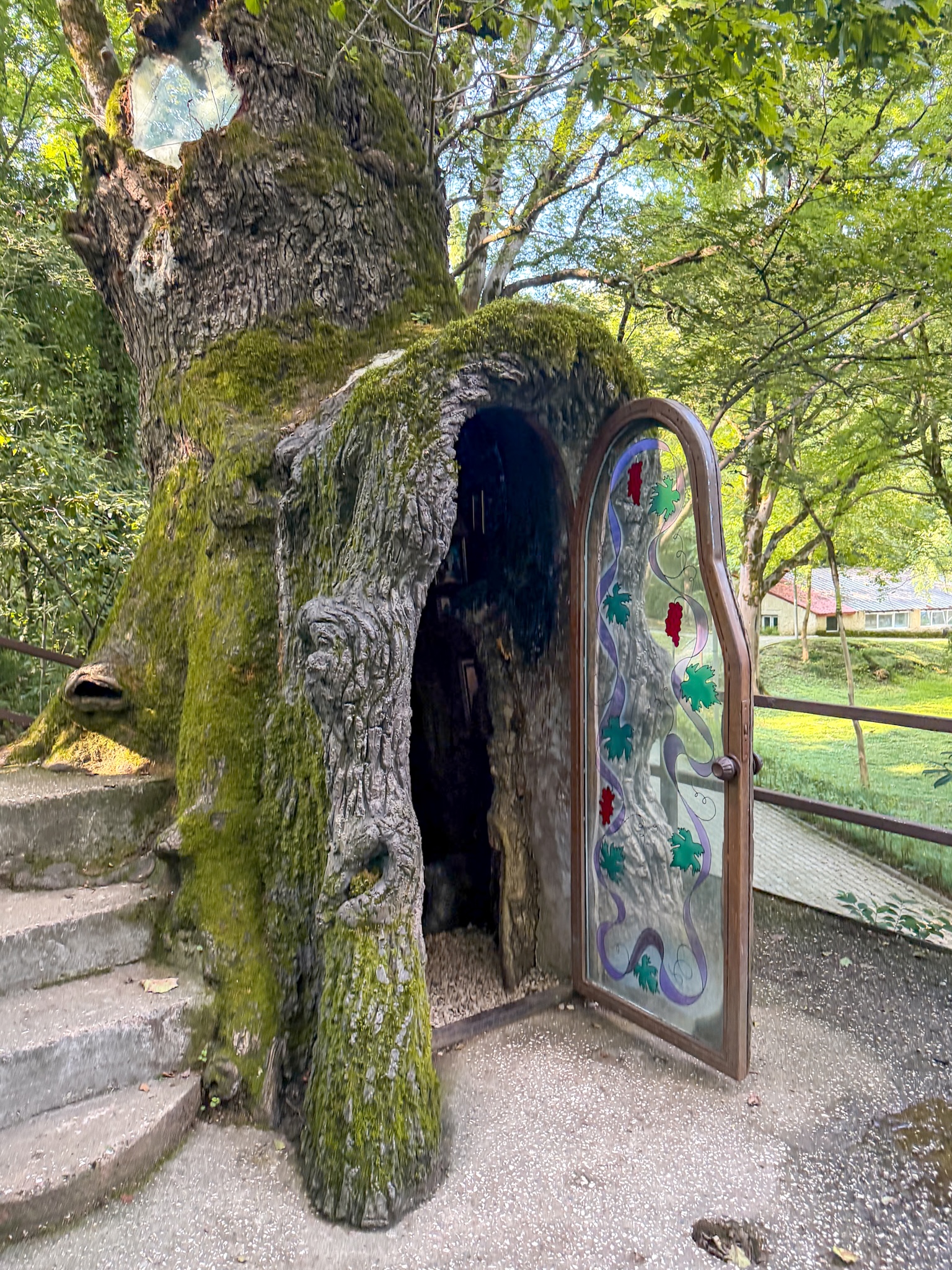
The tiny chapel inside a 400-year-old oak at the Kutaisi Botanical Garden.
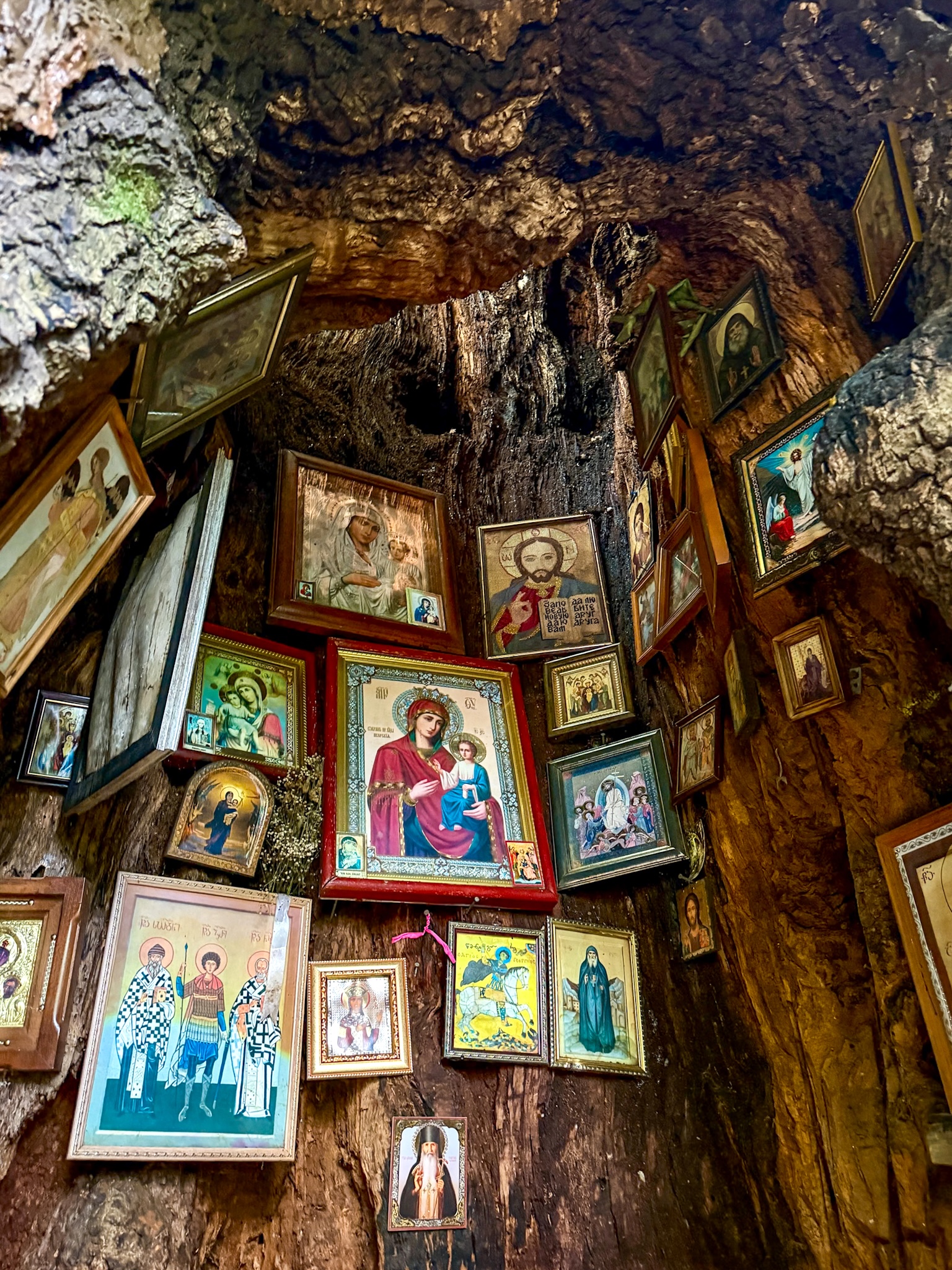
Icons hanging inside the hollow trunk of the oak tree chapel.
3. Colchis Fountain
Best for: an evening walk in the center, when the fountain is lit up.
- Cost: free
- Time needed: 15 minutes, or longer if you walk on to the Green Bazaar
- Getting there: it’s in the main square, in the middle of the center
The Colchis Fountain sits in the main square, and it’s the symbol of the city. Around Kutaisi, about 2,500 years ago, there was an ancient kingdom called Colchis, famous for its gold. It’s the land Jason and the Argonauts sailed to in the Greek myth of the Golden Fleece. The fountain, opened in 2012, is covered with about 30 gold-colored animal figures, enlarged copies of tiny figurines found in Colchian graves around the region. The two horses on top are modeled on a pair of gold earrings.
We saw it at night, when it’s lit up in gold and the square is busy with cars driving around it. Behind it is the Lado Meskhishvili Theatre, a drama theater with a curved front and tall columns that’s also lit up after dark.
If you're visiting during the day, a few minutes’ walk from the fountain is the Green Bazaar, Kutaisi’s main covered market. We didn’t make it inside. It’s open every day, and it’s where locals buy fresh fruit, cheese, spices and churchkhela, a Georgian snack made of walnuts threaded on a string and dipped in thickened grape juice.
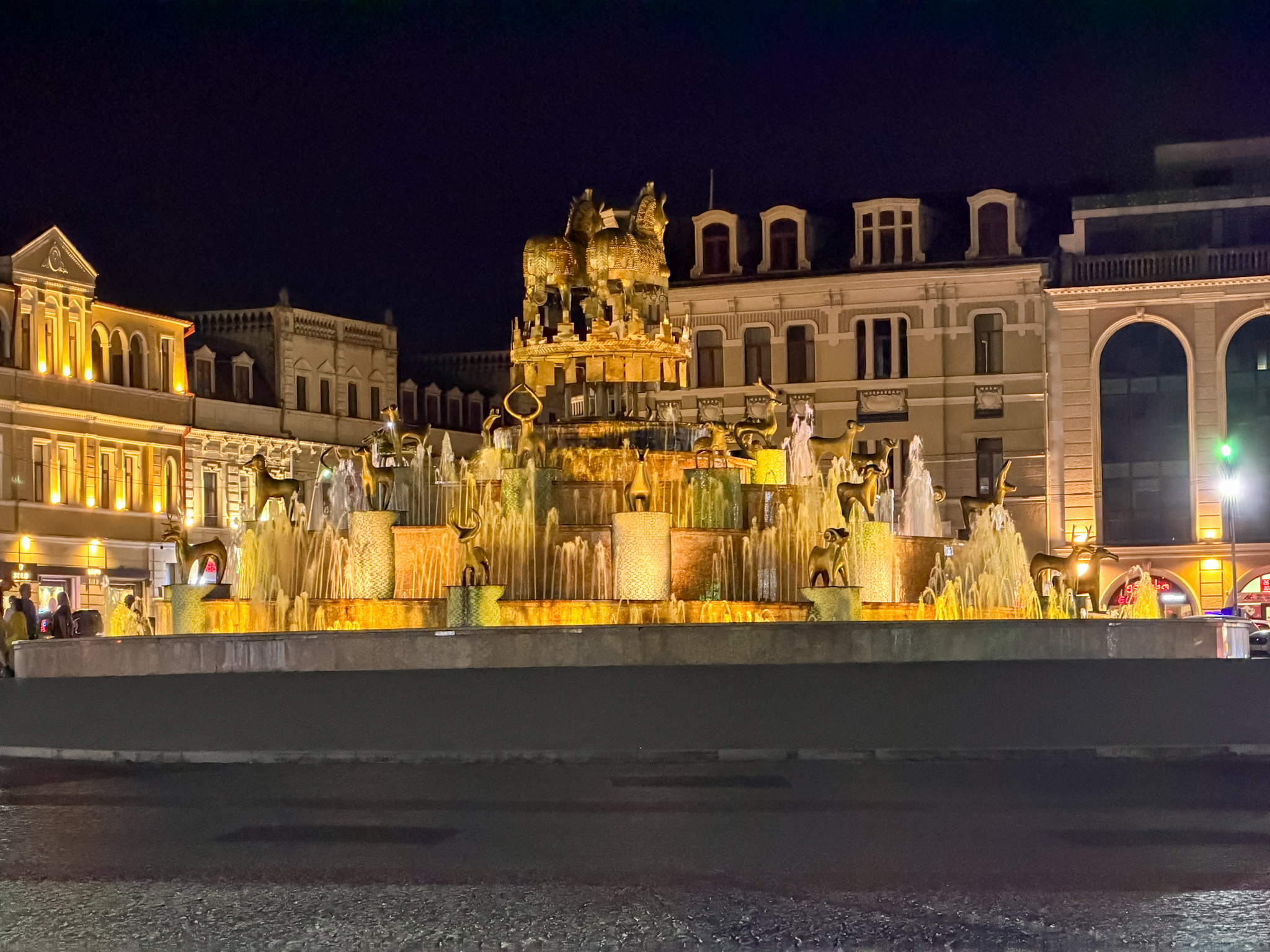
The Colchis Fountain at night, with copies of ancient Colchian gold figures
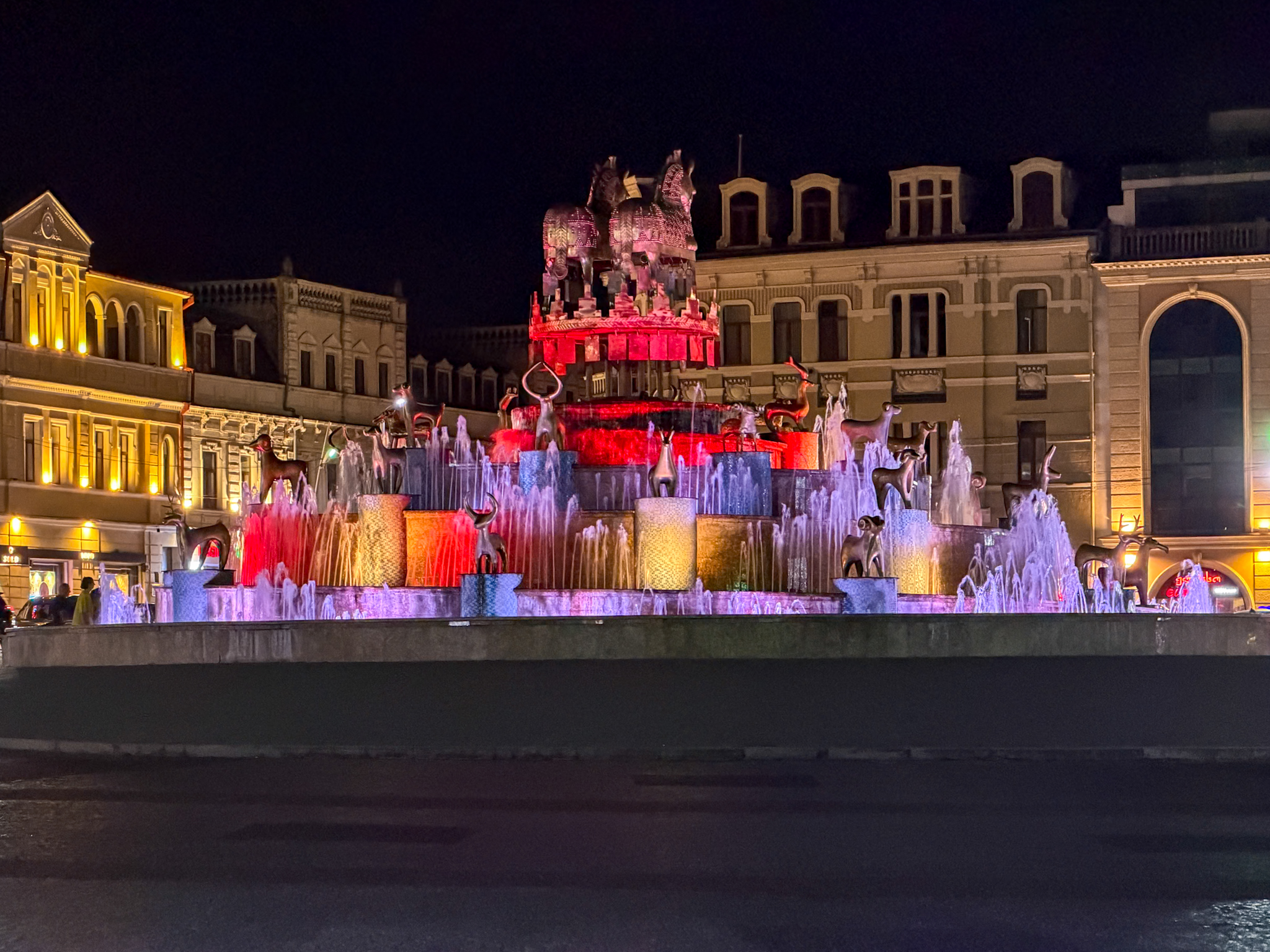
Colchis Fountain, lit up at night
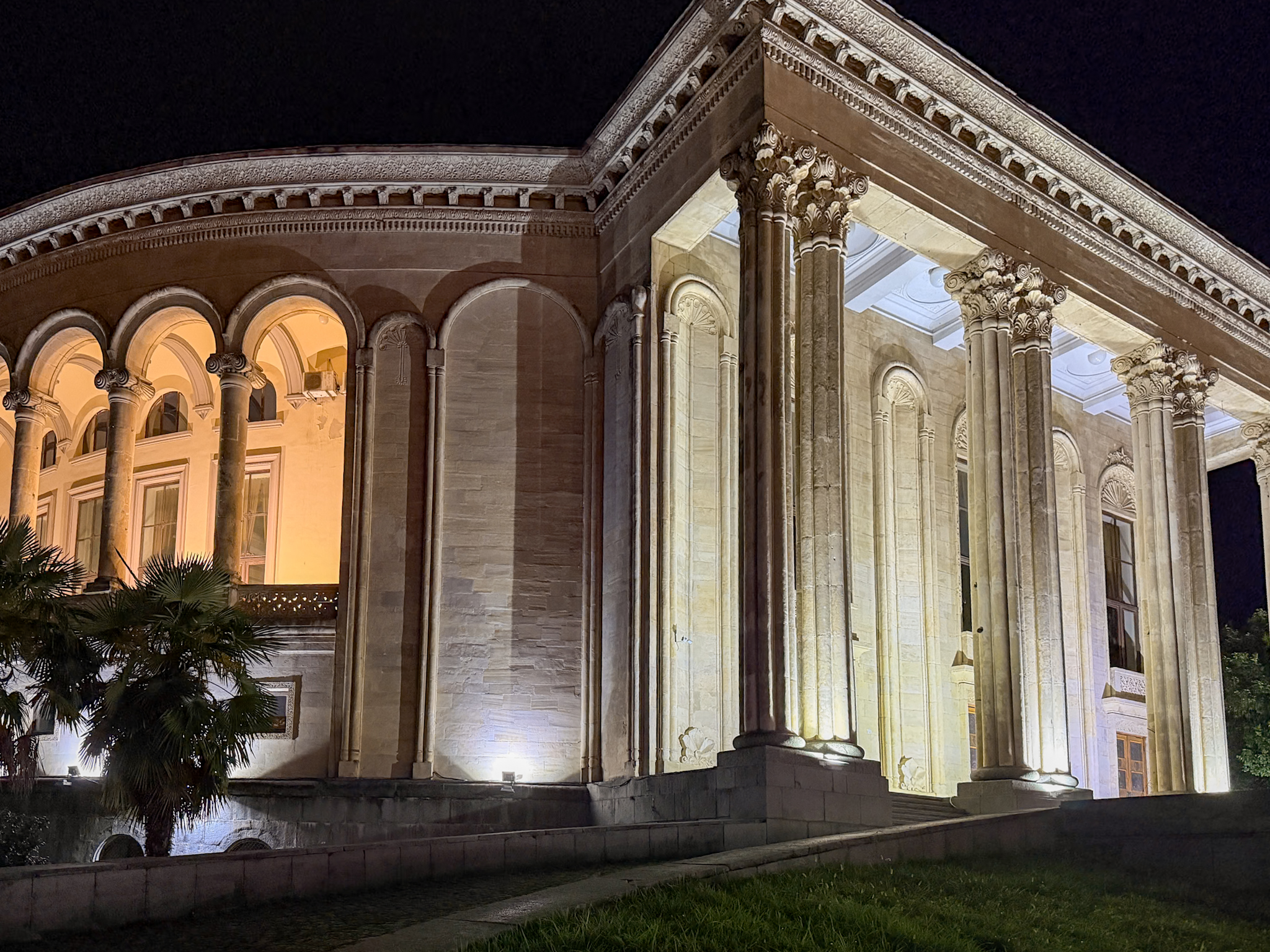
The Lado Meskhishvili Theatre, right behind the Colchis Fountain
4. Cable Car and White Bridge
Best for: a quick, cheap view over the Rioni River and the old town.
- Cost: a few lari for the ride
- Time needed: 30 minutes
- Getting there: a 5-minute walk from the Colchis Fountain, down toward the river
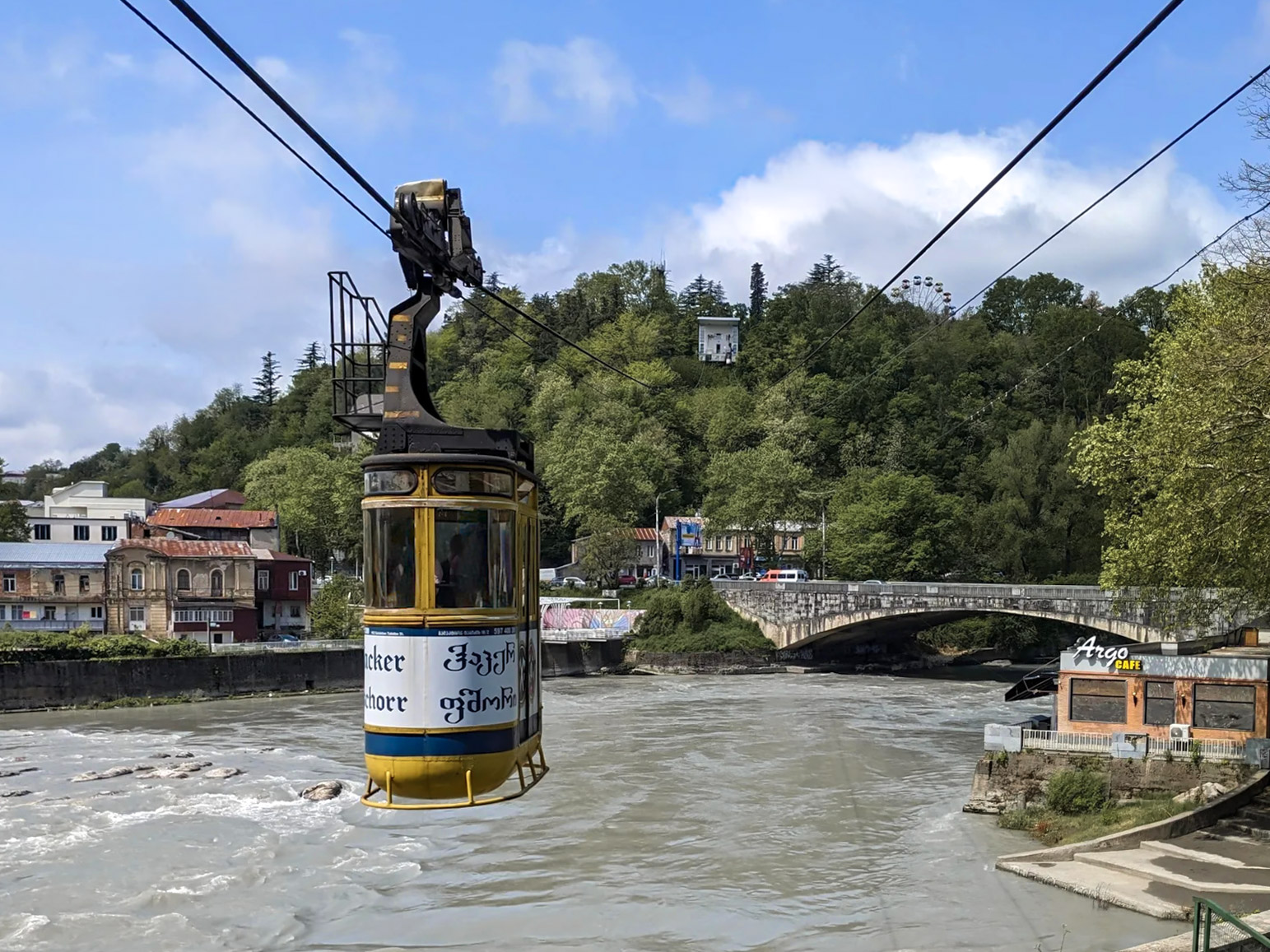
Kutaisi’s cable car has been running since 1961. It’s a single small cabin that crosses the Rioni River and climbs to Besik Gabashvili Park, a little amusement park on the hill with an old Ferris wheel. The ride is short, and the views of the river and the old town are good. The cabin leaves once enough people are waiting.
The lower station is at the end of the White Bridge, the only bridge in Kutaisi just for pedestrians. Some of its floor panels are glass, so you can see the river rushing over the rocks below. On the railing there’s a bronze statue of a boy holding his hat, a character from a film by Rezo Gabriadze, the Kutaisi-born artist and puppeteer.
5. Gelati and Motsameta Monasteries
Best for: two very old monasteries close to the city.
- Cost: free for both
- Time needed: 1.5 to 2 hours for both
- Getting there: Gelati is 9 km (6 mi) from the center, about 10 minutes by car. Motsameta is about 2 km (1.2 mi) down the same road, back toward Kutaisi.
Gelati Monastery stands on a wooded hill above Kutaisi. King David the Builder founded it in 1106, and for centuries it was one of the most important places of learning in Georgia, with its own academy where scholars studied and taught. David the Builder is buried at the south gate. Gelati has been on the UNESCO World Heritage list since 1994, and the main church is known for its 12th-century mosaics and frescoes. The catch right now is the restoration. Gelati is open to visitors only on weekends and public holidays, and much of the main church is covered in scaffolding inside and out. Check before you go, and plan it for a Saturday or Sunday.
Motsameta is smaller and sits on a cliff above a bend of the Tskaltsitela River, surrounded by forest. Its name means “place of the martyrs.” It holds the relics of two brothers, the princes David and Constantine, who were killed in the 8th century for refusing to give up their Christian faith. Local tradition says that if you crawl three times under the shrine with their relics and make a wish, it will come true.
These monastery tours from Kutaisi visit both, usually together with Bagrati Cathedral.
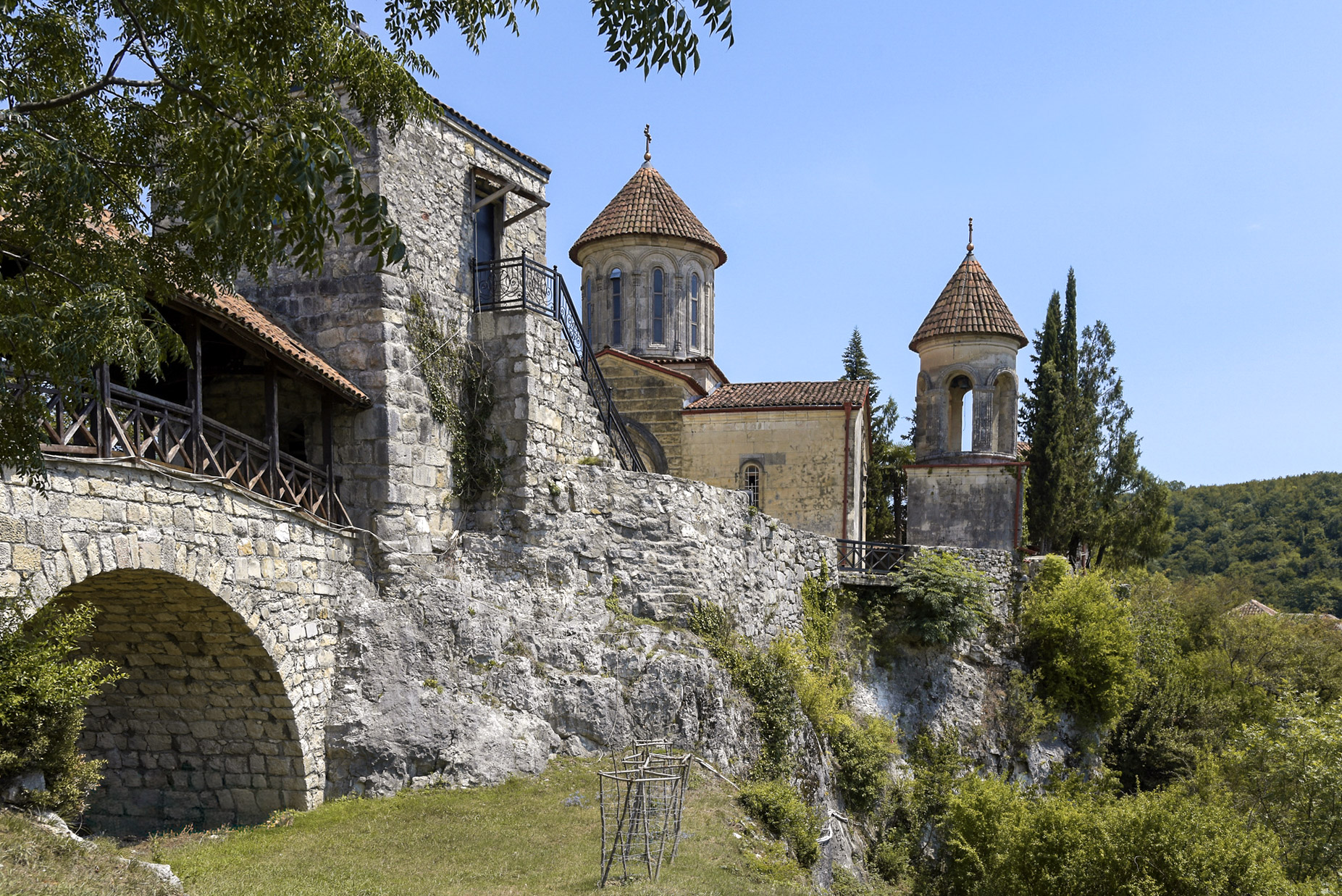
Motsameta Monastery
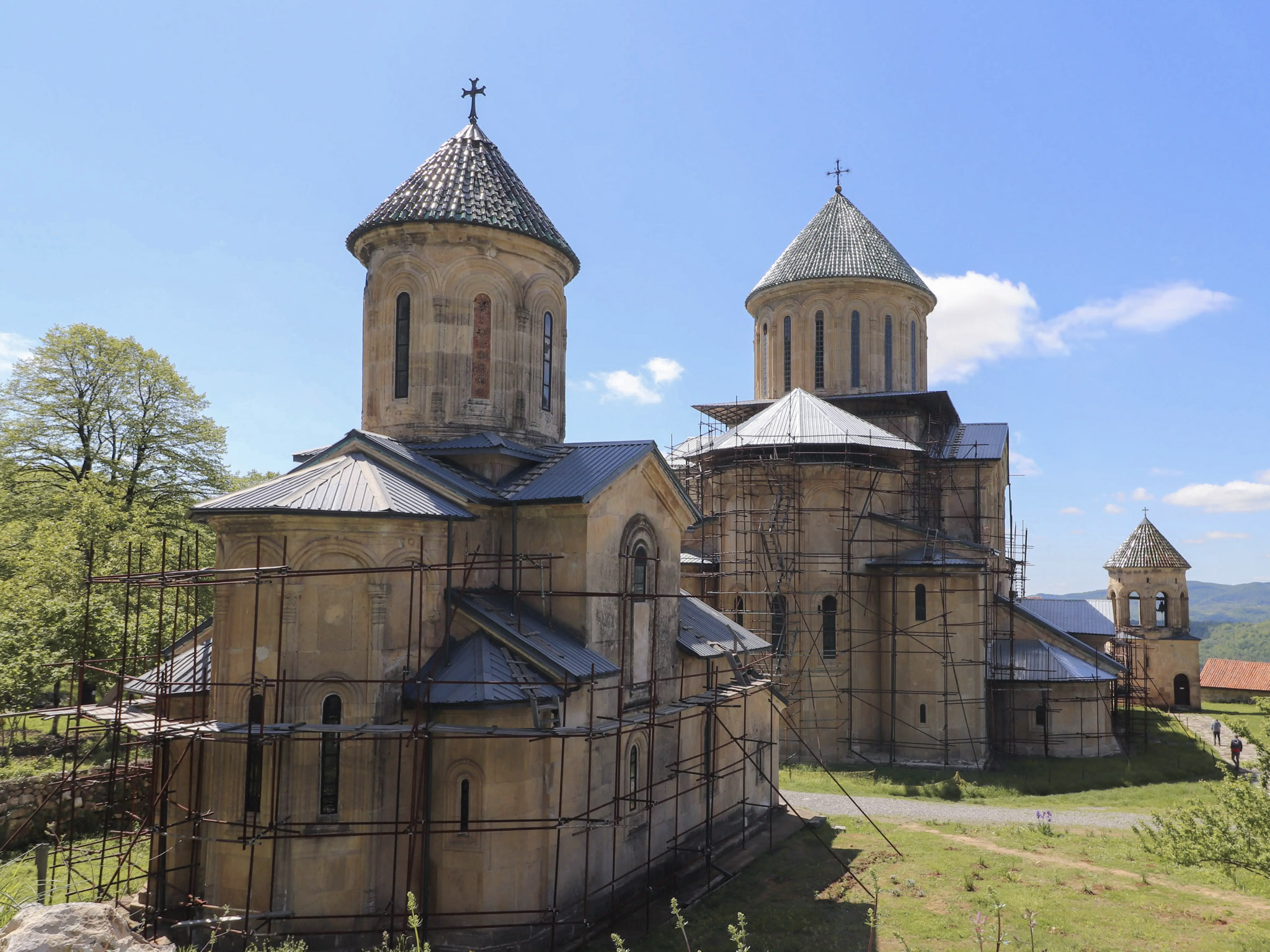
Gelati Monastery
6. Tskaltubo Sanatoriums
Best for: Soviet architecture and abandoned buildings, a short drive from the city.
- Cost: free to walk around. Some buildings have someone at the door asking for a small donation.
- Time needed: 1 hour for a few buildings, half a day for about ten
- Getting there: 14 km (9 mi), about 20 minutes by car
Tskaltubo is a small town known for its warm mineral springs. In Soviet times it became a big spa resort, and more than 20 sanatoriums (a mix of hotel and health clinic), were built around its central park. After 1991 the guests stopped coming, and most of the buildings were left to fall apart.
We spent a little over an hour there in the afternoon and saw six buildings, moving between them by car. My favorite was Sanatorium Metallurgist, the easiest one to visit, with a huge old chandelier and marble columns. Bathhouse No. 8 is the strangest, a round concrete building with the old pools still visible.
Be careful in there. The buildings haven’t been maintained in more than 30 years, and some floors and stairs aren’t safe. Stick to the main halls, wear shoes with good grip, and stay out of anything that looks lived in.
-
-
I go through every building we saw, plus the ones worth adding, in my guide to the Tskaltubo sanatoriums and which ones you can still enter.
-
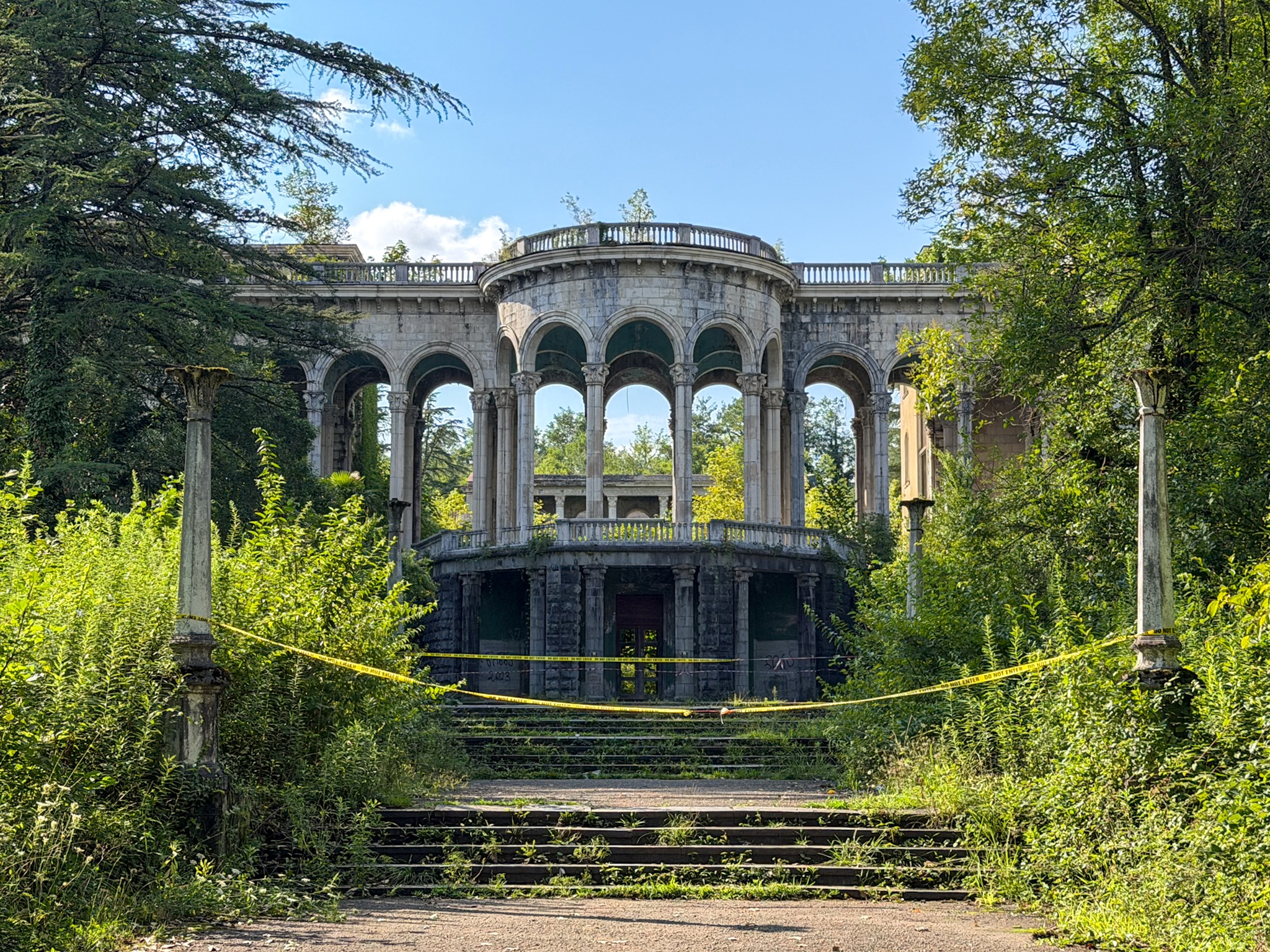
Sanatorium Medea, taped off and closed in August 2026
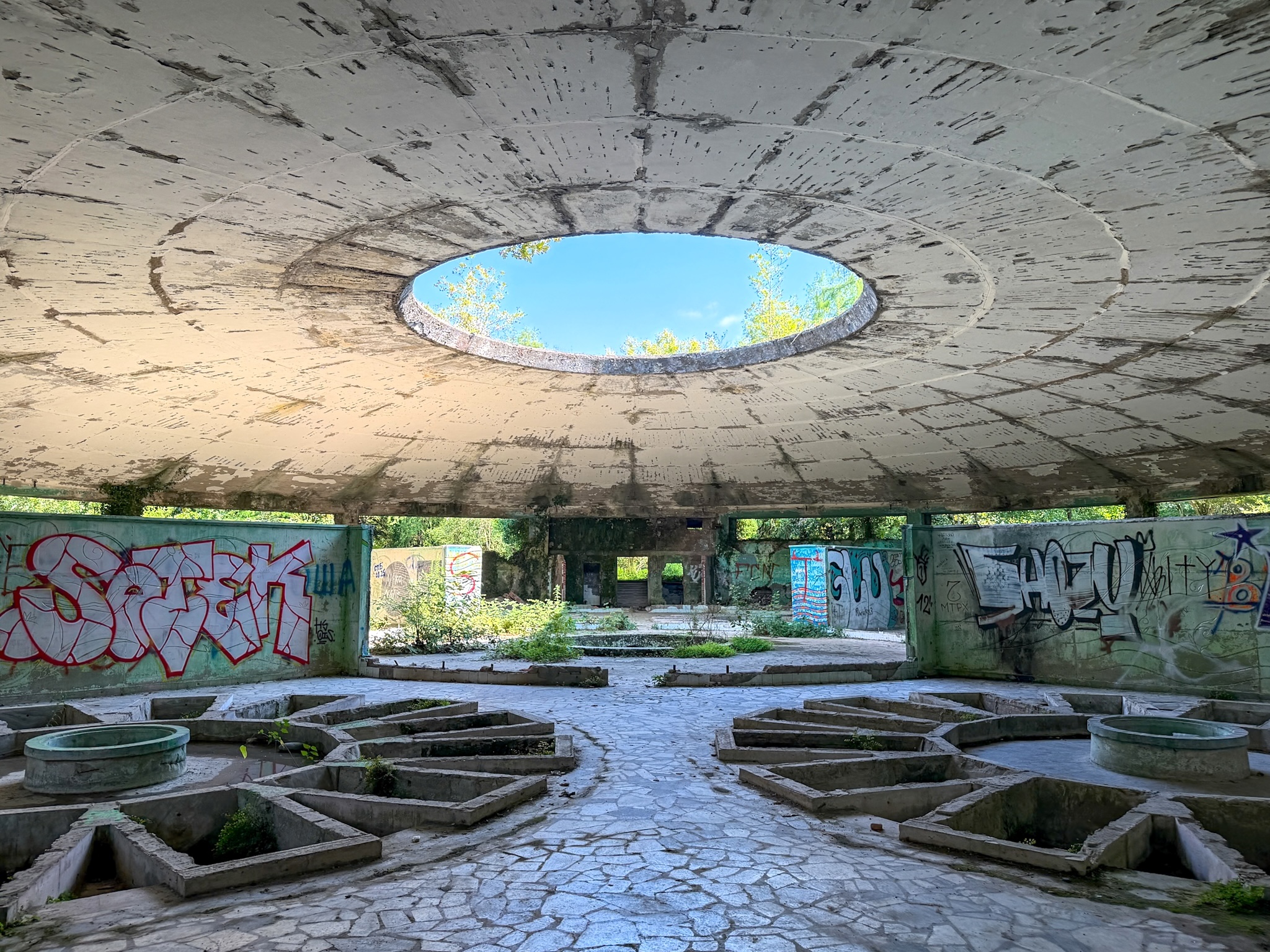
Inside Bathhouse No. 8
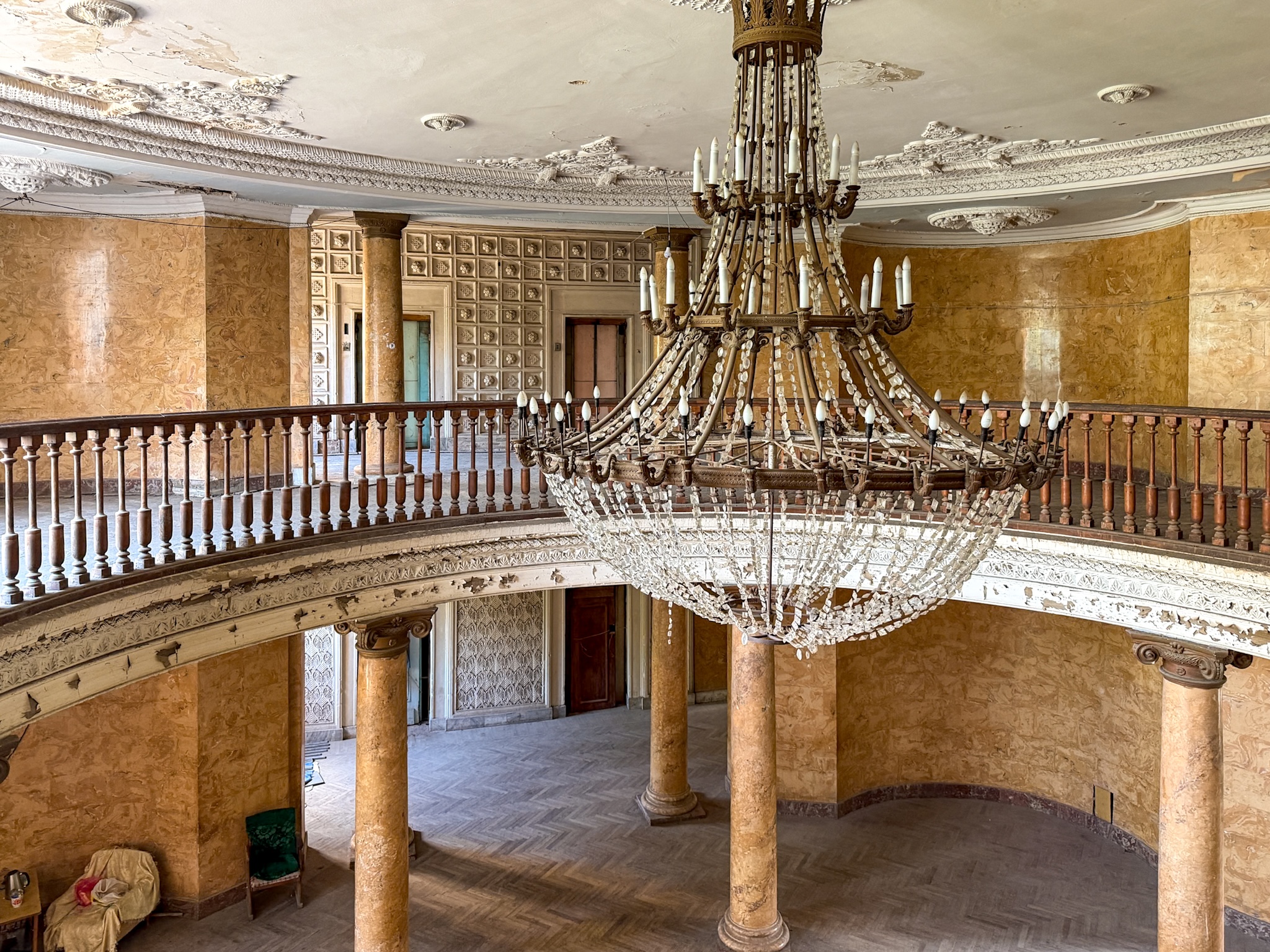
Chandelier, pink & blue elevator doors inside Metallurgist Sanatorium
7. Prometheus Cave
Best for: a cool, easy walk underground, and a good option on a rainy day.
- Cost: about 40 GEL (about $15), with an optional boat ride extra
- Time needed: 1 to 1.5 hours
- Getting there: 21 km (13 mi), about 30 minutes by car
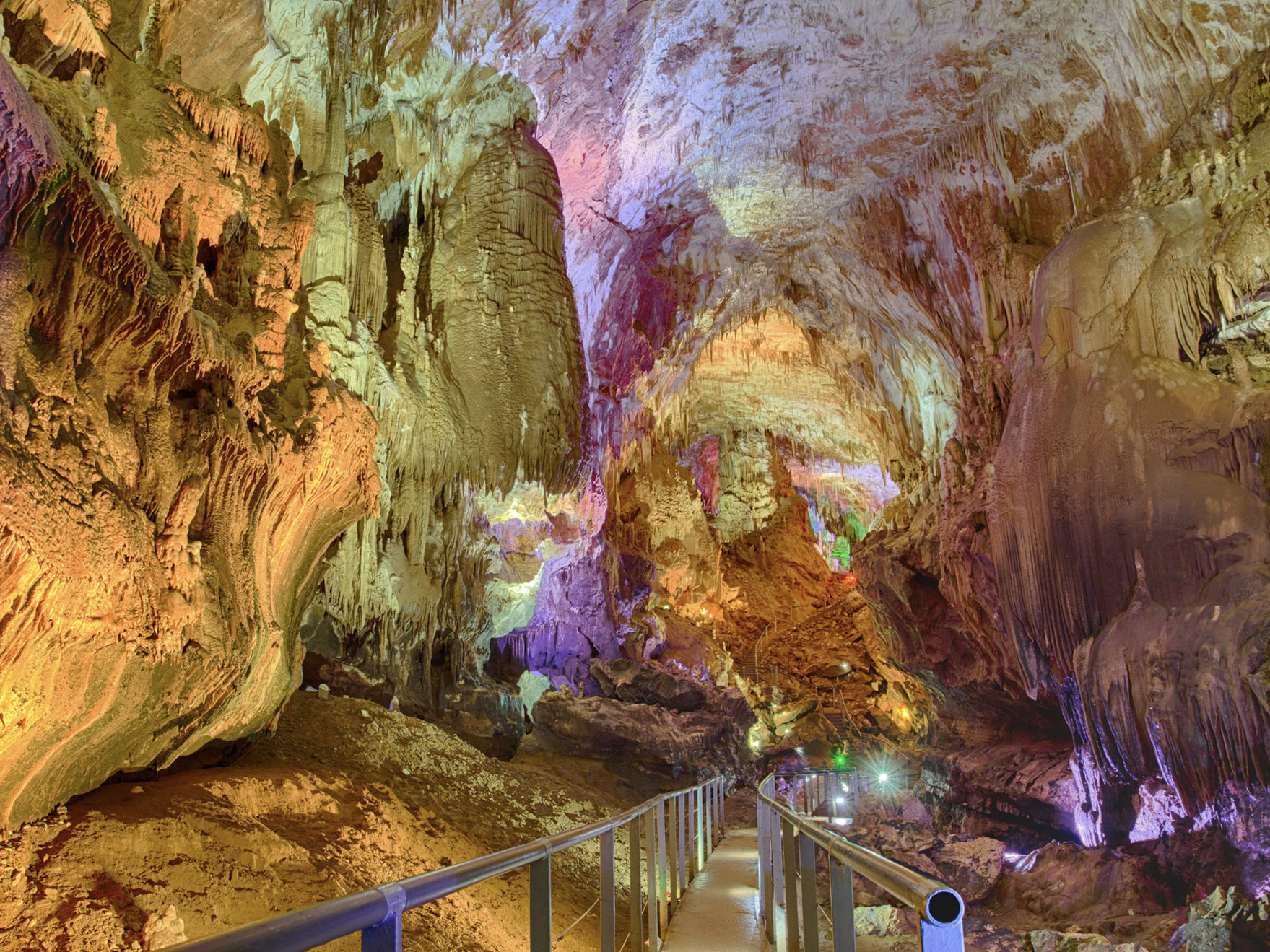
Prometheus Cave is one of the largest caves open to visitors in Georgia, discovered in the 1980s near the village of Kumistavi. You follow a lit walkway of about 1.4 km (0.9 mi) through six halls full of stalactites and stalagmites, with a guide. At the end, when the water level allows, there’s an optional boat ride on the underground river.
Inside it stays around 14°C (57°F) all year, so bring a light jacket even in August. It’s closed on Mondays. It’s on the same road as Okatse and Martvili, so most people visit it on the same day, and the canyons and cave day tour covers all three.
8. Okatse Canyon and Kinchkha Waterfall
Best for: walking on a metal walkway hanging over a deep canyon. It was my favorite stop of the trip.
- Cost: 30 GEL (about $11) for the canyon, 20 GEL (about $7) for the waterfall, 40 GEL (about $15) for both
- Time needed: about 45 minutes for the canyon walk, plus about 50 minutes for the waterfall
- Getting there: 46 km (28 mi), about 1 hour by car to the canyon. The waterfall is another 15 to 20 minutes up the road.
Okatse Canyon is a narrow gorge cut by the Okatse River. A metal walkway is bolted to the side of the cliff and hangs over the drop. The loop is 780 m (about 0.5 mi) long and takes about 45 minutes with photo stops. The first part is easy, and the way back is an uphill climb with very little shade, so go in the morning in summer. Parts of the walkway floor are see-through metal grid, so if you’re afraid of heights this one isn’t for you. Kids under 120 cm (3 ft 11 in) aren’t allowed on it. Buy your tickets at the visitor center in the village of Zeda Gordi, then drive about 5 minutes to the canyon entrance.
Kinchkha Waterfall, signposted locally as “Okatse Waterfall,” is a tall waterfall about 9 km (5.6 mi) further up the road. A short metal walkway takes you to the viewpoint.
-
-
All the details on tickets, roads and the walkway are in my full guide to Okatse Canyon and the waterfall.
-
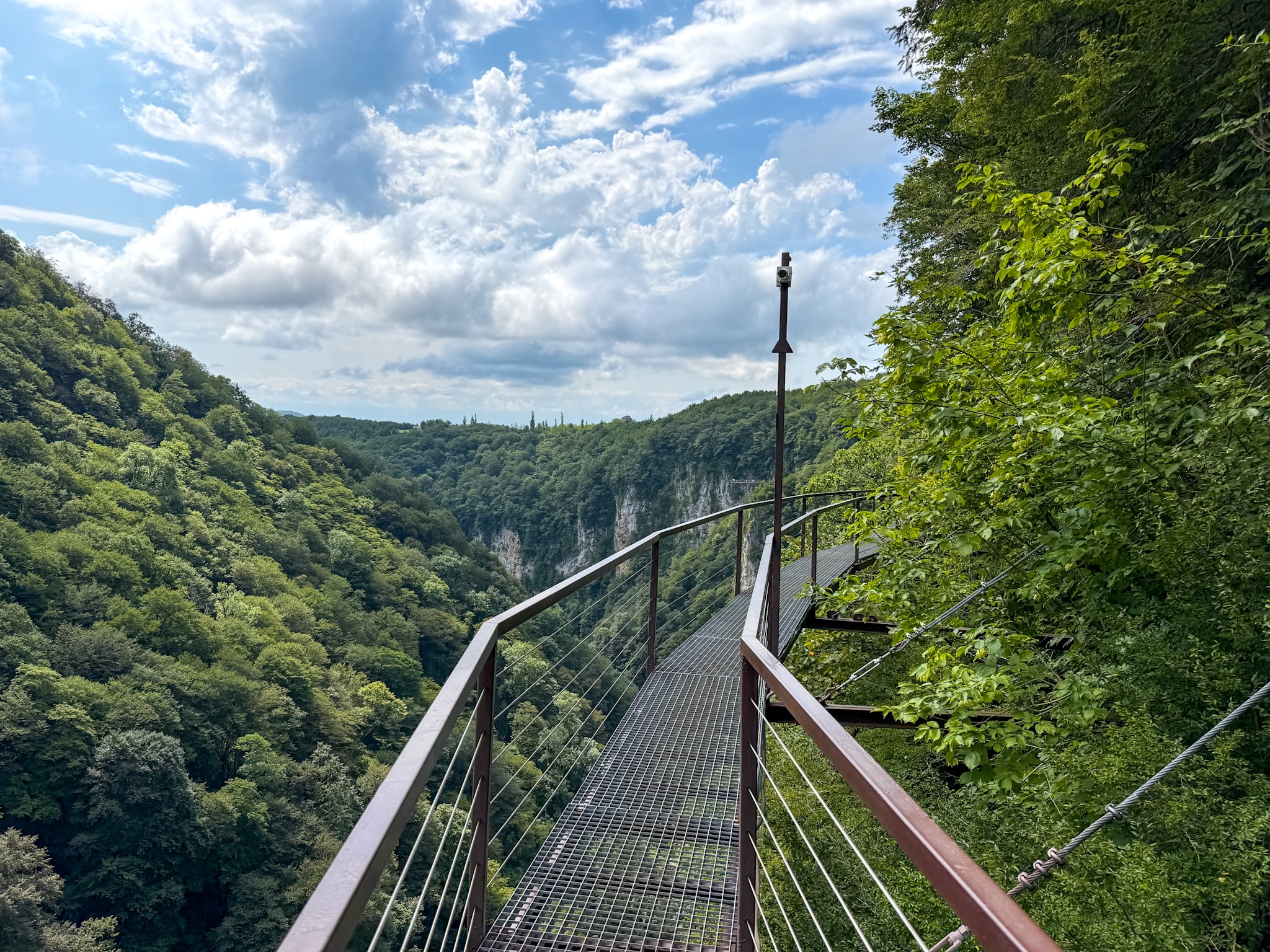
Suspended steel skywalk at Okatse Canyon
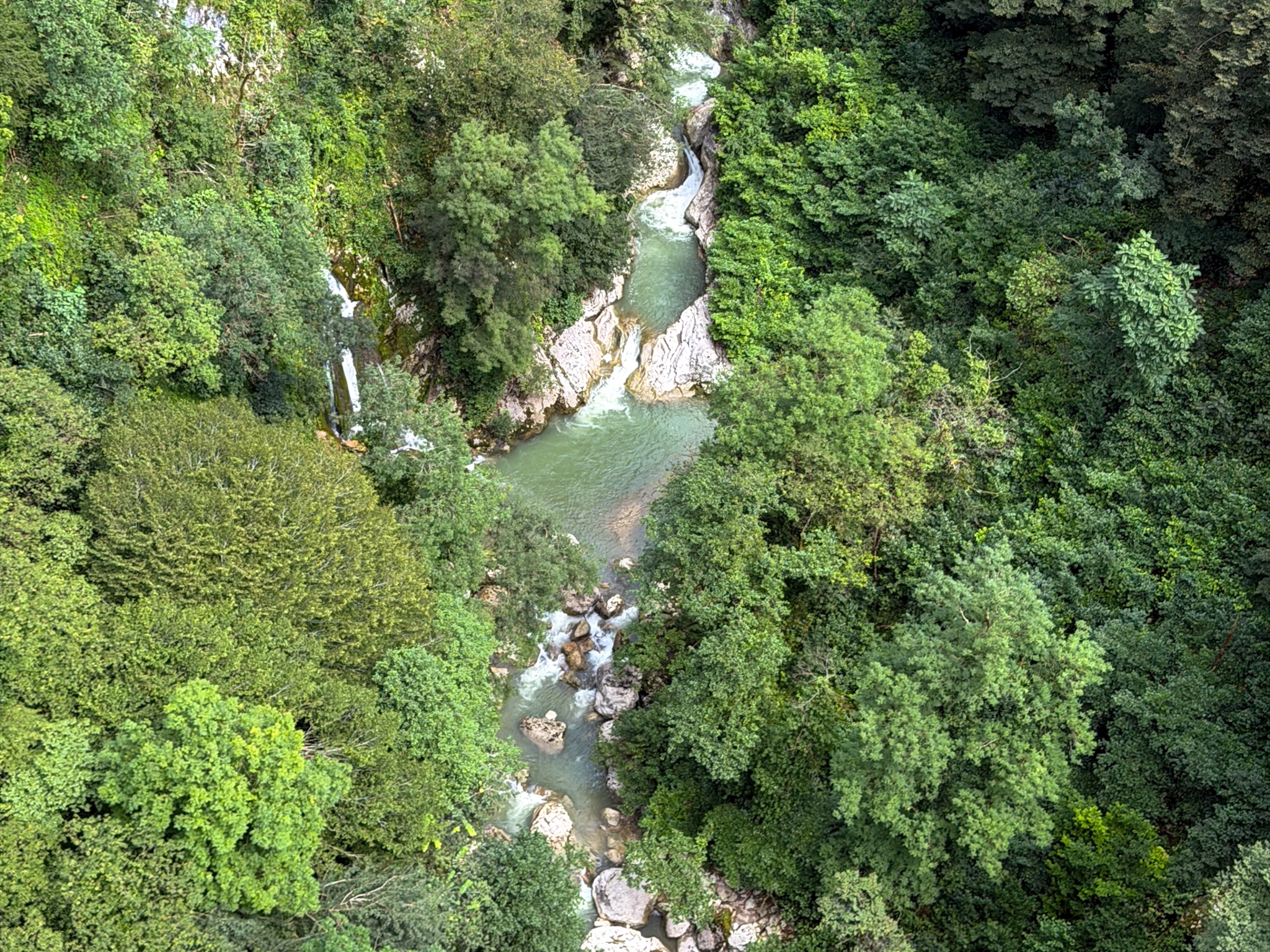
Okatse Canyon view
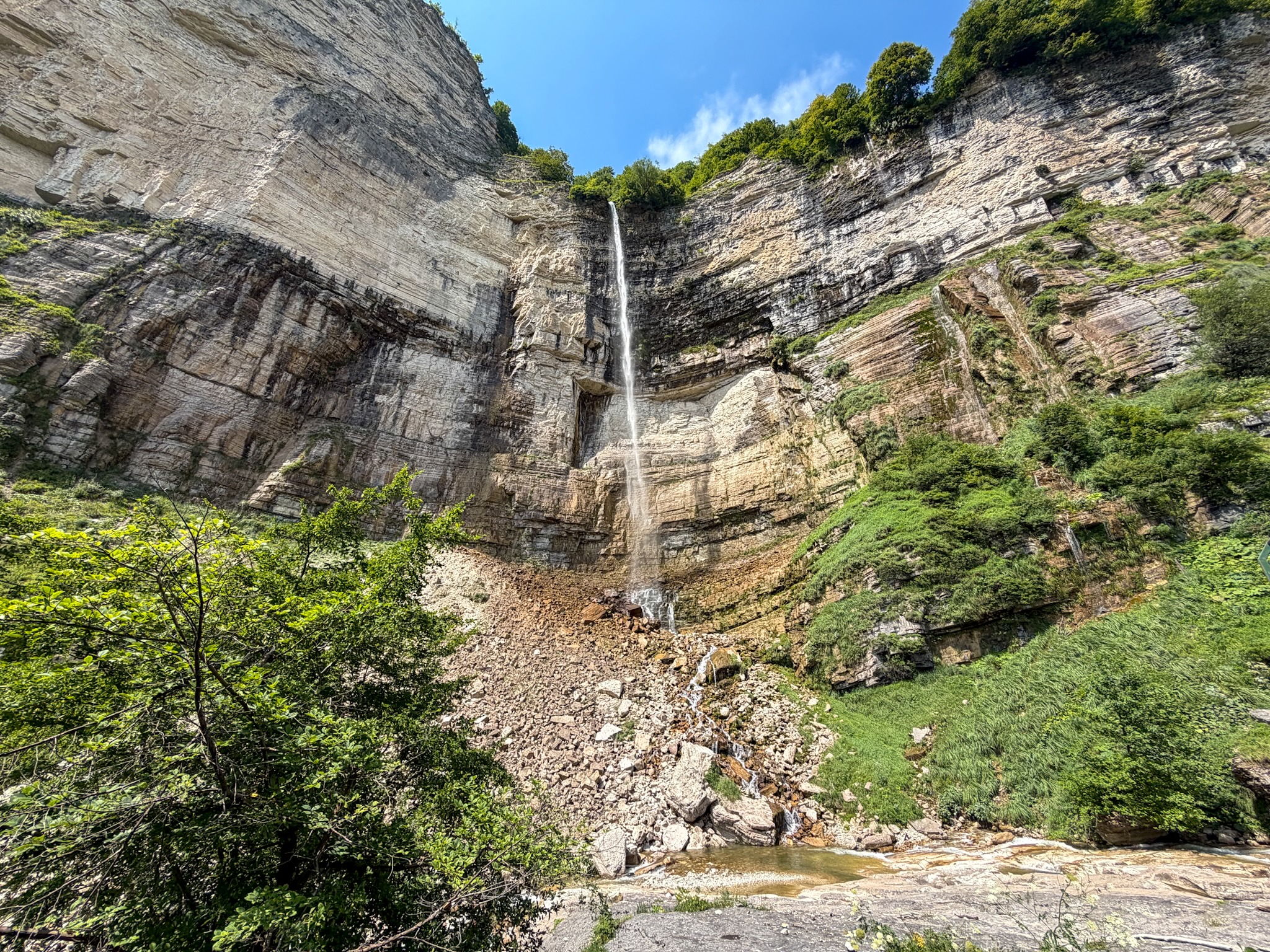
Okatse Waterfall (Kinchkha)
9. Martvili Canyon
Best for: turquoise water, small waterfalls and, if the river is calm, a short boat ride through the canyon.
- Cost: 40 GEL (about $15). The boat is extra, 20 to 30 GEL depending on the season.
- Time needed: about 45 minutes for the walk, plus about 20 minutes for the boat
- Getting there: 50 km (31 mi), about 1 hour 10 minutes by car
Martvili Canyon is a narrow, green canyon with bright turquoise water, once a private bathing spot of the Dadiani family, the old rulers of this region. A walking loop of about 700 m (0.4 mi) takes you along the river on stone steps and small bridges, with views of the waterfalls. At the main viewpoint we saw a small rainbow in the spray in the middle of the morning.
The famous part is the boat ride, an inflatable raft that goes about 300 m (1,000 ft) up the canyon and back. It only runs when the river is calm. On our day the water was too high, and the ticket office told us right away, so we paid only for the entrance. Ask before you buy the boat ticket.
Two tips. Get there at 10 am, when it opens, because it was already crowded by 10:30. And ignore the men waving you into car parks along the road. Those lots aren’t official, they cost more and they leave you with a long walk. Drive all the way to the visitor center, where the official parking is right next to the ticket office.
-
-
I explain the parking scam and the boat in more detail in my Martvili Canyon guide, with everything to know before you go.
-
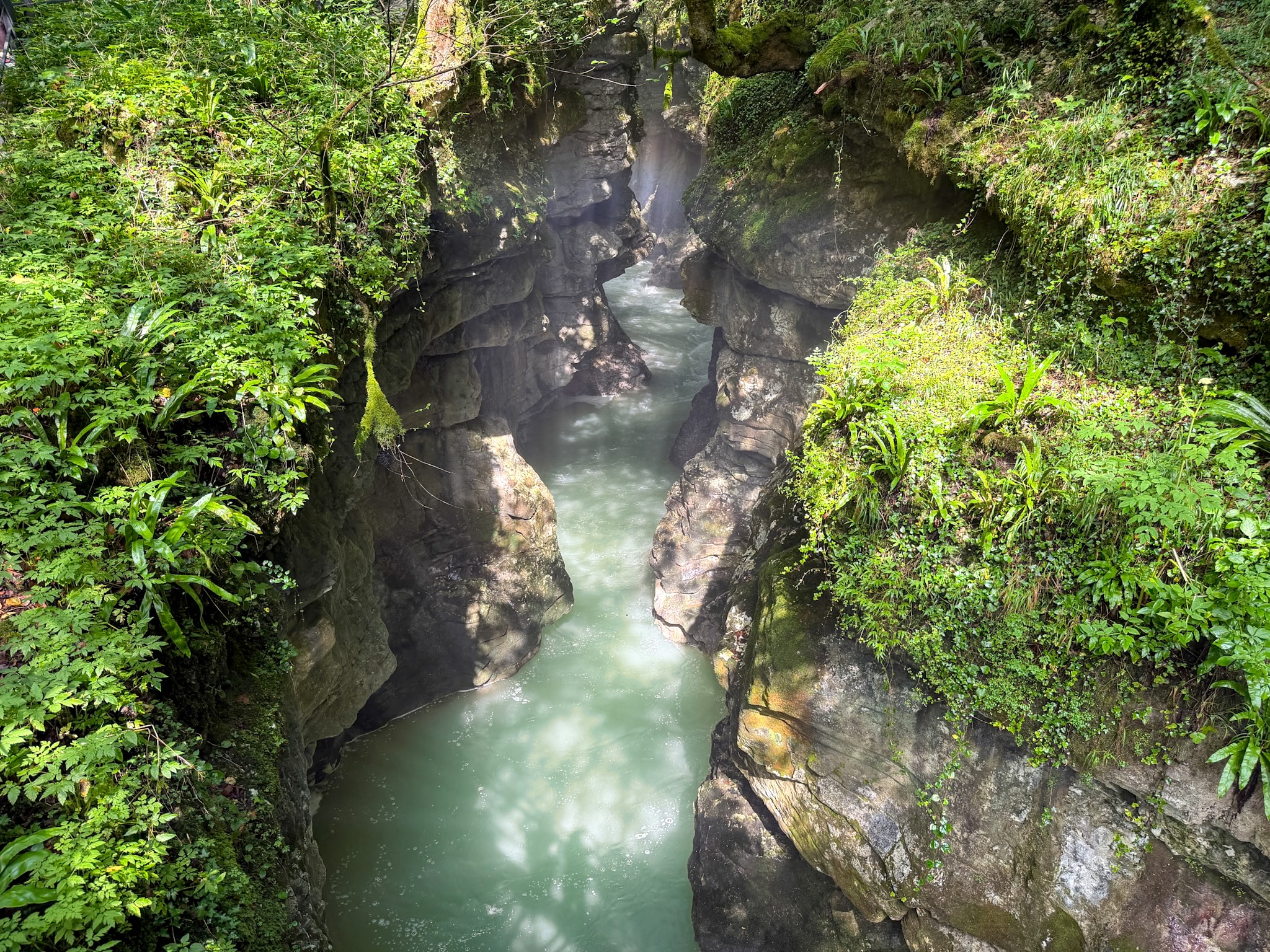
Martvili Canyon, Kutaisi
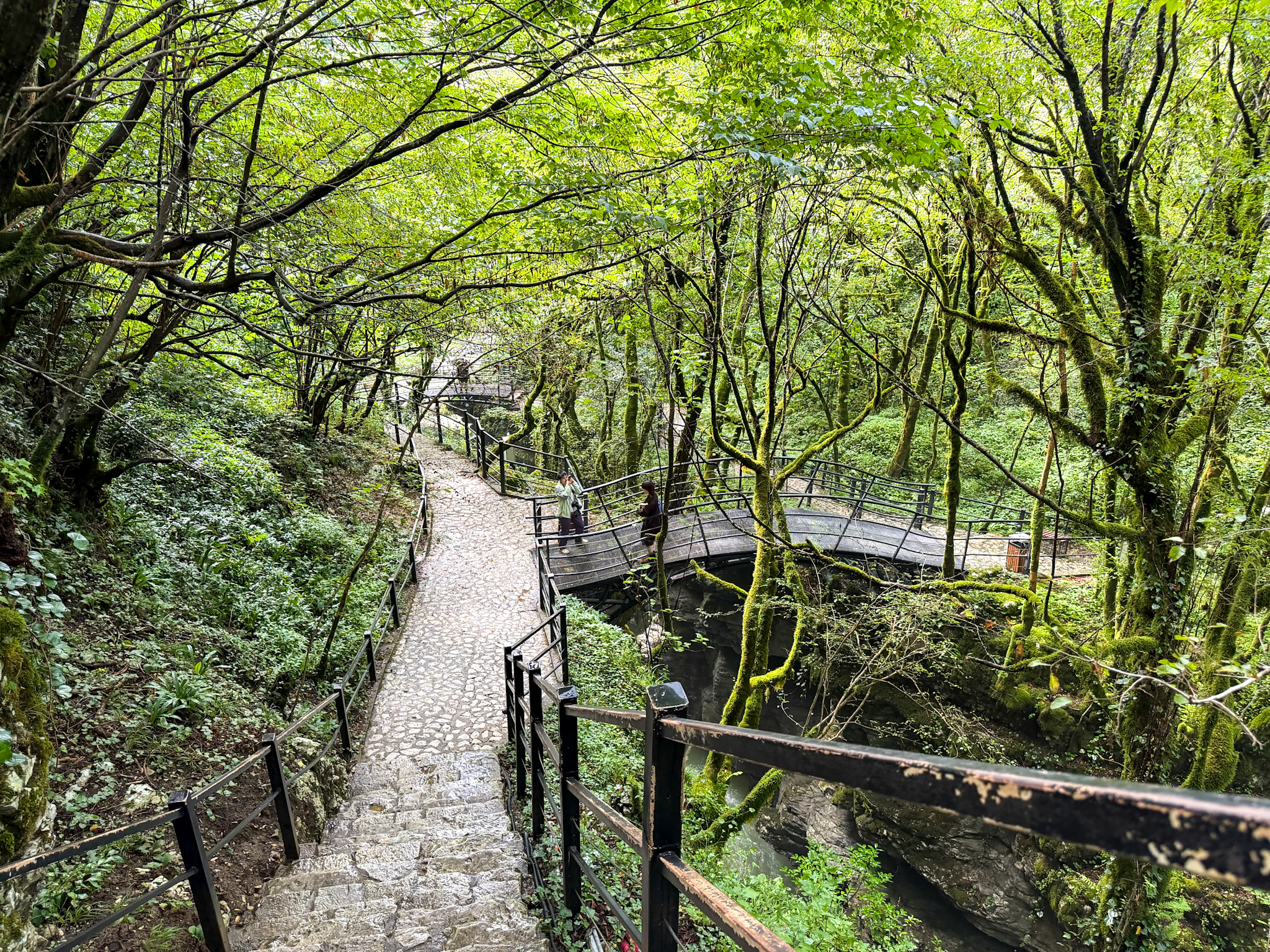
Martvili Canyon walking path
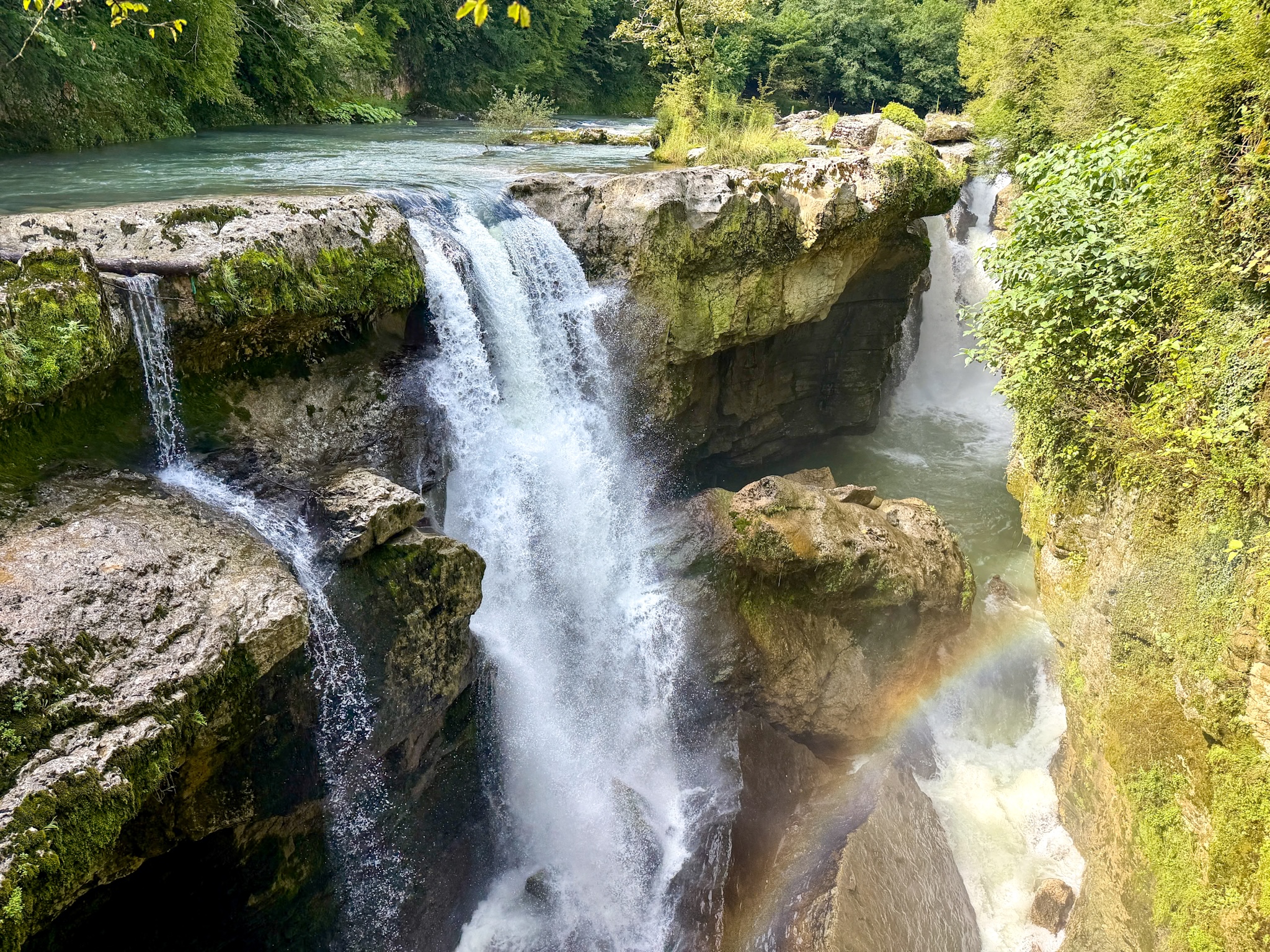
Martvili Canyon waterfall viewpoint
10. Katskhi Pillar
Best for: one of the strangest sights in Georgia, and an easy stop on the drive between Tbilisi and Kutaisi.
- Cost: free, including the small museum
- Time needed: about 1 hour
- Getting there: 67 km (41 mi), about 1 hour 15 minutes by car. It’s roughly on the way if you’re driving from Tbilisi.
Katskhi Pillar is a limestone column about 40 m (131 ft) high, standing alone in a green valley, with a small church on top. Monks lived up there for centuries. The church was rebuilt in the 2000s, and a monk named Maxime lived at the top for about 20 years. Visitors can’t climb it. Since 2018 only monks are allowed up.
We stopped on our drive from Tbilisi to Kutaisi. From the free car park, it’s a 5-minute walk uphill to the base. There you can see the metal ladder that goes up the side, visit a small church at the foot of the pillar and step into a free one-room museum with things found at the top. To enter the church, women need a headscarf and a skirt, and there’s a basket of them at the museum.
-
-
The history is much more interesting than what most guides say, and I dug into it in my Katskhi Pillar guide, with the real story of the monks.
-
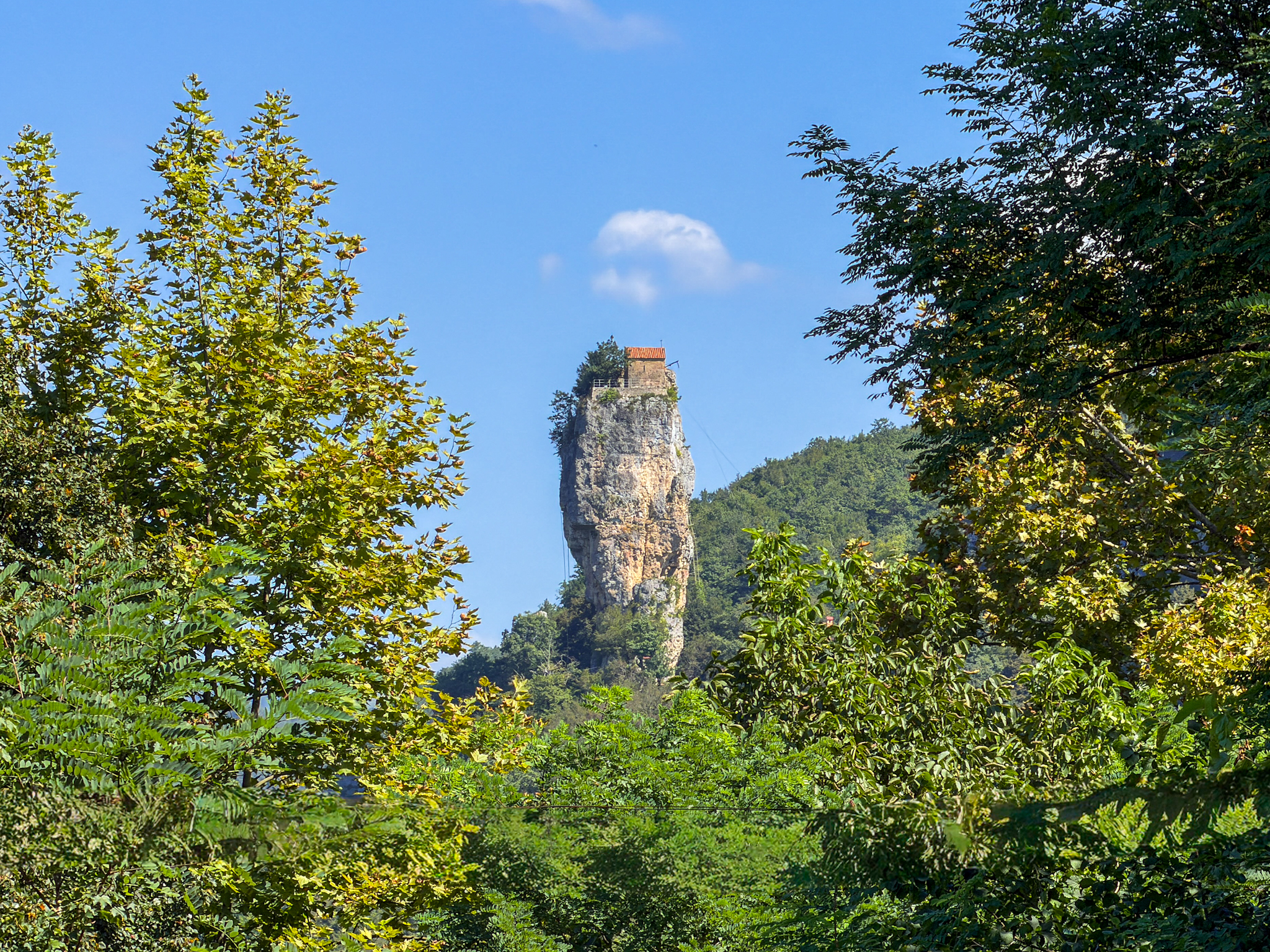
Katskhi Pillar view from the street
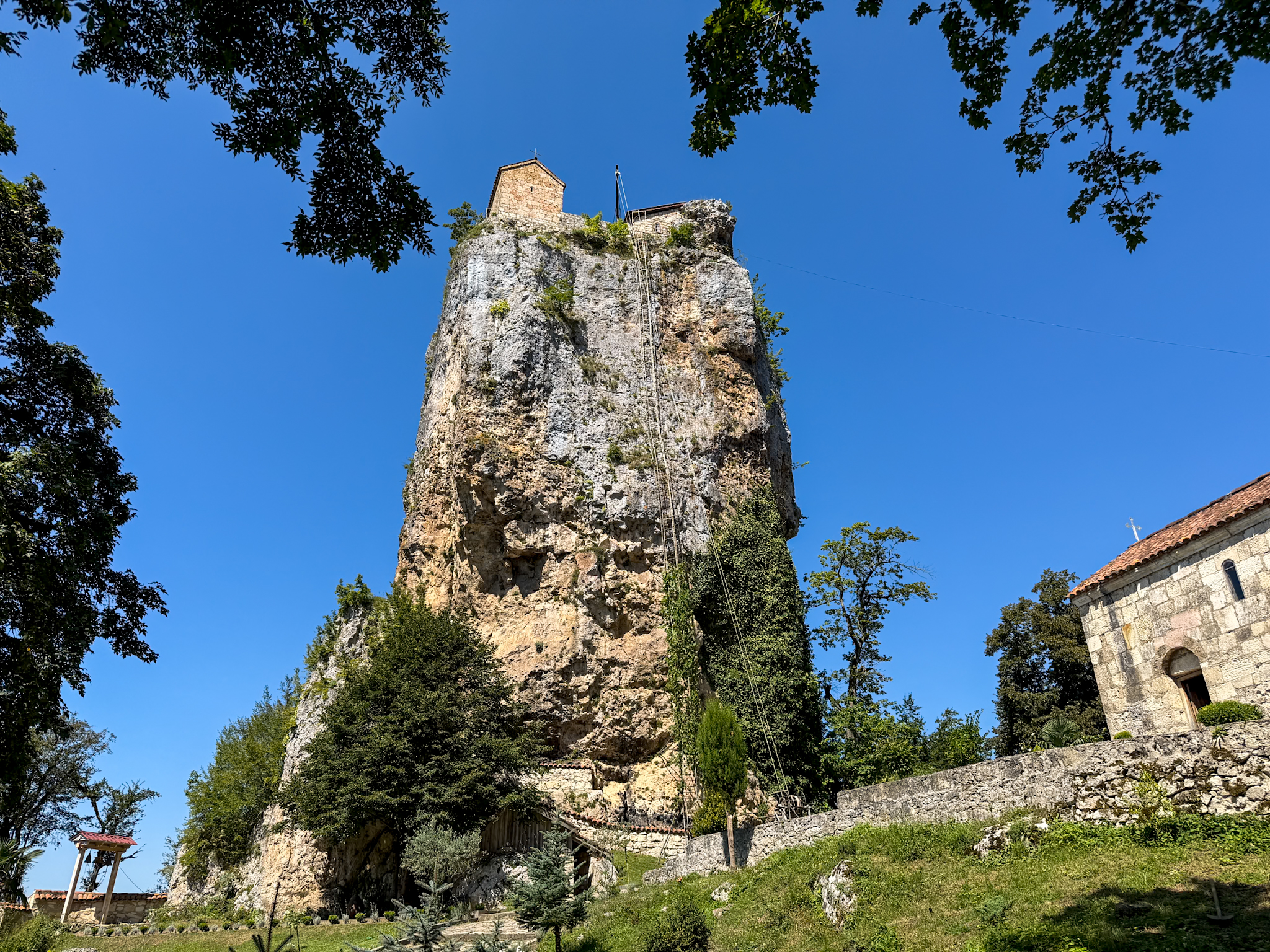
Katskhi Pillar view from below
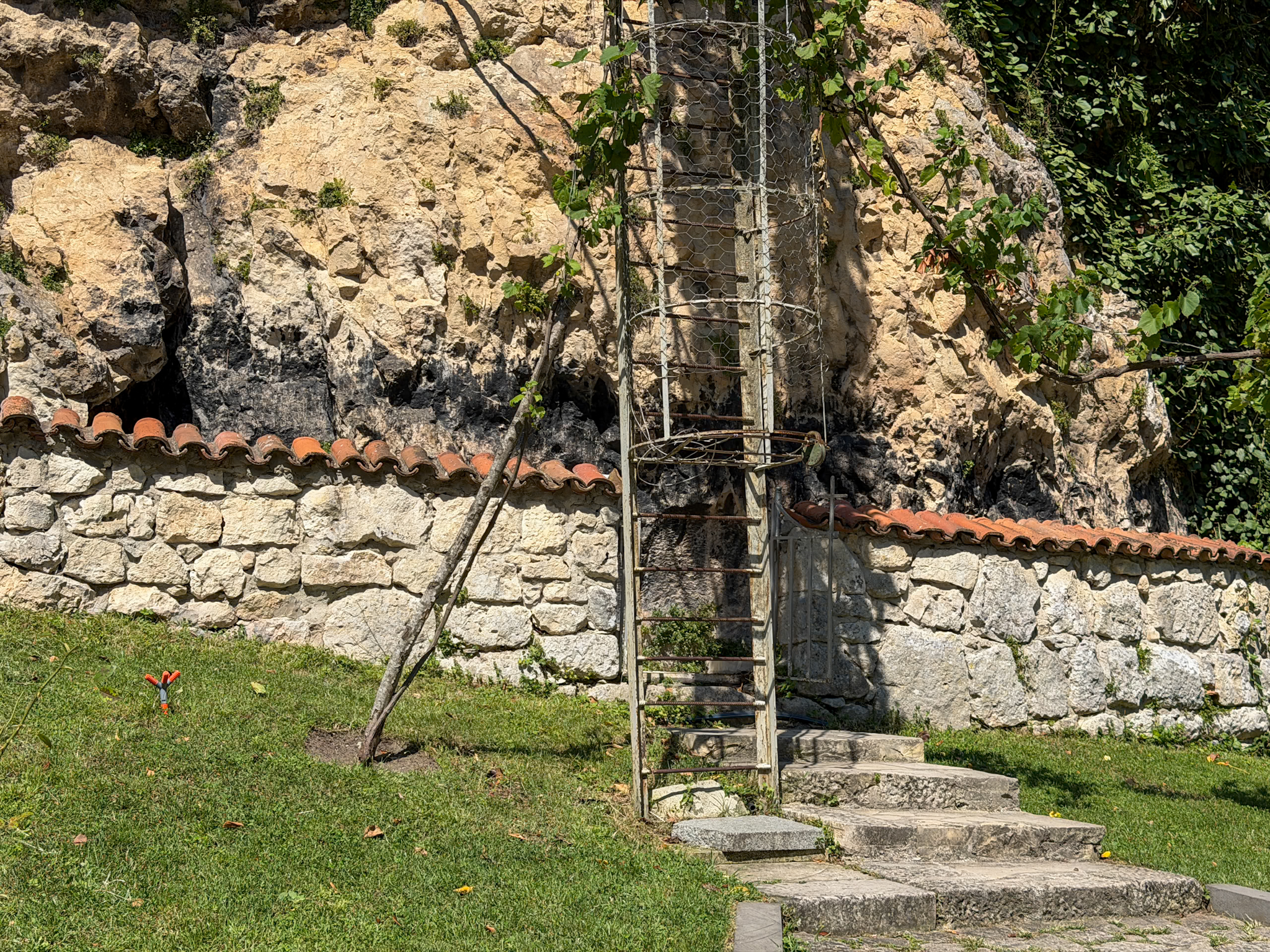
The bottom of the monks’ ladder, with its wire-mesh cage
How Many Days in Kutaisi: A 2-Day Plan
Two days is the minimum I’d give Kutaisi to see the city sights and all the day trips at an easy pace. This plan follows the map: one day around the city, one day on the road north toward the canyons.
Day 1: monasteries and the city
- Morning: drive out to Gelati and Motsameta, 10 minutes from the center. Gelati opens to visitors only on weekends and holidays during the restoration, so try to make Day 1 a Saturday or Sunday. On a weekday, go to Tskaltubo for the morning, 20 minutes away in the other direction.
- Afternoon: Bagrati Cathedral, then the Botanical Garden just down the road. Leave the car at the hotel and take a Bolt up the hill.
- Evening: walk to the Colchis Fountain once it’s lit up, then down to the White Bridge and the cable car, and finish with dinner in the center.
Day 2: canyons and the cave
- Morning: be at Martvili Canyon when it opens at 10 am, before the crowds. Then drive about 40 minutes to Okatse Canyon, and on to Kinchkha Waterfall.
- Afternoon: stop at Prometheus Cave on the way back to Kutaisi, about 30 minutes from the city. If it's not too late, you can also add here a late afternoon visit to Tskaltubo, which is on the same road.
Katskhi Pillar is about 1 hour 15 minutes east of Kutaisi, so it doesn’t fit well into either day. The easiest way is to stop there on the drive between Tbilisi and Kutaisi, like I did.
Where to Eat and Stay in Kutaisi
Where to Eat: Best Restaurants in Kutaisi
We had dinner at two restaurants in Kutaisi and liked both. Both serve Georgian food, and both were full in the evening, so book ahead.
Doli is the restaurant of the Communal Hotel, in the center. We ordered pkhali, a cold starter of chopped vegetables mixed with walnut paste. With it we had Imeruli khachapuri, the round, flat bread filled with melted cheese that comes from this region, cut into four like a pizza. We also had vegetable mtsvadi, Georgian grilled skewers, here made with eggplant, zucchini, peppers and mushrooms under a green herb sauce. And khinkali, big dumplings filled with meat and broth. You hold them by the knot on top, bite a small hole and drink the broth first.
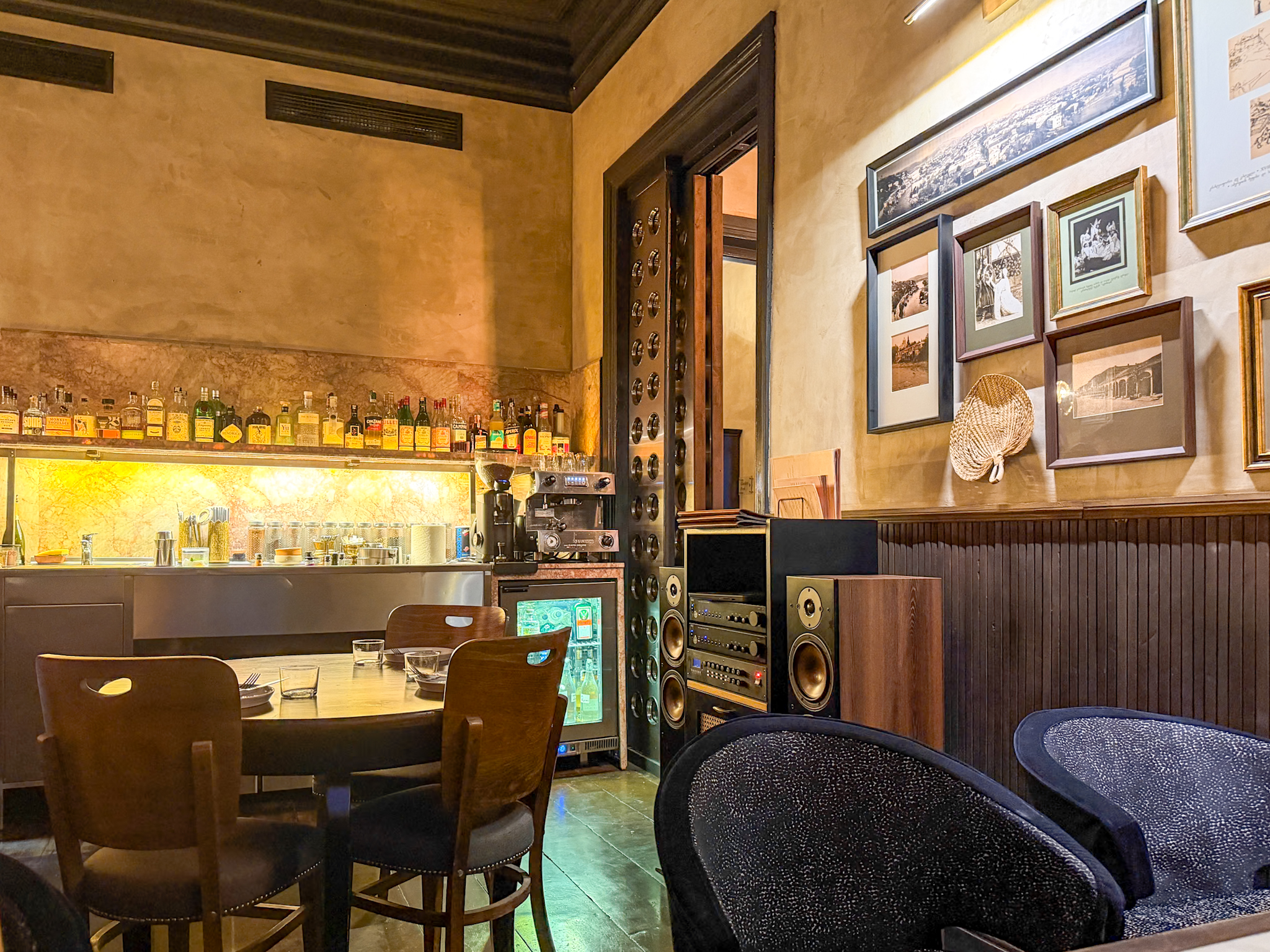
Doli Restaurant in Kutaisi
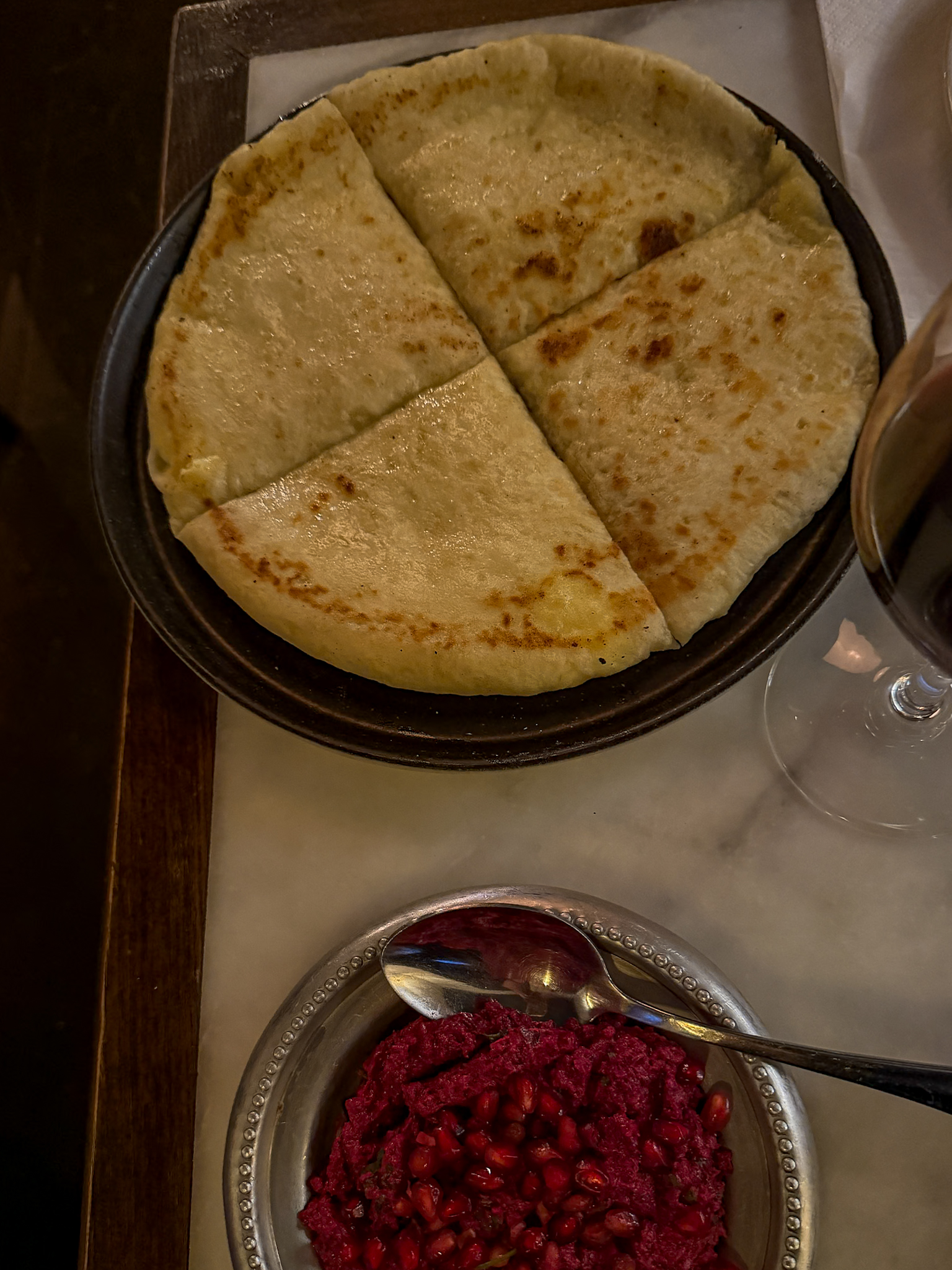
Imeruli khachapuri
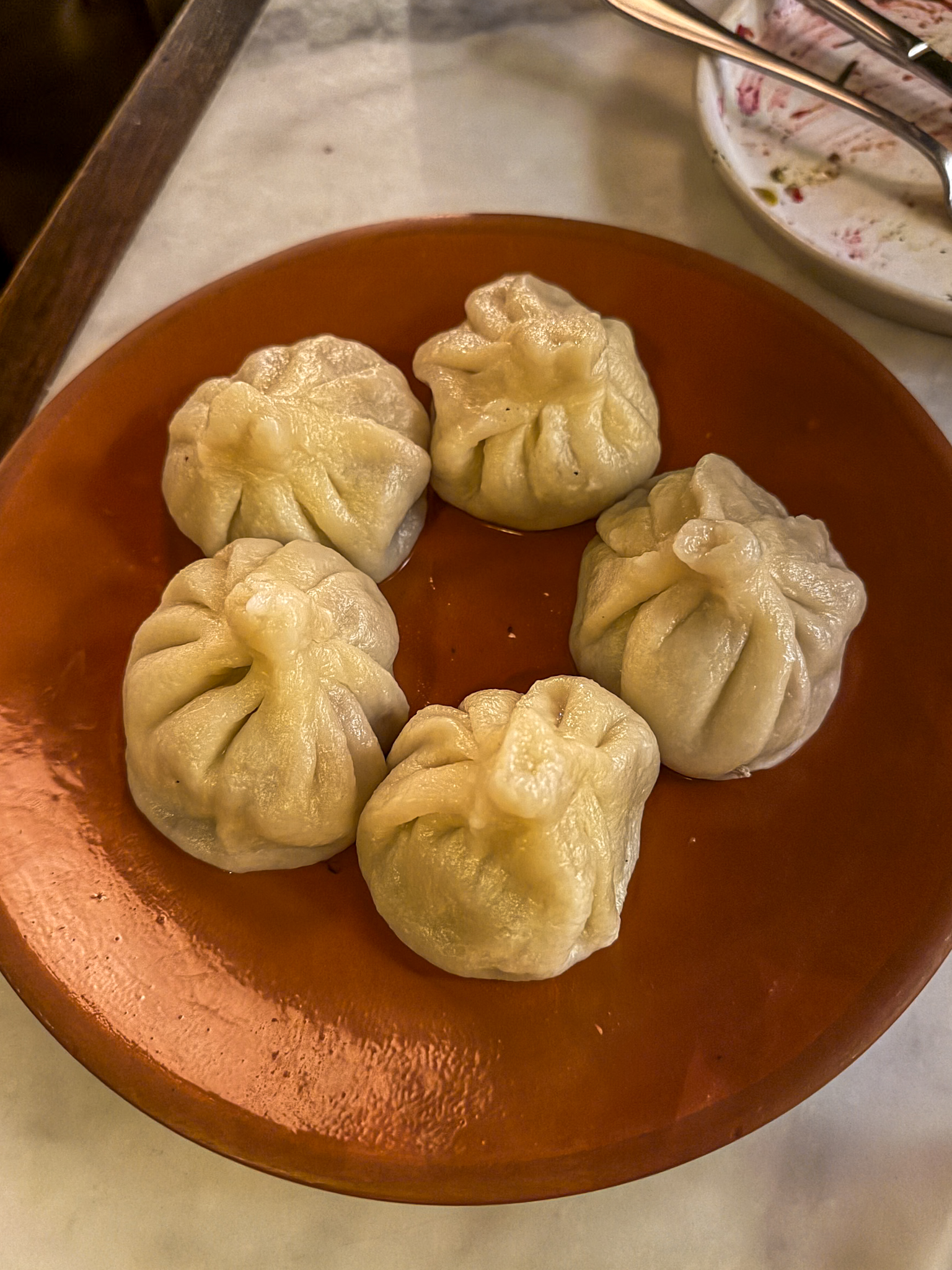
Five khinkali dumplings on a terracotta plate
Sisters is on the second floor of a pink building on the edge of the central park, a short walk from the Colchis Fountain. The dining room is full of vintage furniture, and one wall is covered in notes guests have written by hand. We had a creamy mushroom soup with grated cheese, and chikhirtma, a Georgian chicken soup thickened with egg and topped with fresh herbs. To drink we tried a craft pale ale from Otia’s Brewery, a small brewery in Tskaltubo.
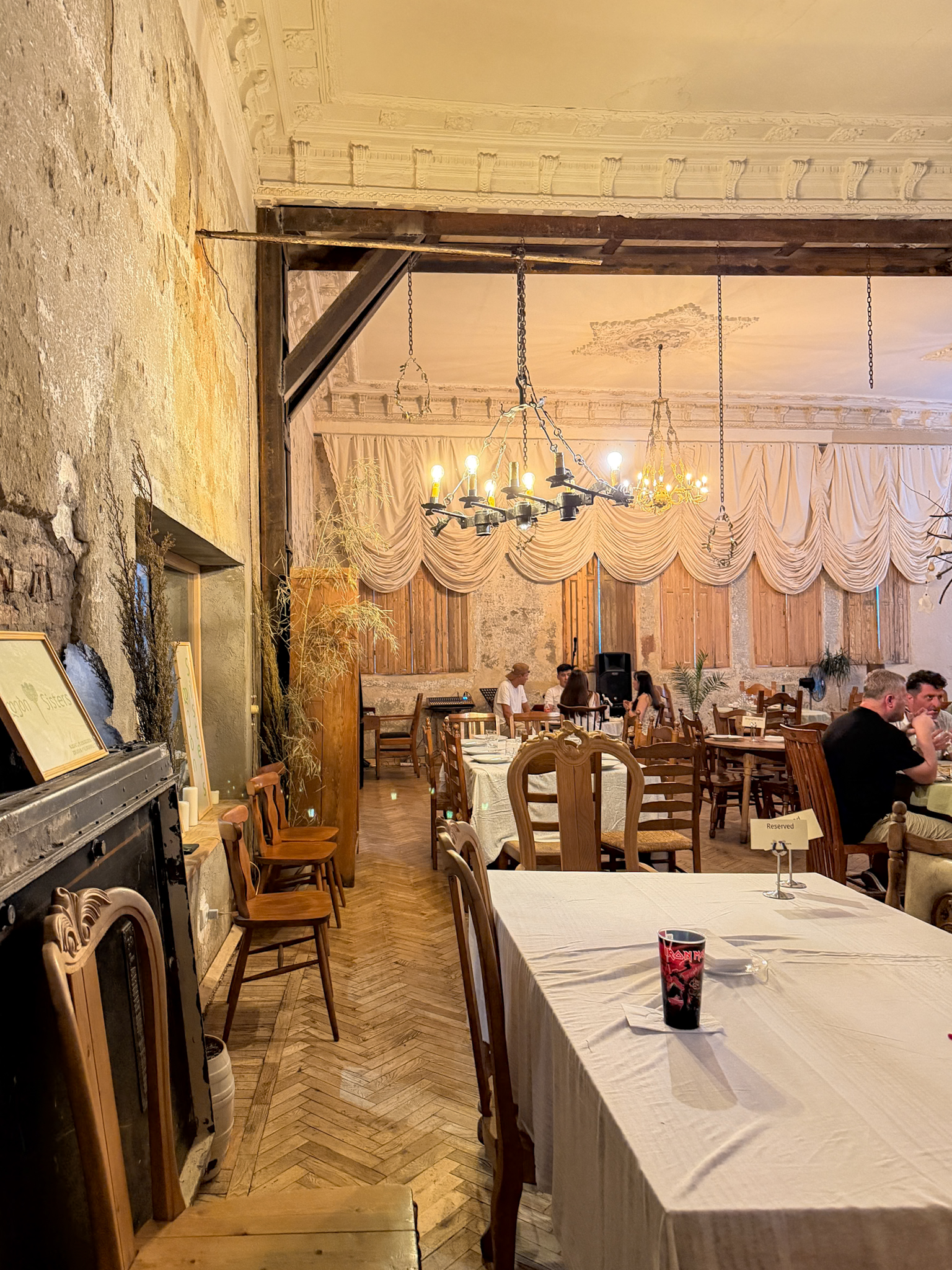
Sisters Restaurant in Kutaisi
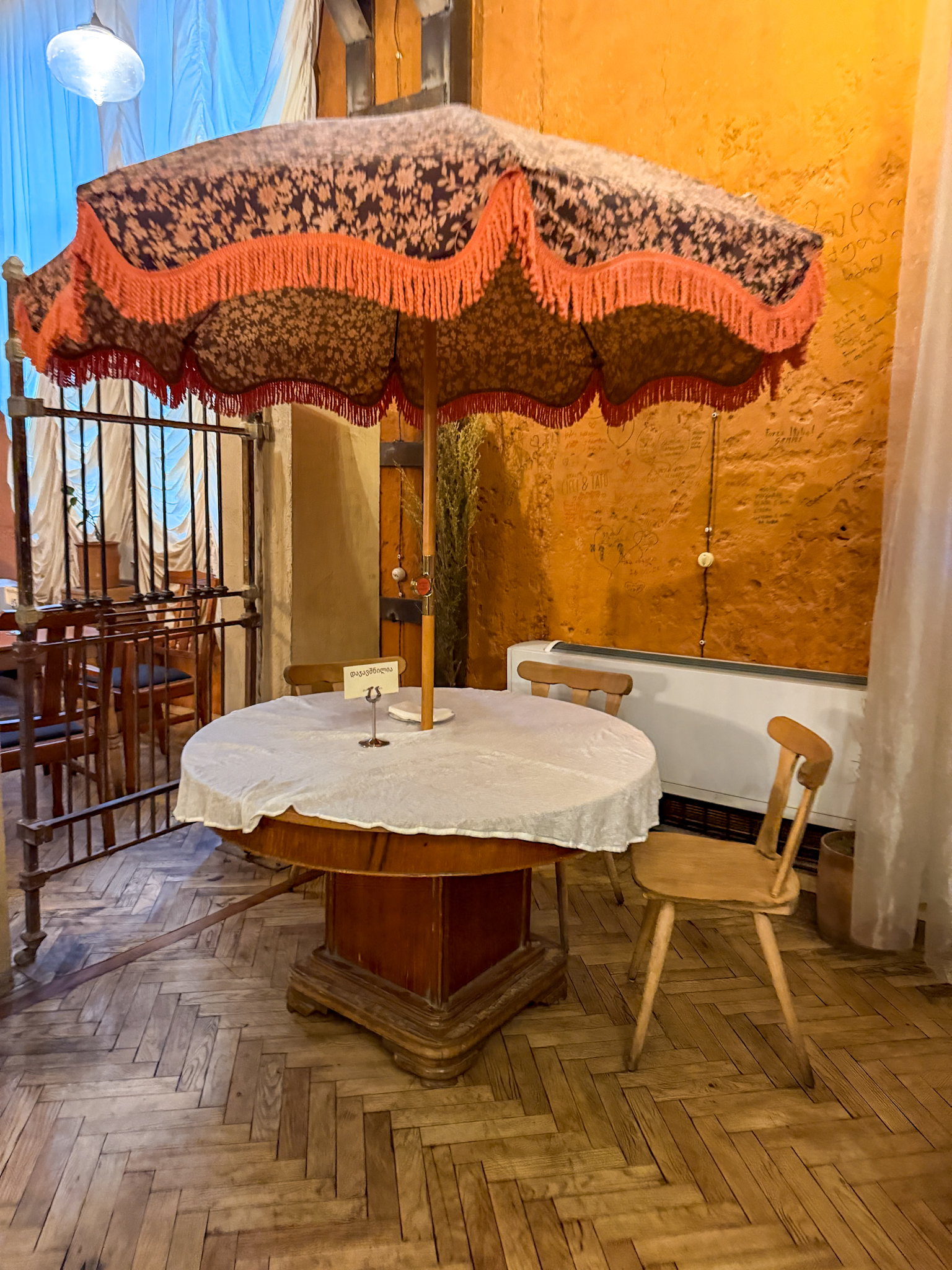
Table setting at Sisters Restaurant
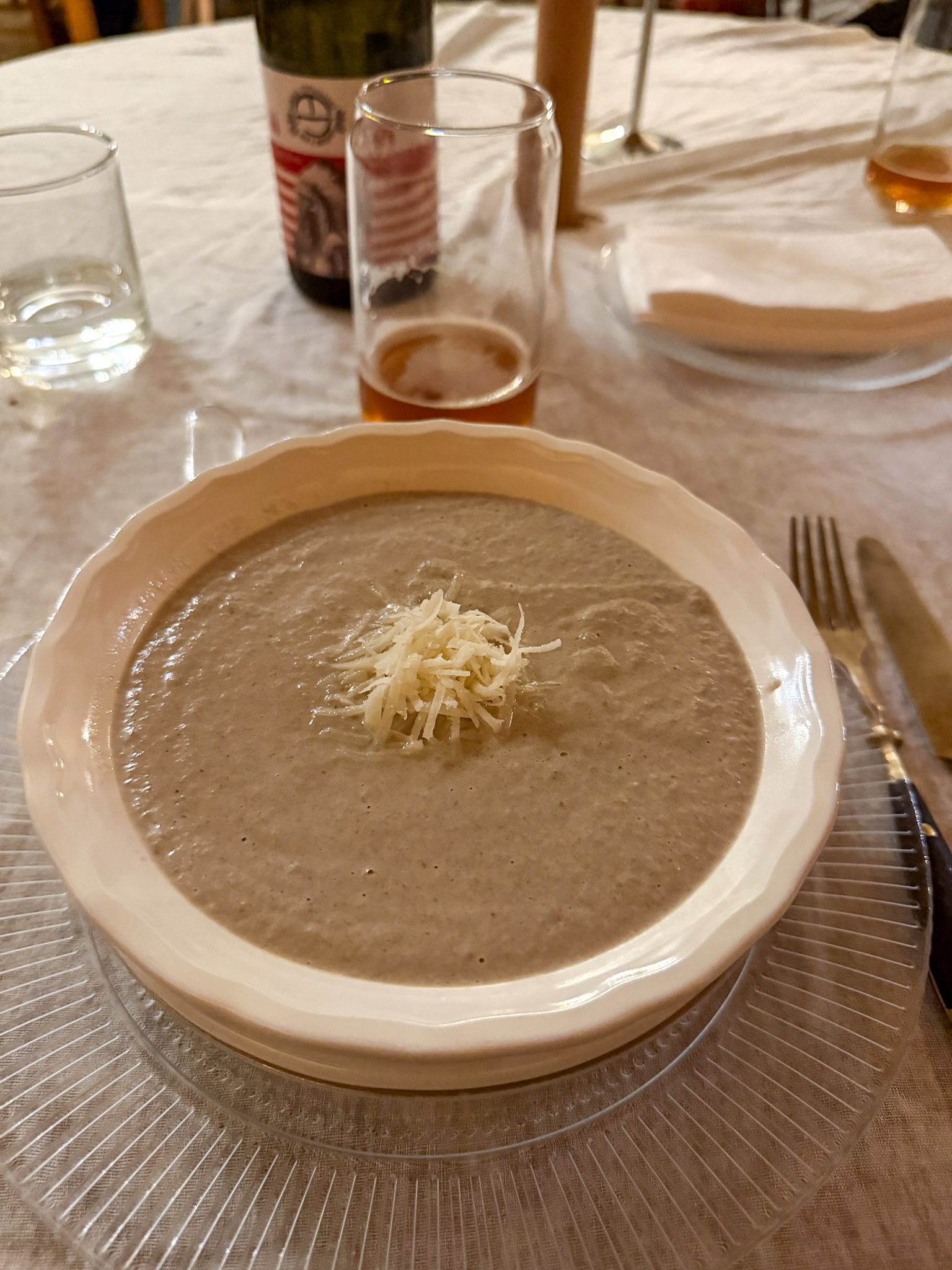
Mushroom soup at Sisters, with a local craft beer from Tskaltubo
Where to Stay
We slept in two hotels in Kutaisi, both in the center and within walking distance of the fountain.
- Newport Hotel Kutaisi ⭐⭐⭐⭐: right next to the Colchis Fountain, with the comfort you’d expect from an international hotel. Best if you want an easy, reliable base.
- Hotel Memoire Kutaisi ⭐⭐⭐: a smaller hotel with a more local Georgian feel and a very particular style. Best if you want somewhere with more character.
FAQ
Can you visit Kutaisi as a day trip from Tbilisi?
You can, but I wouldn’t. The drive is about 220 km (136 mi) and takes around 3.5 hours each way, so you’d spend seven hours on the road and barely see the city. Kutaisi works much better with at least one night, and two if you want the day trips.
Can you do the day trips from Kutaisi without a car?
Some, yes. Marshrutka number 30 (marshrutkas are the shared minivans used all over Georgia) leaves for Tskaltubo from the end of the Red Bridge about every 20 minutes. For Martvili, minibuses leave from Kutaisi Central Bus Station roughly every hour between 8 am and 6 pm, and you take a taxi for the last 5 km (3 mi) from Martvili town. No public transport goes to Kinchkha Waterfall. For the canyons and the cave, a tour for the day is much easier.
Do you need cash in Kutaisi?
Carry some. The ticket offices at Martvili and Okatse take cards, and so did the Botanical Garden. Small cash in lari is useful for donations at churches and at the Tskaltubo sanatoriums, for parking at Martvili and for small cafés along the way.
Can you go from Kutaisi to Svaneti?
Yes, Kutaisi is the usual starting point for Svaneti, the mountain region in the north of Georgia. It’s too far for a day trip, though: Mestia, the main town, is about 5 hours away by road. I’ve put together every way to get to Mestia from Kutaisi, Tbilisi and Batumi. We went with a private tour that picked us up in Kutaisi, and you can read my review of the 3-day Megobari tour through Svaneti.