My experience visiting Paestum's Greek temples, from getting there and buying tickets to walking the ruins step by step, practical tips included.
When I visited the Parthenon a few years ago, I spent most of my time dodging tour groups and trying to get a view of that beautiful temple without someone's selfie stick in it. Paestum, on a random Tuesday morning in June, was nothing like that.
For long stretches I had three Doric temples older than the Colosseum pretty much to myself. This UNESCO World Heritage Site is on Italy's Cilento coast, an easy day trip if you're coming from Naples, and somehow still not that well known.
Here's what my day in Paestum archeological site looked like, from getting there to walking through the temples one by one.
Paestum at a Glance
- Hours: 8:30 am–7:30 pm in summer, shorter in winter (it shifts month to month, so double check the official website before you go)
- Tickets: €15 March–November, €10 December–February, covers the park, the museum, and the Velia site, valid for 3 days
- Time needed: 2–4 hours for the temples and museum together
- Best time to visit: April–June or September–early November, to dodge the worst of the heat and the crowds
- One thing to know: there's almost no shade on site, so a hat and sunscreen aren't optional
Where Is Paestum, Italy?
Paestum sits on the Cilento coast in Campania, about an hour south of Salerno and just over 100 km south of Naples. If you're based in Naples or along the Amalfi Coast for a few days, it's a realistic day trip.
The Greeks founded it around 600 BC as Poseidonia, named after Poseidon, before the Romans eventually took over and renamed it Paestum.
It changed hands a few more times after that, and then a nearby river turned the area into a malaria-ridden swamp, so Paestum was essentially left to rot until the 1700s. That's actually part of why they're so well preserved, nobody built over them while they were forgotten.
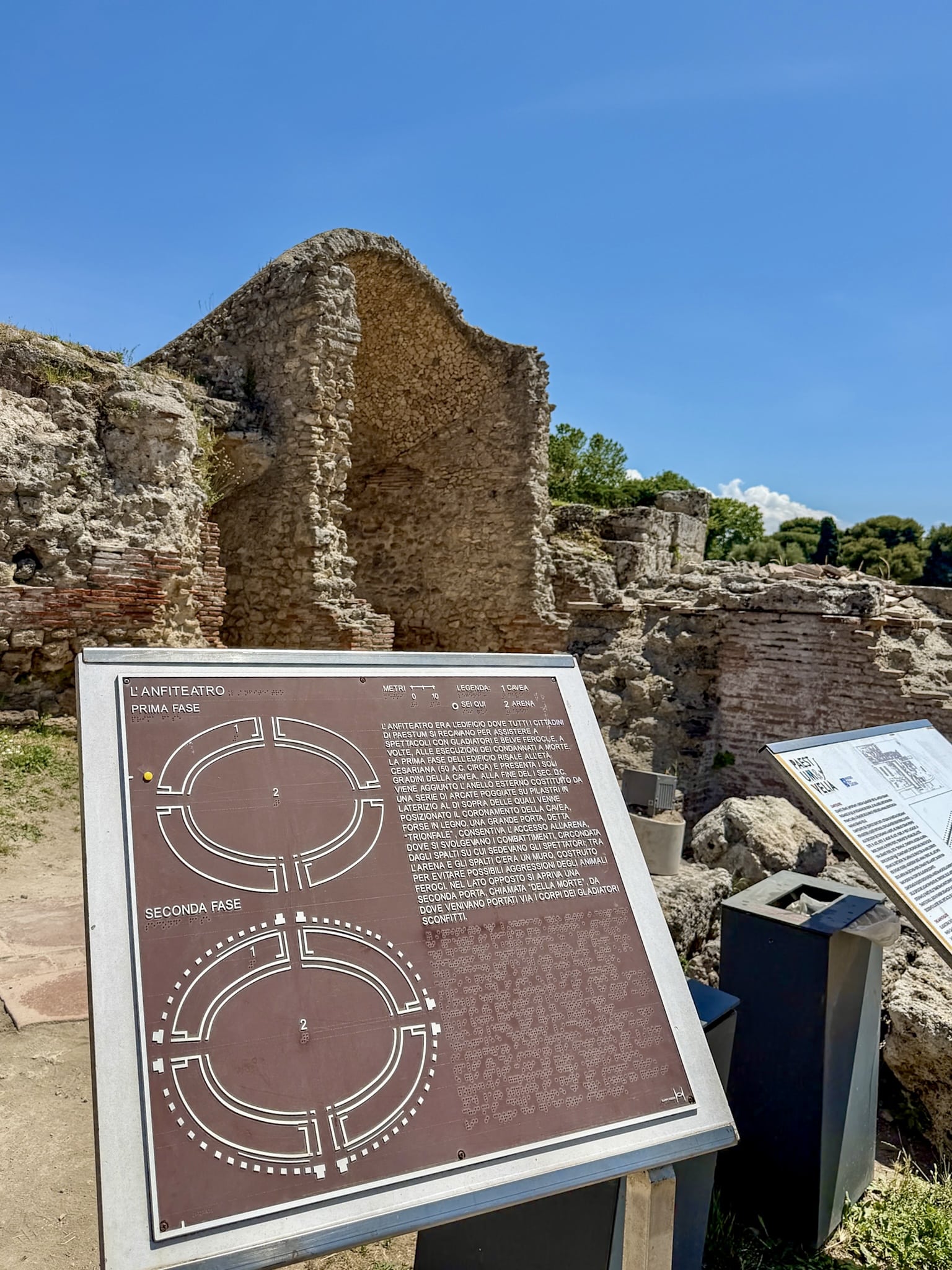
When King Charles III of Bourbon ordered a new road built straight past the ruins, that road finally put Paestum back on the map, literally. European travelers on the Grand Tour started detouring here just to see the temples. You can still see traces of that history today, as part of the old Roman amphitheater is sliced clean in half by the modern road running through the site.
How to Get to Paestum
There are three realistic ways to get here: driving, taking the train, or joining an organized tour.
By car
This is how I did it, and it's straightforward. From the north, take the A2 highway to the Battipaglia or Eboli exit, then follow the SS18 south toward Paestum. I parked in one of several parking lots just a few minutes' walk from the entrance, without any trouble finding a spot. It does get a bit more crowded on Saturdays and Sundays between July and August.
By train
If you don't have a car, Paestum has its own train station, about 15 minutes on foot from the ruins. It's best reached through Naples Centrale, which sits on Italy's high-speed network, so you can get here from almost anywhere in the country with one change.
Since your exact connection depends on where you're starting from, just plug your departure station and "Paestum" into Google Maps and it'll lay out every combination for that day. I'd also use the Trenitalia app (the national railway system) to book the return ticket ahead of time, since there’s just a slow ticket machine at the station, no staffed counter.
The walk from the station is pleasant: a straight country lane, past some fields, without much traffic. There's no cover if it rains though, so keep that in mind.
On a tour
Plenty of organized day trips run to Paestum, mostly departing from Naples, cruise-port pickups included, often paired with a stop at a buffalo mozzarella farm. If you're already staying further south on the Cilento coast, like in Palinuro, local operators run their own half-day excursions up to Paestum too, so you don't need a car even coming from that far out.
Buying Tickets for the Paestum Temples
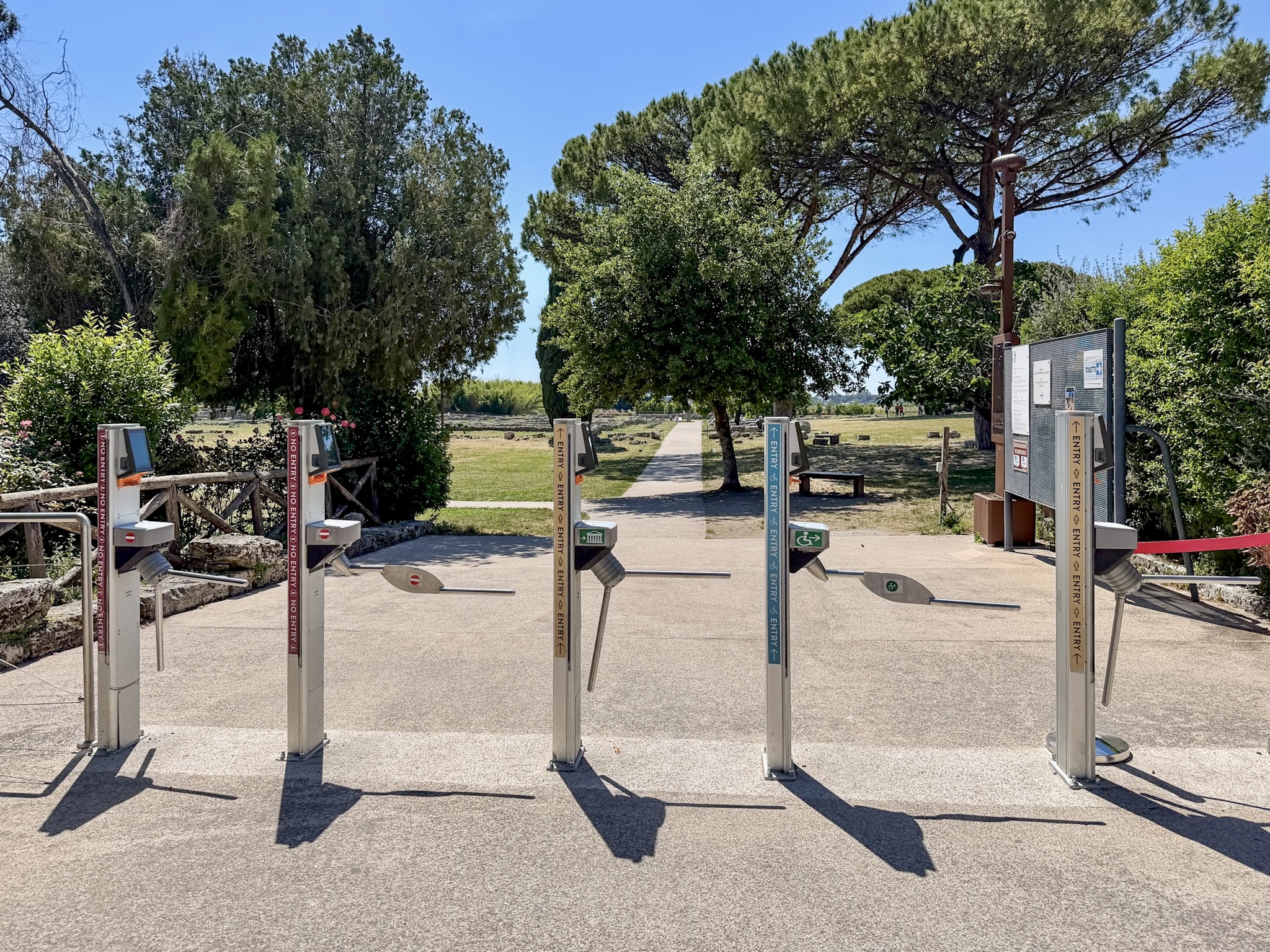
Paestum has two entrances, each with its own ticket booth:
- The first is Porta Principale (‘Main Gate’), which faces the Temple of Neptune and Temple of Hera at the south end of the site.
- The second ticket booth is inside the National Archeological Museum itself, located near the north entrance gate, which is closer to the Temple of Athena.
You can pick whichever entrance and ticket booth works best for you, and exit through the same gate or through the opposite one.
One ticket covers everything: the open-air Paestum ruins and the archeological museum nearby. I'll get into why the museum is worth your time later, but don't skip it.
Full price runs €15 from March through November and €10 in winter, valid for three days and also covering the Velia archaeological site further south. If you're between 18 and 25, the reduced rate is just €2, and anyone under 18 gets in free.
You don't need to book anything ahead of time for a standard visit. The only real reason to reserve online is for a guided, skip-the-line tour, especially in peak summer, when those can sell out a few days ahead.
Exploring the Temples of Paestum: A Step-by-Step Walk
I'll walk you through it in the order I actually did it, starting from the museum entrance near the Temple of Athena and finishing back where I started. For reference, it took me a little less than 3 hours to complete this loop, including photo stops.
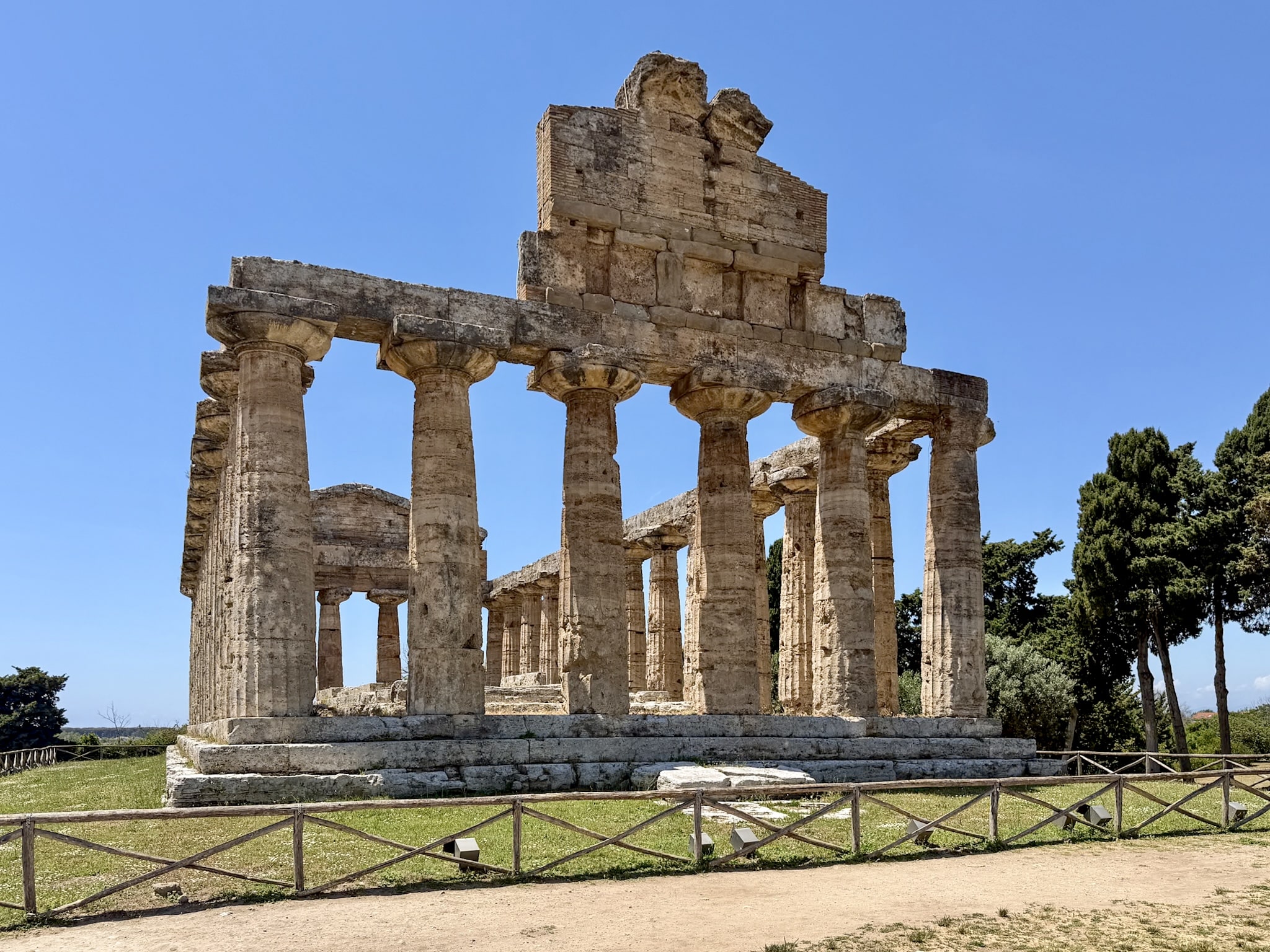
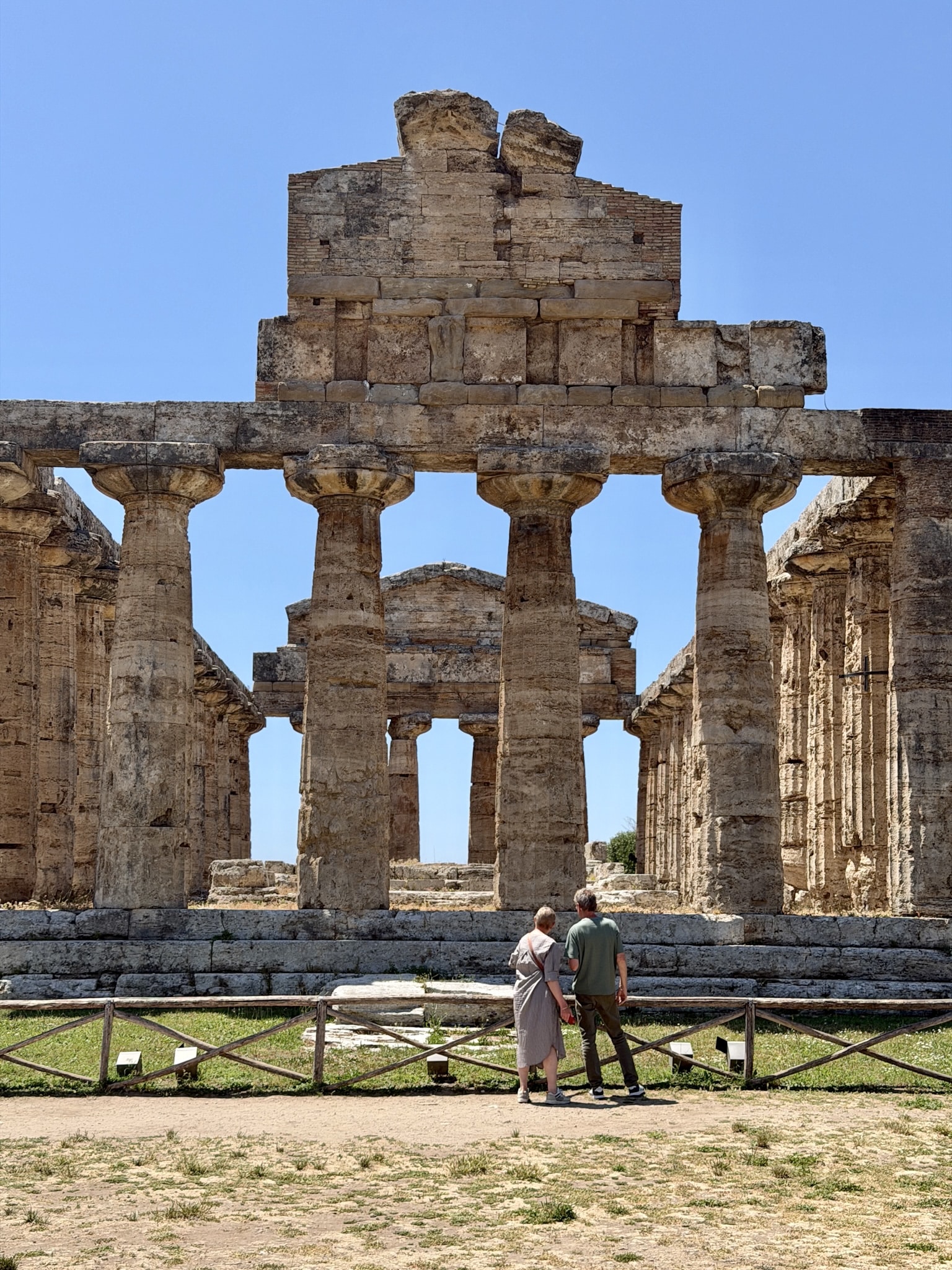
Temple of Athena
Also labeled the Temple of Ceres on some older signage, a mislabel that stuck from the 18th century, this one is dedicated to Athena, the Greek goddess of wisdom and strategic warfare.
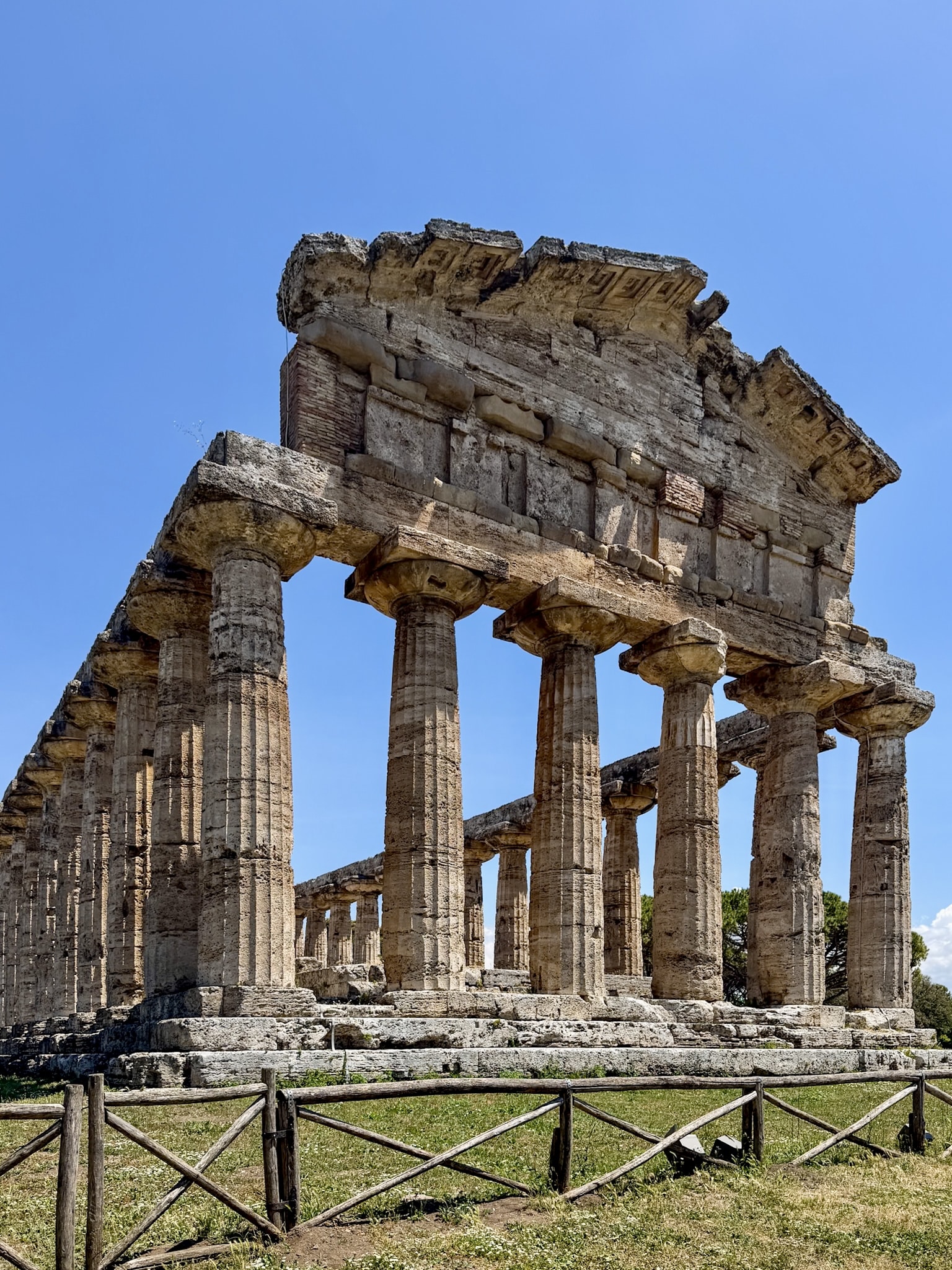
Built around 500 BC on the highest point of the ancient city, it's the smallest of the three big temples, but architecturally I found it to be the most particular: it mixes sturdy Doric columns you can see from outside with more delicate Ionic ones tucked into the entrance porch. It's something no other temple in the Greek world had done before this one.
Look for the entasis, the subtle bulge partway up each column shaft, a trick ancient builders used to keep the columns from looking too rigid. You can't walk inside this temple, only around it.
The Roman Forum Area
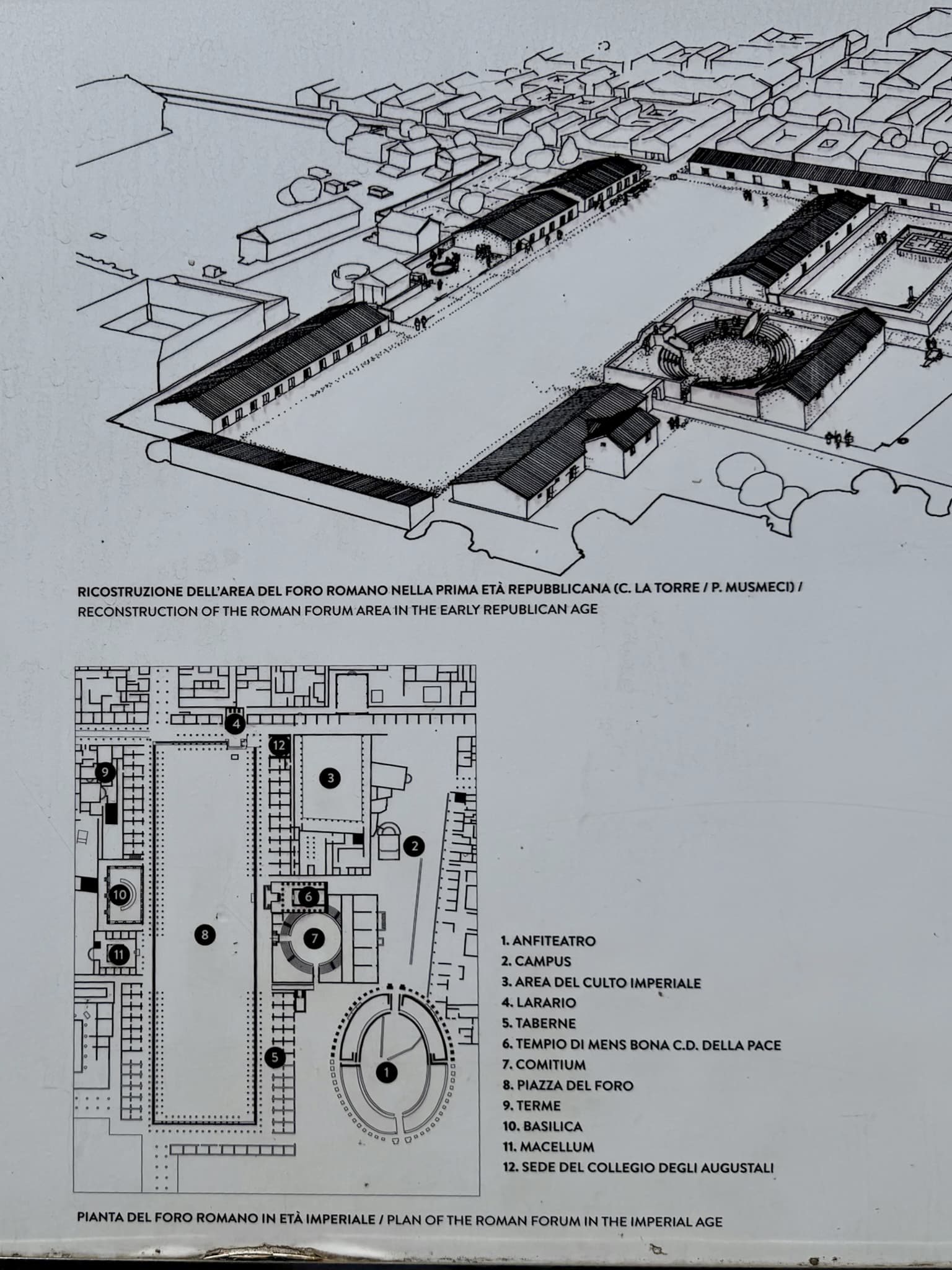
From Athena, the path cuts through what used to be the political and commercial center of the ancient city, and there's a lot packed into this stretch.
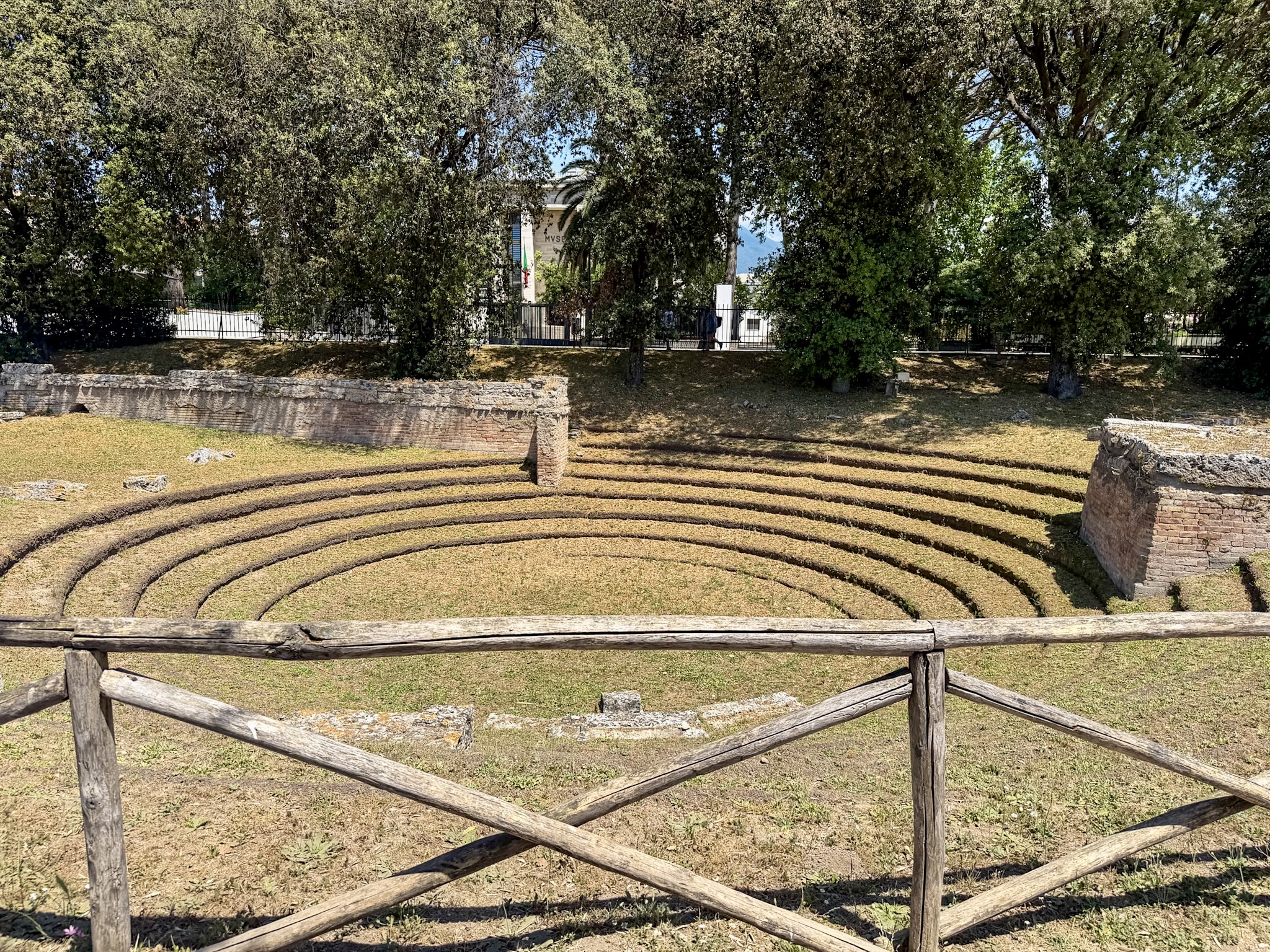
First is the Ekklesiasterion, one of the oldest surviving structures on the whole site, built around 480-470 BC. It's a sunken circular space where male citizens of Poseidonia gathered to vote and debate, back when the city still ran on Greek-style democratic assembly. When the Romans took over, they built a small sanctuary directly on top of it, so you basically see two different eras stacked on each other.
Next is the amphitheater, Roman-era, 1st to 2nd century AD, used for gladiator fights and staged animal hunts. Only its western half survives. The eastern half was either buried or destroyed outright when a modern road, the same SS18 I mentioned earlier, got built straight through it.
A bit further on are the Temple of Peace and the Aerarium. The Temple of Peace, built sometime in the 2nd to 1st century BC, once had a full grid of 6 by 8 columns on a raised podium, with a staircase and altar out front.
Last in this stretch is the Macellum, Paestum's Roman-era covered market, essentially the ancient version of a food hall, built directly over what used to be an older Greek temple. Archaeologists actually found oyster shells preserved in a small pool at its center.
Temple of Hera II (previously Temple of Poseidon or Neptune)
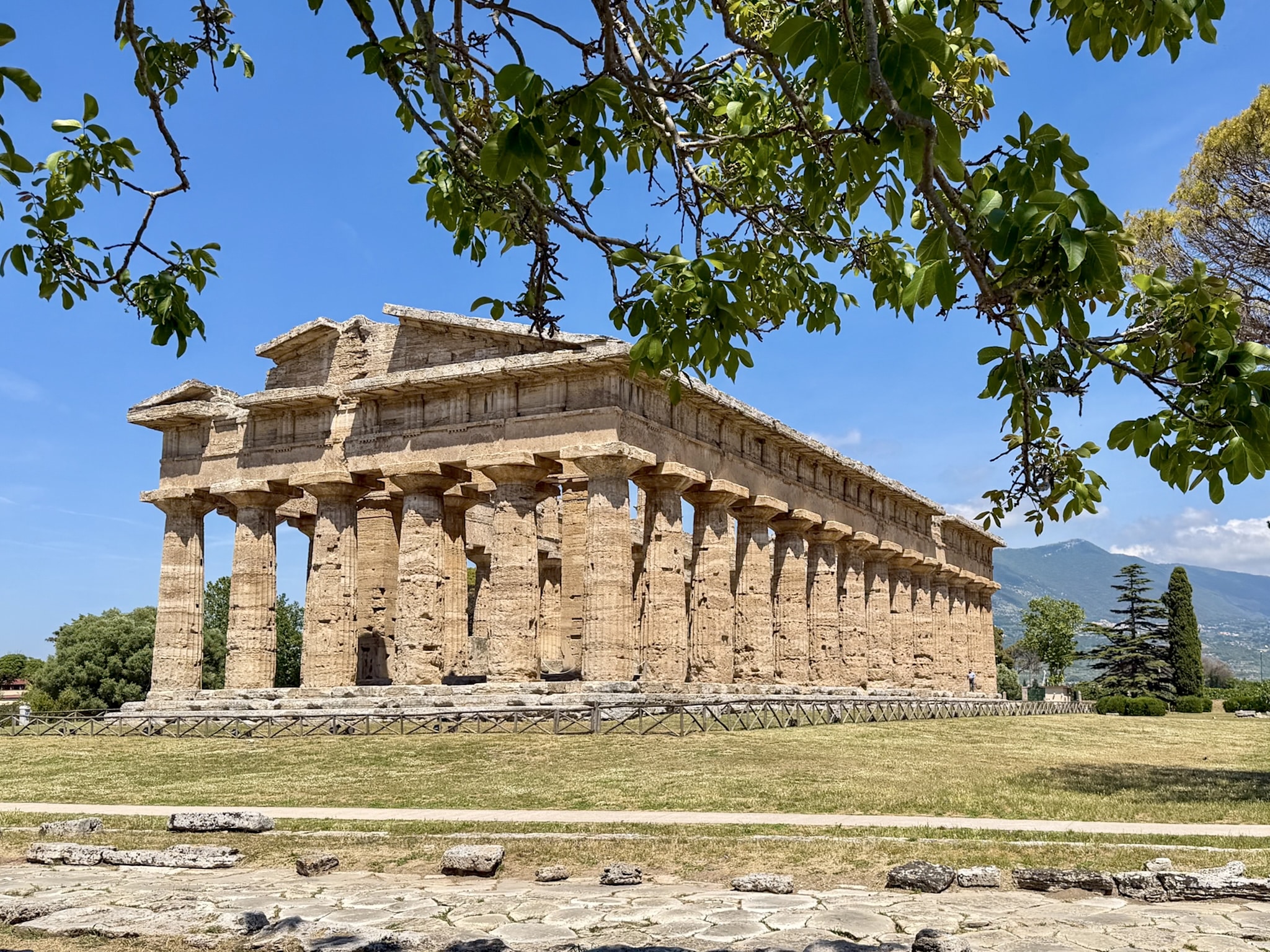
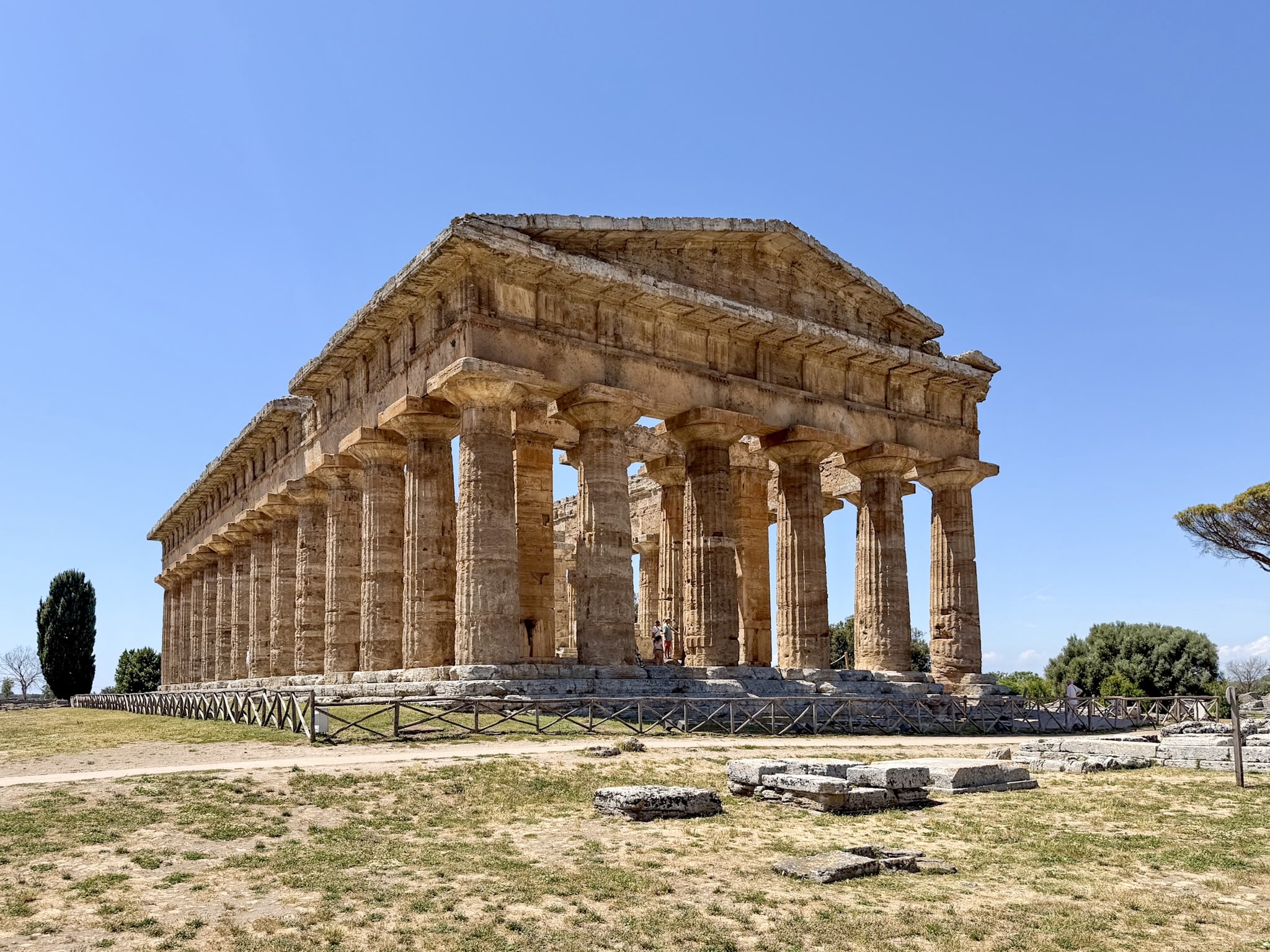
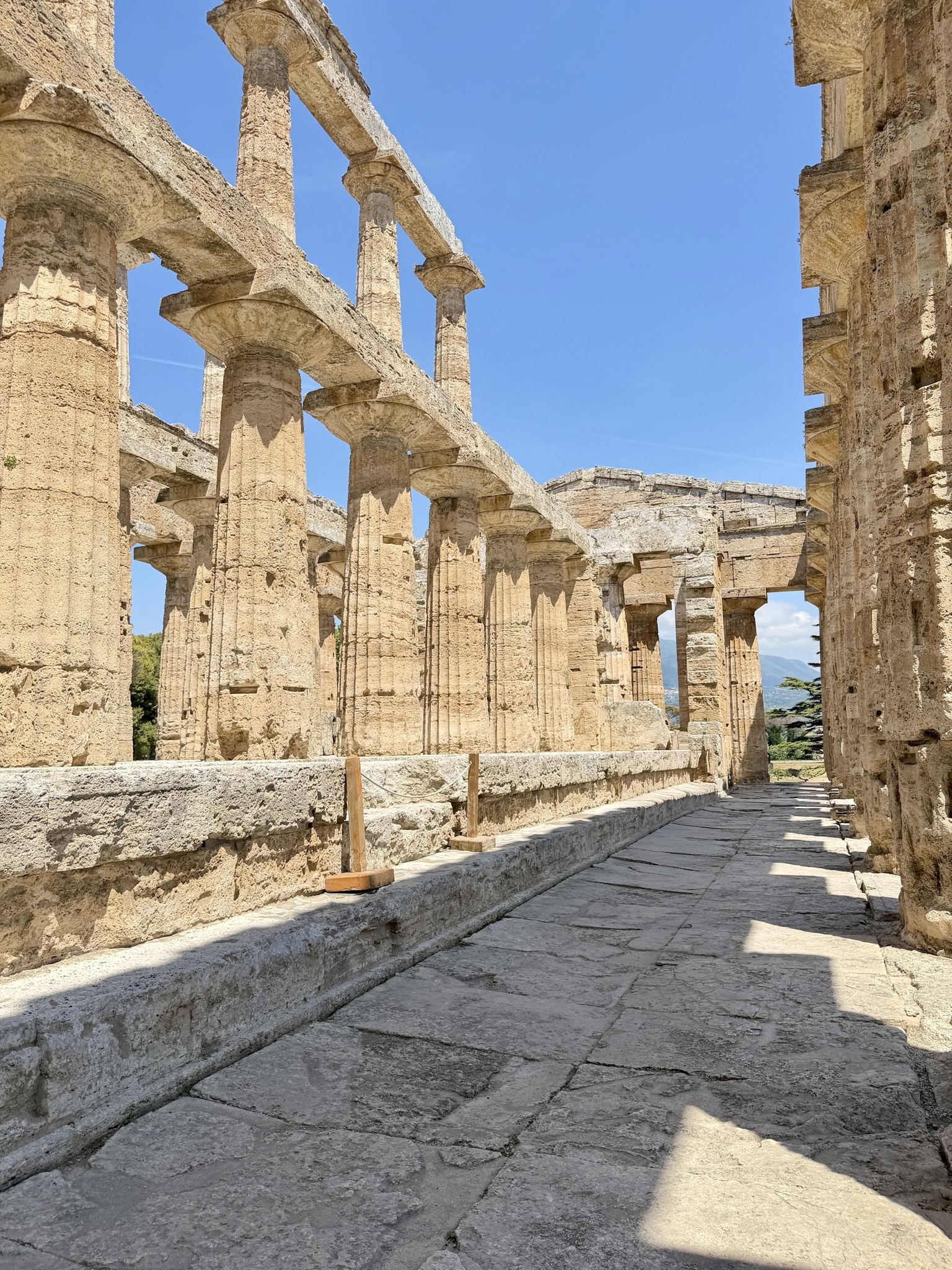
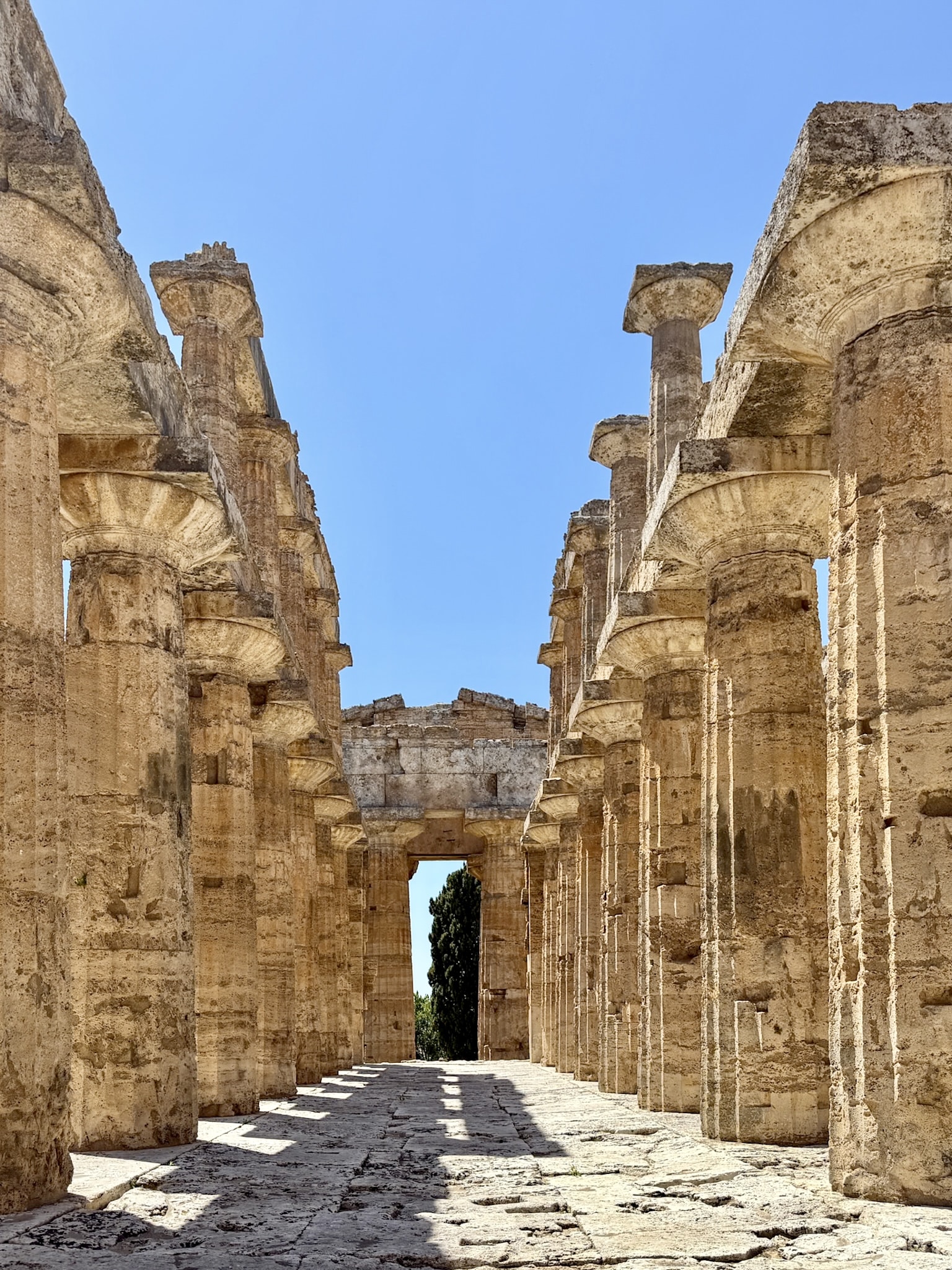
Despite the original name, historians now think this temple probably wasn't Neptune's at all. Modern scholars usually call it Hera II instead, and it may really have honored Zeus and Hera, king and queen of the Greek gods, or possibly Apollo. The Neptune name comes from an 18th-century assumption, made simply because this had been a Greek city named after Poseidon.
Built around 460-450 BC, it's purely Doric, no Ionic mixing here, and is considered one of the most refined examples of Doric architecture anywhere in the Western world: 6 columns across the front, 14 along the sides.
What I particularly loved is the double row of slim interior columns standing inside, which I was told once split the inner chamber into three aisles and held up a wooden roof. You can see that structure clearly since you're allowed to walk right into it.
Temple of Hera I (or 'the Basilica')
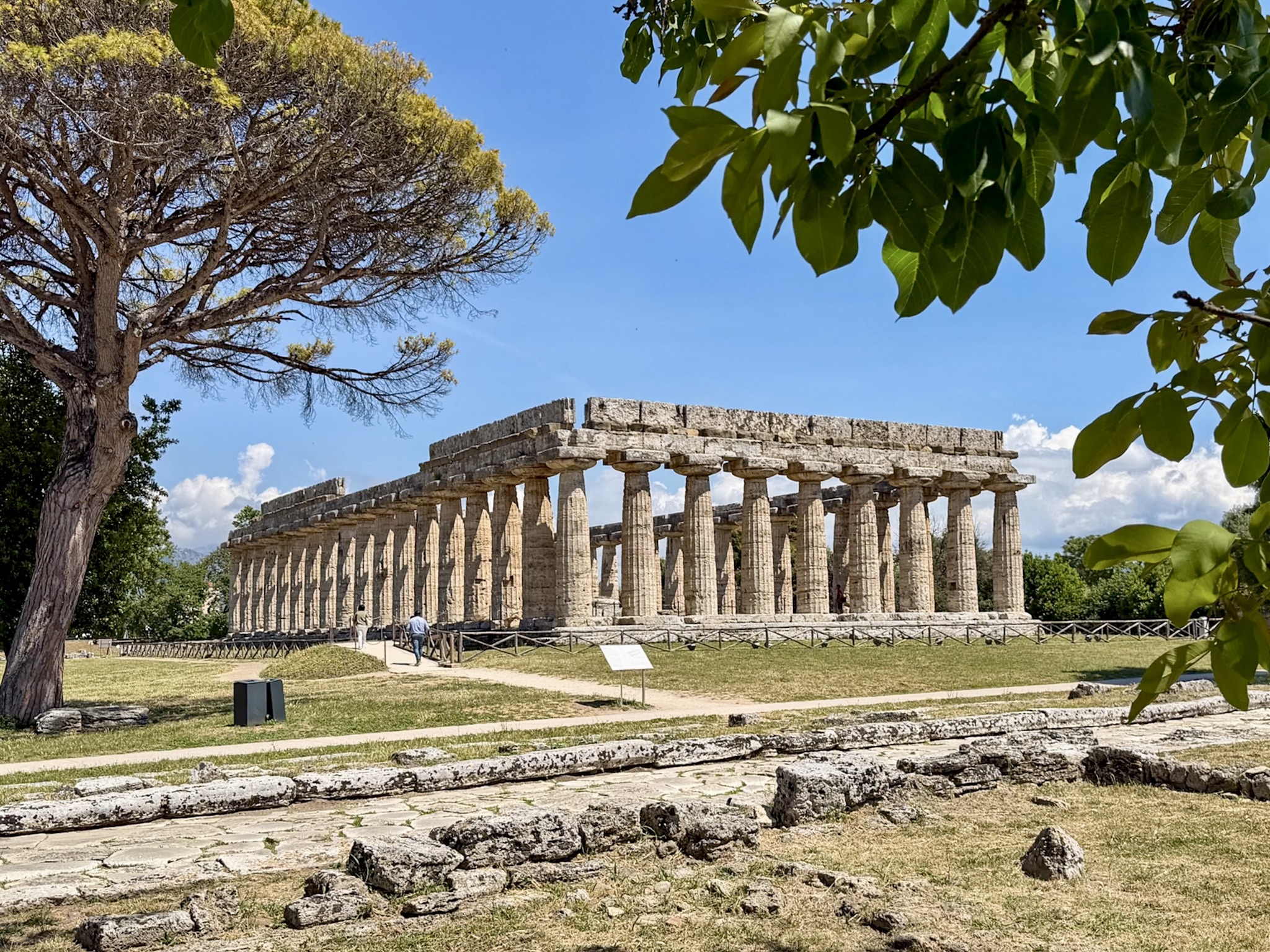
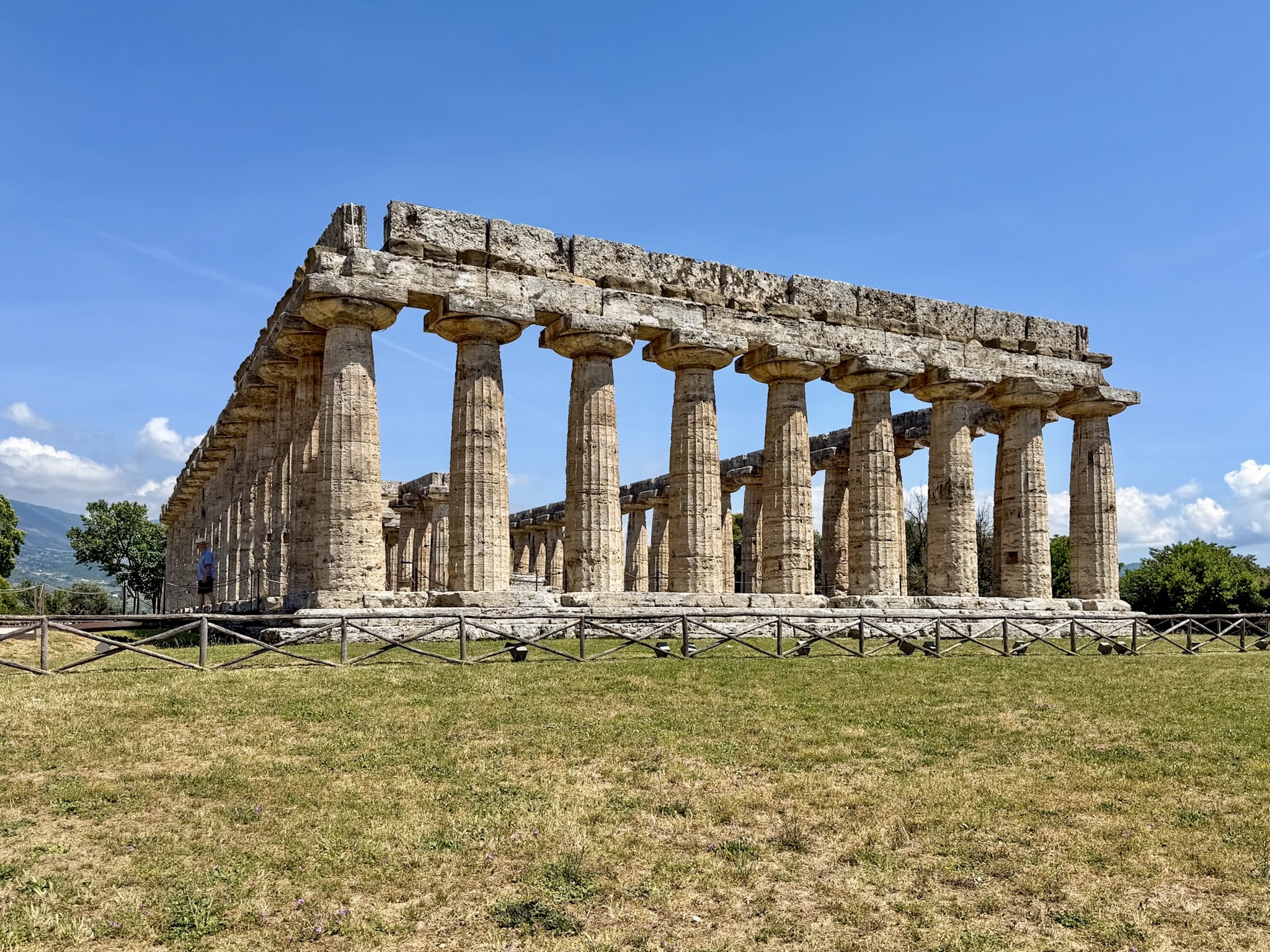
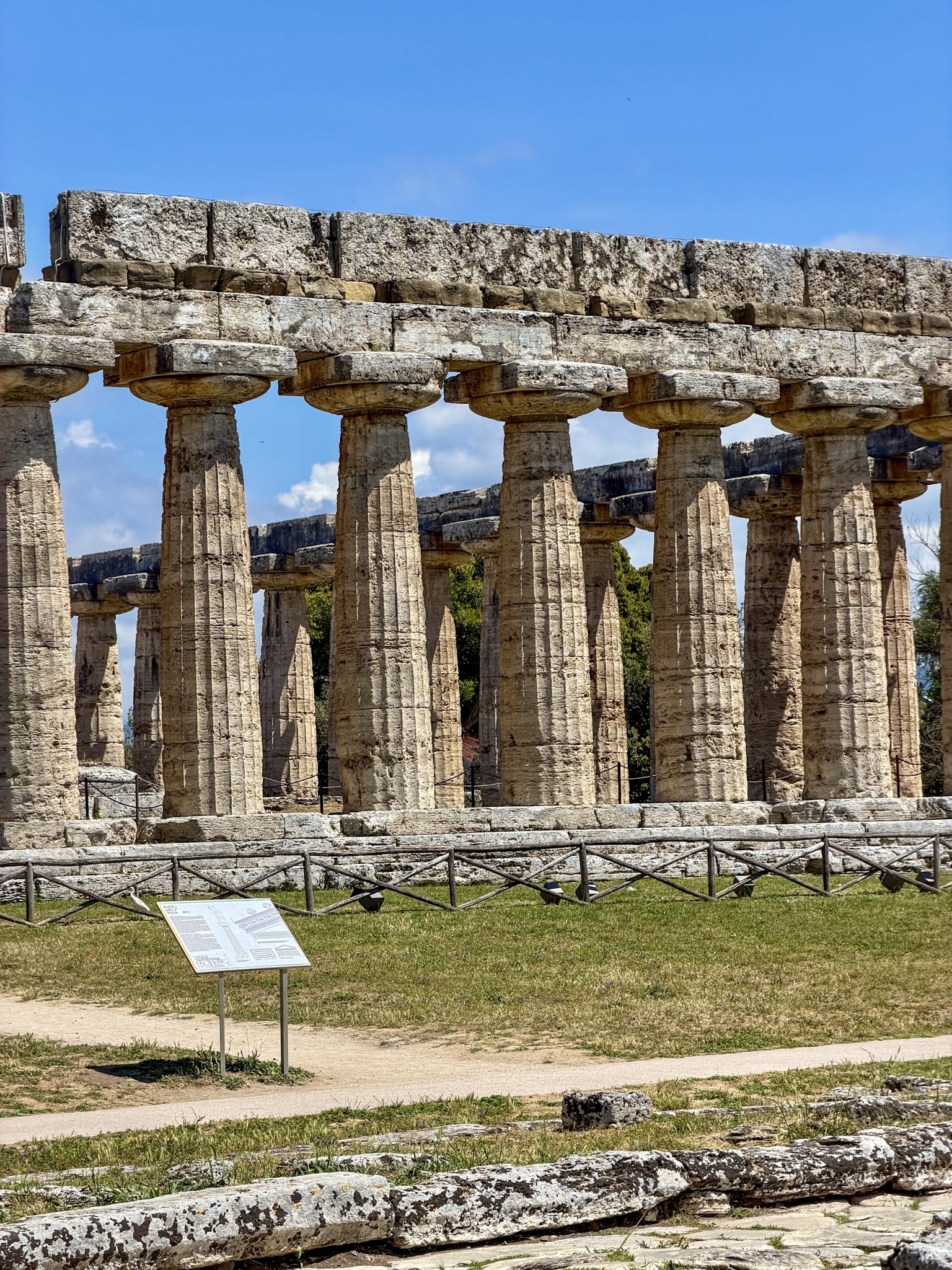
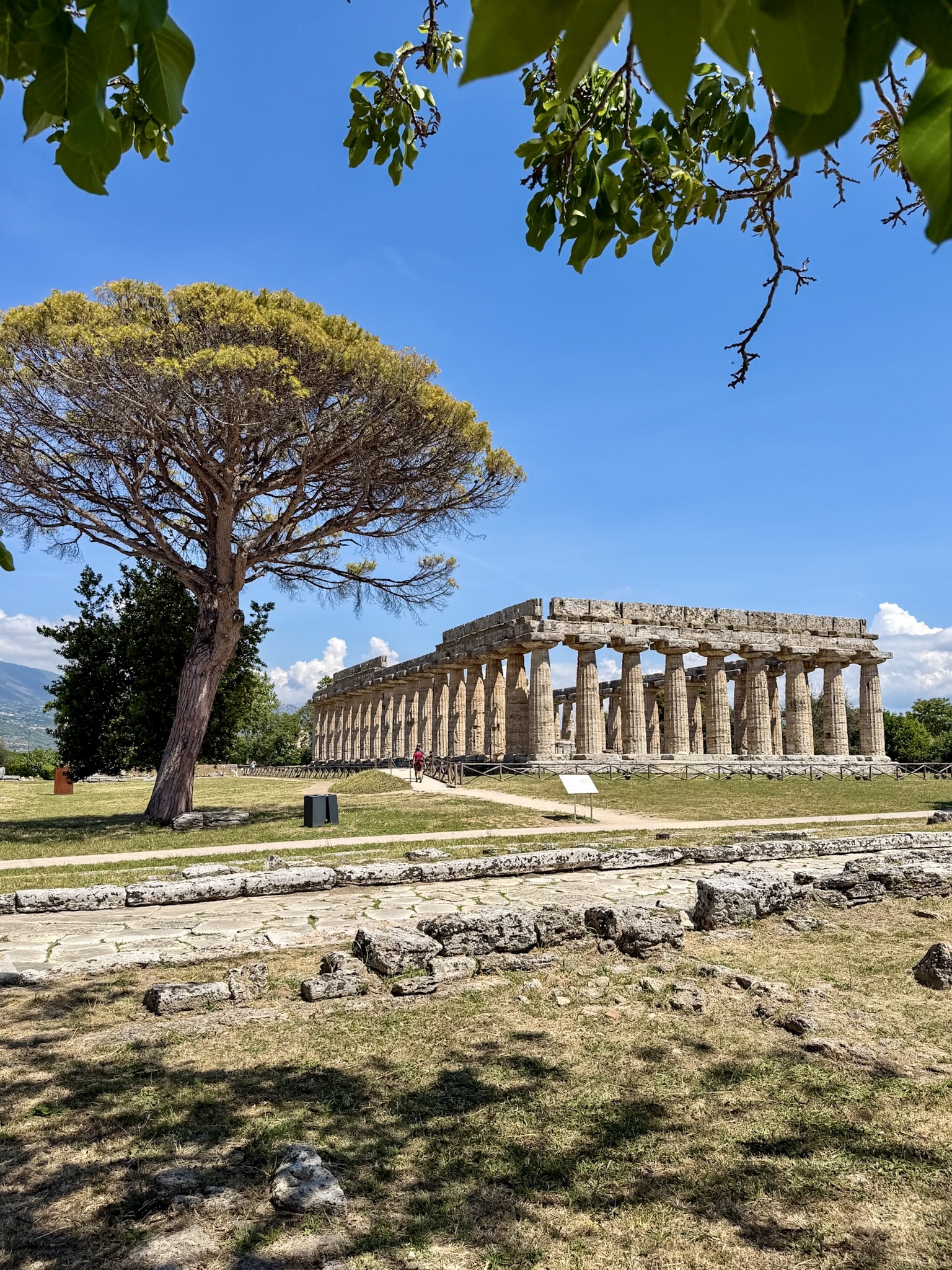
Also called Hera I, or "the Basilica," a name 18th-century scholars gave it when they mistook it for a Roman civic building instead of a temple. It's dedicated to Hera, queen of the Greek gods and goddess of marriage, and it's the oldest of the three, dating to around 550 BC.
Instead of the usual 6 columns across the front, it has 9, with 18 along the long sides, an unusual, asymmetrical-feeling layout for the period. Its capitals are also more bulging and cushion-shaped than the crisper ones on the other temples, a hallmark of earlier, more archaic Doric style. You can walk inside this one too.
Honestly, all Paestum Greek temples are in exceptional shape, and with barely anyone else around when I visited, it felt more special than standing in front of the Parthenon ever did.
The Loop Back
Instead of retracing my steps through the forum, I looped behind the temples through what used to be Paestum's Roman-era residential quarter, a part of the site that gets a fraction of the attention the temples do. A few details I particularly loved:
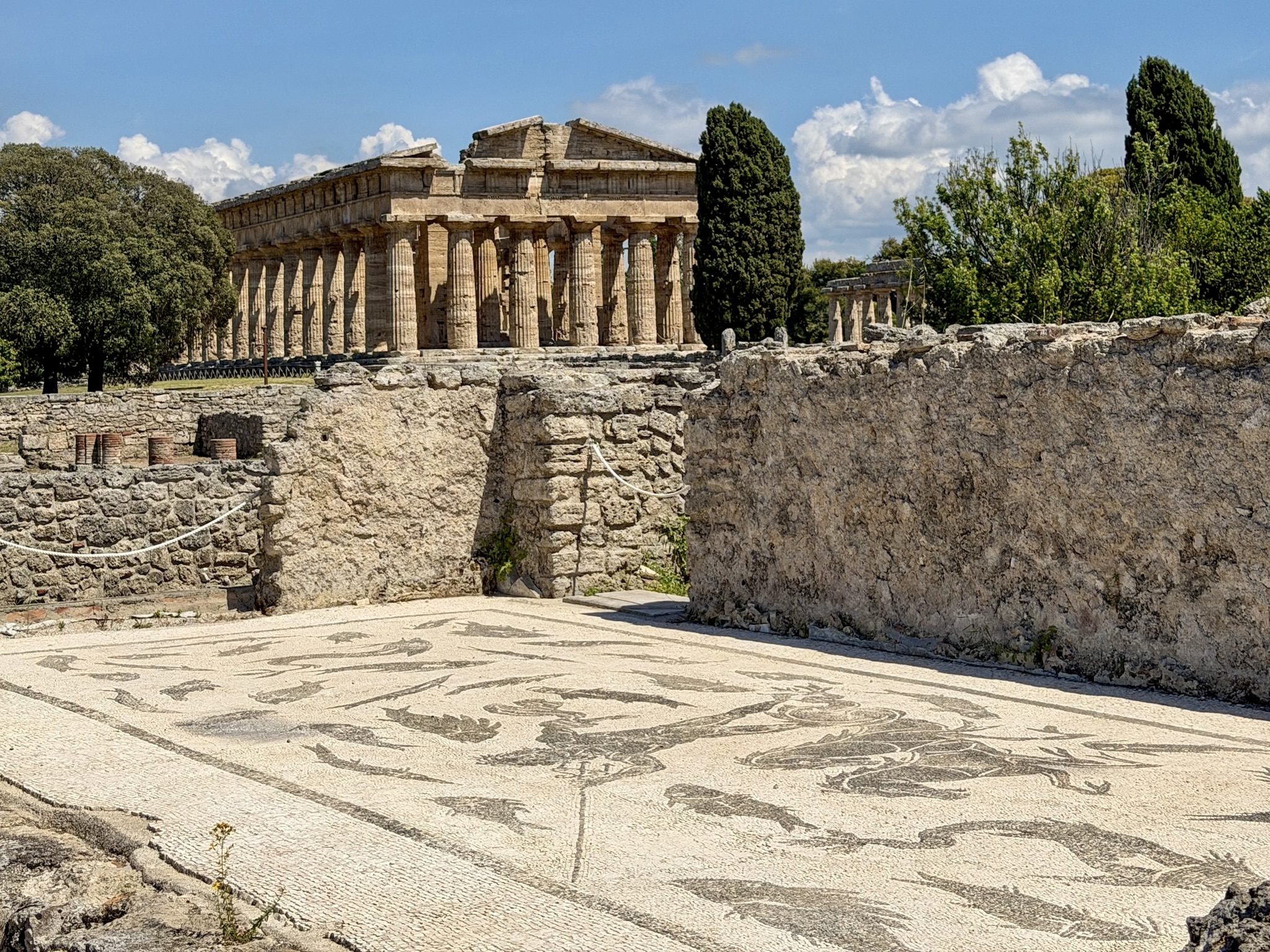
Piscina Ellenistica (Hellenistic Pool)
This pool was perhaps part of a large private residence, one of several wealthy Roman houses excavated in this part of the city (a nearby one, known simply as the House with the Pool, covers almost 2,800 square meters).
The Peristyle House
Nearby the pool is a peristyle house, easy to spot by the ring of columns that once framed its central garden courtyard, a signature feature of upscale Roman homes. Several houses along this stretch kept fragments of their original mosaic floors. There’s one with some kind of marine scene, fishes, and a Neptune figure worked into the tiles.
The Perfume Workshop
Then comes what's labeled as an old perfume workshop, and there's real substance behind that label. A 2000 study in the American Journal of Archaeology by archaeologist Jean-Pierre Brun examined this exact site alongside a similar one on the Greek island of Delos, and found genuine production equipment still in place: furnaces, large marble mortars, and stone press beds carved with circular channels that funneled oil toward a collection groove, evidence of a vertical wedge press once used to extract scented oils from crushed petals.
From there, the path loops back to where I started, at the Temple of Athena.
One more thing worth knowing
Paestum still isn't fully excavated.
In 2019, archaeologists found a completely separate, previously unknown Doric temple along the city's western walls, closer to the sea and off the main visitor path. Excavation stalled during the pandemic and picked back up after, turning up terracotta bull heads, a gorgon relief, and a figurine of Eros riding a dolphin, all suggesting animal sacrifice rituals nobody had firm evidence for before. It's not something you can walk up to on a normal visit, but it's a good reminder that Paestum is still an active dig, not a finished museum piece.
The National Archaeological Museum of Paestum
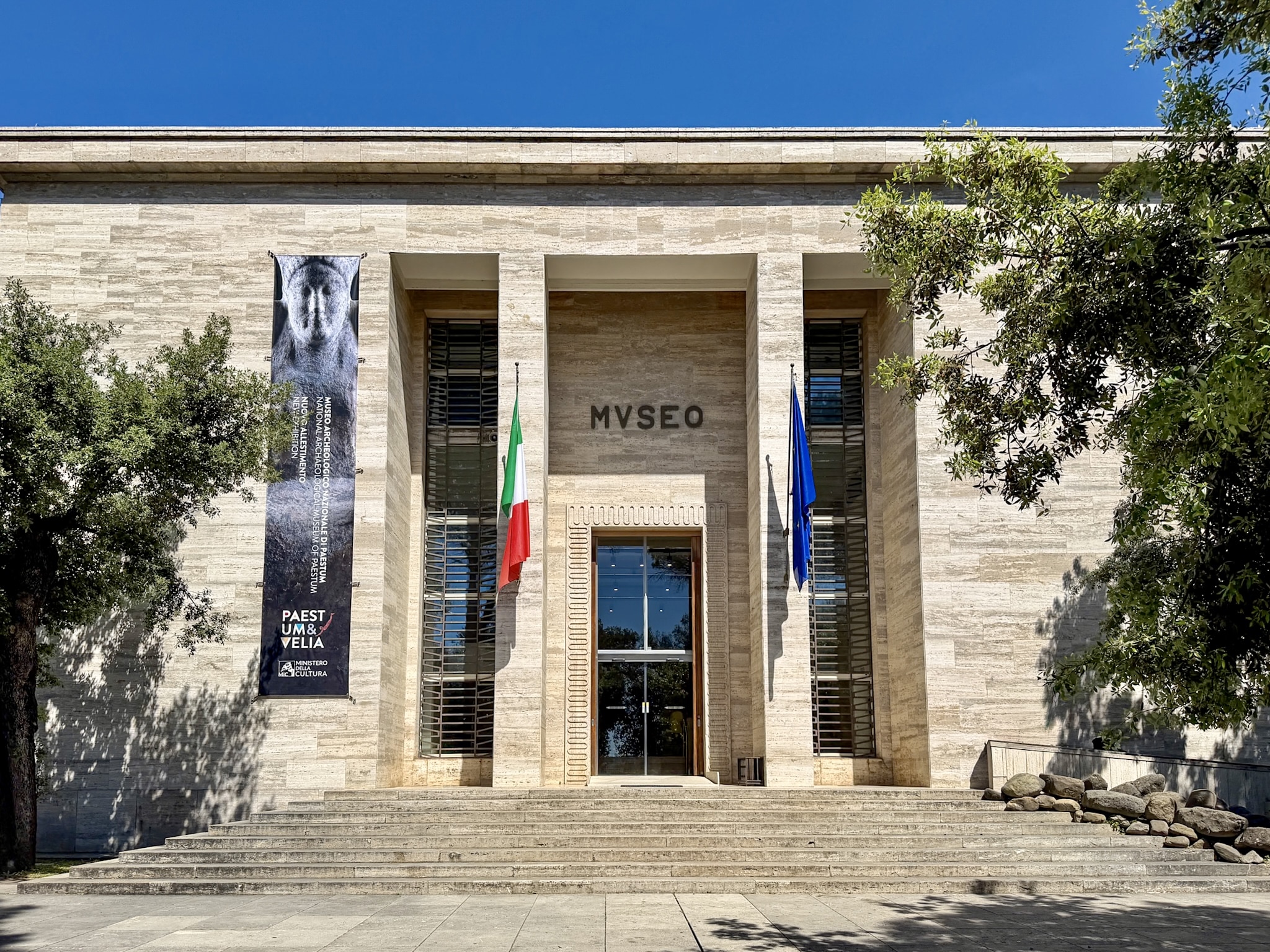
The museum sits right next to the ruins and is covered by the same ticket, and it's genuinely worth the extra hour. It opened in 1952, and it was built specifically to house one discovery.
The Sele Metopes
In the 1930s, archaeologist Paola Zancani Montuoro went looking for a sanctuary that ancient texts described but nobody had ever located. They found it about 9 km north of Paestum: the Heraion, a sanctuary dedicated to Hera Argiva. What they pulled out of the mud were around 70 carved stone relief panels, known as metopes, dating to roughly 570 BC. The building they once decorated is long gone, but the panels survived, and the Paestum museum was built around them the following decades. They're some of the earliest surviving large-scale Greek relief sculpture anywhere in Italy.
The Tomb of the Diver
This is the piece most people come for. It was discovered in 1968 by archaeologist Mario Napoli in a small necropolis about 1.5 km south of the main site, and it's made of five limestone slabs: four painted with scenes from a symposium, a Greek drinking banquet, and the fifth, the cover slab, painted with a young man mid-dive into a stream of water.
What makes it a genuinely big deal is rarity: it's the only known example of Greek figurative wall painting from the Archaic or early Classical period to survive completely intact anywhere in the ancient Greek world.
What Else to Do in Paestum
Paestum isn't only temples. Here's how to fill the rest of the day.
A Buffalo Mozzarella Tasting
About a 10-minute drive from the site, Tenuta Vannulo is the name most people mention first. It was Italy's first certified organic buffalo dairy, and everything here comes exclusively from their own buffalo, fed on grass grown on the same farm. They turn out something like 400 kg of unpasteurized mozzarella a day.
Tours run mostly in the morning and cost around €8 per person, and take you through the milking stables, the cheese-processing room, and a small agricultural museum, before ending with a tasting of the mozzarella itself along with other buffalo-milk products like yogurt and gelato. Worth knowing: it's cash only, and popular enough that booking a couple of days ahead is a good idea.
Time at the Beach
Paestum sits right on its own stretch of the Tyrrhenian coast, with sand backed by a shady pine forest that runs for miles between the beach and the road. You've got two options: free public beach, or one of several private beach clubs (called lidos) where you rent an umbrella and a sunbed for the day.
Honest note though: the beaches right here are fine, not spectacular.
-
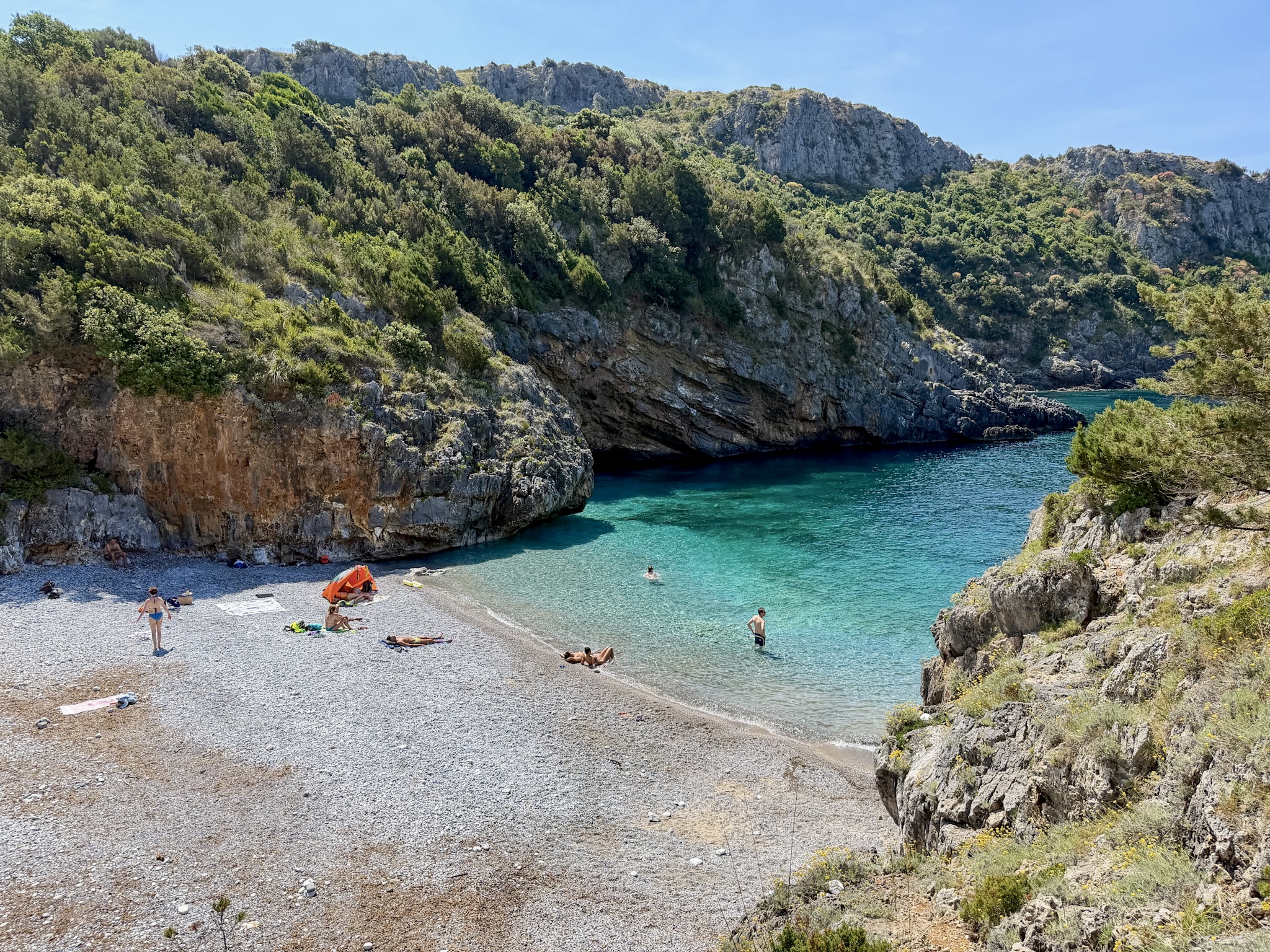
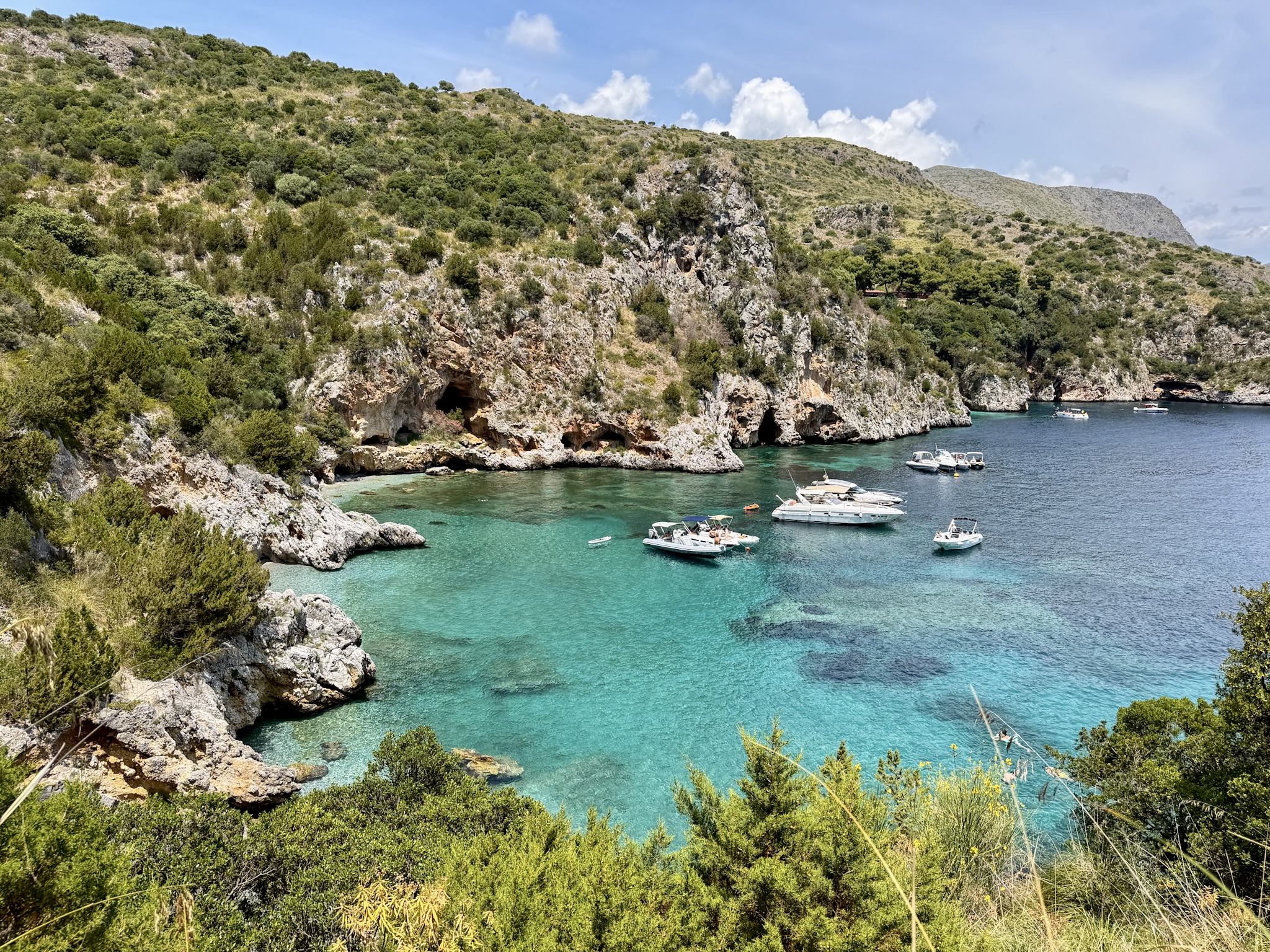
- If you've got extra time, the real standouts on this coast are further south toward Palinuro. I covered Cilento's best beaches in a separate article.
Practical Tips for Visiting Paestum
Sun protection is not optional. The site is almost entirely open, with next to no shade outside a few scattered trees, and the walk between all the temples and the Roman quarter takes a while. Bring a hat and sunscreen, and if you can, aim for early morning or the couple of hours before closing, when the light is better for photos anyway and the heat is easier to handle.
Wear real shoes. The ground is uneven ancient stone and gravel path, not paved sidewalk, so comfortable, closed shoes make a real difference.
Bring your own water. Once you're out among the temples, there's nowhere to buy anything, so stock up before you go through the ticket gate.
Large backpacks aren't allowed inside, for preservation reasons, but there's a cloakroom at the Porta Principale ticket office if you need to leave one behind.
If you're traveling with a dog, pets are allowed on site as long as they're leashed.
If walking the whole distance is a concern, the park offers electric vehicles to help visitors with mobility issues get around.
FAQ
How much time do you need at Paestum?
For just the temples, 2 to 3 hours covers the essentials if you're moving at a brisk pace. Add the museum and you're looking at 3 to 4 hours total.
Is Paestum better than Pompeii?
They're not really comparable, but here's the practical difference:
- Pompeii is a full ancient Roman city, and it takes a minimum of half a day just to see the highlights, on uneven cobblestone streets, with almost no shade and heavy crowds even outside peak season.
- Paestum gives you three of the best-preserved Greek temples outside Greece itself, with a fraction of the crowds, plus a forum, and a museum you can genuinely cover in half that time.
Doing both on the same trip (just not the same day) works well since they're roughly 100 km apart by car or train.
Is Paestum good for kids?
I would say yes, but it's not stroller-perfect. The paths between temples are gravel and packed earth rather than cobblestone, so it's not a smooth sidewalk, expect some bumping. The open layout means kids have actual room to run, though. The catch is shade: there's almost none, so plan around nap time or the hottest hours if you're visiting in summer. The museum is air-conditioned and makes a good indoor break partway through, and kids under 18 get in free.
Can you combine Paestum with a mozzarella farm in one day?
Yes, and it's a genuinely common pairing, but the order matters. Tenuta Vannulo's tours run mornings only, since that's when the mozzarella is actually being made, so go there first, then head to Paestum afterward. It's about a 10-minute drive between the two, and you'll want a car since there's no direct public transit connecting them. Book the farm tour 2 to 3 days ahead if you can, spots fill up.