
A firsthand look inside the Grand Egyptian Museum. Photos, tickets, layout, highlights, and practical tips from a real visit, plus what to expect in 2026.

The Grand Egyptian Museum had been a rumor for so long that walking through its glass façade in Giza felt almost unreal. I’d followed the headlines for years — construction delays, shifting opening dates — and yet suddenly, in 2025, it was there: enormous, and filled with everything Egypt had been promising for two decades. The entire Tutankhamun collection is on display, and the galleries are running smoothly.
If you’re wondering what it’s like inside, this is not a press release or tour ad. I actually went, camera in hand, early in the morning. In this guide, you’ll see real Grand Egyptian Museum photos, how the ticket system works, the smartest way to move through the building, what to expect from crowds, where to eat, and a few more tips.
Plan Your Visit: Opening Hours, Tickets and Prices
The Grand Egyptian Museum opens daily at 8:30 a.m., with galleries starting at 9:00 a.m. and closing by 6:00 p.m. (last entry at 5:00 p.m.). On Wednesdays and Saturdays, the museum stays open late — galleries until 9:00 p.m., complex until 10 p.m.
The museum’s official ticketing site is visit-gem.com, and it is the only place I recommend using. Third-party resellers add confusion and extra fees. All tickets must be booked online in advance with a selected entry time slot, so you cannot buy tickets at the gate. A QR code, either printed or on your phone, will be requested immediately at the gate.
Current prices follow a clear tier. Foreign adult admission is 1450 EGP (30$), with students and children at 730 EGP. Egyptian nationals pay less, and there is a resident rate for foreign residents. Children under six and visitors with disabilities have free entry with ID.
If you want clear photos and fewer crowds, book the 8:30 a.m. slot and reach the gate by 8:15. That early window gives you quiet time in the Grand Hall before tour groups arrive.
How to Get to the Grand Egyptian Museum
Getting to the Grand Egyptian Museum in Giza is simpler than it looks.
The best and easiest option is a ride-hail car like Uber or Careem. These apps work reliably in Cairo and Giza, let you set your drop-off as the Grand Egyptian Museum without language hassle, and show you the fare before you book.
Most trips from central Cairo take about 30–40 minutes, depending on traffic. If you’re coming from Giza hotels or near the pyramids, an Uber ride is even quicker, often 10–15 minutes. The museum sits just off the Cairo–Alexandria Desert Road at El Remayah Square, only a couple of kilometres from the plateau where the pyramids sit.
Local taxis are available too, but many visitors find negotiating a fare better on the app than on the street, especially if you’re not comfortable bargaining.
Right now (January 2026), official public transport options like subway or buses to the museum aren’t really practical for visitors. In the future (possibly early 2027), there will be a metro stop at the site that will make it easy to reach from downtown Cairo.
Layout, Areas to Explore, and Highlights
The Grand Egyptian Museum layout is straightforward once you’re inside. You can, however, explore the layout in the official GEM Plan here.
The Obelisk
Before even entering the museum, you pass beneath the suspended obelisk of Ramesses II, carved from red granite and originally erected at Tanis in the Nile Delta. It’s the only hanging obelisk in the world, lifted to reveal the royal cartouche that would normally sit out of sight.

Grand Hall
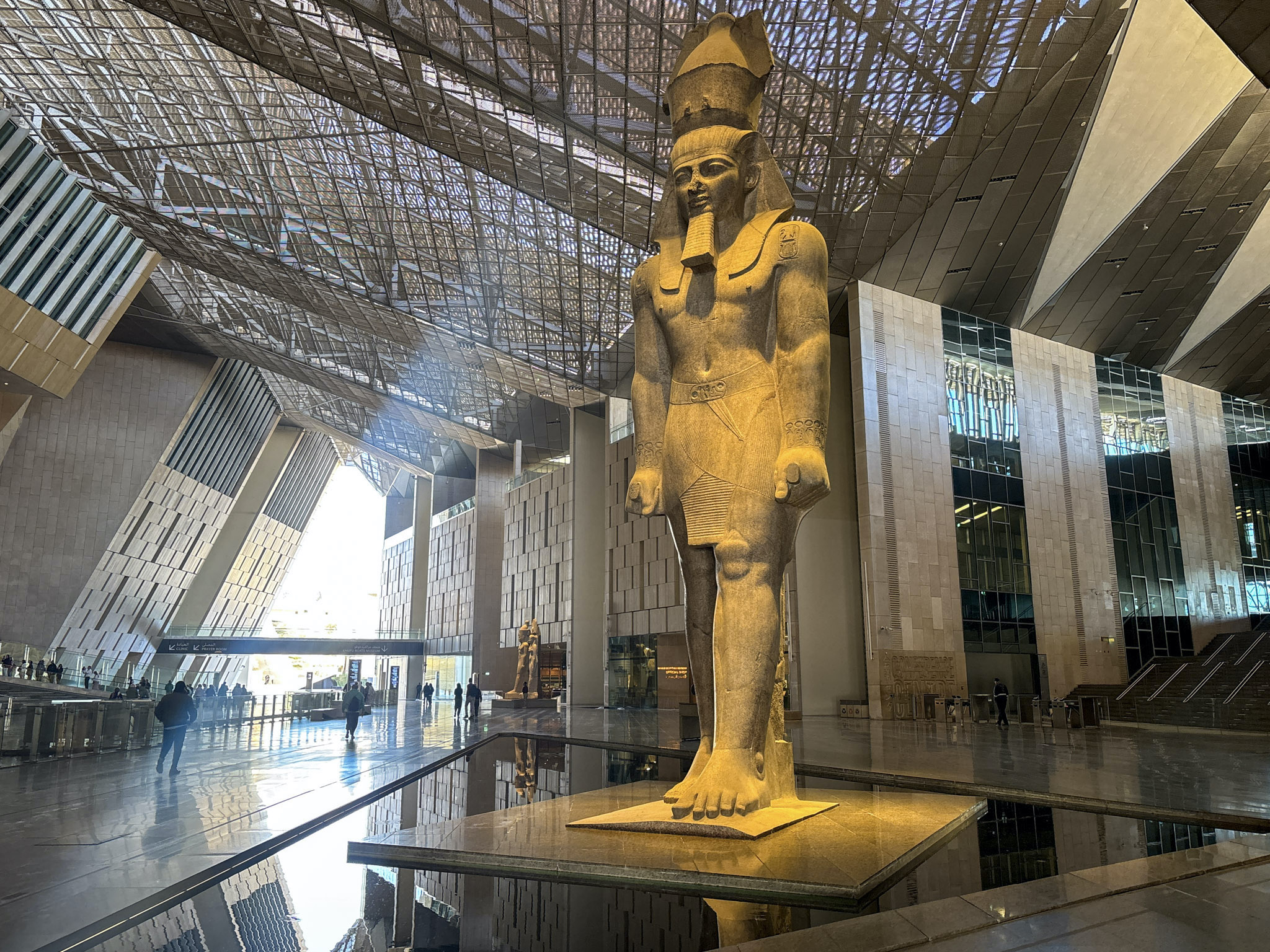
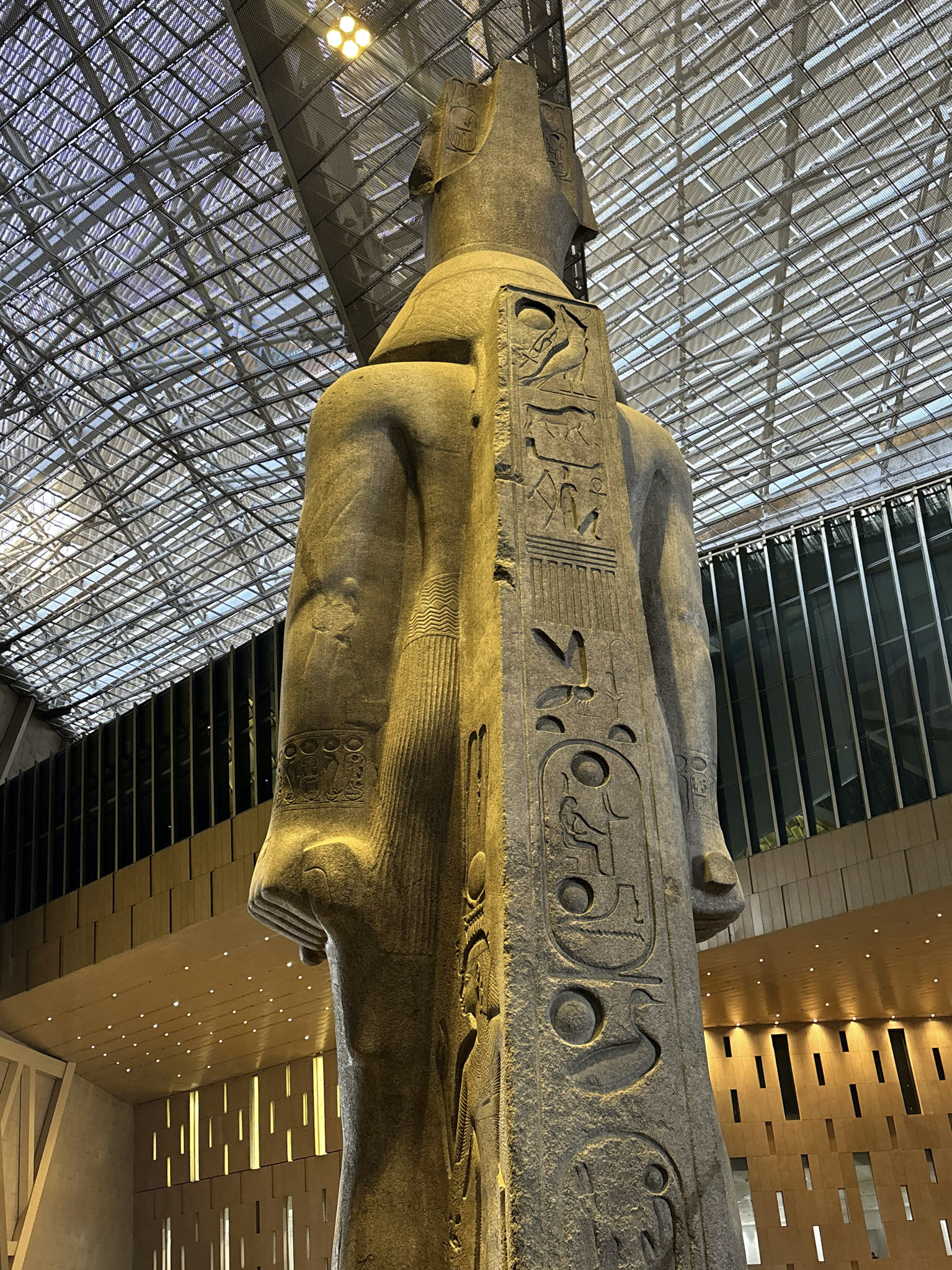
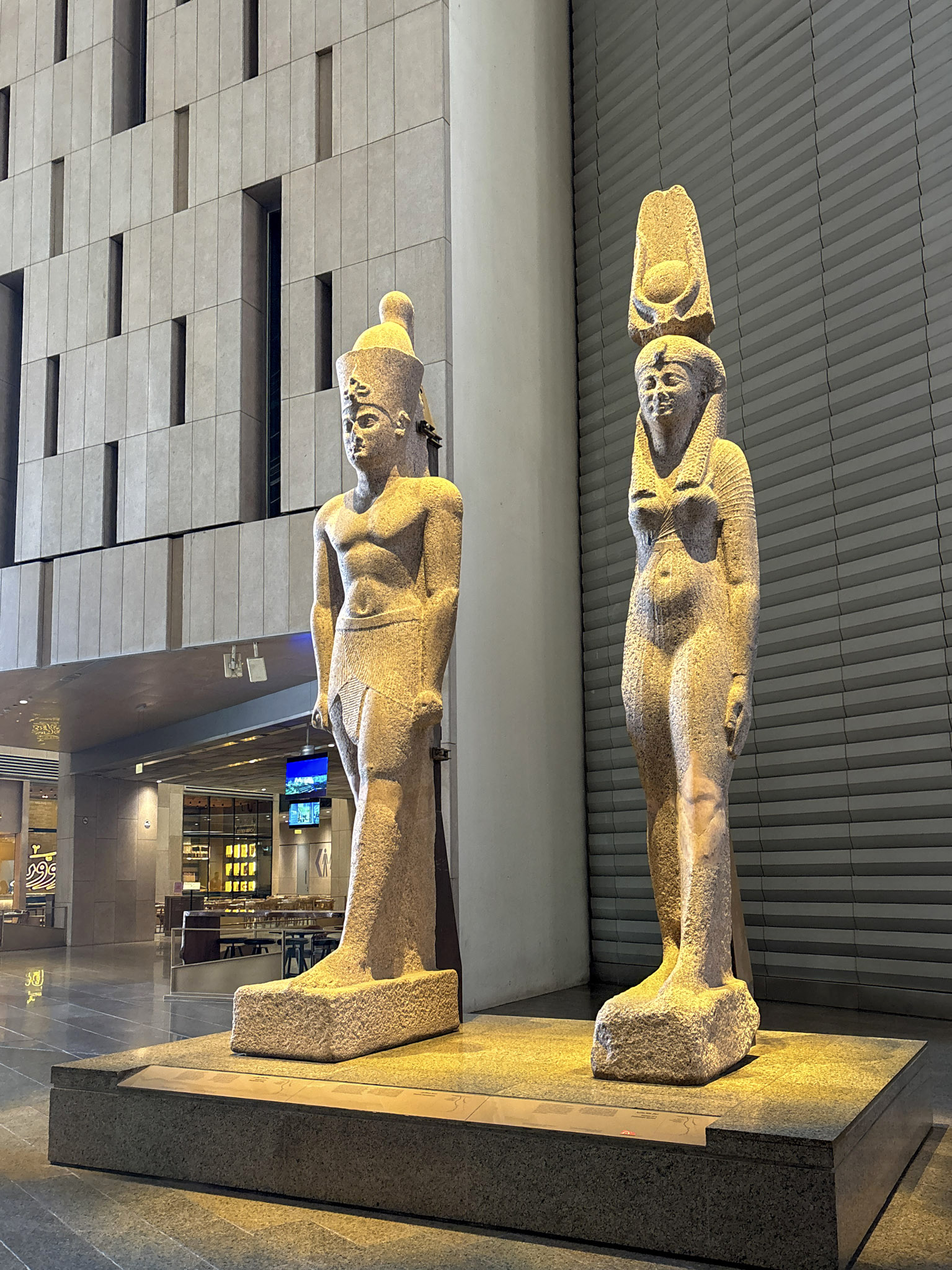
The Grand Hall is the museum’s prologue, a monumental glass atrium where ancient Egypt first meets modern architecture. The 11-meter statue of Ramses II, moved here from Ramses Square, anchors the space as Egypt’s emblem of kingship. Around it stand the Victory Column of Merenptah, the Sakkara Cannon listing 58 early kings, and twin Ptolemaic statues salvaged from the submerged city of Heraklion. These pieces were chosen because they frame Egypt’s royal narrative before you enter the chronological galleries.
Grand Stairs
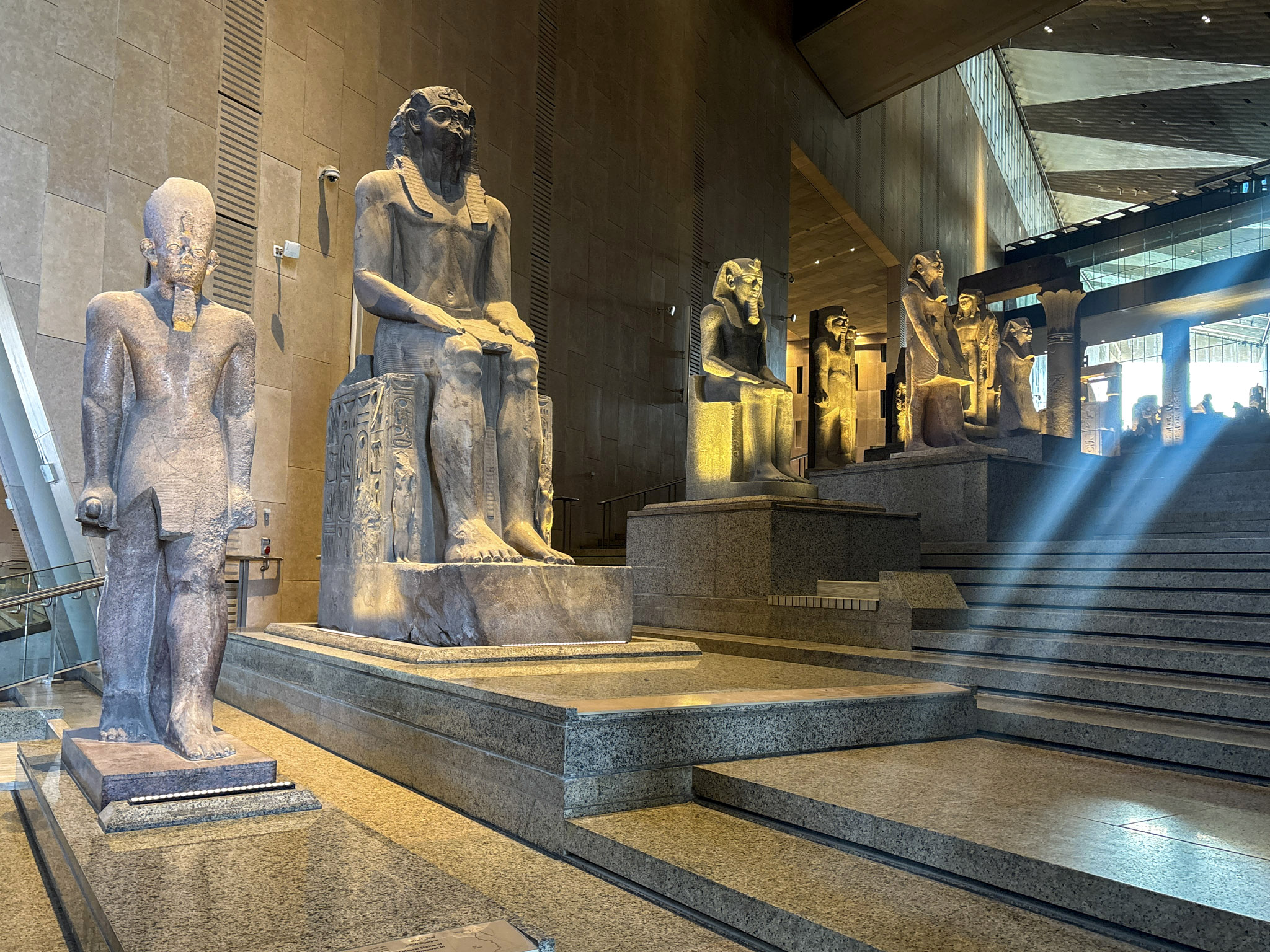
The Grand Stairs function as both passage and open-air gallery, with six intermediate floors lined with 59 colossal sculptures, columns, and sarcophagi drawn from temples and tombs across Egypt. Items here are not tied to one specific era or location, it’s meant more like a sculptural crescendo showing the artistic evolution of pharaonic form. The craftsmanship shifts from Old Kingdom rigidity to New Kingdom grace, ending with a framed view of the Pyramids through the glass façade.


Tutankhamun Galleries
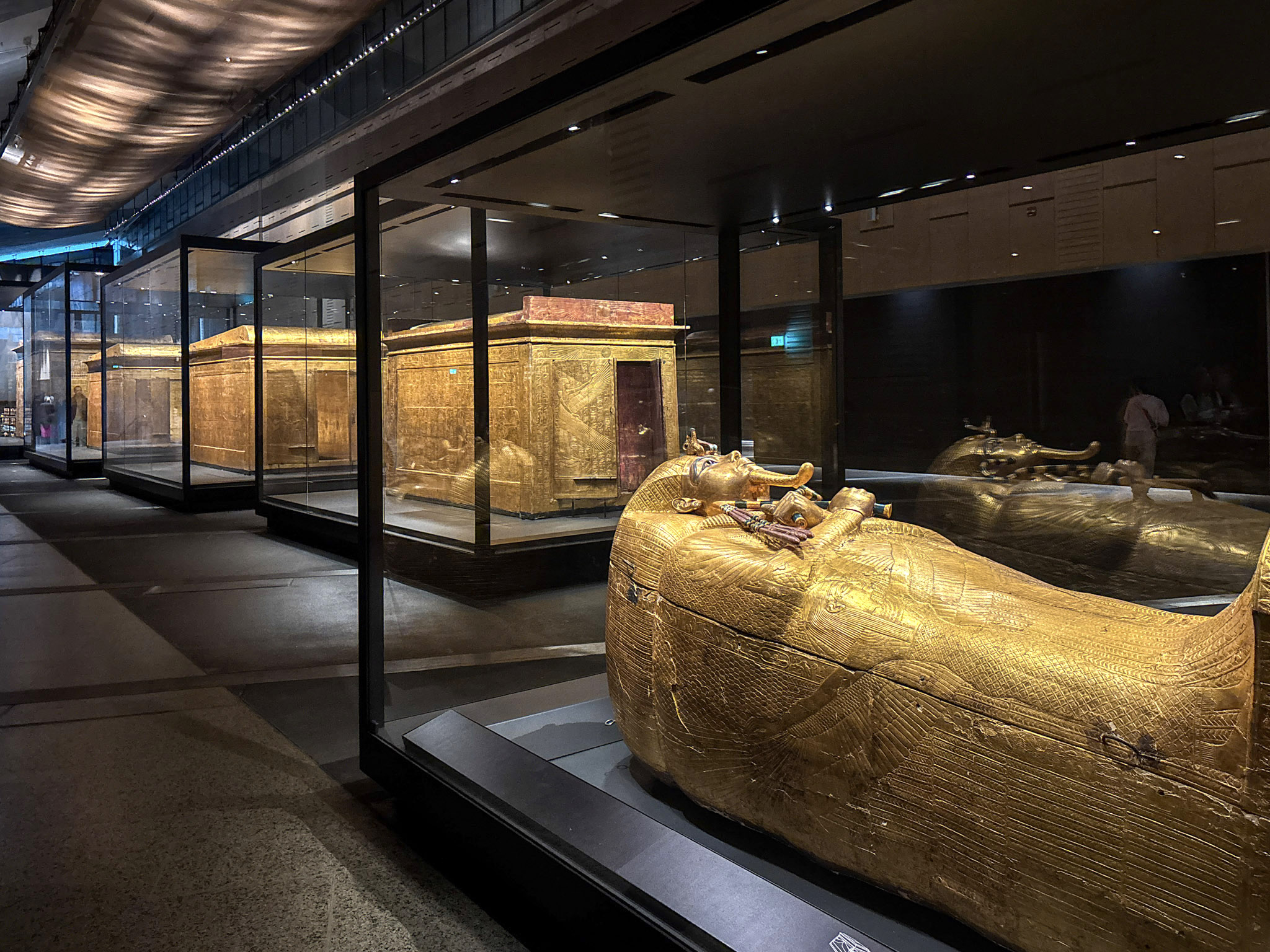
Next, at the top and on the Grand Stairs and on the right, comes the heart of the visit, the Tutankhamun Galleries. They hold over 5,000 objects and follow a deliberate spatial logic that mirrors the tomb’s structure. Visitors move through five thematic zones — Identity, Lifestyle, Funeral, Rebirth, and Discovery — arranged inside two parallel elongated halls.
You can explore the Tutankhamun Galleries layout in the official GEM guide here.

Highlights you shouldn’t miss:
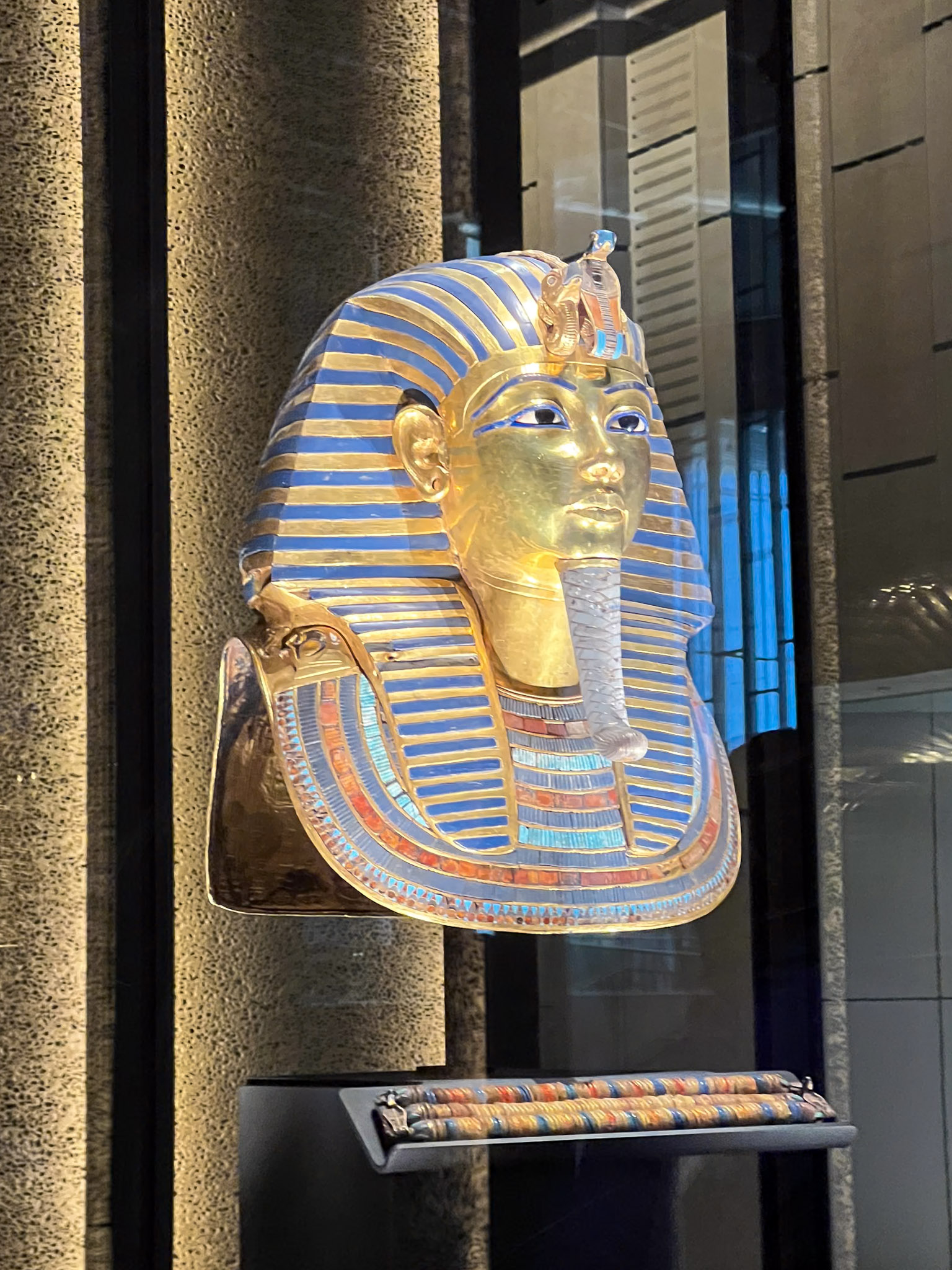
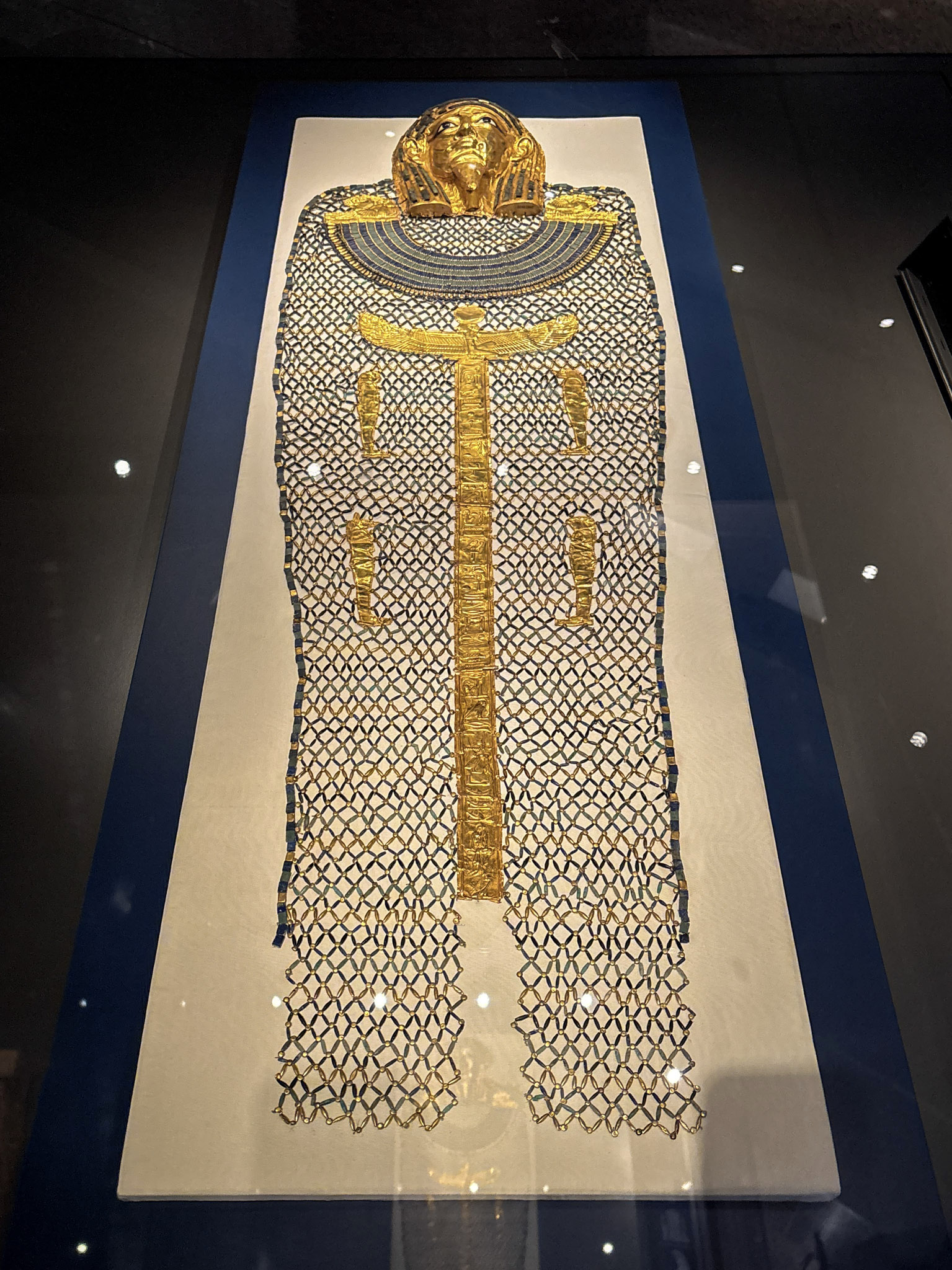
- Golden Mask. The defining piece of ancient Egypt. Crafted from 23-carat gold and inlaid with lapis lazuli and quartz, it portrays Tutankhamun with serene divinity — both portrait and spell of protection.
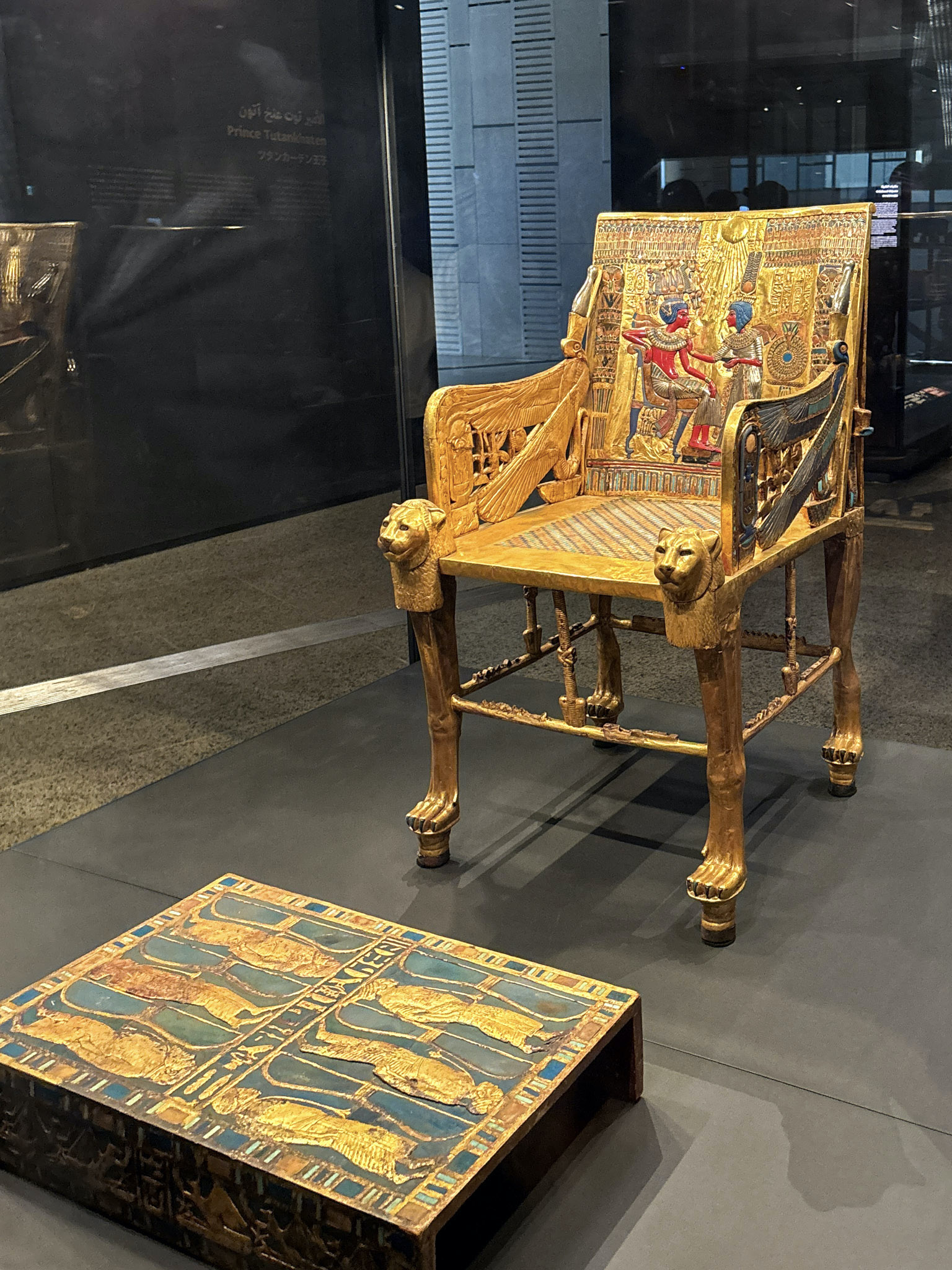
- Golden Throne. Nearby, a gilded chair depicting Tutankhamun and Queen Ankhesenamun in a tender domestic scene. Its colored glass and silver detailing show the height of Amarna artistry and the intimacy of royal life.
- Personal Artifacts. A cluster of cases displaying sandals, jewelry, beds, jars, and even leftover food offerings. These everyday objects, arranged under the Lifestyle theme, show Tut as a teenager who slept, ate, and played games.
- Nested Coffins and Gilded Shrines. The heart of the Funeral section. The three anthropoid coffins — the innermost solid gold — once lay inside four gilded shrines that recreated a sacred chamber within a chamber.
- Anubis Shrine. A sleek black jackal resting on a gilded chest, guarding the funerary goods. Its placement along the right-hand aisle evokes the guardian’s position at the threshold of the tomb.
- Discovery Zone. The final section retells Howard Carter’s 1922 find through photographs, tools, and field notes. It closes the loop between modern archaeology and ancient ritual — the moment Tutankhamun’s afterlife met ours.
Main Galleries
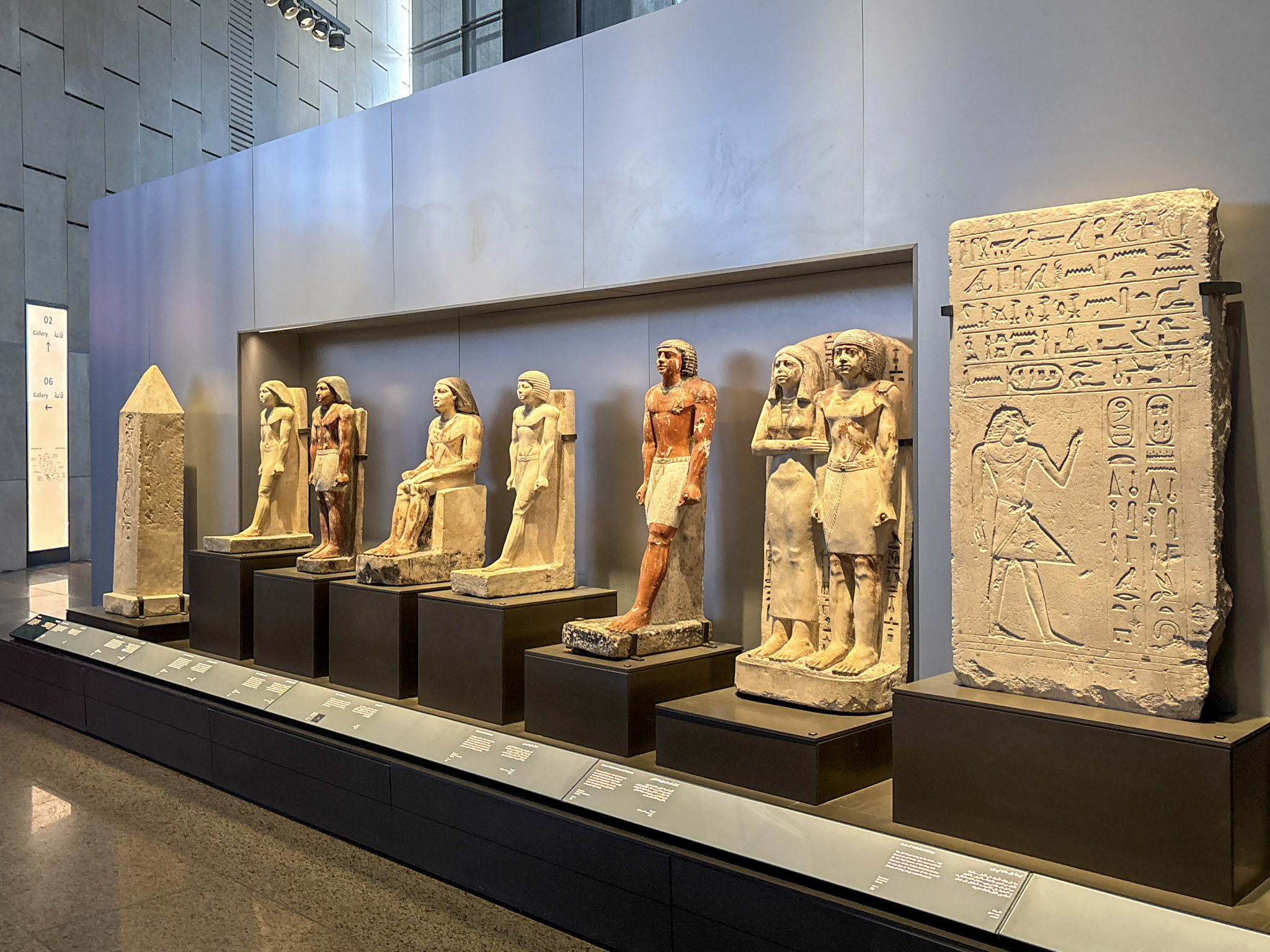
After Tutankhamun, on the same floor, you can move into the Main Galleries: twelve halls covering Egyptian history from 700,000 BC to 394 AD, grouped under three themes: Society, Kingship, and Beliefs. The recommended flow follows a chronological route through four periods, marked by color-coded signposts and star objects. Each hall connects with four “Caves” that focus on specific sites such as Deir el-Medina or the Underwater Cities.
You can explore the Main Galleries layout in the official GEM Galleries dedicated guide here.
Highlights you shouldn’t miss:
- Society Zone (Galleries 01–03) – Begins with Egypt’s earliest story: stone tools from the prehistoric Nile Valley, pottery from the Predynastic period, and the first hieroglyphic carvings. Don’t miss the figurine of scribes and craftsmen that quietly mark the birth of an organized state.
- Middle Kingdom Section (Galleries 04–06) – Expands on governance and artistic renewal. Reliefs and stelae from Abydos and Thebes illustrate Egypt’s shift from local rulers to centralized power. The craftsmanship of jewelry and wood sculpture here signals a golden age of realism and order.
- New Kingdom Masterpieces (Galleries 07–09) – The museum’s sculptural heart. Colossal heads of Amenhotep III, fragments from Karnak, and statues of Hatshepsut and Ramses II stand along the central corridor. Panels and models explain the empire’s expansion and temple architecture.
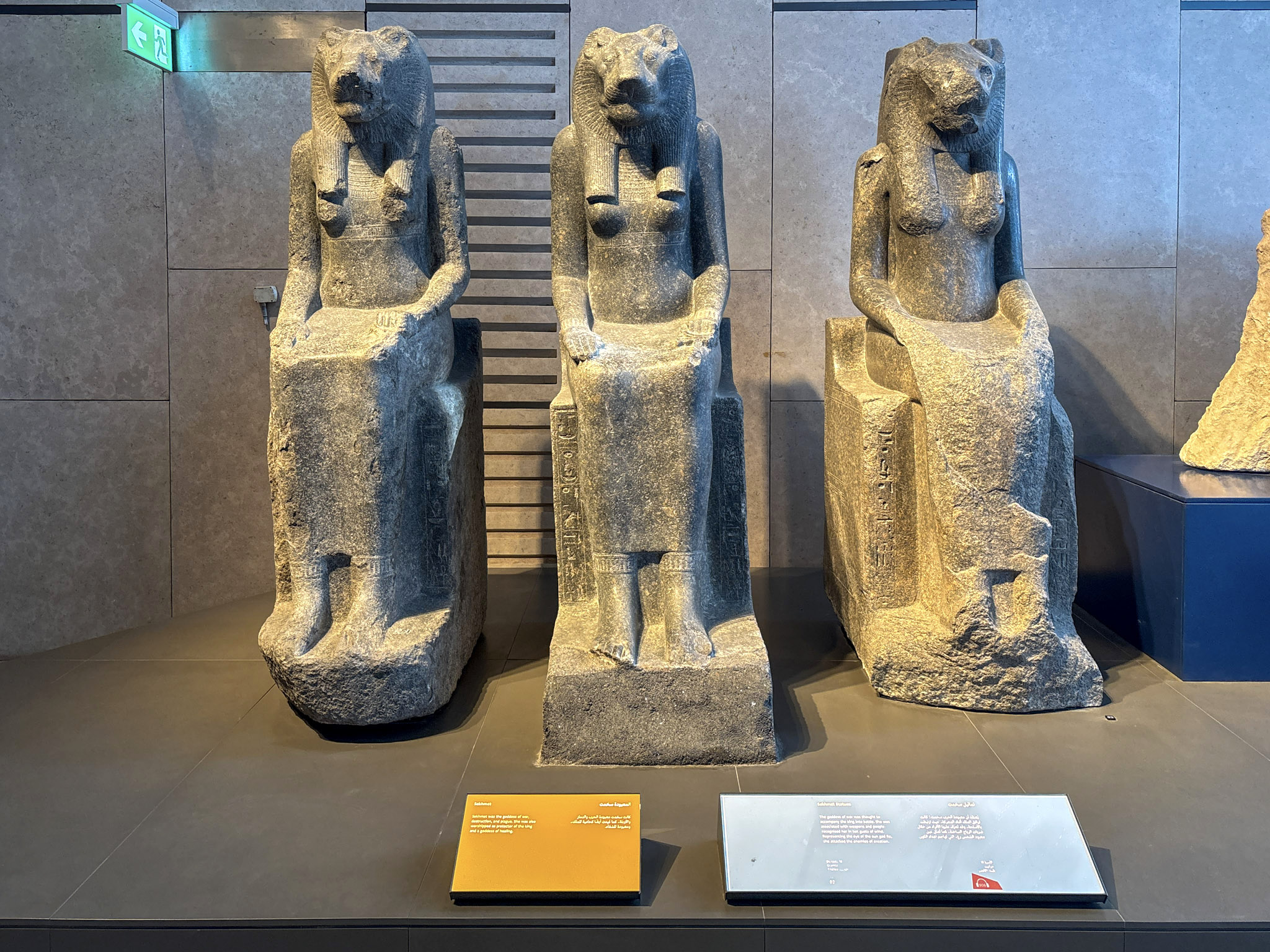
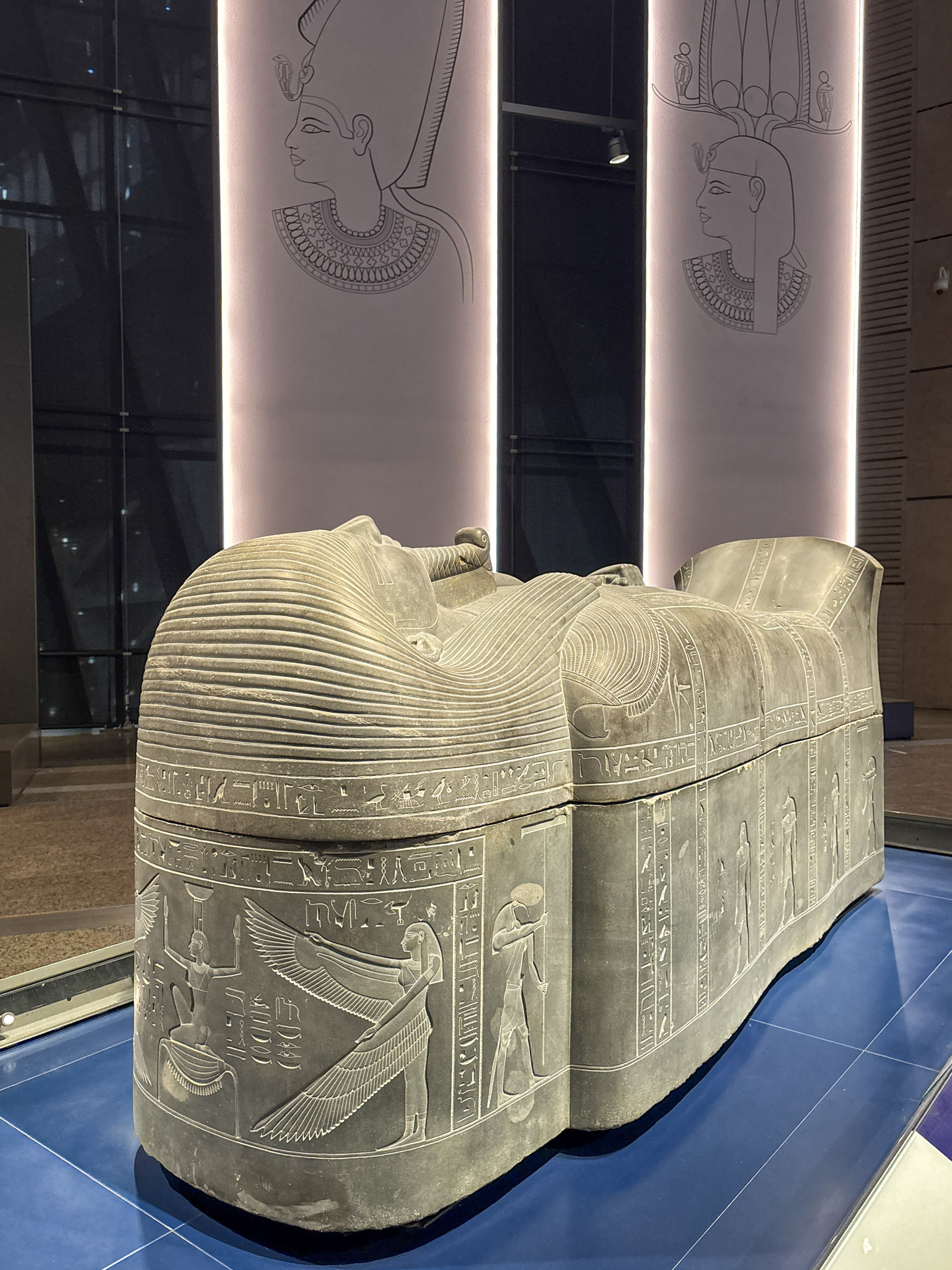
- Beliefs and the Afterlife (Galleries 10–12) – Centers on religion and death rituals. Sarcophagi painted with spells from the Book of the Dead, mummified animals linked to cult worship, and Greco-Roman statues showing Egypt’s later syncretism. Lighting shifts warmer here, echoing tomb interiors.
Khufu’s Boats Museum
Outside the main building, a short walk leads to the Khufu’s Boats Museum, housed in a separate climate-controlled structure beside the Pyramids Steps. It displays two 4,500-year-old cedar boats discovered in 1954 at the base of the Great Pyramid. One has been fully reconstructed to its original 43-meter length; the other is under live conservation behind glass panels, letting visitors watch the restoration in progress. These vessels weren’t for travel, they were solar boats, meant to carry Pharaoh Khufu with the sun god Ra through the afterlife. The museum explains their construction, ritual purpose, and the painstaking modern excavation.

My Take After Visiting the Grand Egyptian Museum
This isn’t an academic review of the museum, it’s simply how the place felt to me as a visitor.
What stood out right away is how intentional the architecture looks. It’s detailed and geometric with plenty of references to the theme, the statues sit exactly where they should, and the use of filtered light feels precise. It’s a gorgeous modern structure that understands the weight of what it’s holding.
I also expected the museum to feel overwhelming. It doesn’t. If you glance at the layout plan when you walk in, the spatial logic is obvious. I did the entire visit on my own without a guide and never felt lost. The labels are actually useful, and the audio guide works very well if you want more context without being dragged around.
The Tutankhamun Galleries are, frankly, perfect. The order makes sense, the lighting is right, and nothing feels crammed. You move through the story naturally, from life to burial to rediscovery, and it never turns into gold overload. You finish and feel like you actually understood something.
The Main Galleries hold a huge number of objects, so some visual fatigue is inevitable, but it’s manageable. It’s more “I’ve seen enough to stop for a coffee” than “get me out of here”. The thematic structure helps, and shifting between daily life, power, and belief keeps the experience engaging.
I also liked ending the visit at Khufu’s Boats Museum. Seeing the reconstructed solar boat up close, and the second one still under conservation, adds a different layer to the experience. It’s quieter, more focused, and works well as a closing chapter after the scale of the main building.
Where to Eat and Rest Nearby
Inside the Grand Egyptian Museum there’s a dedicated food and retail area, and it’s more than just a token café. You’ll find Zooba for Egyptian street food (taameya, koshary-style bowls), 30 North and Beano’s for coffee, Ladurée for pastries, Bittersweet and Dolato for desserts, plus Starbucks if you want something familiar. The full list is shown in the visitor map near the entrance.
Food is decent, but timing matters. Lines start forming around 12:30 p.m., especially at Zooba and the coffee spots. If you want a quick break without waiting, go earlier or leave lunch for after the visit.
Seating is comfortable and air-conditioned, and restrooms are close by, which makes this the best place to pause before or after the Main Galleries. Prices are higher than downtown Cairo, but in line with major museums.
What’s Still in the Old Egyptian Museum?
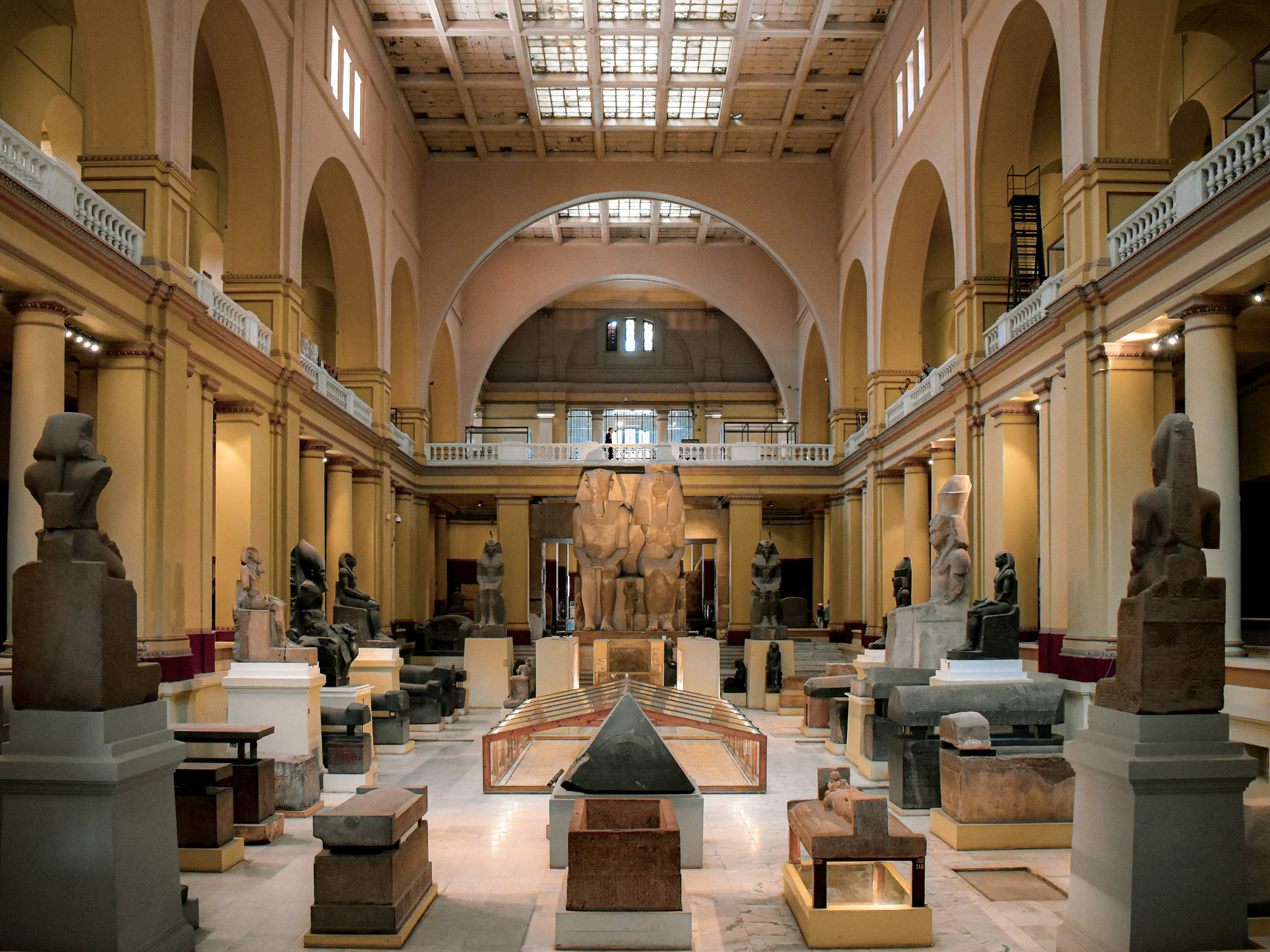
The Egyptian Museum didn’t empty out when the Grand Egyptian Museum opened, and it’s still worth your time if you’re curious beyond the headline pieces.
Some objects never moved. The Royal Mummy Room continues to house several major pharaohs, including Ramesses III and Seqenenre Tao, displayed in a more traditional, less theatrical setting.
You’ll also find large parts of the Middle Kingdom statuary, especially finely carved limestone figures that never needed monumental space to make an impact. Entire rooms of papyri, including administrative and funerary texts, stayed behind, as did substantial collections of wooden coffins, sarcophagi, and everyday objects that don’t fit the GEM’s narrative-driven display logic.
What makes Tahrir interesting now is context. The building is early-20th-century, the displays feel old-school, and the experience is less curated. That can be a downside, but it also gives you a raw sense of how Egyptology was presented for decades. If the GEM feels like a carefully edited book, the old museum feels like an archive you’re allowed to wander through.
FAQ for visiting the Grand Egyptian Museum
How long should I spend at the Grand Egyptian Museum?
Three hours is the sweet spot for most people. It gives you time for the Grand Hall and Grand Stairs, the Tutankhamun Galleries, a solid pass through the Main Galleries, and Khufu’s Boats Museum without turning the morning into a blur.
Can I buy Grand Egyptian Museum tickets on the same day?
No. As of January 2026, you cannot buy tickets at the gate anymore. All tickets must be booked online in advance with a selected entry time slot, and you have to show the QR code at entry.
Are professional cameras allowed inside?
Phones and regular cameras are fine, except in the Tutankhamun Galleries, where only mobile photography is permitted. Flash, tripods, selfie sticks, and drones are not allowed. If you have bulky gear or anything that looks like a production setup, expect extra attention from security.
Is there food inside the museum?
Yes. There’s a dedicated food and retail area with cafés and casual options, and lines usually build around lunchtime.
Can I visit the Grand Egyptian Museum and the Pyramids in one day?
Yes, and it’s a great combo if you plan it. Do the GEM first with an early timed entry, then head to the Pyramids after lunch. Trying to do the Pyramids first usually means arriving at the museum when it’s busier.
Is the old Egyptian Museum still open?
Yes, the Egyptian Museum in Tahrir is still open, and it’s worth it if you want a denser, old-school museum experience and to see pieces that stayed there.
Is the Grand Egyptian Museum accessible?
Yes, very much so. The main circulation is wide and modern, with ramps and elevators. Strollers and wheelchairs move easily through the core routes.
Keep reading:

14 Most Emblematic Artworks at the National Gallery Singapore
A curated guide to the most important artworks at the National Gallery Singapore, aka the famous paintings that actually make it worth stepping inside.[dssb_sharing_buttons icon_placement="icon" icon_width="fixed" alignment="left" icon_color="#000000"...

What It’s Like to Visit Casa Balla, Rome’s Futurist Gem
There are artist homes, and then there’s this. Casa Balla in Rome is what happens when someone turns their worldview into wallpaper, floor tiles, and door handles.[dssb_sharing_buttons icon_placement="icon" icon_width="fixed" alignment="left" icon_color="#000000"...

Borghese Gallery, Rome: 10 Must-See Artworks & Tour Review
Two floors, countless treasures, and centuries of Caravaggio’s drama and Bernini’s brilliance to discover. This tour review will walk you through the Borghese Gallery’s most famous artworks and share some tips to help you get the best out of your...