The Didgori Battle Memorial: giant swords on a hilltop west of Tbilisi mark Georgia’s most famous medieval victory. This guide covers how to get there, what to see and the story of the 1121 battle.
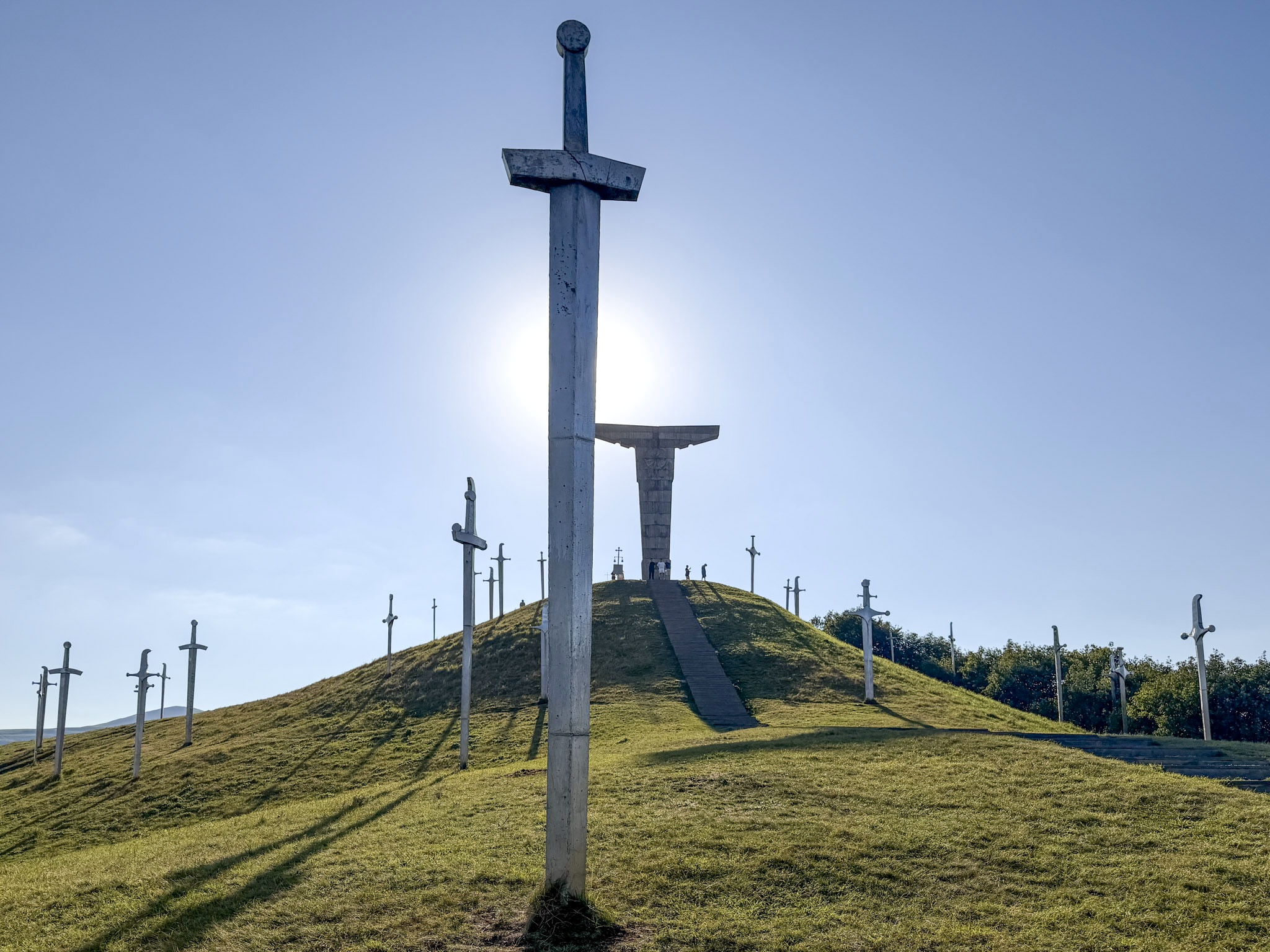
The Didgori Battle Memorial is a field of giant swords planted on a green hill west of Tbilisi, right where King David IV of Georgia won the most famous battle in the country’s history, back in 1121. I stopped there on my drive back to Tbilisi from Kutaisi, and it turned out to be one of the most striking places of the whole trip.
It’s also more popular than I’d imagined. On a Saturday in August there were families walking up the steps, a few food carts grilling meat near the parking lot and music in the air, which made it a lively place to visit. Below you’ll find how to get there from Tbilisi or along the Kutaisi road, what to see once you’re up there, and the story of the battle.
Planning Your Visit to the Field of Swords
-
- Where it is: on the hills of the Trialeti Range in Kvemo Kartli, the region just southwest of Tbilisi, at about 1,650 m (5,400 ft) above sea level.
- Getting there by car: it’s around 55 km (35 miles) from Tbilisi, so an hour to an hour and a half of driving. The road is paved, with a few short stretches under repair where you’ll want to slow down. No public bus goes up there.
- Going with a tour: if you’d rather not drive, these day trips from Tbilisi and Kutaisi all include the memorial:
- Didgori Battle Memorial and Chronicle of Georgia: the memorial plus the Chronicle of Georgia, a set of giant carved stone pillars on a hill above the Tbilisi Sea, the big lake on the edge of the city.
- Chronicle of Georgia, Mtskheta, Jvari and Didgori: the Chronicle, then Mtskheta, Georgia’s ancient capital, with Svetitskhoveli Cathedral and the 6th-century Jvari Monastery on the hill above town, and Didgori to finish the day.
- Didgori and Dashbashi Canyon: the memorial and Dashbashi Canyon, a deep gorge in the same region with a glass-floored bridge across it.
- From Kutaisi: Didgori, Mtskheta, Chronicles and Tbilisi: a long day that starts in Kutaisi, stops at Didgori, Svetitskhoveli and Jvari, then the Chronicle of Georgia, and ends with a walk through Tbilisi’s old town.
- Entrance fee: none. It’s an open-air site and everything is free.
- How long to stay: about an hour is enough for the trumpeter warrior statue and the main memorial together.
- Food and water: on our Saturday in August a few barbecue carts were grilling meat by the parking lot. I wouldn’t count on them on a quiet weekday, so bring water and a snack.
-
-
Where to stay: Tbilisi is the easiest base. I stayed at Mukhrantubani Boutique Hotel ⭐⭐⭐⭐ in the old town, and for the rest of the city there’s my guide to the best things to do in Tbilisi.
-
How to Get to the Didgori Battle Memorial
Two roads climb to the memorial, one from the north and one from the south. They meet by the swords, but the road you choose decides what you see first.
The Northern Road, Through the Nichbisi Valley
Best if you’re coming from Kutaisi or western Georgia.
- Starts from: the main highway near Mtskheta, the old capital just north of Tbilisi.
- The drive: a climb through thick forest that opens onto bare hills near the top.
- What you see first: the trumpeter warrior statue, about 6 or 7 minutes before the swords, so it’s an easy stop on the way up.
This is the road we took, at the end of a long drive back to Tbilisi with a morning stop at Uplistsikhe, an ancient cave town near Gori.
The Southern Road, Through Tskneti and Manglisi
Best if you’re starting in Tbilisi.
- Starts from: Tskneti, a hill suburb on the edge of Tbilisi, then Manglisi, a small town known for its medieval cathedral.
- The drive: the more direct way up from the city.
- What you see first: the field of swords. The trumpeter warrior is about 4 km (2.5 miles) further north, so you’ll need to drive on to see it.
Road Conditions and Parking
- Asphalt: smooth on most of the way, with very little traffic.
- Roadworks: a few short stretches being repaired, partly gravel, where you need to drive slowly. They move as the works go on.
- Car: we had a 4x4, but the rough patches are short.
- Winter: with snow, sleet or poor visibility, Georgia’s Roads Department closes the road to all traffic. Check before you go between December and March.
- Parking: right in front of the field of swords.
No car? The day tours in the planning section above cover the whole route.
What to See at the Didgori Battle Memorial
The Trumpeter Warrior Statue
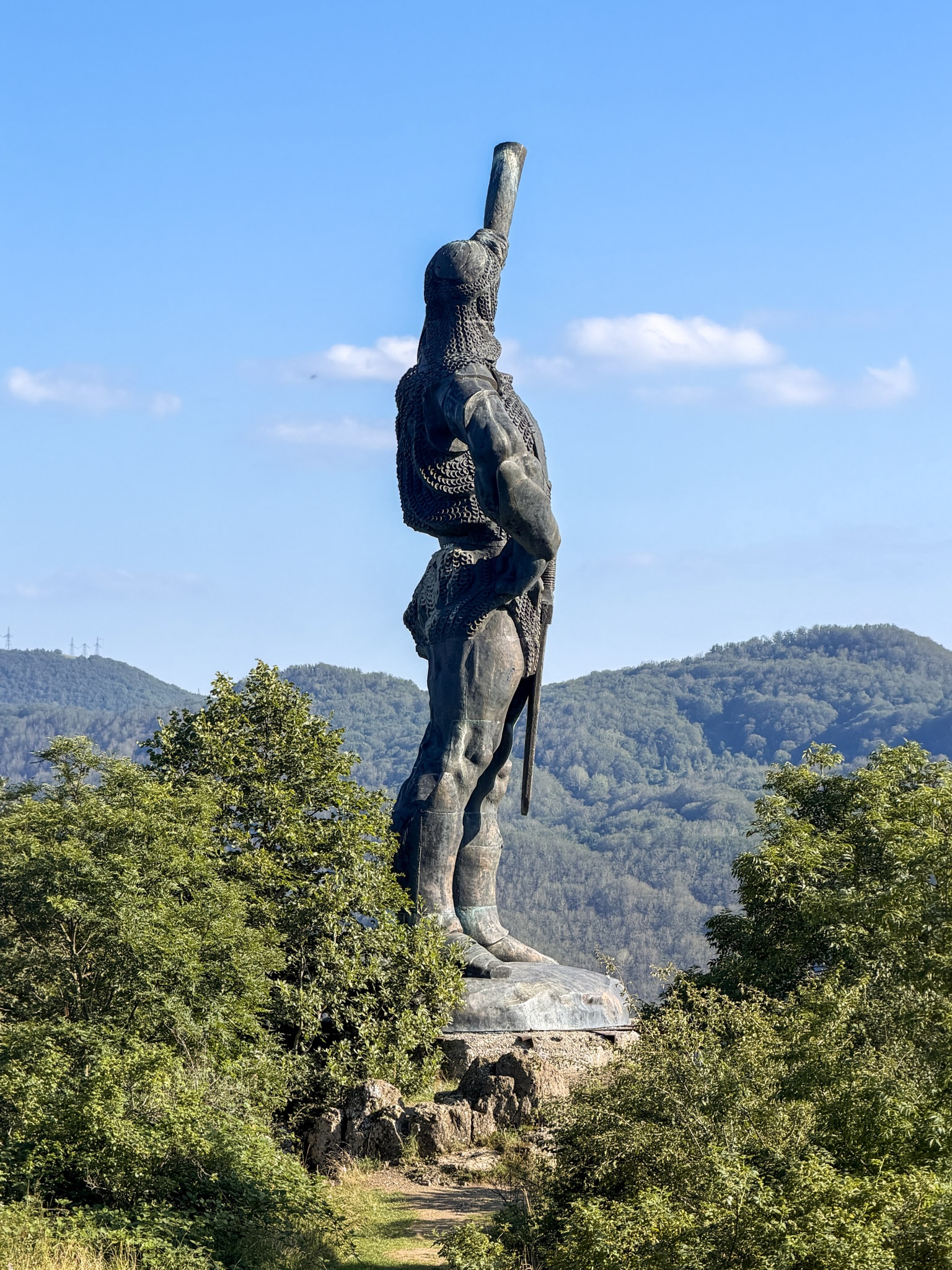
The first thing you meet on the northern road is a giant bronze warrior in chain mail, a sword at his side, lifting a long horn to his mouth. He stands on a rock at the edge of the hills, looking out over the valley, as if calling the army to battle.
There’s no sign for it. You’ll see a small pull-out on the side of the road, and if you look up you can just make out the statue above the trees. From there it’s a flat 5-minute walk along a dirt path.
Some blogs call him David the Builder, the king who won the battle. The Georgian National Tourism Administration simply describes him as a warrior giving the signal to fight, so he’s one of the soldiers, not the king.
The Field of Swords
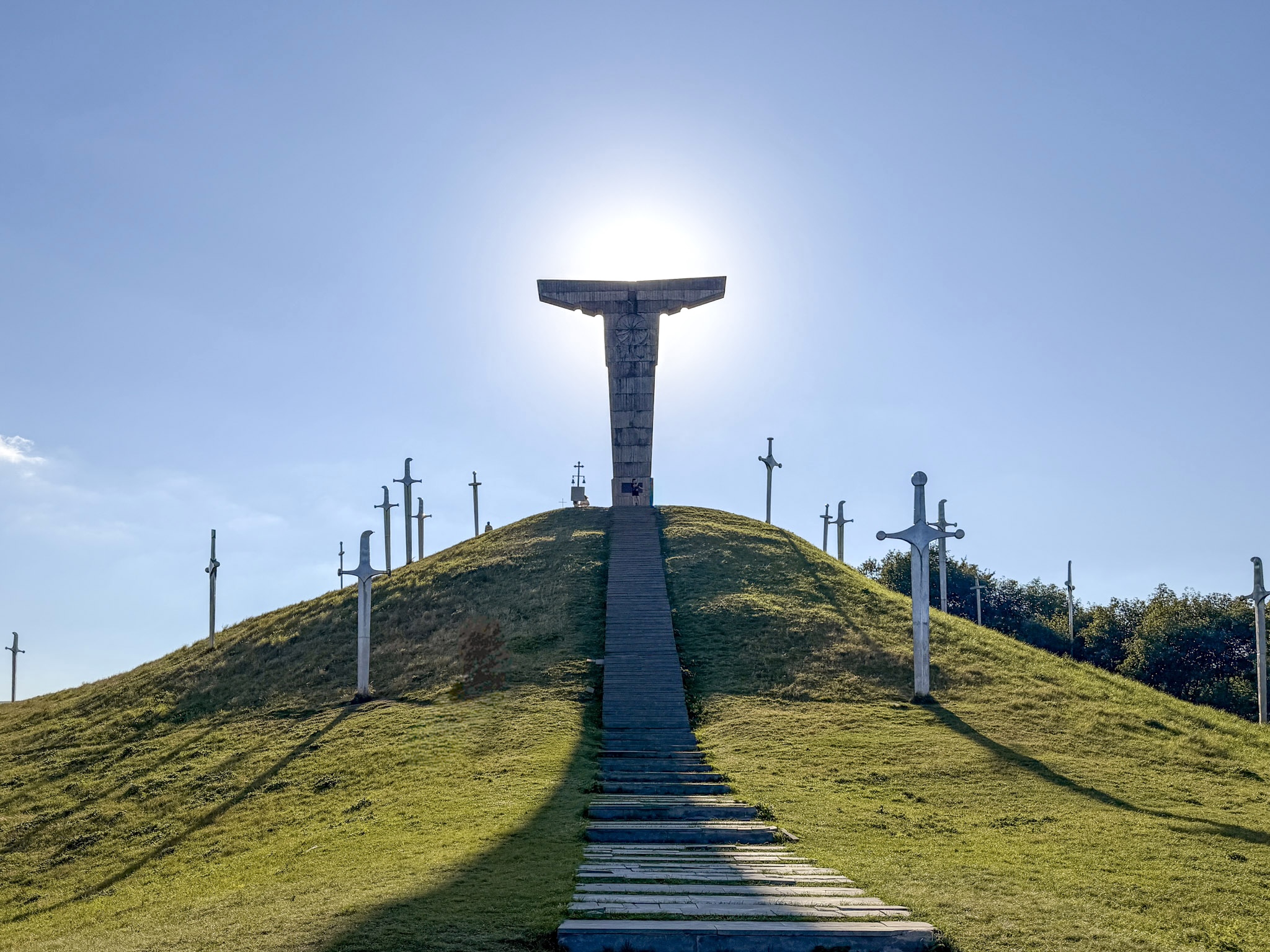
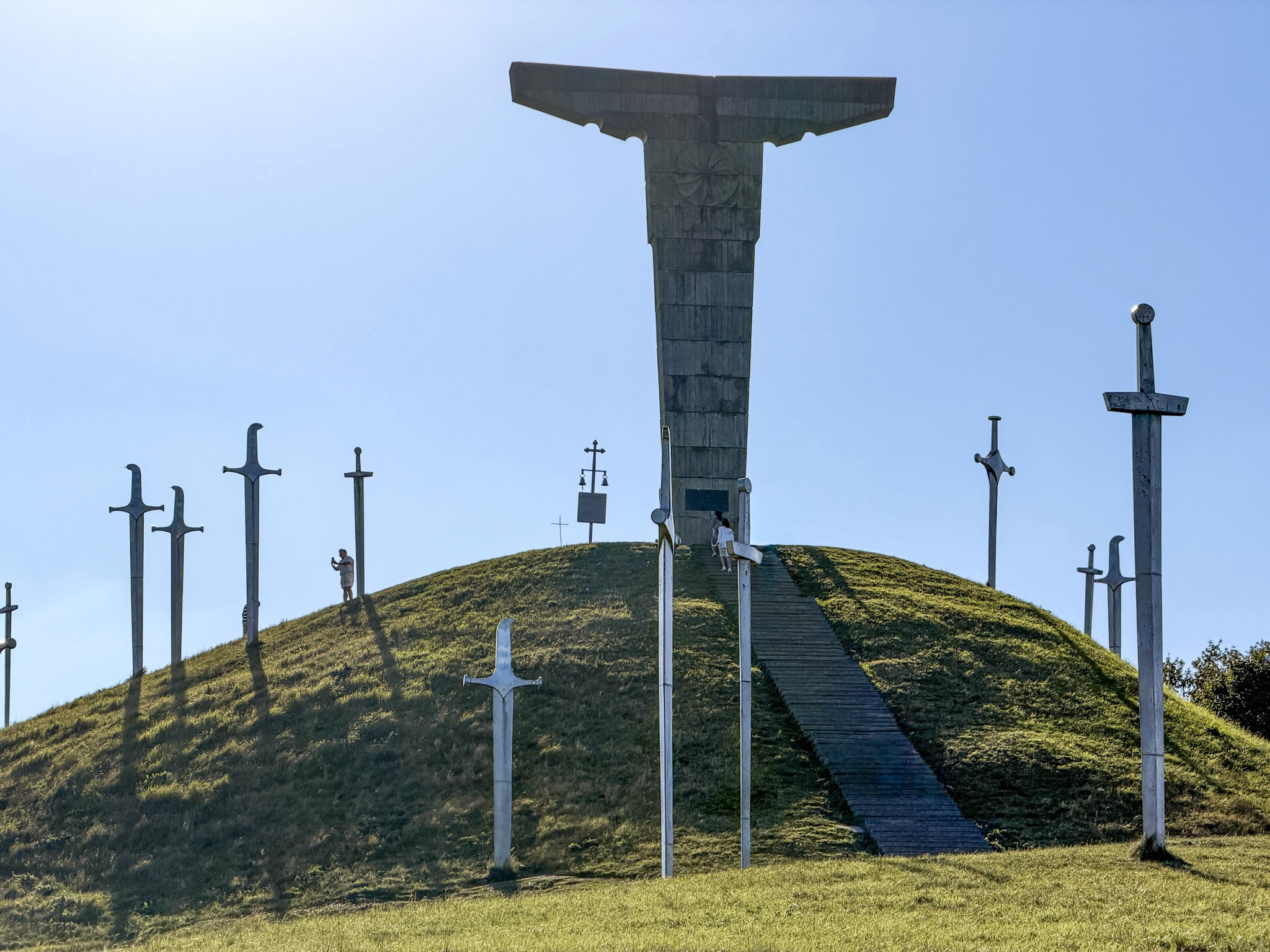
This is the part everyone comes for. Dozens of huge swords are planted all over a grassy hill, point down, the way you’d stick a sword in the ground over a fallen soldier. From a distance their hilts look like crosses on graves, which is the idea.
They’re bigger than they look in photos. Standing next to one, I had to tip my head back to see the hilt. Look closely and you’ll notice they aren’t all the same: some have straight blades, others are curved like sabers.
The Stone Column at the Top of the Hill
A long stone staircase runs straight up the middle of the hill to a tall column shaped like a T. The shape copies the deda bodzi, the carved wooden pillar that held up the roof in the middle of old Georgian houses. The name means “mother pillar.”
Carved on it is a borjgali, an ancient Georgian sun symbol with curling rays that you’ll see all over the country, from churches to coins. Next to the column there’s a stone cross with a few bells, and all around you the hills of the Trialeti Range roll off in every direction.
The climb takes a minute. Nothing hard, but there’s no shade.
The Little Amphitheater Below the Hill
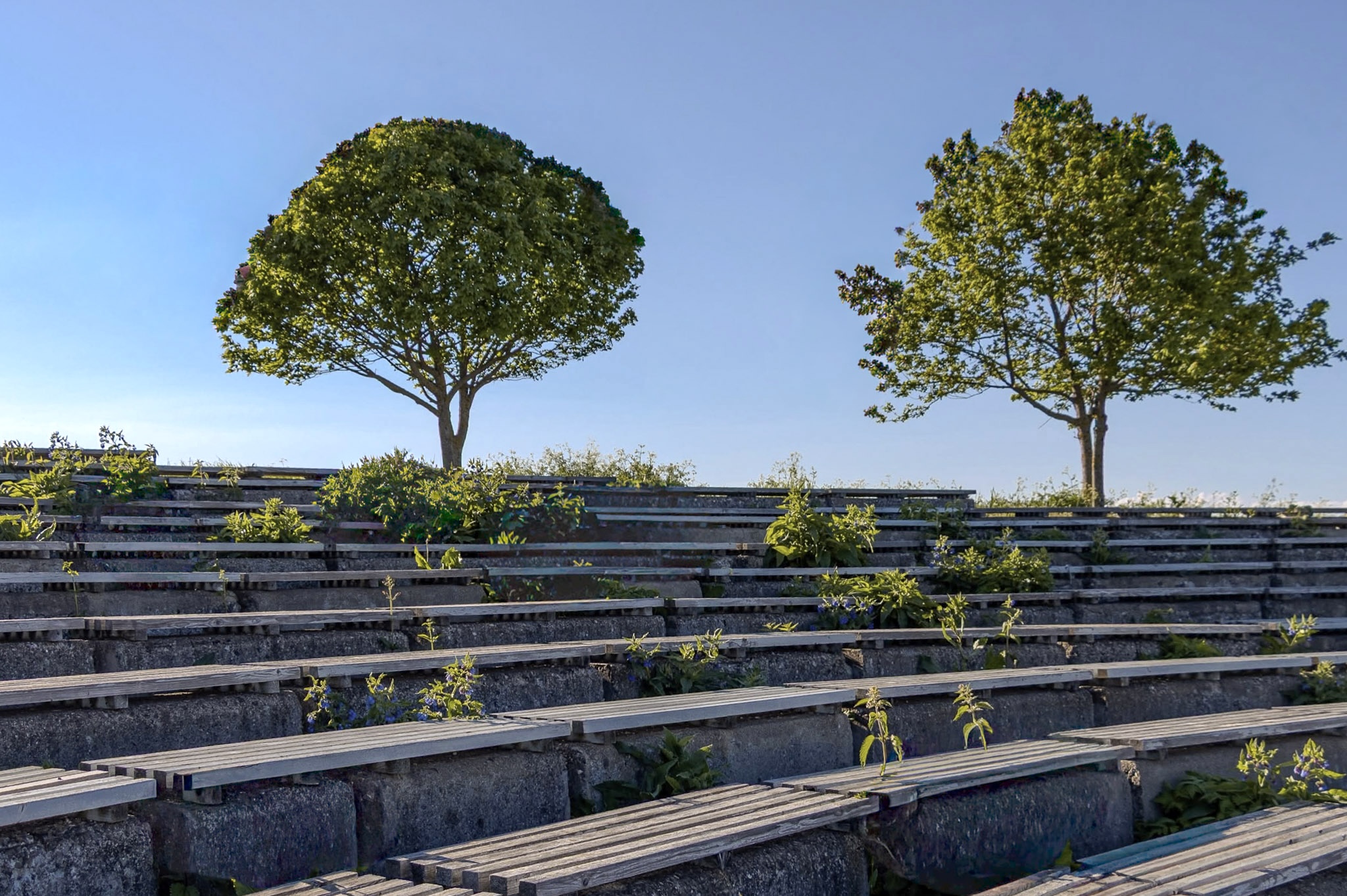
At the foot of the hill there’s a small amphitheater, a half circle of stone steps facing a little stage. I’d watched several videos of Didgori before going and hadn’t seen it in any of them, so it was a nice surprise.
It’s worth a short walk around. Close by there’s also a bronze owl on a rock and a set of bells that ring when the wind picks up.
The Warrior Sculptures in the Meadows
Scattered in the grass around the main hill are more bronze figures, broken and twisted soldiers in strange poses. They’re easy to miss if you only climb the stairs and go back to the car, so take a loop around the meadows.
A small church dedicated to Saint George also stands nearby.
What Happened at the Battle of Didgori?
The Battle in 1121
In the early 1100s, Georgia was under constant pressure from the Seljuks, a Turkish dynasty ruling an empire across Iran and the Middle East, and Tbilisi had been in Muslim hands for centuries. King David IV, remembered as David the Builder, spent years building an army strong enough to fight back, partly with Kipchak horsemen from the steppes north of the Caucasus, whom he invited to settle in Georgia with their families.
On August 12, 1121, a much larger Seljuk army met his troops here, in the hills of Didgori. Alongside the Georgians and Kipchaks fought a couple of hundred crusader knights from Western Europe. David used the narrow valleys to his advantage, and in about three hours the invaders were beaten, a result the Georgian chronicles called the “miraculous victory.” A year later he took back Tbilisi and made it his capital, opening what Georgians call their Golden Age. The battle is still celebrated on the hill every August 12, with a festival called Didgoroba.
Who Built the Memorial, and When
The memorial is the work of Merab Berdzenishvili (1929–2016), one of the most famous Georgian sculptors of the 20th century. A philosopher who wrote about his work called him “the Georgian Michelangelo,” for his big, muscular figures of kings and heroes. In Tbilisi you can see his Muse statue outside the Philharmonic and his monument to the poet David Guramishvili.
Many websites say the memorial was built in 1976, but the Georgian Encyclopedia dates the finished complex to 1991, in the last months before Georgia’s independence.
The whole hill was designed as a symbolic battlefield:
- The swords are planted like crosses over the graves of the soldiers who died.
- The column at the top copies the deda bodzi, the central pillar of old Georgian houses, and carries the borjgali sun symbol.
- The bronze warriors in the meadows are broken, twisted figures that stand for the wounded and the dead.
- The amphitheater below the hill, with its columns and bells, was made for ceremonies.
Is the Didgori Battle Memorial Worth Visiting?
Yes. It’s one of the most unusual places we saw in Georgia, and the setting does a lot of the work: giant swords, a stone column and bronze warriors spread over open hills, with nothing else around for kilometers.
What surprised me was how popular it is. I’d expected a quiet, half-forgotten spot. On a Saturday in August there were plenty of Georgian families walking up the steps, a few carts grilling meat near the parking lot and music playing, which gave the place a relaxed, picnic kind of mood. If you’re after silence and empty photos, a weekday morning is a safer bet.
It’s a great fit if you:
- are driving between Kutaisi and Tbilisi and want to break up the trip
- like big, unusual monuments and history you can see on the ground
- enjoy photography, with wide views and very few buildings in the frame
You could skip it if you:
- only have a day or two in Tbilisi and no car
- are visiting in winter and don’t want to risk a closed road
FAQ
Can you get to Didgori by taxi or Bolt?
You can get a ride up from Tbilisi, but finding one back is another story, since there’s nothing on the ridge and drivers rarely wait around up there. If you’re not driving, agree on a return trip with a driver who waits for you, or book one of the day tours.
Can you combine Didgori and Mtskheta in one day?
Yes, easily. The northern road to the memorial starts near Mtskheta, so you can visit Svetitskhoveli Cathedral and Jvari Monastery in the morning and drive up to the swords in the afternoon. Several of the tours do exactly this.
Is Didgori a good trip with kids?
Yes. The walks are short, there’s plenty of open grass to run around on, and kids usually love the giant swords. The stone staircase to the column is steep, though, and there’s no shade, so bring hats and water.
Can you visit Didgori at sunset?
Yes, it’s an open-air site with no gates, and the low evening light on the swords is beautiful. Just keep in mind that the drive back is on a winding mountain road with no streetlights, so plan for it if you’re not used to driving in the dark.
What should you bring?
A layer even in summer, because the wind on the ridge can be strong and it’s cooler than in Tbilisi. Add sunscreen, water and comfortable shoes for walking on grass and stone steps.
Keep reading: