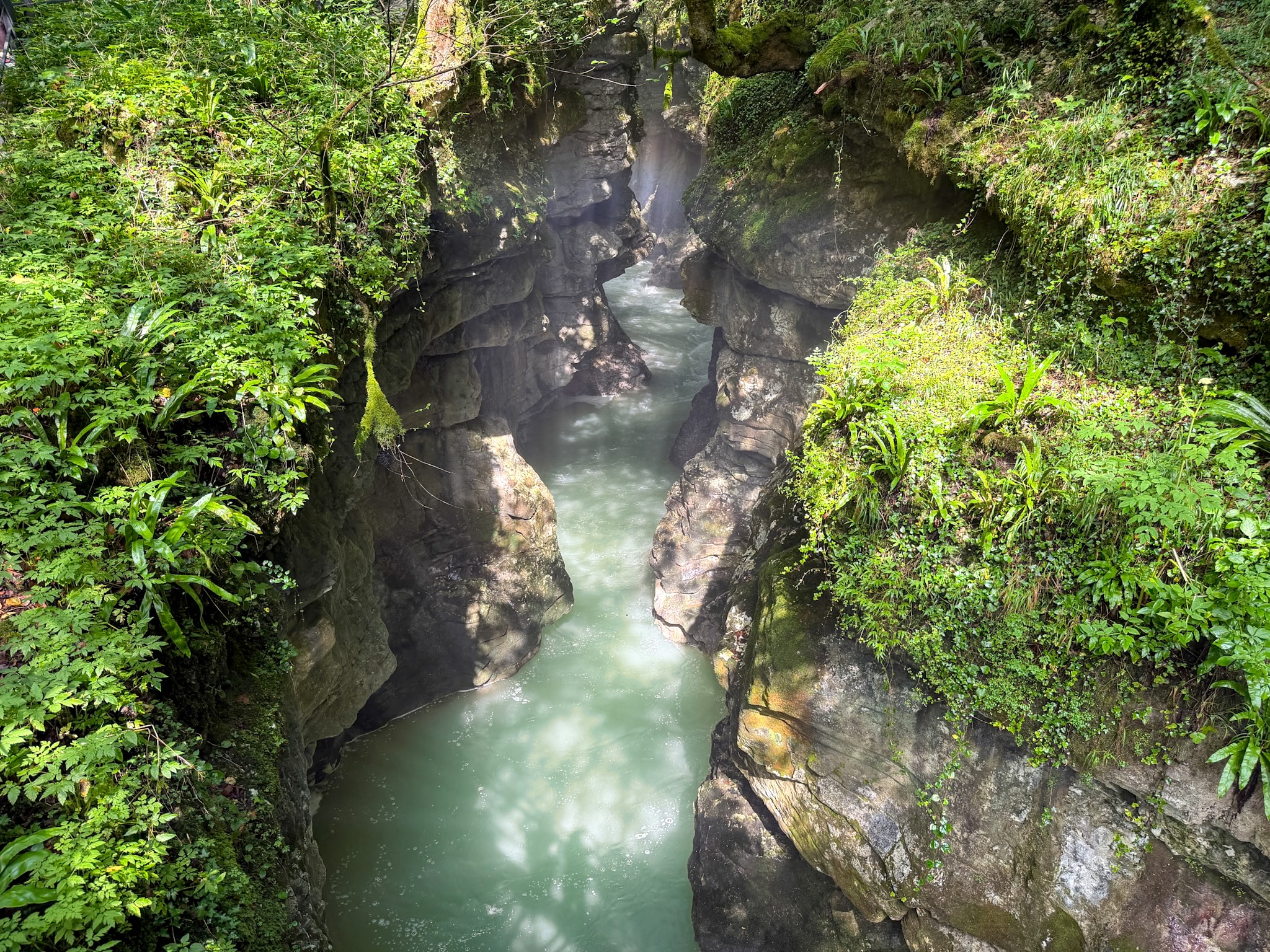
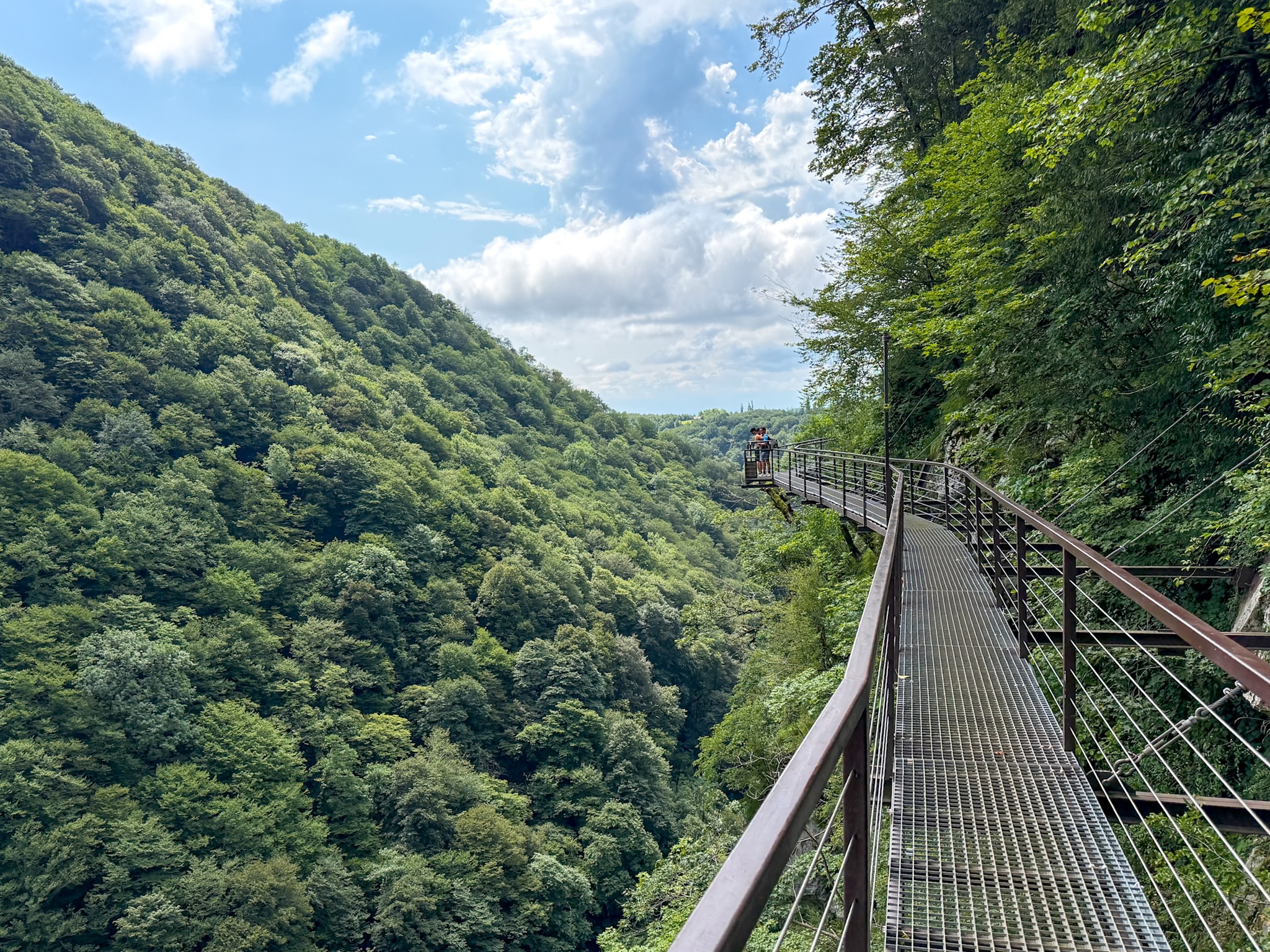
Is Tskaltubo still worth a visit now that its Soviet sanatoriums are being sold and fenced off? My personal answer for urbex fans and Georgia travelers, plus the top buildings and how to visit.
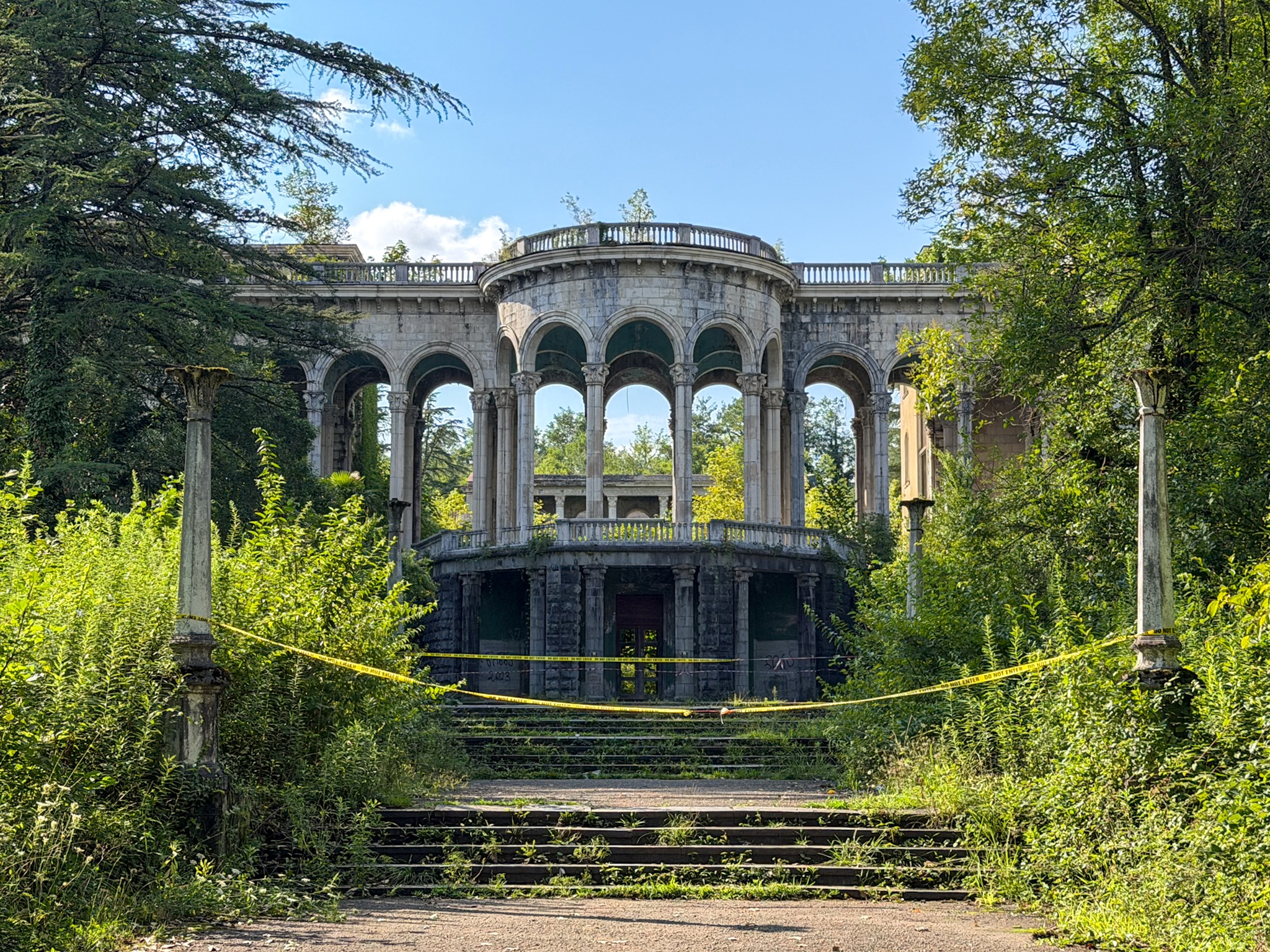
The stairs up to Sanatorium Medea, the most photographed building in Tskaltubo, were crossed with yellow “DO NOT ENTER” tape, and someone had hung a second, angrier sign telling people to actually read the first one. A short drive away, a bride in a full white dress was posing for photos outside the Soviet bathhouse Number 8. At Sanatorium Metallurgist, a woman by the door asked for payment and directed several tourists up the stairs. That was Tskaltubo in August 2026.
For the uninitiated, Tskaltubo is a spa town located 15 km (9 mi) from Kutaisi, in western Georgia. It's where dozens of grand sanatoriums (medical wellness resorts) were built for Soviet workers and then left to decay after 1991.
For years, the resulting ghost buildings were a free-for-all for urbex fans. Now the same buildings are being sold and fenced off, many of the families who lived inside have been rehoused, and walking in often means dealing with a guard or a "donation".
So is it still urbex, or just another tourist stop on a Georgian itinerary? Is it worth visiting if you’re already in Kutaisi? And is it worth a detour from Tbilisi or the mountains? My answer is maybe, with conditions, and they’re all below.
Visiting Tskaltubo: What to Know First
Let's just cover the essentials first:
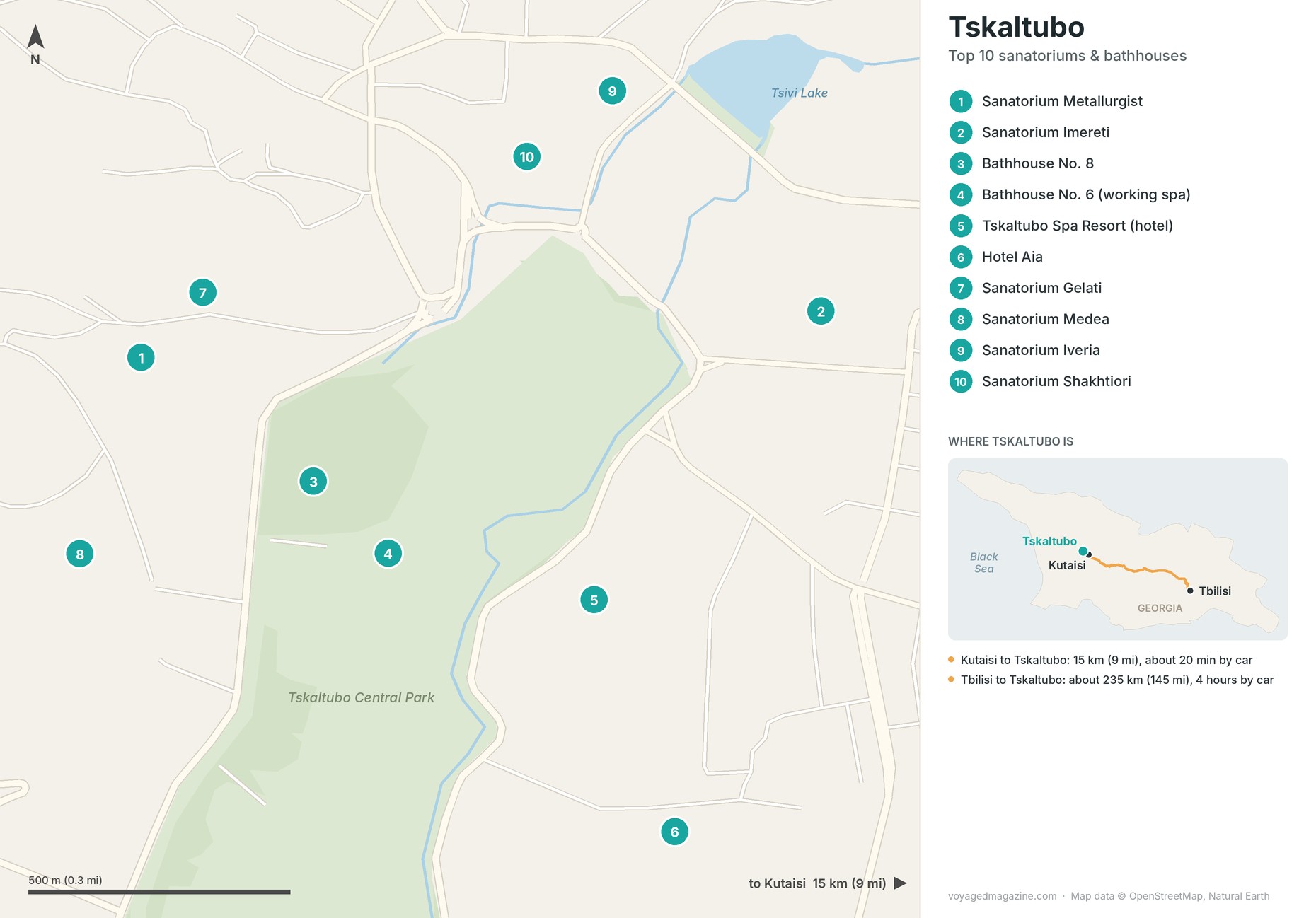
- Where it is: in the Imereti region of western Georgia, about 15 km (9 mi) northwest of Kutaisi. The drive takes 20 to 25 minutes.
- Safety first: these are crumbling buildings with no maintenance, no barriers and nobody checking who goes in, and some still have people living inside. You enter at your own risk. Stick to the main halls unless someone who knows the building shows you the way, and don’t go alone.
- How long you need: I spent a little over an hour on six buildings, moving by car and slowly, since these aren’t places you rush through. To see the ten in this guide, plan on half a day.
- What it costs: most buildings are free to walk around. Inside some, like Sanatorium Metallurgist, you'll find people guarding the entrance and asking for a minimum donation. Bring cash in small bills.
- What to wear: closed shoes with a good grip. I wore hiking shoes, and I was glad I did with the broken glass and loose plaster on the floors.
- When this was checked: building status in this guide is from August 2026. Things change fast here, so treat it as a recent snapshot.
- How to visit:
-
- On your own by car: the easiest way. It’s a 20 to 25 minute drive from Kutaisi, and you can park right outside most buildings and hop from one to the next.
- On your own without a car: marshrutka minibus number 30 leaves from the end of the Red Bridge in Kutaisi about every 20 minutes. Alternatively, Bolt taxi is the faster option. Once there, expect a lot of walking, since the buildings are spread around a big park.
- With a guided tour: a good choice if you want someone who knows which buildings are safe to enter and which are closed this month. Megobari Tours runs a half-day sanatoriums tour from Kutaisi. Budget Georgia runs a cheaper group tour that usually starts at 2 pm.
-
-
-
Where to stay: in Kutaisi, which has far more hotels and restaurants. I stayed at:
- Newport Hotel Kutaisi ⭐⭐⭐⭐, inside the old courthouse building right behind the Colchis Fountain, if you want comfort and service at an international standard
- Hotel Memoire Kutaisi ⭐⭐⭐, a small hotel in a renovated old building on the same street, if you’d prefer a more Georgian-looking hospitality and design for your stay.
-
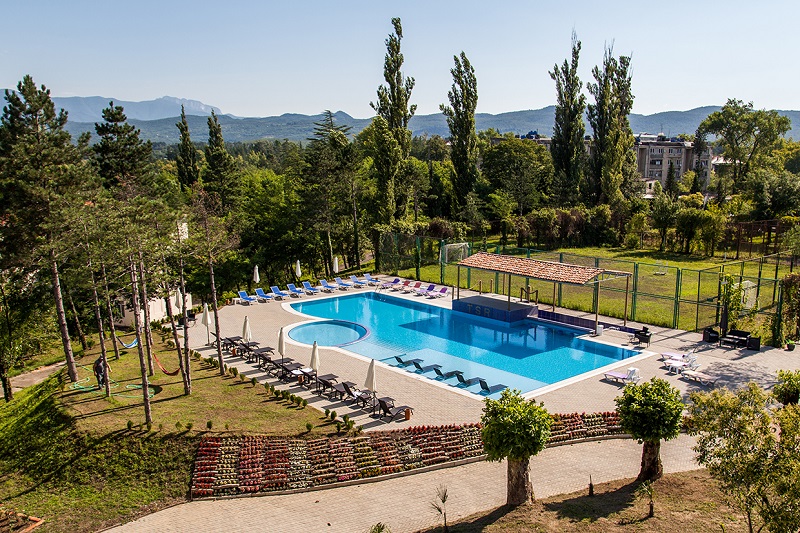
If you want to sleep inside a former sanatorium, there’s Tskaltubo Spa Resort ⭐⭐⭐⭐.
Are the Tskaltubo Sanatoriums Still Worth Visiting?
Here’s what’s different and what you need to consider before answering this question:
- In 2022 the Georgian government launched a plan called “New Life for Tskaltubo” and put 14 of the old sanatoriums up for auction. Investors bought several of them, and on the ground you see it right away: Iveria and Shakhtiori are behind tall metal fences now.
- Some are being turned into hotels, and not always gently. Sanatorium Tbilisi is being rebuilt as a hotel, and the owner told local press that the back of the building couldn’t take the construction work and will be replaced with a new structure.
- The most famous one is closed. Medea, the sanatorium on every Tskaltubo postcard, was taped off and guarded when I got there in August 2026. A guide told me a tourist had stepped on an unstable section while taking photos and fallen.
- Most of the residents have moved out. Families displaced by the war in Abkhazia lived in these buildings from the early 1990s, and most were rehoused in new apartments from 2021 on. A few buildings, like Metallurgist, still have people living in one wing.
- It’s half tourist attraction, half urbex. Tour vans park outside Metallurgist, a local woman collects donations at the door, and couples book wedding shoots in the ruins. But I also walked into Imereti alone, over rubble and loose plaster, with someone watching me from a balcony upstairs. I still don’t know if it was a guard or someone who lives there.
- It’s far from everything except Kutaisi. Tskaltubo is about 235 km (145 mi) from Tbilisi, roughly four hours by car, which is a long way for an afternoon of ruins. From Kutaisi it’s 20 minutes. I drove over in the afternoon after Okatse Canyon, and Martvili Canyon is close enough to fit into the same day.
So, is it still worth it? Yes, as a half-day stop if you’re already around Kutaisi, and as long as you know you won’t get into everything. The Tskaltubo you see in older photos, where you could wander into any building you liked, is mostly gone, but there’s still plenty left to see.
Worth it if you:
- Like urbex and Soviet architecture
- Are already in Kutaisi or driving through western Georgia.
- Are fine seeing some buildings only from the outside.
Skip it if you:
- Expect to explore every building freely.
- Have only a few days in Georgia and Kutaisi isn’t on your route.
- Are traveling alone and uneasy in empty, crumbling buildings.
A Short History of Tskaltubo’s Sanatoriums
A Soviet sanatorium was part hotel, part health clinic. Workers came for two or three weeks of rest, meals and doctor-prescribed treatments, usually paid for by their job or union, because “the right to rest” was written into the Soviet constitution.
Tskaltubo had what these places needed: warm springs, around 33 to 35°C (91 to 95°F), with traces of radon that doctors back then prescribed for joints and circulation. In 1931 it became an official spa resort, and after World War II more than 20 sanatoriums went up around a big central park. Many were named after the workers they hosted, like Metallurgist for metal workers and Shakhtiori for miners. Stalin is said to have come here for treatment, and Bathhouse No. 6 still has the private bath built for him. (For more on his early years, see Stalin’s secret underground printing house in Tbilisi.)
When the Soviet Union collapsed in 1991, the guests disappeared and the buildings were stripped. A year later, war in Abkhazia, in Georgia’s northwest, pushed thousands of people from their homes, and around 9,000 were housed in Tskaltubo’s empty sanatoriums. It was meant to be temporary. Many stayed nearly 30 years.
What It's Worth Seeing: 10 Top Sanatoriums and Bathhouses
These are the ten buildings most worth your time, numbered as on the map.
1. Sanatorium Metallurgist
- Can you go inside: yes, for a small donation (5 GEL per person when I went).
- Don’t miss: the chandelier in the entrance hall and the old concert hall at the back.
- Good to know: families still live in one wing, so stay out of anything that looks lived in.
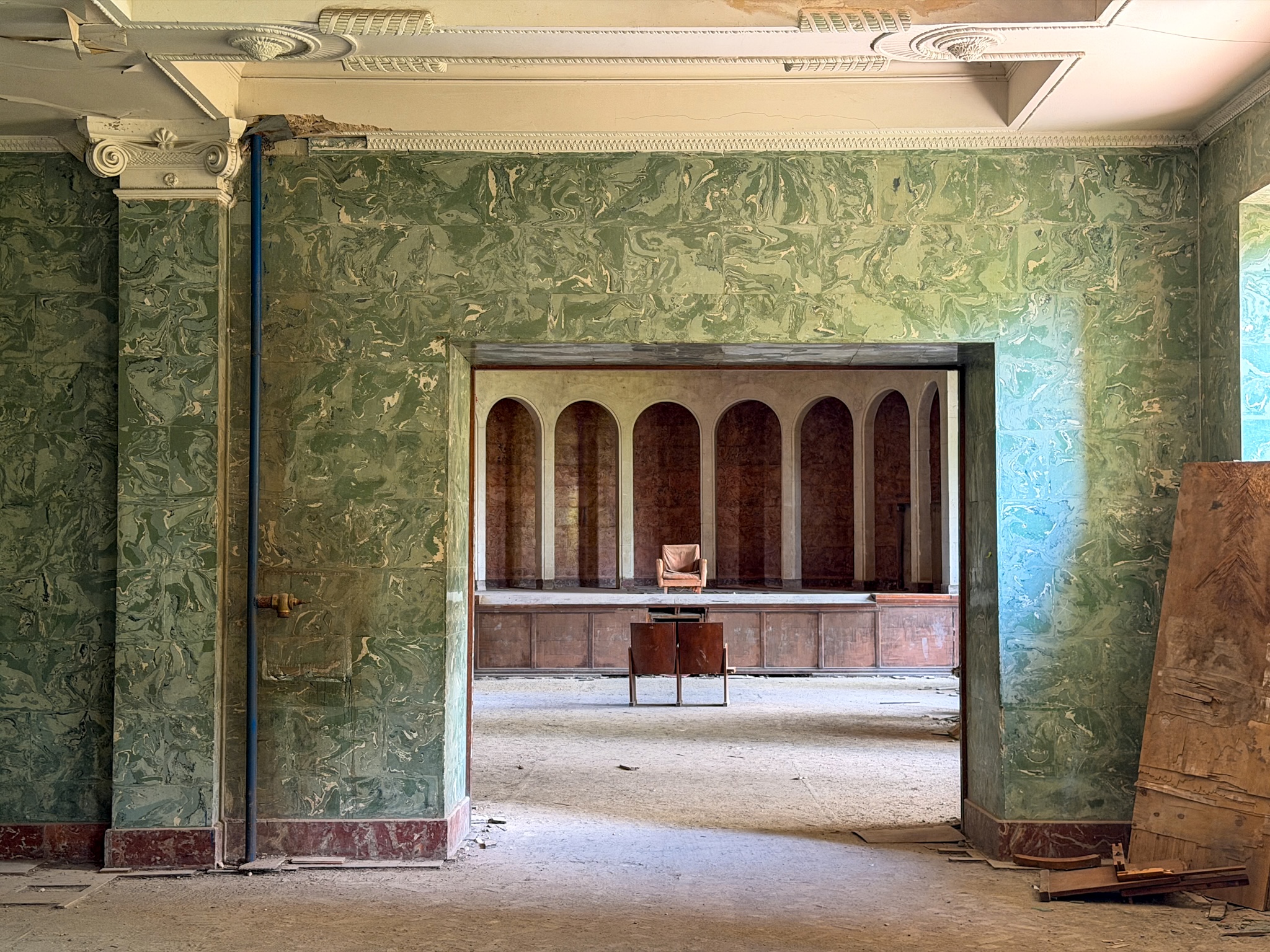
My favorite, and the best preserved by far. It was built for metal workers, and the entrance hall still has its huge crystal chandelier, a round gallery with wooden railings, and two elevator doors side by side, one pink and one blue. A local woman at the door took our donation and pointed us to what we could see. Behind the green fake-marble hall is the concert hall, tall arched windows on the forest, a single armchair on the stage and a piano taken apart on the floor.
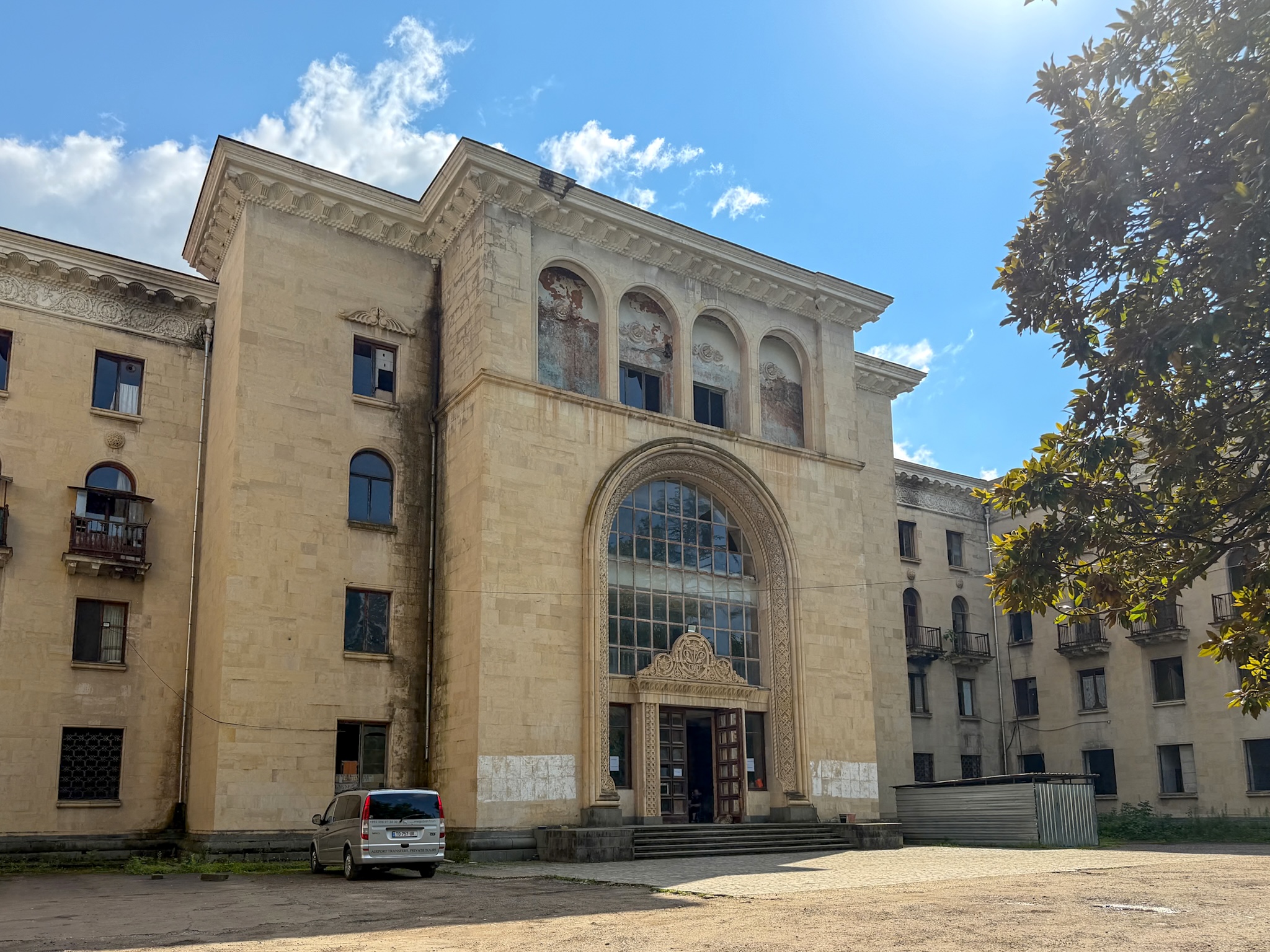
Entrance hall at Sanatorium Metallurgist
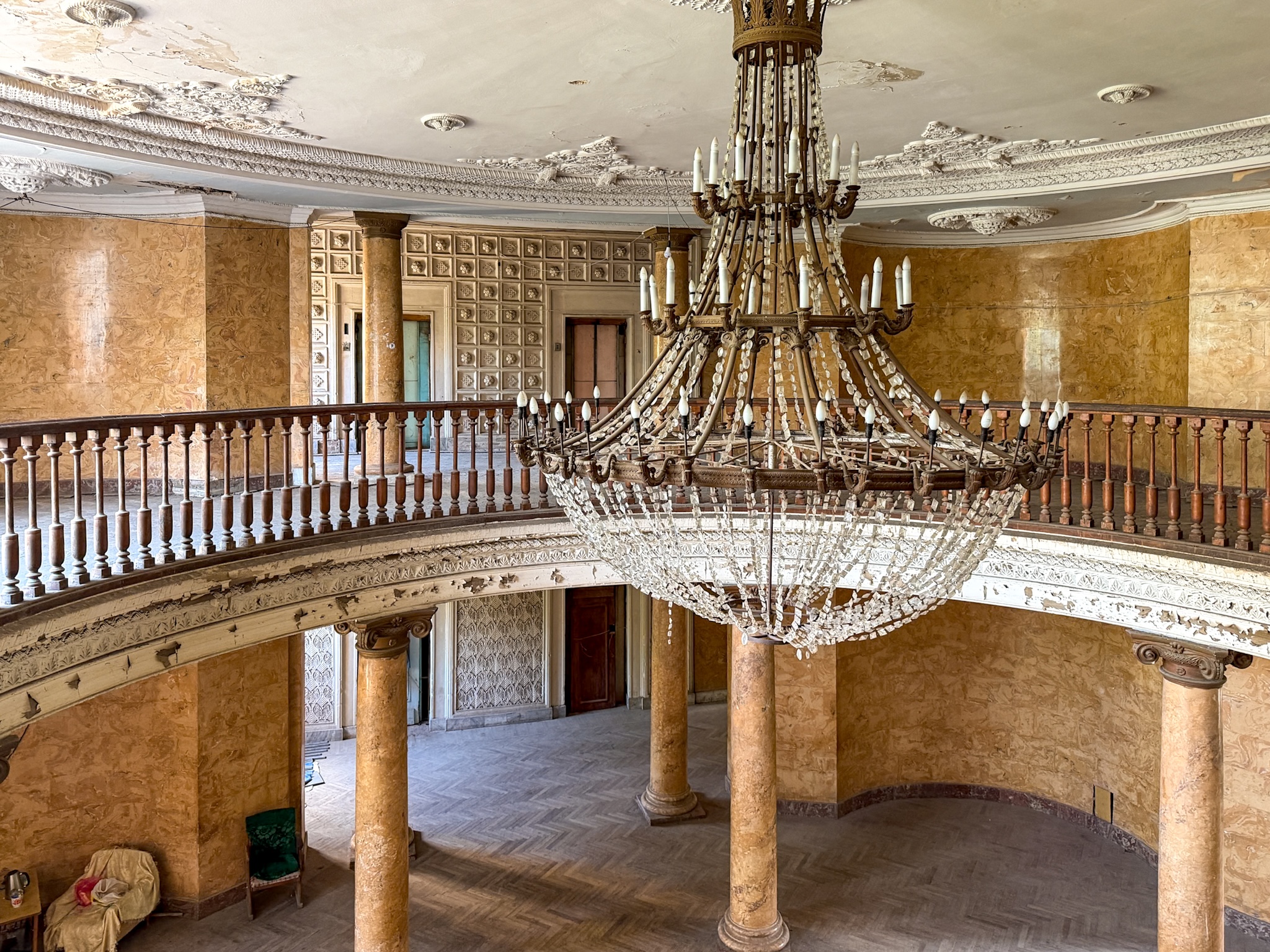
Chandelier, pink & blue elevator doors inside Metallurgist Sanatorium
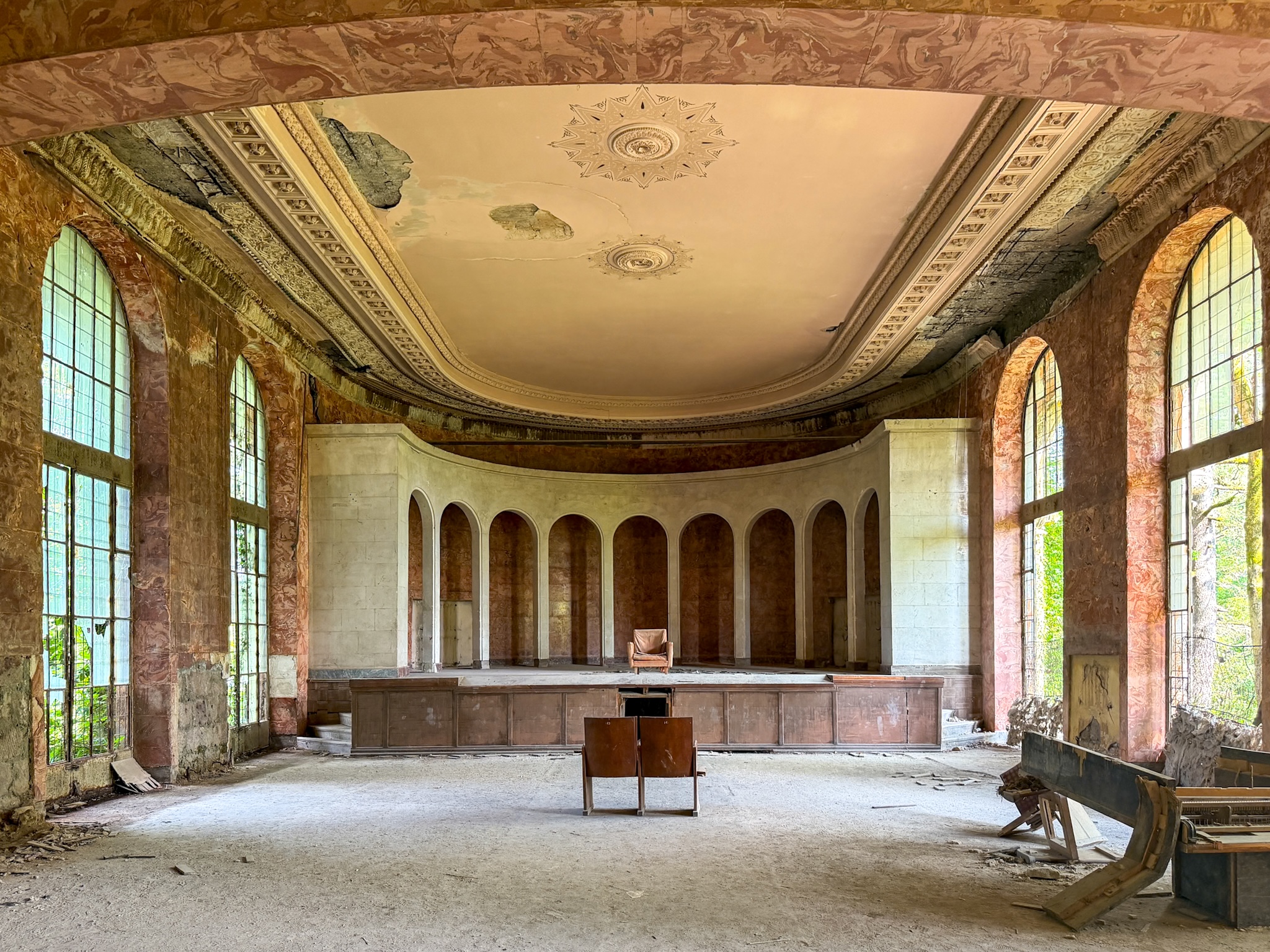
Green hall and concert stage at Metallurgist
2. Sanatorium Imereti
- Can you go inside: I walked in freely in August 2026, but it has been sold, and some visitors report a guard.
- Don’t miss: the entrance hall with its columns and curved staircase.
- Good to know: the floors are covered in rubble, and it’s easy to lose track of where you are.
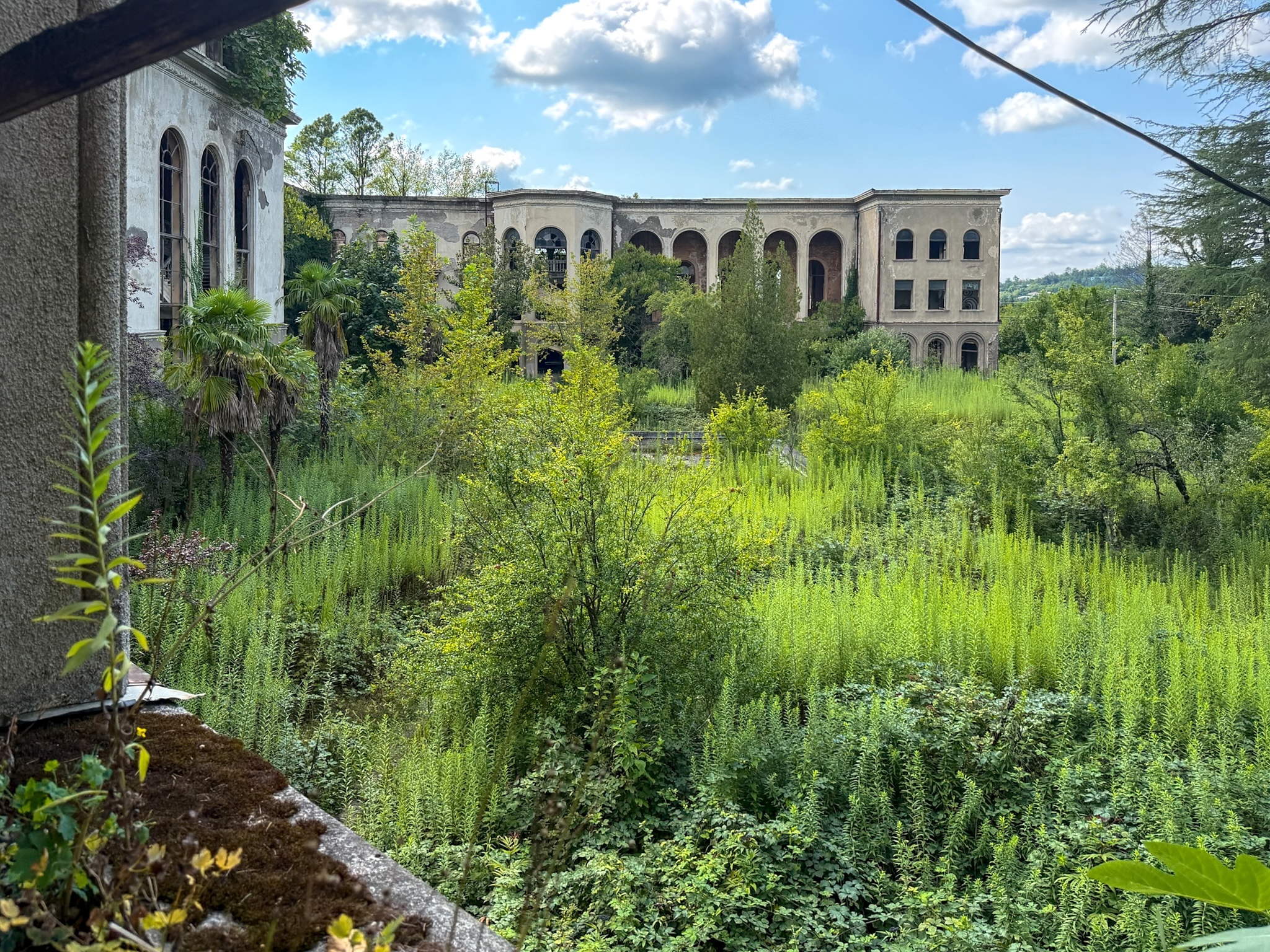
Imereti sits in a small forest of tall cedars, a bit away from the park. The lobby is the most striking room I saw in Tskaltubo: carved columns covered in old Georgian posters, a curving staircase, loose plaster everywhere. From the upper windows you look down on an overgrown inner courtyard. Someone watched us from a balcony the whole time, and I never worked out who.
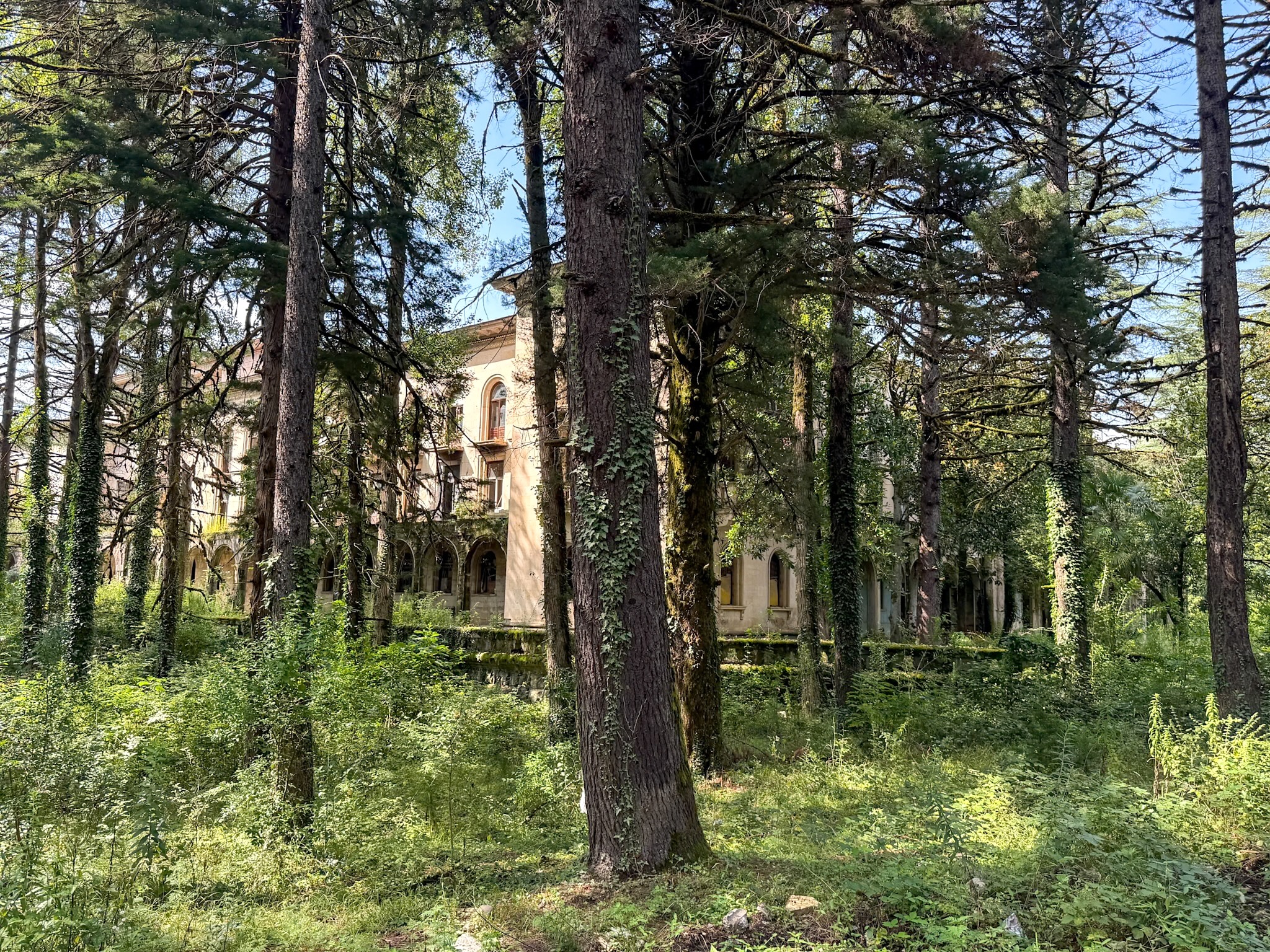
Imereti’s inner courtyard, taken over by plants.
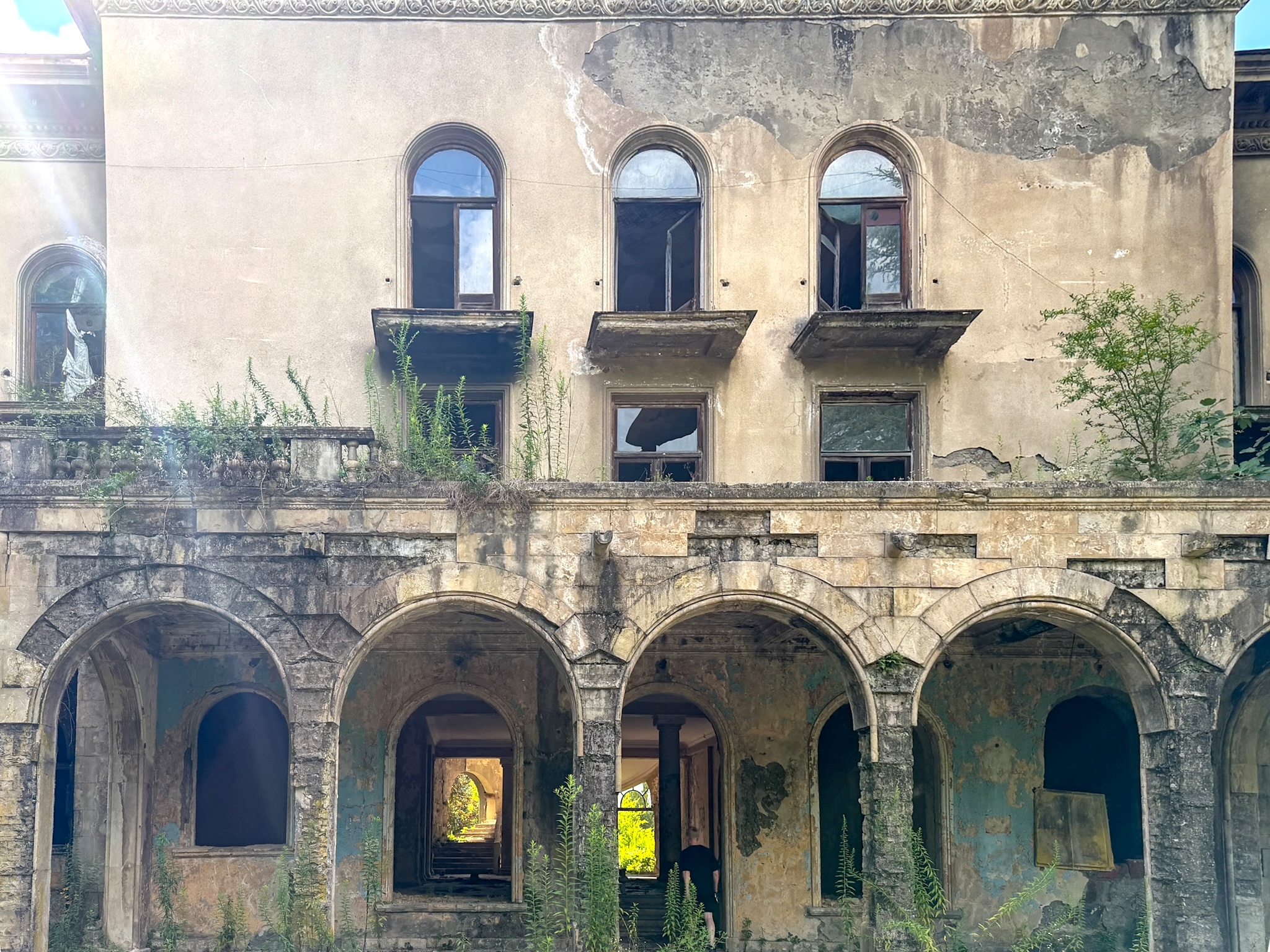
The entrance hall at Sanatorium Imereti.
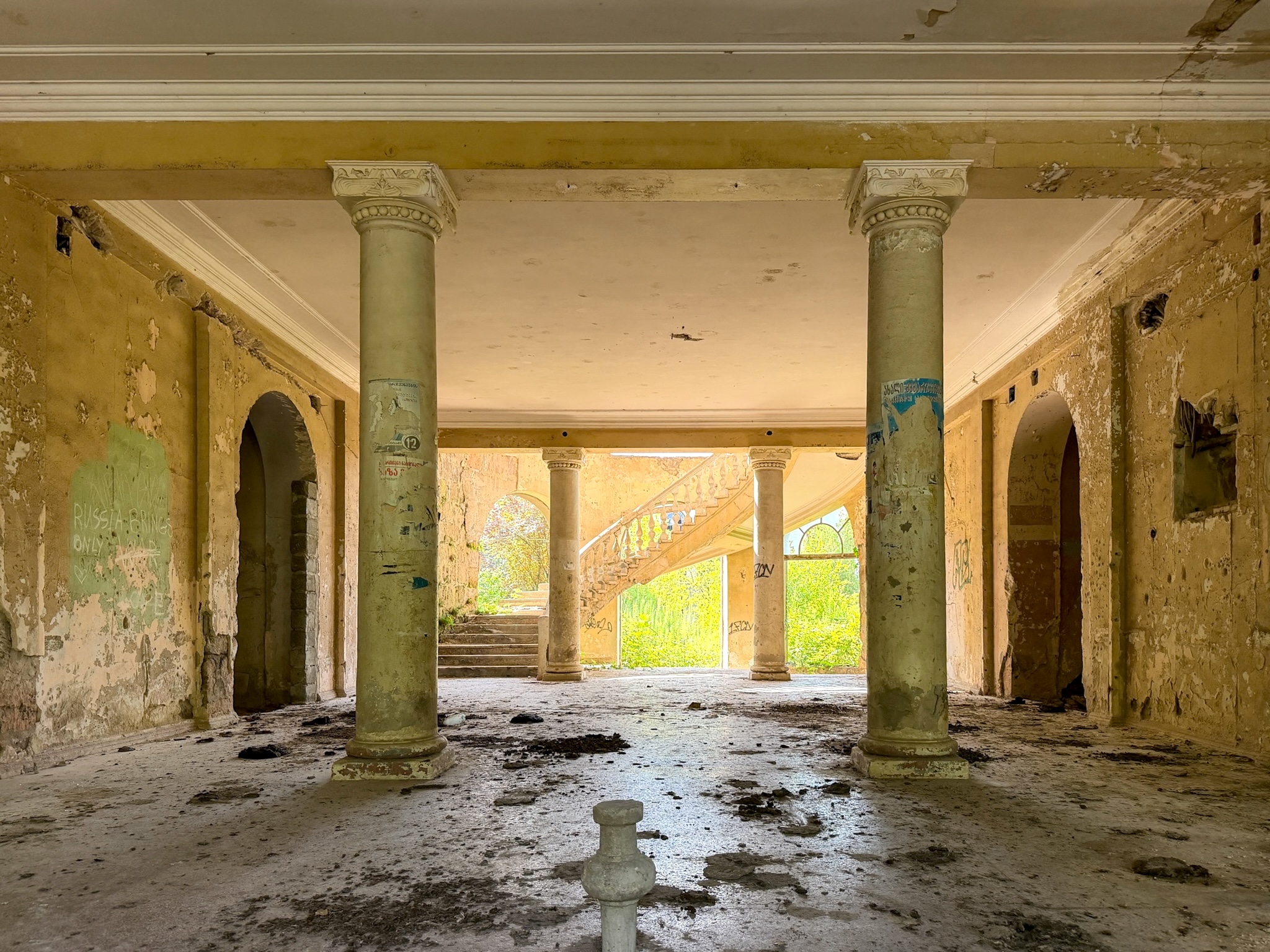
Inside Sanatorium Imereti
3. Bathhouse No. 8
- Can you go inside: yes, it’s open on all sides.
- Don’t miss: the round hole in the middle of the roof.
- Good to know: it’s inside the central park, a short walk from Bathhouse No. 6.
The strangest building in town. It’s a low, round concrete bathhouse from 1959, with a huge circular opening in the roof and rows of small individual baths fanning out around it like petals. Today it’s covered in graffiti and ivy, and when I was there a couple was doing their wedding photos outside.
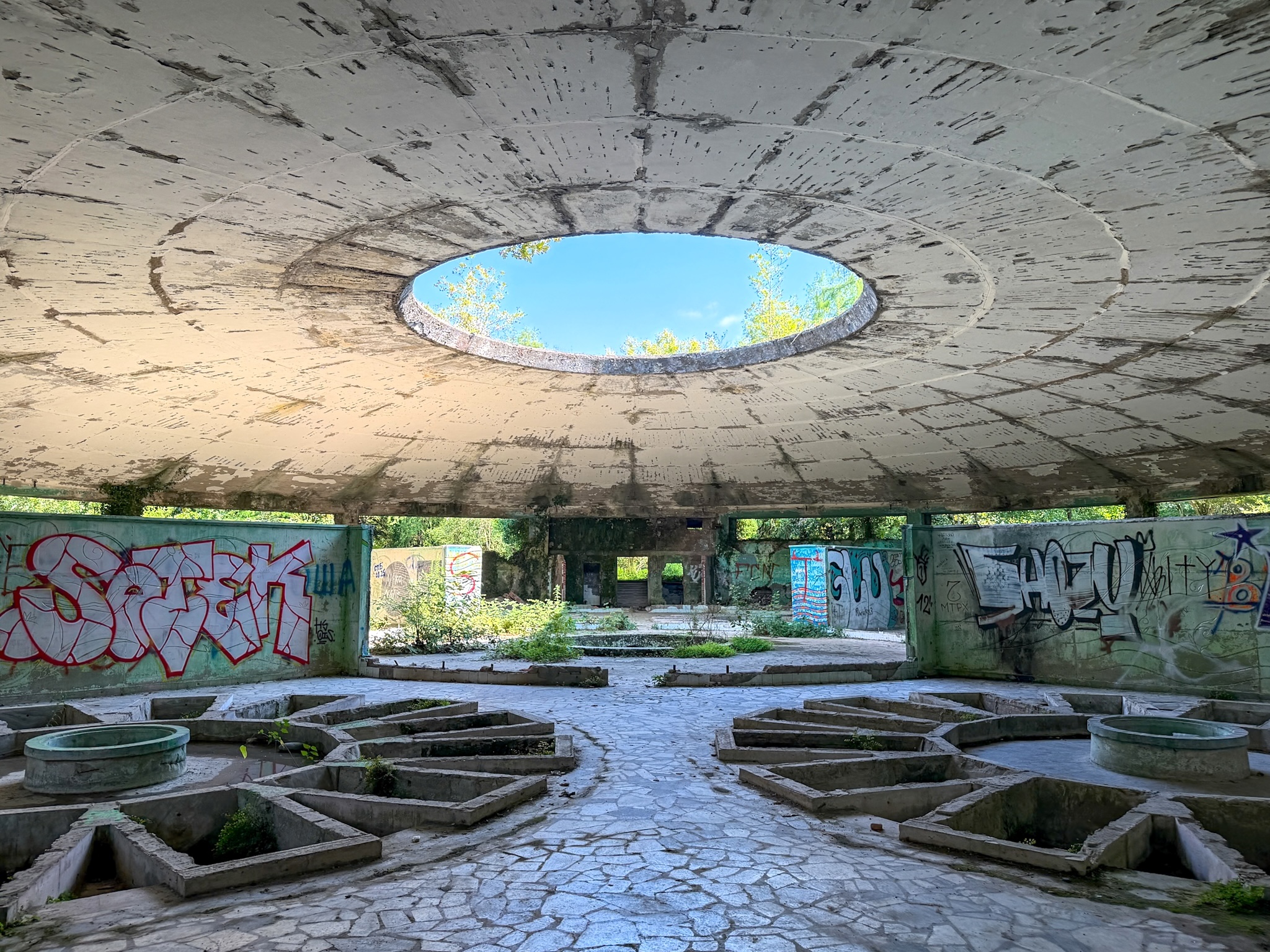
Inside Bathhouse No. 8
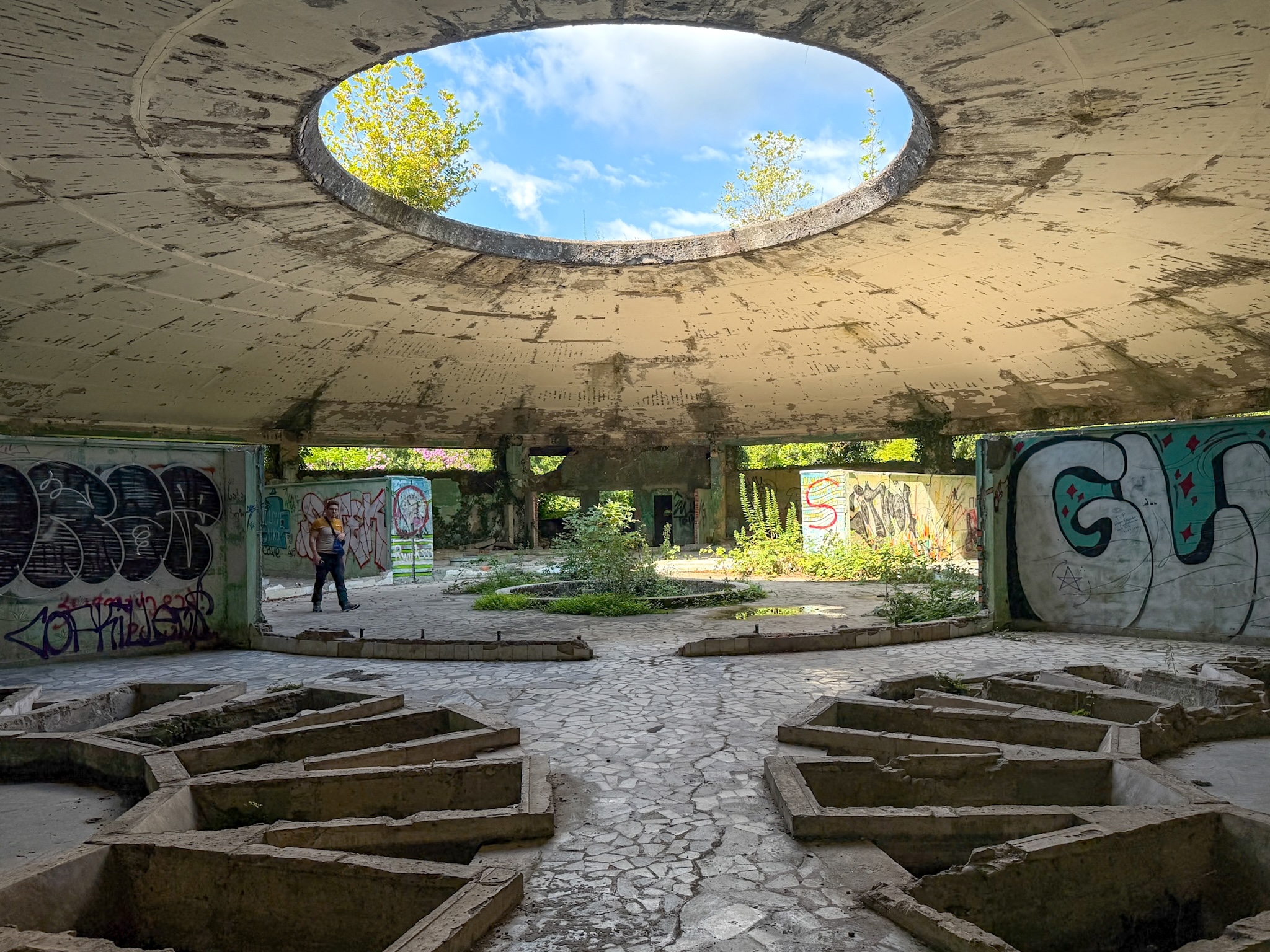
Close-up to Bathhouse No. 8
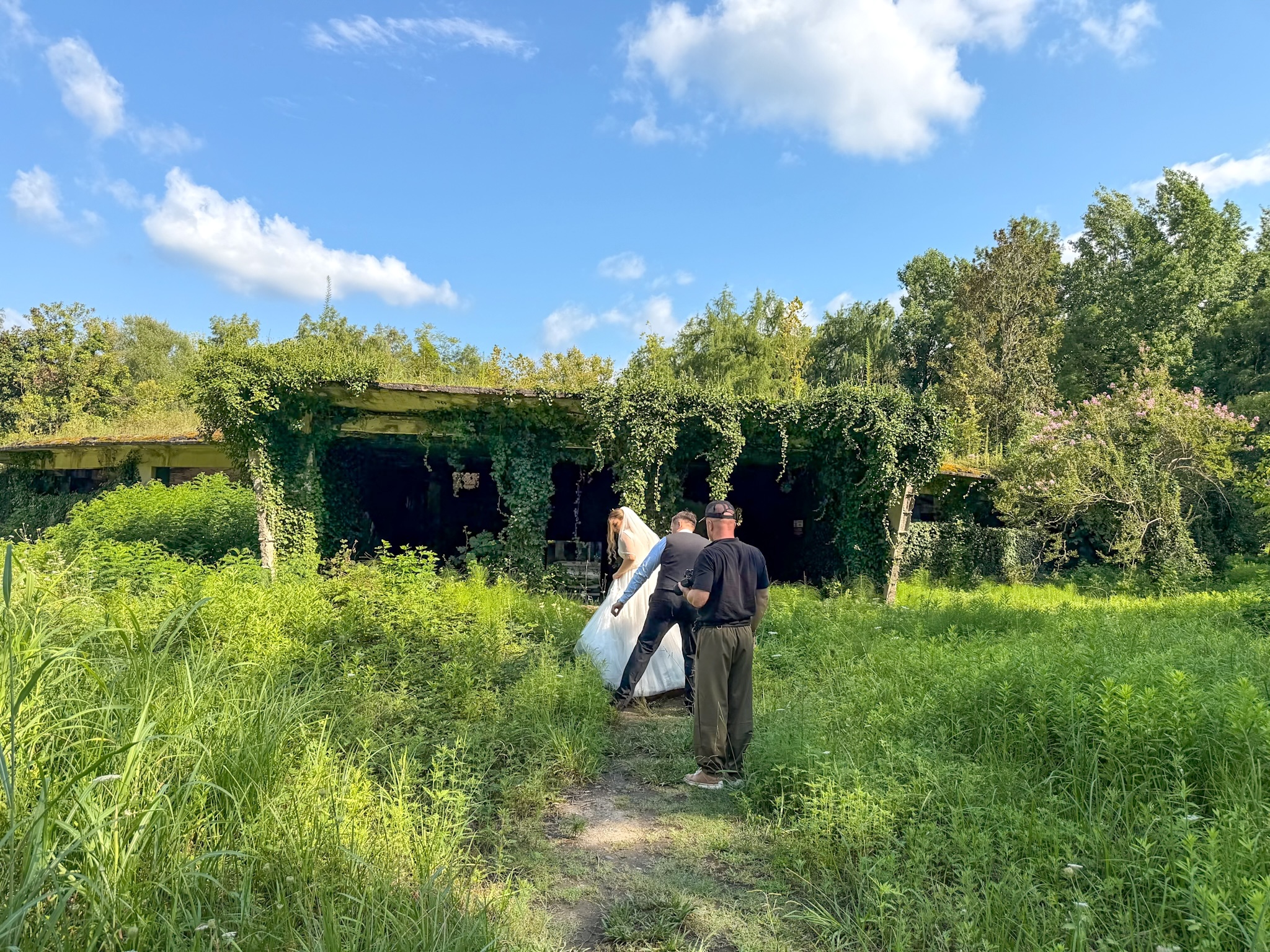
Bride Outside Bathhouse No. 8
4. Bathhouse No. 6
- Can you go inside: yes, it’s a working spa.
- Don’t miss: Stalin’s private bath, if staff agree to show it to you.
This is the big bathhouse still in use, where you can book a soak in the mineral water. The grand facade has Stalin in the relief above the door. Inside, visitors report a marble lobby with an old vase covered in tiny photos of Tskaltubo in its heyday, and a private bath with mosaics kept as it was for Stalin. Seeing that room depends on who’s at reception that day.
5. Tskaltubo Spa Resort
- Can you go inside: yes, it’s a hotel.
- Don’t miss: the unrenovated wing and the suite kept for Stalin.
- Good to know: Non-guests can sometimes get a tour for a fee by asking at the gate.
This was the sanatorium of the Soviet Ministry of Defence, reopened as a hotel in 2011. Only half was restored. The other half was left as it was, with old corridors, a Soviet-era concert hall and the rooms said to have been used by Stalin, so it’s the easiest way to see the before and after side by side.
6. Hotel Aia
- Can you go inside: only the hall, and quietly. Families live here.
- Don’t miss: the wine-harvest mosaic.
A tall 1980s block built for the Soviet Ministry of Internal Affairs, now apartments. The reason to come is a big colorful mosaic in the old main hall showing people picking grapes and making wine in clay jars, in surprisingly good shape for a building this damp.
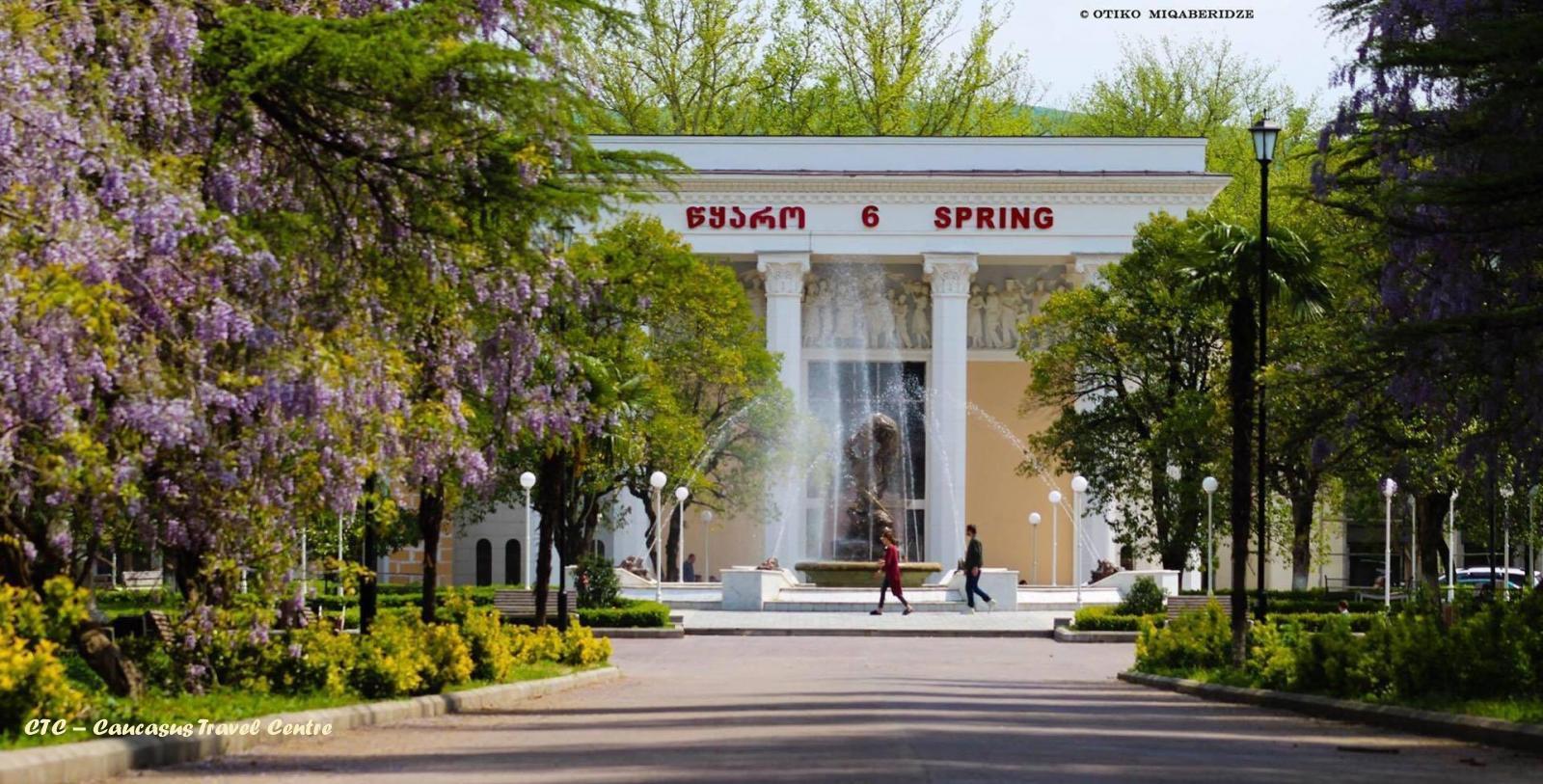
Bathhouse No. 6 tskaltubo. Photo by tskaltuboresort.ge
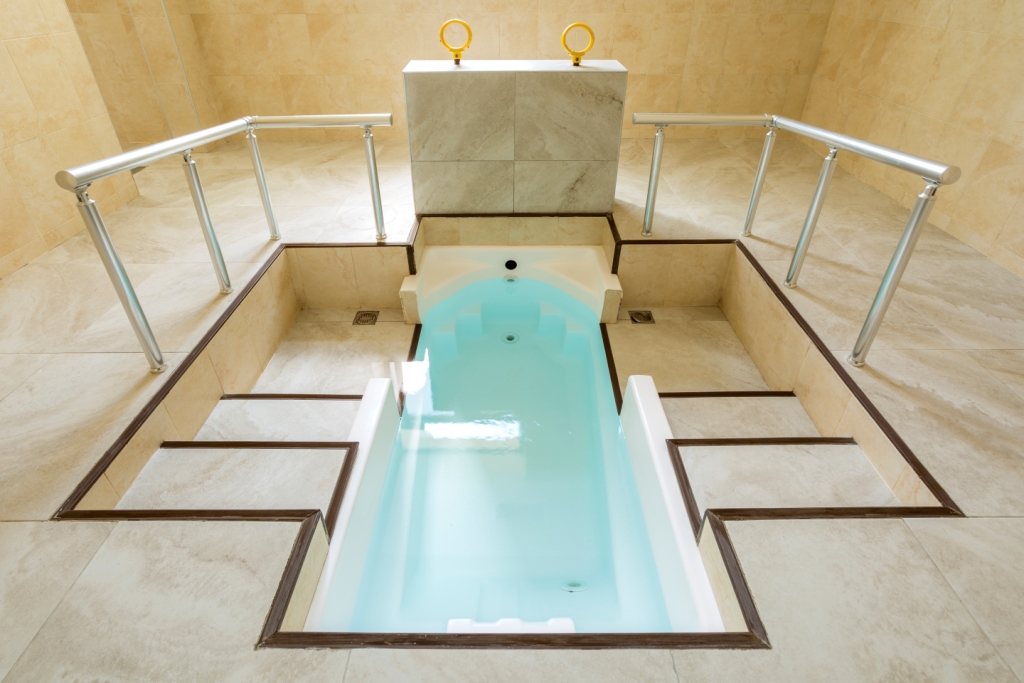
Bathhouse No. 6 tskaltubo. Photo by tskaltuboresort.ge
Tskaltubo Spa Resort. Photo by sanatoriumi.ge
7. Sanatorium Gelati
- Can you go inside: partly. Some of it is lived in.
- Don’t miss: the mosaic playground behind the building.
- Good to know: I didn’t go here. Visitors sometimes mention guard dogs.
Gelati was the sanatorium for mothers and children, which explains its best feature: a Soviet children’s playground at the back, with curved concrete walls covered in mosaics of animals like giraffes and deer.
8. Sanatorium Medea
- Can you go inside: no, closed since summer 2026.
- Don’t miss: the round colonnade at the top of the stairs.
- Good to know: you can still walk up the driveway and see it from the foot of the steps.
Medea is the one on every Tskaltubo postcard: a circle of marble columns and arches on a grand staircase, with trees growing out of the roof. When I got there the stairs were crossed with “DO NOT ENTER” tape and a guard was on site. It’s still worth the short walk for the view from below.
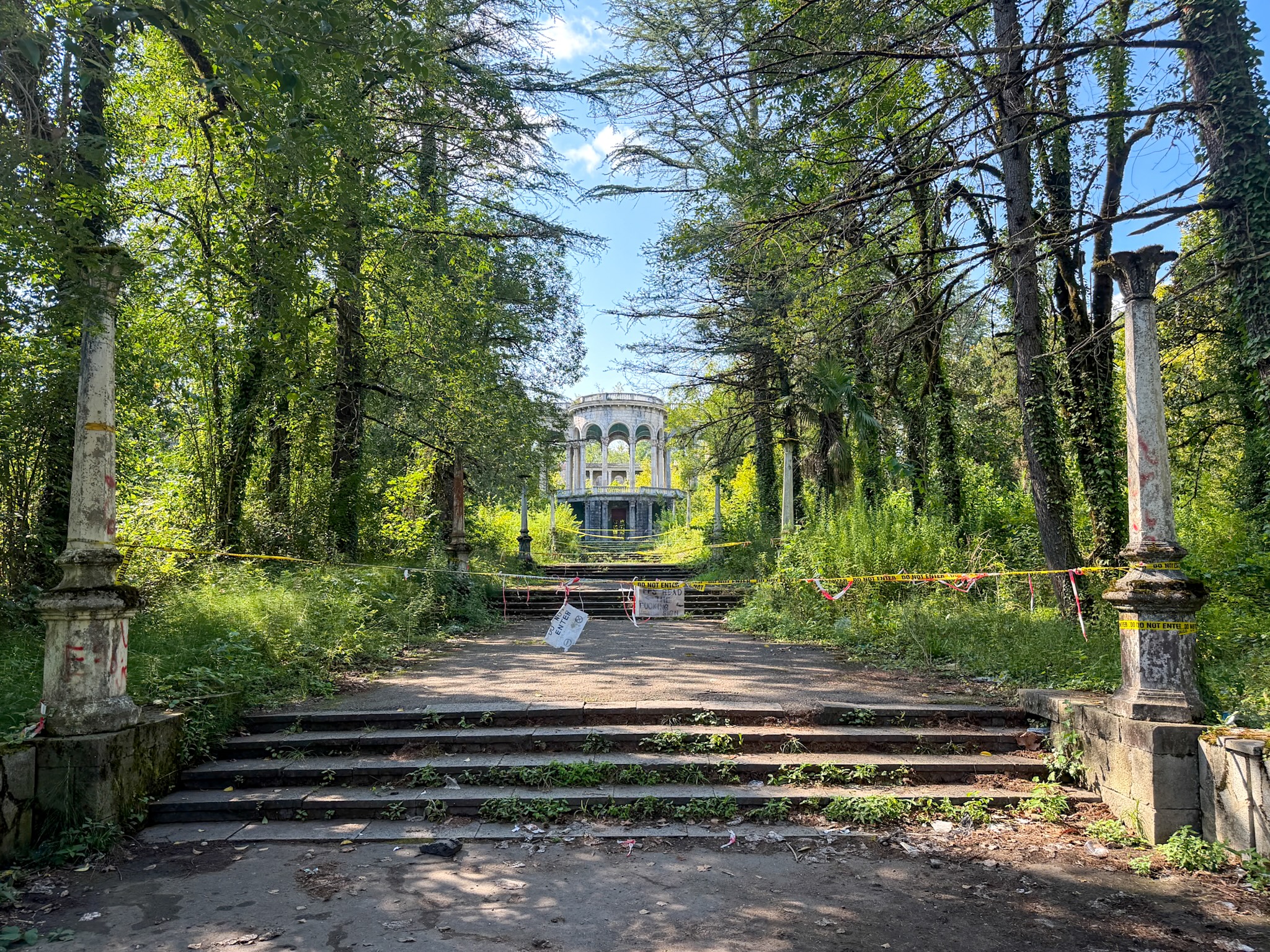
The walkway to Medea, with the closed stairs at the end.
Sanatorium Medea, taped off and closed in August 2026
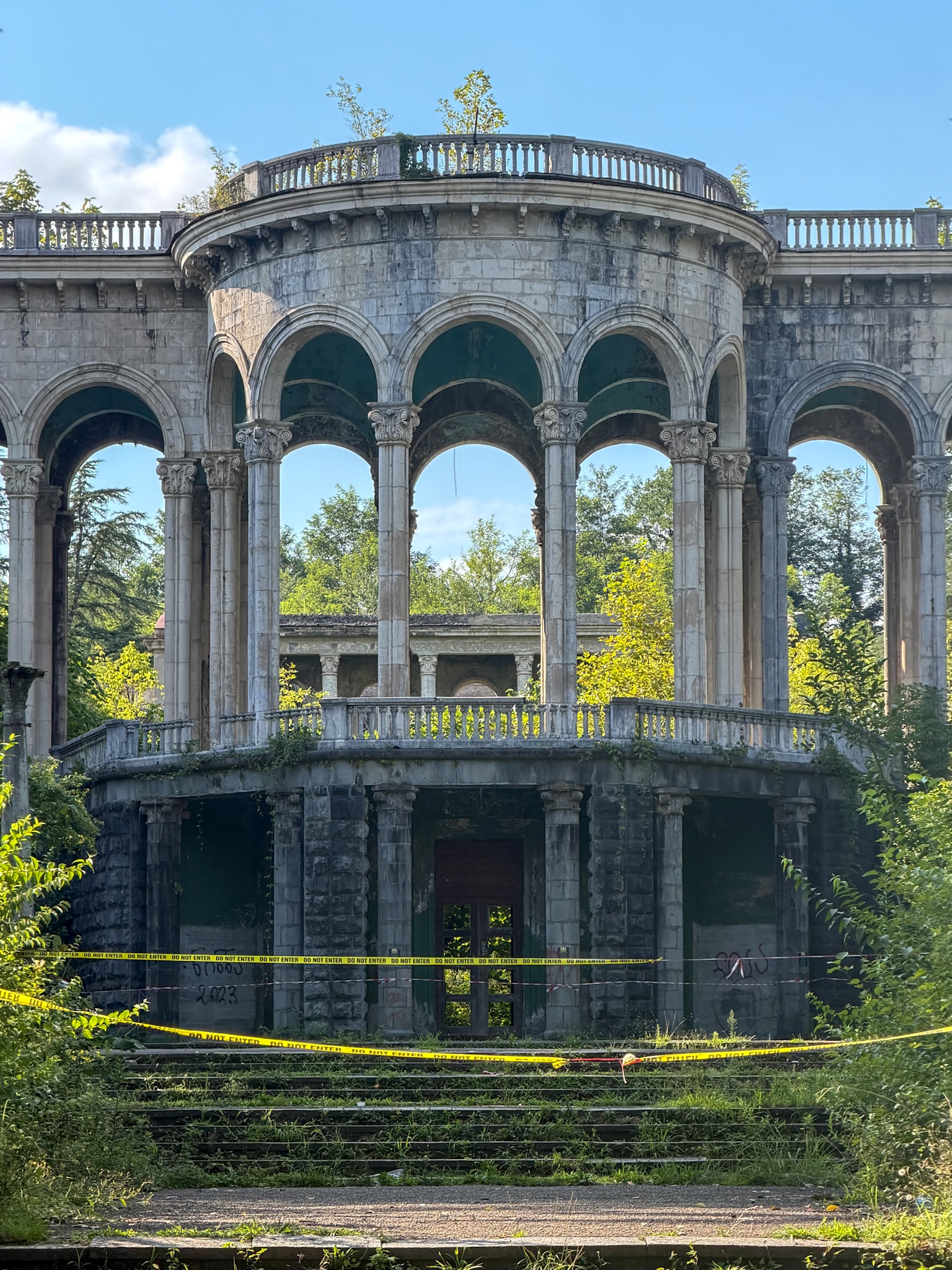
Sanatorium Medea Close Up
9. Sanatorium Iveria
- Can you go inside: no, it’s fenced off.
- Don’t miss: the carved stone portico at the front.
- Good to know: I got my photos by holding my phone up over the fence.
Iveria was sold to an investor years ago and is now closed behind gray metal sheeting. Over the top you can see three floors of arches with broken windows and torn curtains, with fig trees growing between the fence and the walls. Inside, according to older reports, is a famous blue hall with a round hole cut through the ceiling.
10. Sanatorium Shakhtiori or Gornika
- Can you go inside: no, it’s fenced off.
- Don’t miss: the full facade, if you can get your phone above the fence.
- Good to know: locally it’s also called Gornika, from the Russian word for miners. It’s the same building.
The largest and grandest sanatorium in town, built for miners in the early 1950s. It’s private and surrounded by a green metal fence with no gaps that I could find. From above it you see a long curved facade with about twenty arches, a double stone staircase, palms, and a statue next to an empty fountain.
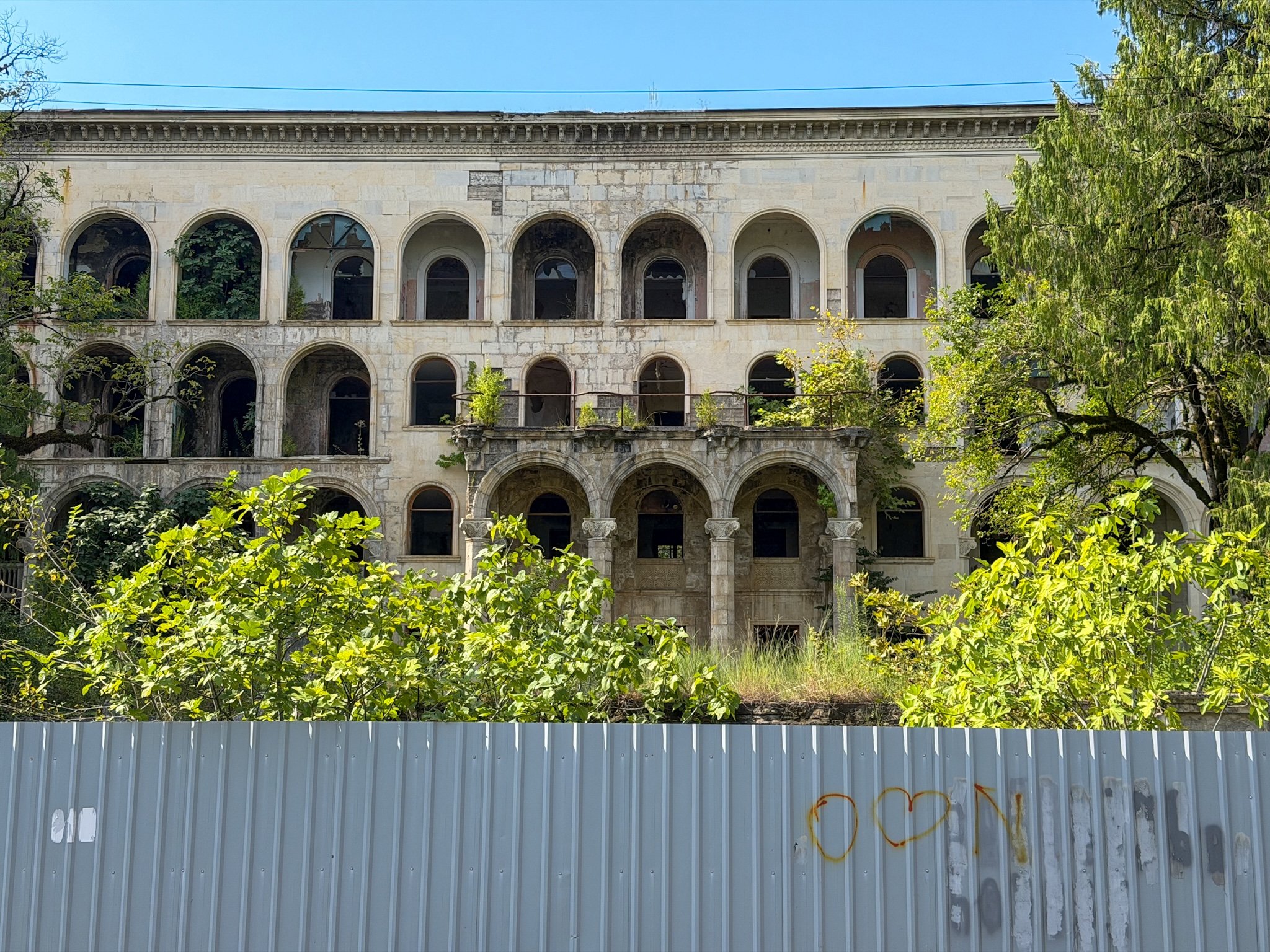
Sanatorium Iveria
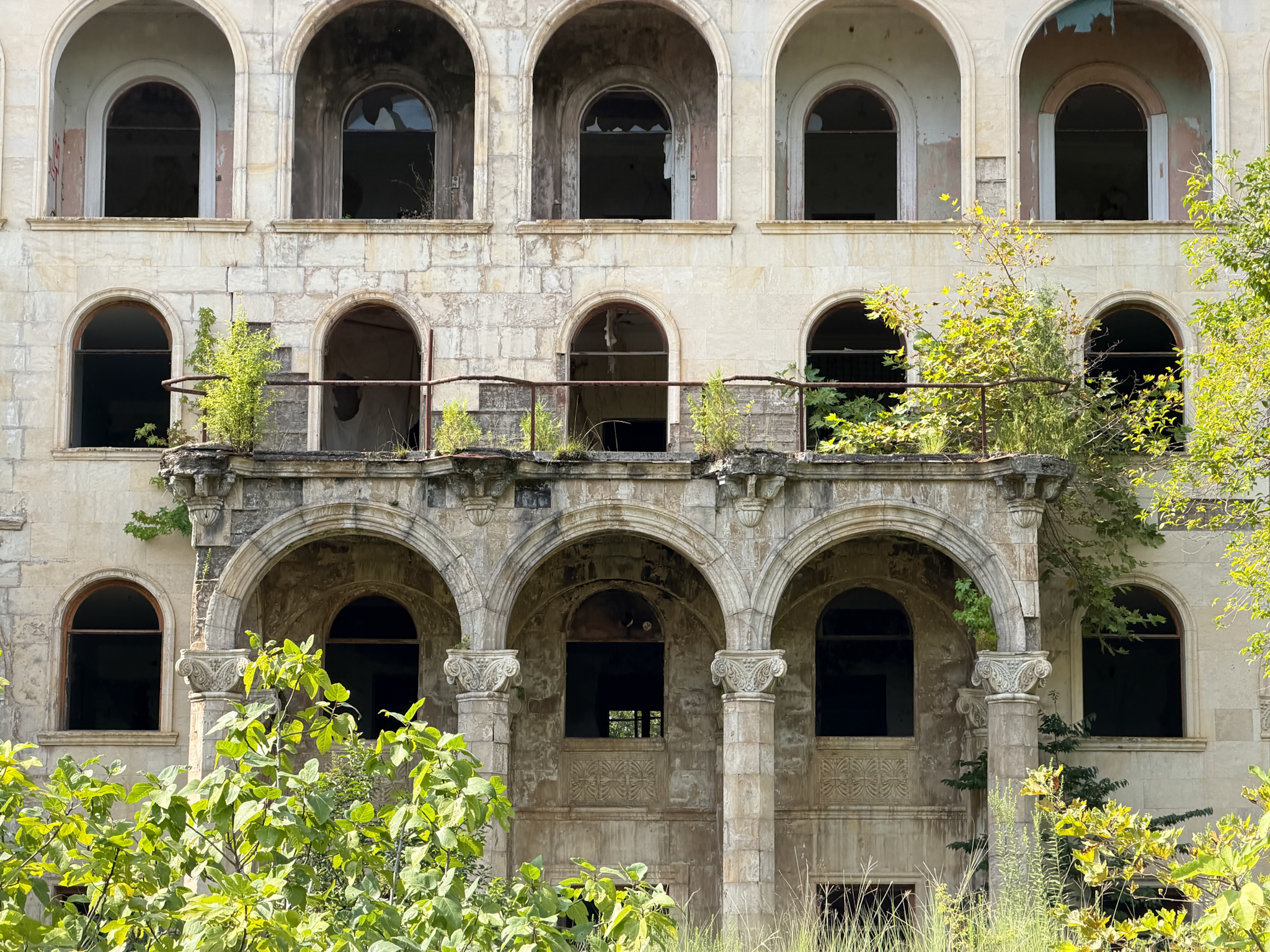
Sanatorium Iveria Close-Up
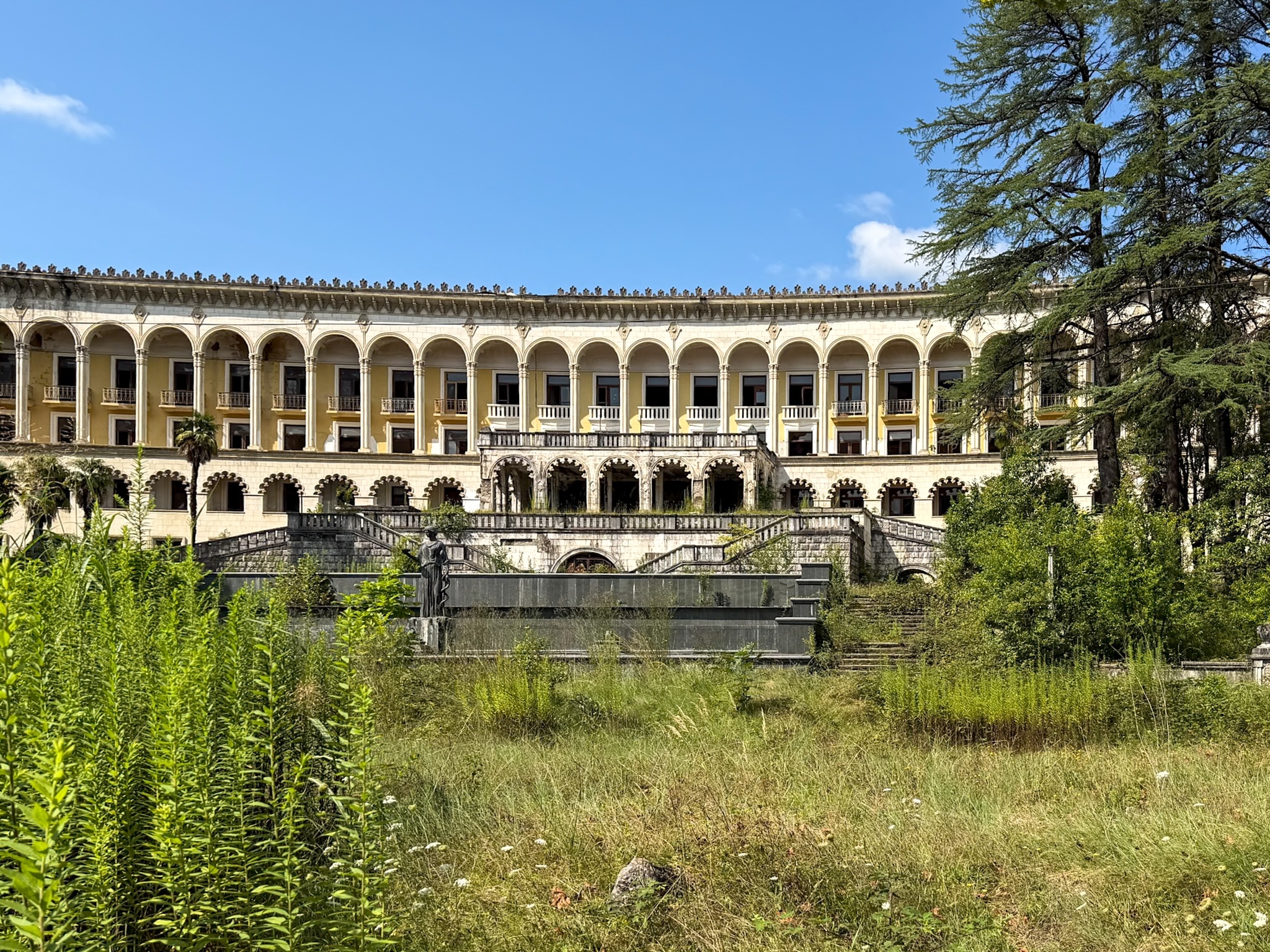
Sanatorium Gornika
Staying Safe and Respectful in Tskaltubo
These buildings have had no maintenance for more than 30 years. Floors are missing in places, stairs have no railings, and loose plaster and broken concrete are everywhere. Watch where you step and look up now and then, too. A tourist fell inside Medea in summer 2026, which is why it’s closed now.
My rule was simple: entrance halls and big open rooms, yes; dark corridors and upper floors, only if someone who knows the building shows you the way. Go with at least one other person. As a woman I’d also avoid the more isolated buildings alone, as you can’t always tell who’s around.
Remember that for many families these buildings were home for decades, and some still are. Stay out of anything that looks lived in, like corridors with doors, laundry or flower pots, and don’t photograph people or their windows without asking. A “gamarjoba” (hello) goes a long way.
If you’d rather not work all this out yourself, a guided tour is the easy fix.
FAQ About Tskaltubo
Is Tskaltubo a ghost town?
No. It’s a normal small town with shops, a market, cafes and people going about their day. Only some of the old sanatoriums and bathhouses are empty, and several of those are being renovated.
Is it legal to go inside the abandoned sanatoriums?
There’s no ban on walking into the ones that are open, and many sit on public land, so you’ll see visitors and tour groups going in. Buildings that are fenced, taped off or guarded are private or closed for safety, so stay out of those. Either way, you go in at your own risk.
Are the donations requested inside some buildings a scam?
No, not really. There are no official tickets, of course. However, sometimes residents of the building or locals ask for a small amount (5 GEL per person when I went) and in exchange they let you in and tell you which parts you can see. Some visitors online refuse on principle, but I find it more than fair.
Are there stray dogs in Tskaltubo?
Lots. Most are calm and some will happily follow you from building to building. A few act as guard dogs near lived-in buildings or animals, and those can bark and get pushy, so give them space.
Can you fly a drone in Tskaltubo?
People do, and you’ll see plenty of drone shots online. Tskaltubo is close to Kutaisi International Airport, though, so check Georgia’s current drone rules before you fly, and keep away from windows and balconies where people live.
Will Sanatorium Medea reopen?
There’s no date. It was sold to an investor in 2022, so once the safety closure ends it’s more likely to become a construction site than reopen to visitors.
Can you bathe in Tskaltubo’s thermal water?
Yes. Bathhouse No. 6 and Bathhouse No. 2 still work as spas, and you can book a soak without staying overnight.
Is the radon in the water dangerous?
Radon is a known cause of lung cancer when you breathe it in over long periods. In a bath you take in far less of it than in the air of a radon cave, but Germany’s radiation protection office still advises against radon as a wellness treatment. A single soak on a trip is a small exposure. If you’re pregnant, have health concerns or would simply rather not, please skip it.
Do trains still run to Tskaltubo?
No. The 1950s railway station, where trains from Moscow used to arrive, is abandoned and overgrown, and it has become another stop for people photographing the town’s Soviet past.
Where can you eat in Tskaltubo?
I didn’t eat there, but the most recommended place is Magnolia, a 1950s cafe on the edge of the park that was restored a few years ago, with Georgian food and a terrace. Otherwise Kutaisi is 20 minutes away, with far more choice.
Keep reading: